Food Safety & the Law
I love the old ways of preserving food, and I want you to be able to enjoy them — which means I have to be straight with you about safety. Preservation sits right on the line between “keeps food good for months” and “grows a toxin that can kill you,” and the difference is knowledge. This page is the knowledge. None of it is meant to scare you off; it’s meant to let you do all the rest of this section confidently and safely.
The one villain to understand: botulism
If you remember nothing else, remember Clostridium botulinum. It’s a bacterium whose spores are everywhere — in soil, on vegetables, on meat — and they’re harmless until you give them their perfect home: moist, low-acid, low-oxygen, and warm. In that environment the spores wake up and produce botulinum toxin, one of the most lethal substances known. And here’s the part that makes it so dangerous: you cannot see, smell, or taste it. A jar of improperly canned green beans can look and smell perfectly fine and still put you in the hospital.
Nearly every rule below exists to deny botulism one of the four things it needs. Take away the moisture (drying), the low acid (pickling/fermenting), the low oxygen, or the warmth (refrigeration) — or add the right cure — and you’re safe.
Why some foods keep and others kill you
Whether a preserved food is safe comes down mostly to two dials: how moist it is and how acidic it is. Here’s the map I keep in my head:
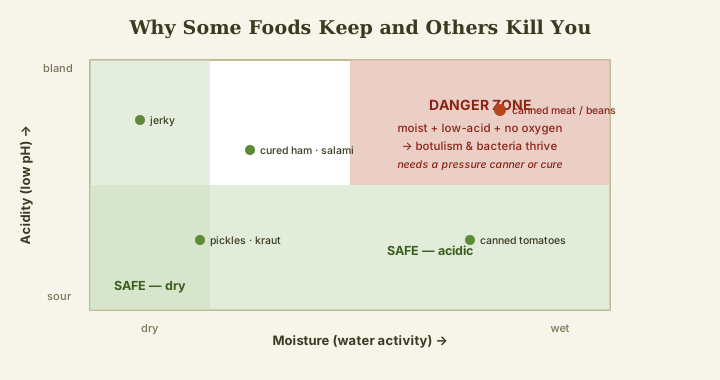
- Dry (jerky, hard cured salami): too little water for anything to grow. Safe.
- Acidic (pickles, sauerkraut, kimchi, most canned fruit and tomatoes): too sour for botulism, which can’t tolerate a pH below about 4.6. Safe.
- Salty/cured (ham, bacon, prosciutto): salt plus (usually) nitrite makes meat inhospitable. Safe when the cure is done correctly.
- Moist + low-acid + sealed (canned meat, beans, corn; oil infusions; sealed low-acid preserves): the danger zone. These are only safe with a pressure canner, a proper cure, or the refrigerator.
The danger zone (the temperature one)
There’s a second “danger zone,” about temperature: 40°F to 140°F is the range where bacteria multiply fastest. The rules that fall out of it:
- Don’t let perishable food sit in that range for more than about two hours total.
- Keep cold food cold (below 40°F) and hot food hot (above 140°F).
- Thaw in the fridge, not on the counter.
- This is also exactly why cold smoking (which happens inside this range) is only safe for cured meats and low-risk foods — see my Hot vs. Cold Smoking page.
Canning, in one rule
Home canning is safe and wonderful, and it comes down to a single line: pH 4.6.
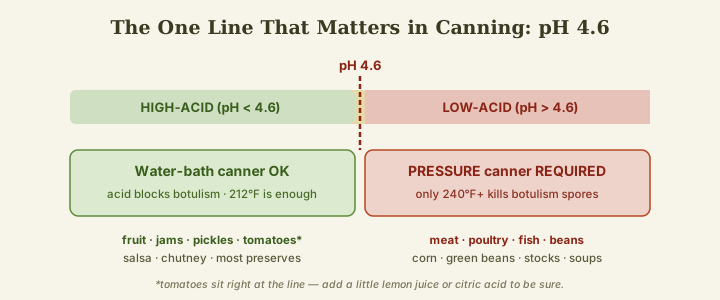
High-acid foods (fruit, jams, pickles, tomatoes with a little added acid) can be safely water-bath canned — boiling water is enough because the acid handles the botulism risk. Low-acid foods (meat, poultry, fish, beans, most vegetables) must be pressure canned, because only the 240°F+ that a pressure canner reaches will destroy botulism spores. Never water-bath-can low-acid food, and never invent your own canning times — this is the one place I follow tested recipes to the letter. More on the Canning page.
The US vs. Europe question
Here’s something that fascinates me. If you’ve traveled — and I’ve been lucky enough to visit every state and more than thirty countries — you’ve seen that much of the world eats traditionally preserved foods that are hard or illegal to sell in the United States. Whole European food cultures are built on aged, air-dried, and fermented meats made and sold much the way they were centuries ago: raw-milk cheeses aged in caves, dry-cured hams hung for years, lardo, ‘nduja, salami cured in a village cellar.
The reason isn’t that those foods are dangerous and ours are safe. It’s a genuine difference in philosophy:
- The United States regulates toward a zero-risk, scalable standard — pasteurize it, refrigerate it, get it tested and inspected, forbid what can’t be guaranteed at industrial scale. It’s a system optimized to protect millions of people buying from huge producers, and at that it works remarkably well.
- Much of Europe regulates toward tradition plus expertise — protected regional methods (think of all those “PDO” designations), master producers who’ve done it for generations, and an acceptance that a properly made aged meat or raw-milk cheese is safe because of the craft, not in spite of it.
Neither is simply “right.” The American approach trades away a lot of glorious traditional food for a very low baseline risk. The European approach keeps the food alive and trusts the craftsman. What it means for you, the home cook, is that a lot of the best old-world preservation is perfectly achievable in your own kitchen — the knowledge exists, the craft is learnable — even where you can’t buy the result in a store.
Doing the old ways safely today
So how do I square my love of the old methods with all these warnings? A handful of principles let the old ways work beautifully in a modern kitchen:
- Use the right cure. For any cured meat that will sit at unsafe temperatures or be cold-smoked, use a proper curing salt (sodium nitrite — “cure #1” — or nitrate “cure #2” for long ages). This is the single biggest safety upgrade over the truly ancient methods, and it’s what makes charcuterie safe. See Curing & Salt.
- When in doubt, keep it cold. The ancients had no choice but room temperature; you have a refrigerator. A method that “keeps 45 days at room temp” traditionally is far safer treated as a short-term fridge preserve.
- Hit the numbers. Safety in preservation is measurable: a dry-enough jerky, a low-enough pH in a ferment, a high-enough salt in a cure, a long-enough time at pressure. Get a thermometer, get pH strips, weigh your salt. Craft plus measurement is what turns a risky tradition into a safe one. ⚠ One qualification on “get pH strips”, added later: strips are only good enough at or below pH 4.0 — that is 21 CFR 114.90’s own line — and anything between 4.0 and 4.6 wants a meter. Measuring pH has the whole argument, including what a usable meter costs.
- Respect the danger zone and practice clean handling — sanitary surfaces, clean hands, fresh ingredients, no cross-contamination.
- Cook thoroughly when the method leaves any doubt. Many traditional preserves were always meant to be cooked before eating, and cooking is a powerful safety net (heat destroys the botulinum toxin, even though it doesn’t destroy the spores).
- Know the absolute limits. Never feed honey to infants under one year. Never eat from a canning jar that’s bulging, leaking, spurting, or off. Never trust “it looks fine” over the rules — remember, botulism is invisible.
Do all that, and you can explore this whole section — the old ways, curing, canning, pickling & fermenting, and drying — with confidence. The knowledge is what makes the tradition safe. That’s the whole point.
Comments (0)