Where the Flavor Went
I can taste the difference between a sausage I made and a sausage off the cold-case shelf blindfolded, and so can you. That part isn’t controversial. What took me years to work out — years of grinding and stuffing and reading the small print on other people’s packages — is why. It isn’t one thing. It’s three, and they stack, and every one of them is a place where a factory made a perfectly rational decision to save money and lost a little flavor doing it. Added up, those three decisions are where the flavor went.
This is exactly the kind of subject that turns into a rant, and a rant is where accuracy goes to die. So I’m going to split the page into the three cuts — the meat and the water, the spices, and the casing — and for each one keep two things apart. There’s the science, which I can source: a regulatory number, an enzyme reaction, a measured oil loss. And there’s my judgment — “blander,” “spongier,” “the snap matters” — a reasonable read of that science but still my opinion, not something a lab proved about a specific hot dog. When I’m giving you my opinion I’ll say so.
And here’s the through-line of the whole page: you can read most of this cost-cutting right off the ingredient panel. The law governing a commodity sausage isn’t hidden — the added water is capped, the binders have to be named, the mechanically separated pork has to be declared. None of it is a conspiracy. It’s all in 9 CFR, and once you know what the numbers mean, a hot dog package reads like a confession.
The first cut: the meat, the grind, and the water
The most expensive thing in any sausage is the meat. So if you’re a factory and you need the number on the pallet invoice to come down, the meat is where you look — and there are three legal ways to get less meat into a sausage without technically making less sausage. You use leaner, cheaper, more variable trim. You replace some of the meat mass with water. And where the standard allows it, you use mechanically separated meat. Every one of these is legal, every one of them is disclosed somewhere on the label, and every one of them costs a little flavor. That’s not a slander. It’s the trade.
Added water is real, and it’s capped — but the room is real too
Start with the water, because it’s the one people don’t believe until they see the number. Water is cheaper than pork. Water weighs something. And a sausage is sold by weight. So the incentive to get water into the mix and keep it there is enormous, and the USDA has written down exactly how much you’re allowed.
For a fresh (raw) sausage — your breakfast links, fresh chorizo, bratwurst — the added water or ice is capped at 3% of total ingredients (9 CFR 319.140). That’s a genuinely tight limit, and it’s why a good fresh sausage still tastes like meat: there’s nowhere to hide much water. But the moment you cross into cooked sausage, the ceiling jumps. A cooked sausage can carry up to 10% added water in the finished product (9 CFR 319.140). And for the emulsified cooked crowd — frankfurters, bologna, wieners, knockwurst — the rule is written differently and more generously still: no more than 40% fat plus added water combined, and no more than 30% fat (9 CFR 319.180). Do that arithmetic. If the fat is sitting at, say, 25%, there’s legal room for a real slug of water on top of it. A hot dog can legally be a large fraction water. It isn’t a defect; it’s the standard of identity.
And it doesn’t stop at the water you added on purpose. Retained water — the moisture a product picks up during chilling and washing, beyond what’s natural to the meat — has to be declared on the label when it’s there (9 CFR 441.10, FSIS Directive 6700.1). That’s the “up to X% retained water” line you’ve read on a chicken package and never thought about. On sausage it means the same thing: the package is telling you, in the fine print, how much of what you’re buying by weight is water.
Phosphates: the trick that makes the water stay
Here’s the piece that ties the water cut together, and it’s the one I find genuinely clever even though I don’t use it. Water on its own won’t behave. Pump water into ground meat and it weeps back out — it purges in the package, it cooks out in the pan, and you’re left with a shrunken, wet, disappointing thing. So the water needs a partner, and the partner is phosphate.
Alkaline phosphates are limited to 0.5% of the finished product, calculated as P₂O₅ (9 CFR 424.21(c)). What they do is raise the meat’s water-holding capacity — they help the muscle proteins grab and hold water, which cuts purge and cook loss. In plain terms: phosphate is what lets the added water stay in instead of leaking out. It’s the enabling technology for the whole water cut. Without it, the water is a liability; with it, the water reads as “juicy.”
That last sentence is where I cross from fact into opinion, so let me flag it: my read is that phosphate is a cost-cut dressed up as a quality feature. The sourced fact is only that it raises water-holding capacity and is capped at 0.5%. Whether “holds more water” means “better” or “diluted” is a judgment, and mine is diluted. But I’ll own that it’s mine.
Binders and extenders — and the label tell
The other way to make meat go further is to put something that isn’t meat where the meat used to be, and give it a job holding the sausage together. These are the binders and extenders, and the CFR is specific about how much and — this is the good part — insists they be named.
Isolated soy protein is allowed at 2%. Soy protein concentrate, soy flour, and nonfat dry milk are allowed at up to 3.5% total, alone or in any combination (9 CFR 319 / 424.21). There’s also pork collagen up to 3.5% of the formulation and transglutaminase — the stuff the internet loves to call “meat glue” — permitted as a binder up to 65 ppm in fresh sausage (9 CFR 319.140). Starches and carrageenan turn up as binders and water-holders in the emulsified cooked sausages too; carrageenan in particular is a common gel-and-water binder and fat-replacer. I’ll be honest that I couldn’t pin a single clean CFR percentage to carrageenan and starch the way I could to soy — some of it is GMP-limited “sufficient for purpose” rather than a hard number — so take “they’re in there” as solid and any specific percentage as something I’d want to check against the 424.21 tables before I printed it.
Now the payoff, the thing that makes this whole page practical instead of just grumpy: when any of these extenders goes in, the ingredient’s name has to go on the label — “isolated soy protein added,” “nonfat dry milk added,” “cereal added,” and so on (9 CFR 316.11). The cut isn’t hidden. You can read it off the package. When I pick up a sausage and the panel says “nonfat dry milk added, isolated soy protein added, sodium phosphate,” I’m not reading a list of contaminants. I’m reading a cost sheet.
My judgment on what all that buys: a cheaper, blander, spongier sausage. Meat carries meaty flavor; cereal and soy and gum don’t, and they change the bite from a meat set — protein knitting to protein — to a gel set. That’s the core of my complaint. But I want to be square with you: “blander and spongier” is my conclusion, not a lab result. Nobody ran a controlled panel proving that a 3.5%-binder hot dog tastes spongier than a butcher’s. It’s the reasonable sum of the sourced parts, and I’m confident in it, and it’s still a judgment.
Mechanically separated pork — and the beef that’s banned
The last meat cut is the one with the scary reputation, and it deserves a clear head. Mechanically separated pork — the paste forced off the bones after the good cuts are gone — is legal in frankfurters, hot dogs, and similar cooked sausages, capped at 20%, and it must be labeled “mechanically separated pork” (9 CFR 319.180 / 319.6). Twenty percent is a real amount and it’s disclosed, which is the pattern of this whole section: legal, limited, on the label.
Mechanically separated beef is a different story: it’s prohibited for human food outright, and has been since 2004, as a BSE (“mad cow”) safeguard (FSIS rule). So the “pink slime” panic gets the shape wrong in both directions. Pork MSM isn’t a free-for-all — it’s capped and declared. And beef MSM isn’t lurking in your hot dog — it’s banned. While I’m at it, one distinction worth keeping straight: MSM is not the same thing as lean finely textured beef, the actual “pink slime,” which was ammonia- and citric-acid-treated trim, not a bone paste, and not the same thing as advanced meat recovery either. People blend all three into one boogeyman; they’re three different processes.
The quiet cut underneath all of this — the one I can’t hand you a statute for — is simply leaner, more variable trim: the cheap ends of the carcass, more connective tissue, whatever the day’s cutting floor produced. That’s economics, not a rule, so I frame it as industry practice, not law. But it’s the reason the flavor floor drifts even before the water and the binders get involved.
Read it off the label
Here’s the whole first cut on one card. Every number is CFR-sourced and quotable.
| What to look for | The legal limit | Where it’s written |
|---|---|---|
| Fresh (raw) sausage — added water/ice | ≤ 3% of total ingredients | 9 CFR 319.140 |
| Cooked sausage — added water | ≤ 10% in the finished product | 9 CFR 319.140 |
| Frankfurters/bologna — fat + added water combined | ≤ 40% | 9 CFR 319.180 |
| Frankfurters/bologna — fat alone | ≤ 30% | 9 CFR 319.180 |
| Fresh pork sausage — fat | ≤ 50% | 9 CFR 319.141 |
| Fresh beef sausage — fat | ≤ 30% | 9 CFR 319.142 |
| Phosphates (hold the added water) | ≤ 0.5% as P₂O₅ | 9 CFR 424.21(c) |
| Isolated soy protein | 2% (must be declared) | 9 CFR 319 / 424.21 |
| Soy concentrate / soy flour / nonfat dry milk | ≤ 3.5% total (must be declared) | 9 CFR 319 / 424.21 |
| Mechanically separated pork in hot dogs | ≤ 20% (must be labeled) | 9 CFR 319.180 / 319.6 |
| Mechanically separated beef | PROHIBITED (2004, BSE) | FSIS rule |
| Any extender | Must be named on the label | 9 CFR 316.11 |
The honest one-line summary: added water isn’t unlimited and it isn’t hidden — but the legal room is real. A cooked sausage can be up to 10% added water, a frankfurter up to 40% fat-plus-water, with up to 3.5% cereal or soy binder and 0.5% phosphate on top of that. The blandness is legal, and it’s printed on the side of the box. For the version where I do none of this, look at any of my fresh sausage recipes — the ingredient list is meat, fat, salt, and seasoning, and it’s short because there’s nothing in it to hold water it doesn’t have.
The second cut: the spices
This is the cut I care about most, because it’s the one home cooks control completely and mostly get wrong — including me, for my first decade. The commodity playbook on spice is simple and rational: buy it pre-ground, in bulk, cheap, store it for months, season the sausage, and let the sausage sit before it’s sold. Every step of that leaks flavor, and the science of why is some of the most solid material in this whole section.
Flavor is mostly smell, and smell evaporates
Start with the fact that reorganized how I think about seasoning: roughly 80% of what we call “flavor” is actually aroma — smell, not taste. And aroma is carried by volatile compounds, which is a chemist’s word for compounds that evaporate. That’s the whole problem in one sentence. The character of a spice isn’t locked in the way color is; it’s a set of molecules actively trying to leave. Clove is eugenol. Cinnamon is cinnamaldehyde. Black pepper’s bite is piperine (that one’s more pungent than volatile, which is why pepper holds up a little better than most). Garlic is a family of allyl sulfur compounds. Expose any of them to air and they go.
Grinding is the trigger that lets them go. A whole spice keeps its oils sealed behind a seed coat or a piece of bark. The moment you grind it, you multiply the surface area enormously and start oxidation and evaporation immediately. This is textbook, and it’s the mechanism behind every “buy whole, grind fresh” rule you’ve ever been told. The direction is certain. The rates are where I have to be honest with you: the figures that get quoted — ground spice losing something like 40–60% of its flavor compounds within 6 to 12 months, or one industry line of 70% of volatile oils within a year, whole peppercorns holding 2–3 years while pre-ground “loses most of its punch in 3 to 6 months” — those come from spice vendors and food writers, not peer-reviewed labs. They’re internally consistent and I believe the shape of them, but I’d cite them as “commonly cited,” not as constants. The government’s own freshness dating splits the same way, gently: roughly 4 years for whole spice versus 2 years for ground.
The teaching point for sausage is direct. A commodity sausage is seasoned with spice that was ground months ago, stored, then put into a product that itself sits before you eat it. By the time it reaches your mouth, much of the aromatic top note is simply gone — it evaporated somewhere between the grinding mill and the grocery cooler. A sausage seasoned with whole spice ground to order is louder for one very physical reason: the volatiles are still in it.
The basil case — the one I can actually source hard
Because the general spice numbers are soft, let me hand you the one that isn’t. Basil, studied properly and published, is the clean example of what drying does — and it does two things, not one.
First, it strips oil. Air-drying sweet basil at room temperature cuts its essential oil by roughly 36–45%, and delicate herbs as a class can lose on the order of 60–70% of their flavor compounds when dried. That’s the reduction everyone expects. But the second thing is the one that matters more to a cook: drying doesn’t just turn the volume down, it changes the profile. The monoterpene hydrocarbons — the fresh, bright, green notes — are largely lost, and secondary compounds (alcohols, aldehydes, ketones) form in their place, pushing the herb toward “hay-like, sweet, earthy, woody” and away from “fresh and floral.” Higher drying temperatures make both effects worse — more loss, more off-notes.
That’s the citable proof behind a rule I’d otherwise just be asserting: fresh herbs and dried herbs are not the same ingredient in two different amounts. They’re chemically different things. You cannot fix a dried herb by using more of it, because the compounds that made it fresh aren’t there in any quantity — they’ve been replaced by different compounds. That last framing is my conclusion drawn from the data, so I’ll flag it as judgment; the oil-loss and profile-shift numbers themselves are journal-backed and solid.
Garlic — the cleanest fact in the whole section
If I could keep only one fact from this entire page, it’d be this one, because it turns a preference I’ve had for forty years into a mechanism I can prove. The punch of garlic does not exist in the intact clove.
An unbroken clove contains alliin — an odorless amino-acid compound — and, kept carefully in separate cells, an enzyme called alliinase. Nothing happens while the clove is whole. But the instant you cut or crush a fresh clove, you rupture those cells, the alliinase reaches the alliin, and it converts it into allicin — the sharp, hot, aromatic compound that is the smell and bite of fresh garlic. No damage, no allicin. Crush a fresh clove and you generate something like 2.5–4.5 mg of allicin per gram. This is standard biochemistry; the gold-standard write-up is the Linus Pauling Institute at Oregon State.
Now here’s why it demolishes garlic powder. Most commercial garlic powder is dehydrated with heat, and heat deactivates the alliinase enzyme. With the enzyme dead, the powder is chemically unable to make allicin the way a fresh clove does. Rehydrating powder can wake up some residual enzyme, but it yields far less than a fresh clove ever will. So garlic powder in a factory sausage doesn’t deliver the sharp, allicin-driven hit at all — it delivers a muted, cooked garlic note, because the machinery that makes the sharp note was switched off before the powder ever went in the jar.
That’s not my opinion. That’s the enzyme. It’s the mechanism behind my flat rule: fresh garlic cloves from the bulb, crushed into the mix — never powder, never the jarred pre-minced stuff. I’ve been doing it for forty years because it tasted right. It turns out it tasted right for a reason you can write down.
What I actually do
So my spice practice isn’t fussiness, and now I can show you the wiring under each part. Whole spices, ground to order — the volatiles stay sealed in until I grind them. Fresh herbs where the recipe leans on the herb — dried isn’t a weaker version, it’s a different compound set. Fresh garlic from the bulb — the allicin enzyme. And minimal reliance on powders, the one blend I trust being P.S. Seasonings, because on a big batch I’ll take a known, consistent cure-and-spice blend over a cabinet of half-stale jars any day. It’s not purism. It’s picking the version of each ingredient that still has its flavor in it.
One honest footnote: blooming or toasting spice — warming it in fat to open the aromatics — is real, worthwhile kitchen craft, and I do it. But I couldn’t find a clean food-science paper quantifying it for sausage. So when I tell you a bloomed spice tastes fuller, take that as craft and my own palate, not sourced fact. I’d rather tell you where the paved road ends than pretend it keeps going.
The third cut: the casing, and the snap
The casing is the cut people forget, because it feels like packaging — it’s just the bag the sausage comes in, right? No. The casing is part of the eating experience and part of how smoke gets into the meat, and the industry moved off natural casings for reasons that are entirely about cost and speed and traded away two real things doing it: the snap and the smoke.
Three casings, and what each one is
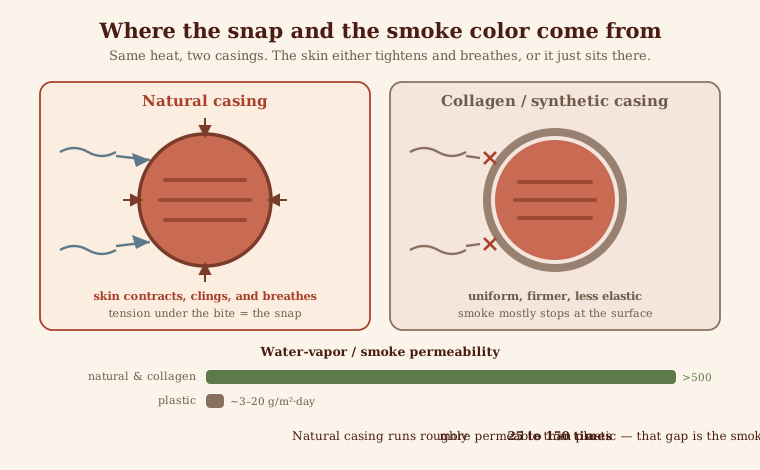
There are three families a home maker meets. Natural casings are animal intestine — a collagen matrix. They’re edible, elastic, semi-permeable to smoke and moisture, they give the classic snap, and they shrink and cling to the meat as it cooks. They’re also variable in size, labor-intensive — you soak them, rinse them, sort them — and more expensive. Collagen casings are reconstituted from hide collagen. They’re edible, uniform in size, cheap, need no soaking, and run fast on automated stuffers — and they’re firmer, less elastic, with a less pronounced snap, and less breathable. Cellulose casings are regenerated plant cellulose; they are not edible and get peeled off after cooking — that’s literally how a skinless hot dog is made. And there’s a fourth I do use: fibrous casing, cellulose reinforced with paper fiber, large and strong and permeable, made for summer sausage and other big dry and semi-dry sausages. That’s the one exception to my rule, and I’ll get to it.
The snap has a physical cause
People talk about the snap like it’s magic, but it’s mechanics. When you heat a natural casing, the casing protein tightens and contracts, a controlled loss of surface moisture firms it up, and because the casing is genuinely elastic, it holds that tension — so when your tooth hits it, it resists for an instant and then breaks cleanly. Snap. The same contraction is what makes a natural casing cling tightly to the meat as it cooks, which is why a good natural-cased link has no gap between skin and filling. Collagen, by the industry’s own description, is “firmer and less elastic” with a “slightly less pronounced snap.” That’s not a natural-casing salesman talking — that’s how collagen gets described by the people who make it. Whether “less snap” is “worse” is my call, and I say yes; the fact that it differs is not in dispute.
Smoke permeability is measurable, not folklore
Here’s the part I didn’t fully believe until I saw the numbers. When you smoke a sausage, the smoke has to get through the casing to flavor and color the meat, and moisture has to get out. Natural, cellulose, and collagen casings are all selectively permeable — they let smoke in and water vapor out. Where it gets stark is the comparison to plastic. Regenerated cellulose and collagen casings run over 500 g/m²·day of water-vapor permeability. Synthetic thermoplastic casings run about 3–20 g/m²·day — meaning plastic is on the order of 25 to 150 times less permeable. That’s why a plastic-cased product can’t take smoke flavor or color at all; those are the ones peeled and sold skinless. These figures come out of casing patents, which are technical documents with no marketing axe to grind, and I trust them.
Natural casing does a little better than even that number suggests, because its surface has microscopic pores and a protein structure that actually attracts smoke compounds, so it takes on more smoke flavor and color while letting moisture pass out during the smoke — and faster surface drying helps the smoke adhere. The clean, big, well-supported fact is the ranking: natural, collagen, and cellulose are all vastly more smoke-permeable than plastic. The fine gap — exactly how much more smoke a natural casing takes up than a collagen one — I’ll be straight that I couldn’t source with a hard number; the sharpest “collagen breathes less” claims come from a company that sells natural casings, so the direction is right and corroborated by the permeability physics, but I won’t quote their adjectives as neutral fact.
Why the factory switched — and what it cost
The reason processors moved to collagen is not a mystery and it’s not sinister: collagen is cheaper, uniform in size, needs no soaking or rinsing or sorting, and runs faster on automated stuffing lines. For a plant that lives on throughput and wants every link identical for branding and packaging, natural casing is a nightmare — it’s variable, it’s slow, it’s expensive, it’s inconsistent. The switch is a genuine cost-and-speed decision, stated plainly by the casing industry itself. And the thing traded away for that consistency is exactly the bite and the smoke I just described.
Here’s the third cut on a card:
| Natural | Collagen | Cellulose / Fibrous | |
|---|---|---|---|
| Edible? | Yes | Yes | No — peeled off |
| Snap | The classic snap; protein contracts, clings to meat | Firmer, less elastic, less snap | N/A (removed before eating) |
| Smoke permeability | High; pores + protein attract smoke | High, but the industry’s own word is “less breathable” | High during processing, then peeled |
| Size consistency | Variable | Uniform | Uniform |
| Labor / cost | Soak, rinse, sort; expensive | Cheap, no prep, fast on automated lines | Cheap; for skinless dogs (cellulose) and summer sausage (fibrous) |
| Where you meet it | Real butcher’s links, my whole bench | Most supermarket sausage | Skinless hot dogs; large dry/semi-dry sausage |
What I do, and the honest hedge
I use only natural casings, with the single exception of fibrous casing for summer sausage — and now you can see it’s not nostalgia. Natural casing is more permeable to smoke and has a more elastic, snappier bite; collagen is firmer, less elastic, and less breathable. Those are the sourced facts. Whether snappier-and-smokier equals better is taste, and it’s mine — but it’s taste standing on real physics, not a hunch. The fibrous exception isn’t a contradiction: a summer sausage is a big log that needs a strong, permeable casing that’ll take a long smoke and that you peel anyway, and fibrous is built for exactly that. It’s the right tool, and it happens not to be edible, which for that product doesn’t matter. If you want to see the choice in a real formula, my summer sausage leans on fibrous for that reason and my smoked sausage leans on natural hog casing for the snap and the smoke.
Adding up the three cuts
So that’s where the flavor went, and it went three directions at once. The meat got leaner and more variable, and some of it got quietly replaced by water held in place with phosphate and by binders that carry no flavor of their own — all legal, all capped, all printed on the label if you know the words. The spice arrived pre-ground and faded, the garlic came as a powder whose flavor enzyme was killed in the drying, the herbs came dried into a different compound than the fresh ones they replaced. And the casing switched from a snappy, smoke-hungry natural gut to a cheaper, firmer, less breathable collagen tube that runs faster on the line.
Every one of those is a rational decision for a factory. I’m not even mad at them — if I had to make ten thousand pounds a shift at a price a grocery chain would accept, I’d make some of the same calls. But add them up and you get the sausage most Americans think a sausage is: milder, softer, less smoky, a little spongy, a little dull. Not bad, exactly. Just quiet.
And here’s my judgment, stated as the judgment it is: the cost-cuts are the difference at the table. No single one ruins a sausage. Together they explain why the one you make yourself — real meat, whole spice ground fresh, a clove of garlic crushed by hand, packed into natural casing and smoked — is louder in every dimension. You didn’t add a secret. You declined to make the three cuts, and the flavor a factory carefully engineered out is the flavor that was there all along.
This is part of Why Sausage Tastes Different Today. Next, The Meat Itself — what leaner, faster-grown, more uniform commodity hogs did to the raw material before it ever reached the grinder. See also The Artisan Problem, The Vanished Butcher, and, for how to read a formula the way this page reads a label, Reading a Recipe.
Comments (0)