The Commodity Sausage: One Product in Twenty Wrappers
Let me start with the thing I actually see with my own eyes, because it’s the whole argument in one image and I don’t need a single footnote to tell it to you.
There are two big meat sellers within about twenty miles of me. Good stores, both of them — the kind of place that still smokes on-site, that has a real counter, that a serious cook drives to on purpose. And each of them carries dozens and dozens of different snack sticks. A whole wall of them. Original, garlic, honey, teriyaki, jalapeño, habanero, cheddar, bacon-cheddar, hickory, mesquite, “old fashioned,” “cracked pepper,” and on and on until you lose count. It looks like the most abundant, most varied corner of the store.
And here’s my honest report as a man who has been grinding and stuffing sausage for forty years: to me, they all taste the same. The jalapeño one is spicier. The habanero one is spicier still. Fair enough — capsaicin does what capsaicin does. But strip the heat off and hand me any two of them blind, and I would be hard pressed to tell you which is which. Same snap, same sweet-salty cured-meat base, same smoke note dialed to the same middle setting, same faint tang. Twenty flavors. One sausage.
I want to be careful and honest right up front, because that matters more to me than winning an argument: that’s my palate talking, not a laboratory. I have not run a blind panel. I don’t have data proving that a store snack stick is measurably more uniform than a butcher’s. So take the “they all taste the same” line as exactly what it is — a very experienced eater’s judgment, offered as a judgment. What I can do — and what this page is really about — is show you the economics underneath that wall of flavors, because the economics are not my opinion. They’re documented, and they explain precisely why a wall of “variety” would end up being one product in twenty wrappers. When the how-it’s-made lines up that neatly with the how-it-tastes-to-me, I’m inclined to trust my tongue.
This is the sequel to the last page of the sausage history, the industrial sausage. That page ended with the factory doing something genuinely good — making a sausage that’s safe, cheap, and the same in Portland, Maine and Portland, Oregon — and then flattening a thousand local sausages into a handful of national products. This page picks up where that one stops. The factory built the machine. This is what the machine did to the market — and to the snack-stick wall — once a few companies owned most of it.
What a commodity is, and why sausage became one
A commodity is a thing that’s the same no matter who sells it. A bushel of No. 2 yellow corn is a bushel of No. 2 yellow corn; nobody asks which farm it came off, because by design it doesn’t matter. That’s the opposite of a craft object, where who made it is the entire point — the reason you drive to a particular smokehouse and not the one ten miles closer.
Sausage started life about as far from a commodity as a food can get. For most of history it was literally defined as what the butcher did with the trim — the odds and ends left after the prime cuts were sold, seasoned by that shop’s own hand, in that region’s own style, changing with the day’s animal and the season. Variability wasn’t a defect. It was the product. My grandfather’s kielbasa didn’t taste like the shop’s down the street, and that difference is the reason I’ve spent forty years chasing his and not theirs.
So the interesting question isn’t was sausage commoditized — the snack-stick wall answers that. The question is how, and the answer is a chain of steps I can source, each one draining a little more of the local out of the product until what’s left is corn-in-a-bushel: interchangeable, national, engineered to a number.
The three siblings to this page walk the pieces of that chain in detail — the vanished butcher who used to make the variable version, where the flavor went once he did, and the meat itself that goes into the modern link. What I want to do here is the economics of the finished sausage: why a national branded product, sold from a few giant plants, has no choice but to converge on one taste, and why that convergence is a business decision rather than an accident or a conspiracy.
The same company makes the “competing” brands
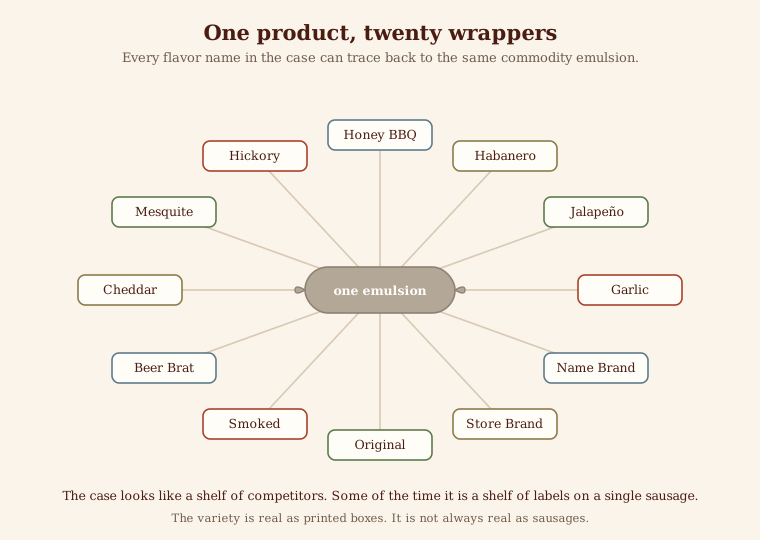
Here’s the first fact, and it’s the one that reframes the whole store shelf. The big processors make both the national brands and the supermarket’s own store brand — often on the same equipment. Large meat companies routinely pack private-label product for retailers alongside their own labeled goods. So two “different” packages sitting a foot apart in the case — the famous name and the cheaper store brand right below it — can come off the same line, out of the same batter, to nearly the same spec.
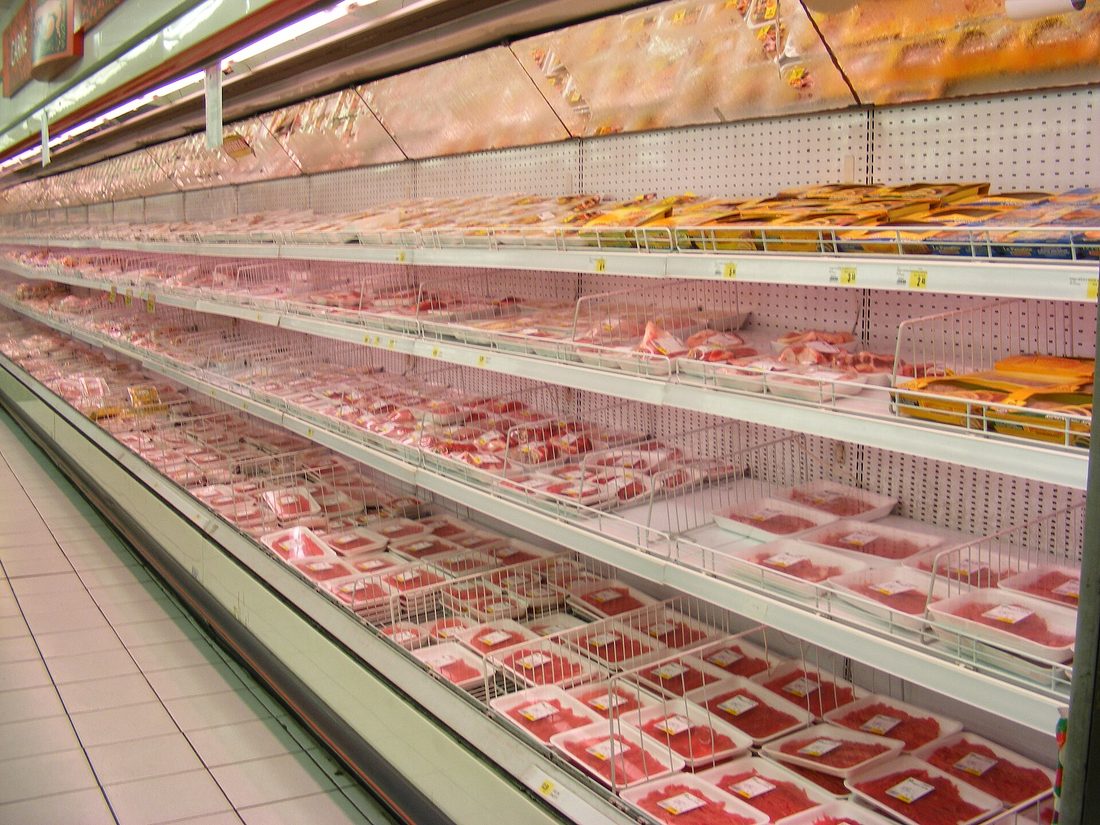
I’ll keep this honest, because the dossier I’m working from is careful about it and I will be too: the specific pairing of which packer makes which retailer’s store brand is a moving target and mostly not public, so I’m not going to name a brand and tell you exactly who packs it. But the structure — big processors producing both national and private-label sausage — is well established. And there’s a nice corroborating breadcrumb: Consumer Reports has run store-brand-versus-name-brand taste tests for years, and store brands repeatedly tie the national brands. That’s exactly what you’d expect if a lot of them are, under the wrapper, the same food.
Sit with what that does to the illusion of choice. You walk the case thinking you’re choosing among competitors. Some of the time you’re choosing among labels on one product. The variety is real as a set of printed boxes. It is not necessarily real as a set of sausages.
Built to a price, not to a flavor
Now the second fact, and this is the engine of the whole thing. A national sausage isn’t built to hit a flavor. It’s built to hit a price. Every decision downstream of that follows, and each one nudges the product toward the same cheap center — which is to say, toward tasting like every other one built to the same target.
There are three levers, and they’re all sourced.
Fat, up to the legal ceiling. In the United States, fresh sausage may legally contain up to 50% fat — that’s the federal standard for the product. Fifty percent. Half. And here’s the economic logic that the ceiling turns into a floor: fat is the cheapest thing in the meat, so a manufacturer building to a price has no reason to swap it for higher-priced lean. If the spec is “as cheap as the law allows,” the product drifts up toward that 50% line, not down. A butcher building to a flavor picks his fat-to-lean ratio because it makes a better sausage — leaner for a snappy summer sausage, richer for a fresh breakfast link. A national plant building to a price picks it because it’s the cheapest formulation that still passes. Two totally different reasons to choose a number, and they land in different places.
Water, because water is cheaper than protein. High-volume plants — we’re talking hundreds of thousands of pounds a day — use binders and extenders and retain added water in the product, because water is much cheaper than protein. Added water is yield: every point of water you can hold in the sausage and legally sell is meat you didn’t have to buy. The binders are there to hold that water and give the cheap formulation a texture that reads as “sausage.” None of this is illegal or dangerous — it’s all labeled, all inspected, the 1906 food-safety law working exactly as designed. But notice what it’s optimizing: yield and shelf life, not character. A product tuned for yield and shelf life across forty states is going to taste like a product tuned for yield and shelf life. Which is to say, like the next one.
Uniformity, as the actual goal. This is the one people miss. The sameness isn’t a side effect the industry tolerates — it’s the target. Mass production explicitly engineers for uniformity: automated machinery, one fixed spice formula, one recipe run identically nationwide, so that every package tastes like every other package on purpose. A national brand sells consistency. That’s the promise on the box — that the one you buy in Michigan is the one you bought in Georgia, that it’ll taste in March like it did in November. Consistency is a real virtue, and I said as much on the industrial page; a family with no money and no butcher can count on that link. But consistency and character are pulling against each other. A product engineered to be the same everywhere cannot also be a product that tastes of a particular place, a particular animal, a particular hand — because those are exactly the things that make it vary. The spice formula is locked. The animals are pooled from a national supply. The line is automated to erase the operator. You cannot build for sameness and get difference; that’s not cynicism, it’s arithmetic.
Here’s the table I keep in my head, because it puts the two logics side by side and the divergence is the whole story:
| The butcher’s sausage | The commodity sausage | |
|---|---|---|
| Built to hit | A flavor he’s proud of | A price point on a spec sheet |
| Fat ratio chosen for | Taste and texture of this sausage | Cheapest formulation the law allows (up to 50%) |
| Water / binders | Little to none — it’s meat | Added — “water is cheaper than protein” |
| Spice | His hand, adjusted by the batch | One fixed formula, run nationwide |
| Variation batch to batch | Real — the day’s trim, the season | Engineered out, by design |
| What it optimizes | Character | Yield, shelf life, uniformity |
Read down the two columns and you can see the sameness coming before you ever taste it. Sameness isn’t a failure of the commodity sausage. It is the product specification. Nobody in the plant is failing to make it varied. They are succeeding at making it uniform, which is what they were asked to do.
Why “engineered to a price” and “tastes the same” are the same sentence
I want to close the loop between the economics and my tongue carefully, because this is exactly the spot where it would be easy to overclaim, and the dossier flags it hard: there is no blind-panel study proving supermarket sausages measurably taste more alike than butcher sausages. I looked; that proof isn’t there. So I’m not going to dress my palate up as a measurement. Let me instead lay the reasoning out in the open and let you judge it, because it’s an argument, not a lab result, and it should be labeled as one.
The reasoning goes like this. If a category of product is (a) built by a handful of firms, (b) to one fixed spice formula, (c) run identically nationwide, (d) tuned to the cheapest legal fat ratio, (e) stretched with the same cheap water and binders, and (f) explicitly engineered for uniformity as a selling point — then it would be genuinely strange for it not to converge on a narrow band of flavor. Every listed force pushes toward the center and none pushes away from it. The convergence isn’t something I need to prove separately; it’s the predicted output of the machine as documented. My palate isn’t the evidence for the convergence. The economics are the evidence. My palate is just the thing that noticed the result and sent me looking for the reason.
And when I go back to that snack-stick wall with this in my head, the wall stops looking like abundance. Dozens of flavors from a small number of brands — some of which, remember, may be the same processor packing both the name and the store label — each engineered to the same price, the same fat ceiling, the same uniform spec, differentiated mostly by which spice-and-heat overlay got sprayed on at the end. Of course the jalapeño one reads as “the same but spicier.” The base is the same. They changed the topping, not the sausage. A wall of variety that is really one product in twenty wrappers is precisely what the economics predict, and it’s precisely what I taste. I can’t hand you a p-value for the taste. I can hand you the whole causal chain that would make it true, every link of it sourced, and tell you my forty-year-old tongue agrees. Weigh that for what it is.
The honest counterweight — this is not a horror story
I said on the industrial page that it’s lazy to just hate the factory sausage, and I meant it, so let me hold myself to it here. A few things need saying so this doesn’t curdle into snobbery.
Nothing here is a scandal. The 50% fat, the added water, the binders, the uniform spec — all of it is legal, labeled, and inspected. The commodity sausage is safe, and safe is not nothing; safe is the 1906 law doing the exact job the country asked it to do after The Jungle. When people get grossed out about the industrial link, they usually aim their disgust at the wrong target — some imagined disgusting ingredient — and miss the real thing, which isn’t gross at all. The real thing is duller and, to me, sadder: it’s just flat. There’s nothing hidden in it. That’s the point. There’s not much of anything distinctive in it.
Cheap and consistent are real virtues for real people. A snack stick that costs a dollar, keeps in a glovebox, and tastes fine is a genuinely useful object. My own kids ate plenty of grocery hot dogs and snack sticks and they’re fine. If your metric is “safe protein, cheap, available in July,” the commodity sausage wins and it isn’t close, same as I admitted about the hot dog. I’m not telling you to feel bad about buying it.
And the sameness is not a moral failing of the companies. They were asked, by the whole structure of national retail, to deliver a product that costs little and tastes identical from coast to coast and month to month. They did exactly that. The uniformity is them succeeding. My complaint isn’t that they’re doing it wrong — it’s that doing it right necessarily squeezes out the thing I happen to love, which is the local, variable, particular sausage. That’s a trade, not a crime, and the two big meat sellers near me carry that whole snack-stick wall precisely because it sells. People like it. I’m not most people about this, and I know it.
There’s even a small counter-current worth naming so I’m not painting it all one color: a younger generation of whole-animal butcher shops has been opening up, from a tiny base, especially since around the 2010s, and the fragility the pandemic exposed in the consolidated supply chain gave it a push. That’s the thing I’m a small part of, and it’s real. But I won’t oversell it — it’s a counter-current, not a turning tide, and I get into where it can and can’t go on the artisan problem. It doesn’t undo the snack-stick wall. It just means a few of us are standing at benches next to it.
Why I still stand at the bench
So here’s where I land, and it’s the same place the industrial page landed, one step further on.
The commodity sausage won the store. Let me be completely clear-eyed: I cannot make a snack stick for what a snack stick costs, I cannot guarantee the coast-to-coast sameness a national brand sells as its whole promise, and a plant does the mechanical part of my craft ten thousand times faster than I do. On price, safety, and consistency, the wall of twenty flavors beats my bench every single time.
But that was never what I was trying to win. When I grind a nearly-frozen pork butt through the coarse plate and stuff it into a hog casing and stage it up through the smoke the way I spent years reverse-engineering from the memory of my grandfather’s kitchen, I’m not making a better commodity sausage. I’m making a different kind of thing than a commodity can be. My batch varies. That’s not a defect I haven’t ironed out yet — it’s the feature. It varies with the day’s meat and my hand and the smoke I tended, and it will never be identical to the last one, because I am not an automated line building to a spec and I have no wish to become one. The whole value of what I make is the exact quality the commodity is engineered to destroy: the fact that it tastes of a particular place, a particular animal, a particular person on a particular day.
That’s why the snack-stick wall doesn’t tempt me even though it’s a wall of my favorite food. It’s not twenty sausages. It’s one sausage, built to a price, wearing twenty wrappers, and I can taste the price in every one of them. So I make my own — not because the wall is bad, but because the one thing the wall physically cannot sell me is the one thing I’m actually there for. You can’t buy variability off a shelf that was engineered for sameness. You have to stand at a bench and make it. Forty years in, that’s still the whole reason I do.
Go dig into what the machine actually costs us next — where the flavor went, the person it replaced on the vanished butcher, the meat that’s left on the meat itself, and whether the small guys can ever really answer it on the artisan problem. And if you want to see the other side of the trade — a sausage with my hand in it — the whole collection is there: pull up snack sticks, summer sausage, kielbasa, and bratwurst and make one that tastes like you.
Part of Why Sausage Tastes Different Today. This page is the direct sequel to the history’s last chapter, the industrial sausage — the factory built the uniform link; this is what happened to the market once a few firms owned it. Next: where the flavor went. Back to the hub, the family tree, reading a recipe, and the collection.
Comments (0)