The Meat Itself: It's Not Grass Good, Feedlot Bad — It's Knowing What the Animal Ate
Let me get the loudest argument out of the way first, because it’s the one that turns this whole subject into a shouting match and I don’t want any part of that shouting match.
Grass-fed is not automatically better. Neither is “local.” I raise and butcher a lot of my own meat, and I still grain-finish on purpose — because I’m after the fat.
That sentence gets me in trouble with people on both sides. The grass-fed crowd hears heresy. The commodity side hears an opening — “see, even the farm guy feeds grain, so what’s the difference?” Both have missed the point, and the point is the whole reason this page exists. It isn’t what the animal ate in some moral sense. It’s that I know what it ate, and I chose it, and I chose it for a specific result in the sausage. That’s the thing the grocery-store cold case can’t give you, and it’s got nothing to do with grass.
I’ll spend most of this page backing that up with real science, and I’ll be honest about where the science backs me and where it doesn’t — because this is a topic drowning in marketing hype from every direction, and I’d rather hand you the honest version than sell you a feeling.
My animals, and why I feed the way I feed
Here’s how it actually works on my place, because it’s the cleanest proof I’ve got that “control” beats “grass.”
My animals graze large pastures. They also get grain. The pigs get a lot of table scraps on top of that — pigs are the great recyclers, and mine eat like it. None of this is a compromise or a shortcut. It’s a set of deliberate choices, and the deliberate part is the whole thing.
The clearest example is my lamb. When I finish lambs, I cut goat milk into their grain. I do it because it gives me a marbling in the meat that I love — a fat distribution and a richness I can’t get any other way. That is not a grass-fed practice. That is the opposite of a grass-fed practice. It’s me reaching into the animal’s diet and deliberately steering the fat toward what I want on the plate and in the grinder.
Think about what that means for the “grass good / grain bad” story. If grass were simply better, I’d finish those lambs on grass alone and stop. I don’t, because I’ve tasted both and I prefer what the goat-milk grain does to the fat. My palate, my choice — and the only reason I can make that choice is that I control every input. That’s the argument. Not the grass. The control.
I butcher just about everything myself. The exceptions are hogs and beef — those are simply too big for me to handle alone, so I get help with the kill and the breakdown on the big animals. Everything else I do at my own bench. And when a goat gets old and it’s time, I butcher it and long-braise the meat — it goes into tacos and burritos, low and slow until it gives up. An old goat is not a tender animal, but it’s a nose-to-tail animal, and braise is what that meat is asking for. Nothing gets wasted, and because I raised it, I know exactly what I’m putting in the pot.
Now — everything above is my practice and my opinion, and I want to keep it clean and separate from the sourced facts, because the facts are what make the case to a skeptic. So from here on, when I tell you something is measured and studied, I’ll say so, and when I’m giving you my palate, I’ll say that too.
The strongest fact I have: the commodity pig was bred bland
If you take one thing off this page, take this one, because it’s the best-documented and the least arguable, and it’s directly about the fat that makes sausage work.
In 1986, the National Pork Producers Council launched “Pork. The Other White Meat.” You remember the slogan. What you probably don’t remember is that it wasn’t just advertising — it described, and celebrated, a real and deliberate change in the animal. The industry was chasing a market that had gotten scared of fat. Per-capita pork consumption had been sliding through the late ’70s and early ’80s amid heart-disease worry, and chicken was eating pork’s lunch. So the industry bred and fed the fat out of the hog.
It worked, and fast. Pork got roughly 31% leaner in under a decade — through both breeding and a lower-fat diet. The 1945 pig, raised outdoors on corn and scraps, carried thick fat. By the mid-1980s pig, raised indoors on formulated feed to corporate breeding standards, was lean and pale. (I’ll flag that the exact “31%” figure I’ve seen traced through advocacy and food-history sources rather than a clean USDA table I could put my hands on — the direction is beyond dispute and well-sourced; treat the precise number as approximate.)
Here’s the part that matters for us. Modern commodity pork loin runs somewhere around 1–2% intramuscular fat. Heritage breeds — your Berkshire, your Duroc — run more like 3–5%. (Those specific percentages come mostly from heritage-pork vendors, so I hold the exact figures loosely; but the direction — heritage carries markedly more intramuscular fat — is backed by peer-reviewed breed work.) And this isn’t some fringe complaint from romantics. Iowa State University’s own Pork Industry Center — an industry research center, not an opponent — concedes that very pale, very lean pork shows “diminished eating quality.” When the people whose job is to defend the product admit that, you can believe it.
Intramuscular fat is where pork tastes like pork. And for a sausage maker, that fat is doing double duty: it carries the flavor and it’s part of the bind and the mouthfeel. Lean, pale commodity pork is exactly the wrong raw material for a good fresh sausage — you end up adding back fat you have to source separately, chasing a richness the animal used to bring on its own. The industry bred out the one thing I most need. That’s the honest spine of “why sausage tastes different today,” and notice it’s a story about fat, which is the same thing my goat-milk lamb is a story about.
PSE and the stress gene: why how it was raised and killed shows up in the pan
The second big sourced fact is the cleanest science I know for “it matters how the animal lived and how it died” — and it’s not a vibe, it’s a protein-chemistry failure you can measure.
It’s called PSE — pale, soft, exudative pork. Here’s the mechanism, and it’s worth understanding because it explains a batch that’s failed on you and you couldn’t say why. When a hog is stressed right before slaughter, its metabolism races and dumps lactic acid into the muscle. If that happens while the carcass is still warm, you get a bad combination: low pH at high temperature, and that denatures the muscle proteins. Denatured proteins can’t hold water. The result is pork that’s pale, that weeps, that’s soft and mushy.
Put that meat in sausage and you get a chain of problems that are all downstream of one cause. Low protein solubility means poor bind. Poor water-holding means drip and cook-out — your sausage sheds moisture in the pan and turns crumbly and dry. And the cured color forms poorly, so even your color’s off. Every one of those is a symptom I’ve chased in a bad batch, and PSE is a real, documented reason behind them.
There’s a genetic side too. The tendency is strongly tied to the recessive halothane gene — the RYR1, or ryanodine-receptor, mutation — a defective calcium-release channel that makes the animal stress-susceptible in the first place. Fast-grown commodity lines have historically carried it. So you’ve got a genetic predisposition and a stressful, high-throughput slaughter environment stacking on top of each other.
This is the single best argument for knowing your animal — and I mean it plainly, not sentimentally. A calm animal that isn’t carrying the stress gene, killed without a panic, makes measurably better sausage: better bind, better water-holding, better color. That’s not “I feel good about where it came from.” That’s protein chemistry you can taste and weigh. When I hear somebody wave off traceability as a rich person’s luxury, this is the fact I point at. Low-stress slaughter of a known animal isn’t a moral flourish; it dodges an entire, specific failure mode.
Feed sets the fat itself — and that’s a sausage problem, not an opinion
Here’s where my goat-milk lamb stops being a quirk and becomes a principle you can put a number on. What the animal eats changes the fat’s physical behavior — how firm it is, whether it smears, how fast it goes rancid. For a sausage maker, that’s not romance. That’s whether the batch works.
The measure is iodine value (IV) — it gauges how unsaturated a fat is, and the rule is simple: higher iodine value means softer fat. Soft fat is a problem. It smears in the grinder instead of cutting clean, it slices badly, and it goes rancid faster because unsaturated fat oxidizes faster.
Now watch what feed does to it. A hog finished on corn and dried distillers grains (DDGS) — DDGS being the leftovers from ethanol production, which got dirt cheap and went into a lot of hog feed — takes on soft, high-linoleic backfat. The numbers are real: a corn-soybean diet without added fat lands backfat iodine value somewhere around 63–68; push to a 30% DDGS diet and it climbs past 74. That’s the difference between fat that behaves in a dry-cured salami and fat that smears in the grinder and turns rancid on you. A hog’s diet directly sets whether its fat will hold up in a cured product. That’s about as concrete as “the meat itself is different” gets, and it’s fully sourced.
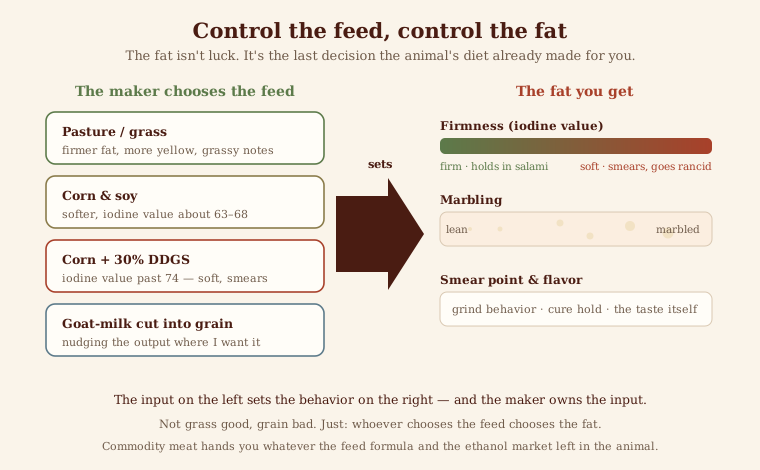
This is exactly what I’m doing when I cut goat milk into my lamb’s grain — reaching into the input side of that diagram to move the output where I want it. I’m not guessing. Commodity meat is the opposite: you get whatever the feed formula and the ethanol market handed the animal, and you find out about the fat when it’s already smearing in your bowl.
Grass versus grain: the composition is real, the taste verdict is not settled
Now the fight everybody actually wants to have. And I’m going to disappoint the partisans, because the honest answer is a split decision.
What’s genuinely different in grass-finished versus grain-finished fat is measured and solid. Here’s the composition, and none of it is in serious dispute:
| Trait | Grass-finished | Grain-finished |
|---|---|---|
| Omega-3 (n-3) fatty acids | Substantially higher — ALA reported up to ~10× | Lower |
| Omega-6 : omega-3 ratio | Lower / more favorable (often < 2:1) | Wider |
| CLA (conjugated linoleic acid) | ~2–4× higher | Lower |
| Saturated-fat type | Skews to stearic acid → firmer fat | More myristic/palmitic |
| Fat color | Yellower (β-carotene from forage) | Whiter |
| Marbling (intramuscular fat) | Less | More |
| Flavor note | ”Beefier,” “gamier,” more intense | Milder, sweeter fat, “buttery” |
| Taste preference | CONTESTED — see below | CONTESTED — see below |
A couple of those deserve a plain-English word so nobody oversells them:
- The yellow fat is the single most visible “this meat is different” tell, and it’s real — it’s β-carotene deposited from green forage, the same pigment that’s in the grass. When you see butter-yellow fat on a grass-finished carcass, you’re looking at the diet.
- The omega-3 story is true as a ratio and oversold as an amount. Yes, grass-finished beef carries several times the omega-3 of grain-finished. But the absolute amount in a serving of beef is still modest — beef is not a substitute for oily fish, and any marketing that implies grass-fed beef is an omega-3 source is stretching a real ratio past what it can bear. Don’t buy the health halo.
- CLA is genuinely higher in grass-finished, but its human-health benefits are themselves contested in the literature, so I won’t build a health claim on it and neither should you.
Now the part that gets people’s blood up. Does grass-finished taste better? By the usual American yardstick — no, and I have to be honest about that.
U.S. consumer taste panels consistently prefer grain-finished beef. In one study, overall acceptance ran something like 6.45 for grain versus 5.50 for grass. Trained panels rate grass-finished steaks less tender. The driver is marbling — that intramuscular fat grain-finishing lays down is exactly the tenderness, juiciness, and mild buttery flavor that American eaters have been trained their whole lives to call “good beef.” Supplement grass-fed cattle with grain and the scores march right back toward the grain-finished end. This is a solid, repeated finding, and I’m not going to pretend it away because it’s inconvenient.
And here’s the tell that it’s cultural, not objective: flip the ocean and the verdict flips. European panels tend to prefer the more intense grass-fed flavor. Same meat, opposite ranking, and the only variable is what the eaters grew up on. That’s the definition of a learned preference. There is no view from nowhere here. “Grass-fed tastes better” is not a fact; it’s an accent.
So where does that leave me? I’ll tell you exactly, and I’ll label it as what it is: I happen to like the beefier, firmer, yellow-fat character. That’s my palate. It is not science’s verdict, and I won’t dress it up as one. What I will claim as fact is that the composition is genuinely, measurably different — and that for my purposes, I’d rather have the difference in my own hands than take whatever the feedlot decided.
And here’s why the grass-versus-grain fight matters less for sausage than for steak
There’s a wrinkle that the whole grass-versus-grain war tends to ignore, and it’s the one that actually applies to us. Most of that fight is about a steak. Marbling, tenderness, whole-muscle juiciness — those are steak virtues. But I’m not eating this as a steak. I’m grinding it, salting it, spicing it, smoking it, and half the time I’m cutting in fat separately anyway.
Grinding and seasoning dilute the whole-muscle marbling argument — you’re rebuilding the fat-to-lean ratio by hand regardless of how the animal marbled. But the fat firmness and the fat flavor matter more, not less, because those survive the grinder. So for sausage, the grain “marbling advantage” is worth less than it is for a steak, while the feed-driven fat differences — firmness, smear point, rancidity, that yellow color in a cured product — are worth more. I’ll be straight that I couldn’t find a study putting grass- versus grain-finished beef through an actual sausage sensory panel — the taste-panel work is all whole-muscle. So take the sausage-specific framing as my reasoning from the composition science, not as something somebody measured. But the reasoning is sound: for us, it’s the fat that counts, and the fat is the part the feed most directly controls.
Aging, briefly — because it’s a steak story, not a sausage story
One more piece of “the meat itself,” and I’ll keep it short because it barely touches what we do, but you should know it so nobody sells you the wrong thing.
More than 90% of commercial beef is wet-aged — it arrives at the store vacuum-sealed in Cryovac and it’s been enzymatically aging in the bag the whole time. The reason is money: wet-aging loses no moisture and no trim, so the yield is high, and it fits high-throughput retail. It’s ready in about 10–14 days and the flavor is mild and familiar. Dry-aging is the other road — 30-plus days in open, humidity-controlled air, losing 15–30% of its weight to evaporation. That concentrates the flavor like reducing a sauce, and the trimmed crust adds a nutty, earthy, eventually blue-cheese funk. Both methods use the same tenderizing enzymes (calpains and cathepsins); dry-aging’s headline isn’t “more tender,” it’s flavor concentration plus crust chemistry.
Here’s the honest relevance to us: almost none. Fresh sausage is ground, salted, spiced, and often smoked — those flavors dominate, and dry-age funk would be masked or flat-out unwanted. Grinding fresh meat is not aging it, and aging doesn’t improve a fresh sausage. I mention aging only so you understand the commodity supply chain the meat travels through — and so that if you ever hear “well-aged” attached to a fresh sausage, you know it’s marketing reaching for a word it hasn’t earned. If I ever did a dry-cured whole-muscle product, aging would matter. For a fresh link, forget it.
Where I have to be honest: “local” and “fresh” are values, not a taste law
This is the part where I have to police my own side, because the local-and-fresh crowd — which includes me — tells a story that outruns the evidence, and a page that laundered that story into fact wouldn’t be worth your time.
Proximity itself has no proven flavor benefit. I went looking, and there is no study showing that meat from thirty miles away tastes better because it traveled a shorter distance. “Local tastes better because it’s local” is a feeling, and I’m not going to sell it to you as a measurement.
Worse for the romantics: for a steak, “fresher” is arguably worse. Aging — time — is what develops beef flavor, which is the whole reason nobody markets day-of-slaughter steak as premium. So “fresh equals tastier” is actually backwards for whole-muscle beef. If I told you my beef tastes better because it’s fresher, I’d be wrong on the science, and I’d rather tell you that than flatter my own operation.
So what is the real payoff of raising and sourcing my own? It’s exactly what this whole page has been building toward, and none of it is magic:
- I control the variables the science says actually matter — the breed, the feed (and therefore the fat’s firmness, flavor, and color), and a low-stress slaughter that dodges PSE. Every one of those is a documented, measurable lever, and every one of them is decided long before the word “fresh” ever comes up.
- I avoid the long cold chain. Here’s the one place freshness genuinely earns its keep, and it’s specific to us: ground, fatty meat oxidizes faster than whole muscle because grinding explodes the surface area. Fat going rancid is a real, time-driven, chemistry-backed off-note, and using fresh, well-handled fat genuinely helps prevent it. That’s a legitimate freshness point — but notice it’s narrow and it’s about oxidation, not about some broad “local magic.”
- I get traceability. I know the animal, the feed, the day, the kill. That’s a genuine food-safety and quality-assurance advantage — knowing your source is how recalls and safety work in the first place. It’s real, and it’s worth something. It’s just not a flavor claim, and I won’t dress it up as one.
So when I say my meat is better, here’s precisely what I mean, stripped of hype: I control the inputs that measurably change the fat, the bind, the color, and the safety of what I make — and I know exactly what went into it. That’s the defensible claim. “Grass good, feedlot bad” isn’t, and “local is magic” isn’t. The truth is quieter and, I think, more interesting: it was never about the grass. It was always about knowing, and choosing, what the animal ate.
The one-line version
The commodity system took the fat out of the pig, stresses the animal on the way to the kill, and hands you whatever the feed formula produced — and it did all of that on purpose, for reasons that had nothing to do with what ends up in your grinder. I do the opposite, also on purpose: I steer the feed to steer the fat, keep the animal calm, and know every input by name. Whether my particular choices — grain-finished lamb with goat milk in the ration — taste “better” than yours is a matter of palate, and I’ll defend mine as mine and not as gospel. But that I made the choice, and can tell you exactly what it was, is the whole difference between meat you know and meat you don’t.
Next: where the flavor went — the seasoning, the curing, and the shortcuts that changed the sausage after the meat was already changed. This section is part of Why Sausage Tastes Different Today; see also the commodity sausage, the artisan problem, and the vanished butcher. The recipes that lean on this meat: my lamb and goat sausages, and the long-braised goat for tacos. Back to the collection and how to read a recipe.
Comments (0)