The Vanished Butcher
The history is over. Everything up to now — Homer’s blood paunch, thirty Polish sausages under one noun, the Chicago disassembly line — was me telling you where sausage came from, and trying hard to keep my thumb off the scale while I did it. This page is where the thumb goes on. This whole section is my argument, not my history, and I want to be honest with you about which is which from the first sentence: the facts on this page are sourced and I’ll show you the numbers, but the reading of them is mine. You’re allowed to disagree. I’d just like you to disagree with the real figures in front of you rather than the story we all tell ourselves.
And the story we all tell ourselves is that the neighborhood butcher “died out,” the way the blacksmith did — gently, naturally, a quaint trade that people stopped needing once the supermarket got good. That’s the comfortable version, and I think it’s mostly wrong. The butcher didn’t die of old age. He was engineered out of the supply chain on a schedule, by a handful of decisions made in a handful of boardrooms, and the sausage on your grocery shelf tastes the way it does partly because of who no longer cuts your meat. That’s the claim. Let me back it up — and then, at the end, tell you about a meat market in Grand Rapids, Michigan, because that store closing is this whole argument in one true story.
A butcher in every town

Start with what we lost, because you can’t measure a disappearance until you know what was standing there before.
For most of American history, meat was cut by a person you could see, in a shop that sold nothing but meat. Every small town had a butcher. A city had dozens — a butcher per neighborhood, often a butcher per ethnic parish, the German one and the Polish one and the Italian one each making the sausage their customers grew up on. This is not nostalgia; it’s the ordinary structure of how Americans bought meat for two hundred years. The man behind the counter knew your name, knew what cut you wanted, and — this is the part that matters for a sausage program — made his own sausage out of the day’s trim. That was the whole economic logic of a butcher shop. You broke down carcasses, you sold the prime cuts, and the scraps, the trim, the odd bits went into the grinder and came back out as that shop’s sausage, seasoned by that shop’s hand. Sausage was, historically, the single most local and most variable product in the whole store, because it was literally defined as “what this particular butcher did with what was left over.”
Now I have to be straight with you about a gap in the record, because the honesty is the point of this section. I went looking for the clean, satisfying line — “there were X butcher shops in America in 1900 and there are Y today” — and I could not source it cleanly below 1997. The deep historical census counts of standalone meat markets aren’t cleanly available; the mid-century peak is a genuine hole in the data, not something I’m hiding from you. So I won’t print a made-up “1900 vs. today” number just because it would land harder. What I can give you is the recent hard series, and it’s grim enough on its own:
| US retail “meat market” establishments | Count |
|---|---|
| 1997 | 7,214 |
| 2002 | 5,847 |
| 2010 (projected) | ~5,059 |
That’s roughly a 30 percent contraction in thirteen years — and notice that it starts in 1997, which is already long past the peak. By the time this series even begins, the standalone butcher shop had been in decline for decades. The self-service grocery store — Piggly Wiggly opened the first one in Memphis in 1916 — began the erosion; the supermarket format spread through the late 1940s; and by roughly the 1960s the neighborhood butcher’s services were in clear retreat, until by the 1990s the standalone shop had, as more than one trade account puts it, “pretty much disappeared” as a mainstream way Americans bought meat. I’m giving you those decade markers as the round numbers they are — the arc is airtight across every source, the exact dates are soft, so read them as “by roughly the sixties, by roughly the nineties,” not as hard census dates.
And where did the butchers go? Mostly, they went inside the supermarket, and then that job got hollowed out too. Today there are about 143,100 butchers and meat cutters working in the United States (2024 figures), and the government projects that number will grow a grand total of about one percent over the following decade. Read that flat line correctly: the occupation isn’t collapsing further, but it isn’t recovering either. It has simply settled onto its low plateau. And most of those 143,000 people are not the independent shop owner of the story above — they’re cutters working inside supermarkets and packing plants, executing a corporate cut sheet. The job title survived. The thing the job used to be — a person with a shop, breaking whole animals, making the house sausage — is what vanished.
The counter died on a schedule
Here’s where the comfortable “it just died out” story really breaks, because we can watch the counter die almost year by year, and it didn’t happen by accident. It happened on a schedule, and the schedule was largely set by one company.
The mechanism has a name: case-ready meat. Case-ready means the meat is cut, packaged, weighed, and priced at a central processing plant — often hundreds of miles away — and shipped to the store ready to drop straight into the refrigerated case. No in-store butcher required. Nobody at your grocery store touches it except to set the tray on the shelf. It arrives as a sealed foam-and-plastic package with a barcode already on it, and that package is the vanished butcher, made physical. Every case-ready tray is a job that used to be done in the back of your store and now is not.
Watch the two numbers flip:
| Share of the fresh-meat case | 2002 | ~2010 |
|---|---|---|
| Case-ready (cut and packed at a distant plant) | 49% | ~66% |
| Cut and packaged in-store (an actual butcher) | 51% | ~17% |
In-store cutting went from just over half the case to about one-sixth of it in less than a decade. Case-ready went from under half to two-thirds. Those aren’t gentle trend lines; that’s a trade being demolished on a timetable. And the single biggest lever was Walmart — by then the largest grocer in the country — which in the early 2000s systematically phased out its in-store butchers and switched to case-ready across its stores. When the nation’s largest meat retailer decides it no longer employs butchers, the entire supply chain reorganizes itself to serve that decision. Everyone else’s economics tip the same way, because the processors build their whole distribution around the giant buyer. The foam tray didn’t win because shoppers demanded it. It won because the biggest buyer in America decided the butcher was a cost center, and had the scale to make that true for everybody.
I want to be fair here, because the case-ready tray is not evil. It’s cheaper, it’s consistent, it wastes less labor, arguably safer in some narrow food-handling sense. If all you want is a pound of ground chuck at a predictable price, it delivers, and I won’t pretend otherwise. But if you want sausage — the variable, trim-defined, house-seasoned product I described up top — the case-ready model has no place to make it. There’s no back room, no grinder, no butcher with a spice hand. The very infrastructure that made a butcher’s sausage possible is the infrastructure that got optimized away. You cannot buy the particular thing from a system built to eliminate the particular.
The slaughterhouse behind the counter
Now go one step further up the chain, to the part almost nobody sees, because this is the half of the story that makes my own practice genuinely hard rather than merely inconvenient — and it’s the part that turns “buy local meat” from a shopping choice into a logistics problem.
Behind every butcher shop, historically, was a small slaughterhouse — a local abattoir, an inspected facility close enough that a nearby farmer could bring in a few animals, have them killed and dressed, and sell the meat locally. That web of small plants is the hidden circulatory system of local meat, and it has collapsed far more completely than the retail counter did. The numbers here are the strong part of this whole page — federally derived, and brutal:
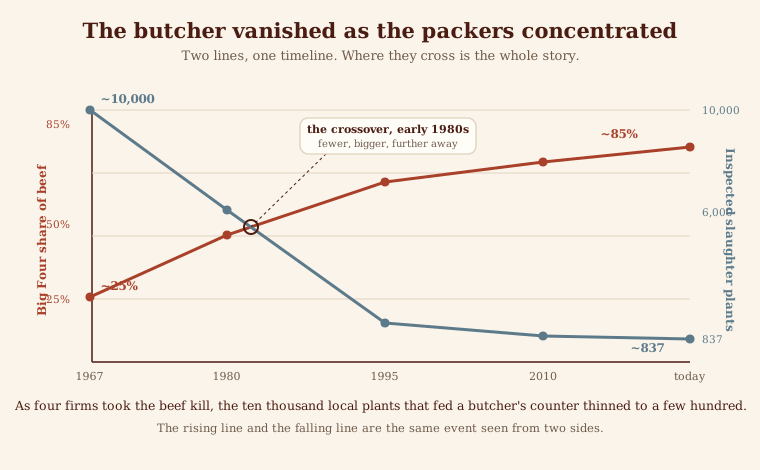
- Federally inspected slaughter and processing plants: from nearly 10,000 in 1967 — the year the Wholesome Meat Act mandated USDA-equivalent inspection — down to roughly 837 USDA-inspected beef-and-pork plants today. That’s a 36 percent drop just since 1990.
- Hog-slaughter plants specifically: 1,388 in 1981 → 721 by 2000. A clean halving in twenty years.
- And the counterpoint that explains where all the animals actually go: about 50 plants now perform roughly 98 percent of US beef slaughter.
Let me be careful and note the honest wrinkle in that first line, because I promised you sourced-not-hyped: the “nearly 10,000 in 1967” figure counts all federally inspected plants, while the “837 today” counts beef-and-pork plants specifically, so those two aren’t a perfectly clean apples-to-apples series — the scopes shift a little. The direction is not in any doubt; the exact denominator wobbles by source. I’d rather tell you that than pretend the two numbers were minted for each other. The sharpest collapse, per USDA’s own economists, ran from roughly 1991 to 2007, and then leveled off — which tells you this is a late-twentieth-century event, not something that happened quietly back in the 1950s. It happened recently. Some of it happened in my adult lifetime.
Sit with that “50 plants do 98 percent” figure for a second, because it’s the whole shape of the thing. You can raise a hog twenty miles from my house. But if there is no inspected slaughterhouse within a three-hour drive that will take one animal from one farmer on a reasonable schedule, then “local pork” is not a choice you can make at any price — it’s a piece of infrastructure that no longer exists. And that’s genuinely the situation across much of the country. Small producers report the surviving local processors booked out a year or more, three-to-six-hour hauls each way, and plants that would much rather run a thousand animals from one big operator than one or two from a family farm — because the economics reward volume and punish the small, single-animal customer. The whole physical apparatus that let a butcher sell you truly local sausage has been thinned to a skeleton.
Why did it happen? Here I’m walking into contested ground, so I’ll walk carefully. The consensus mechanism — and it’s genuinely cross-ideological, you hear it from libertarian small-processor advocates and left-leaning food reformers alike — is that uniform federal food-safety compliance (HACCP plans, staffing a full-time inspector, the capital for a compliant facility) imposes fixed costs a giant plant amortizes over millions of animals and a small plant simply cannot. The rules, even the well-intentioned ones, tilt the field toward scale. Now, how much of the collapse is regulation versus plain old economies of scale is honestly debated, and I won’t hand you the libertarian version as settled fact — the fairest framing is that regulation compounds economies of scale, not “regulation alone did this.” But whichever weight you put on it, the outcome is the same: the small abattoir that used to stand behind the small butcher is mostly gone, and it took the local sausage with it.
The Big Four
Everything above is downstream of one number, and it’s the number I’d tattoo on the section if I could. When you ask “why does supermarket beef — and supermarket sausage — taste like one national product,” the answer starts here: four companies now slaughter roughly 85 percent of America’s beef.
The Big Four are JBS, Tyson Foods, Cargill, and National Beef. Here’s the trajectory of their combined share of steer and heifer slaughter — the CR4, in the economists’ shorthand — and it’s the spine of this entire section:
| Beef “Big Four” share of US slaughter (CR4) | Share |
|---|---|
| 1977 | ~25% |
| 1992 | ~71% |
| ~2022 | ~85% |
That’s a near-tripling in fifteen years, from 1977 to 1992, and then a plateau up around 85 percent. I’ll add the honest caveat the way I always do: one recent (2025–26) data point put the four largest beef packers at around 73 percent of fed-cattle slaughter capacity, with Tyson’s share slipping a little, so don’t take 85 percent as an eternal constant — call it “roughly 80 to 85 percent, possibly easing somewhat in the 2020s.” But the historical trajectory of 25 → 71 → 85 is rock solid and not in dispute; only the exact current figure moves. And economists have a rule of thumb that a CR4 above 50 percent marks an uncompetitive market. Beef blew past that line more than thirty years ago.
Pork tells almost the same story, one beat behind:
| Pork “Big Four” share (CR4) | Share |
|---|---|
| 1976 | ~33% |
| 2016 | ~71% |
| 2020 | ~64% |
I’m keeping that 2020 dip on the page on purpose — concentration is not a tidy monotonic climb, and pretending it is would be exactly the kind of thumb-on-the-scale I said I’d avoid. As of 2020 the top hog slaughterers were Smithfield at 25.4 percent, JBS at 18.2 percent, and Tyson at 16.0 percent. Still far, far past the uncompetitive line, just not a perfect straight arrow up.
Here’s a detail worth naming, because it complicates the flag-waving: of that Big Four, JBS and National Beef are Brazilian-owned, and over on the pork side Smithfield is owned by WH Group, a Chinese company. The all-American hamburger and the all-American breakfast sausage are, to a substantial degree, processed by foreign-owned firms. I don’t raise that to bang a nationalist drum — I raise it because it’s the clearest possible proof that “American meat” long ago stopped meaning “meat handled by your American neighbors” and started meaning “a globally-owned industrial commodity that happens to be slaughtered here.”
And there’s a supporting fact that ties the consolidation directly to the flavor. The way the big firms drove down per-unit costs was by building far larger plants and, in the 1980s, breaking the unions — average hourly wages in the largest meatpacking plants fell about 15 percent between 1982 and 1992 after those labor fights. The modern plant is a high-throughput, low-wage, standardized machine. And a standardized machine makes a standardized product. That’s not a side effect; as I argue on the commodity sausage, uniformity is the specification. Consolidation and sameness are the same phenomenon seen from two angles.
We already fought this exact fight — and lost worse the second time
Now here’s the part that genuinely stopped me when I found it, and it’s the single strongest thing on this page, so I’m giving it its own section.
We have done all of this before. A century ago, meatpacking was dominated by the “Beef Trust” — the Big Five of Swift, Armour, Cudahy, Wilson, and Morris. They controlled the stockyards, the packing, the railcars, the whole chain. In 1902 three of them formed the National Packing Company to consolidate their grip, and it triggered a federal antitrust fight. In 1905 the Supreme Court, in Swift & Co. v. United States, largely upheld the government’s case with its famous “current of commerce” doctrine — though it stopped short of breaking the trust up. In 1920 the packers accepted a consent decree, agreeing to divest their stockyard interests and their retail meat markets. And in 1921 Congress passed the Packers and Stockyards Act, prohibiting price-fixing, price discrimination, and the carving-up of territory, with enforcement eventually housed in the USDA. The country looked at five companies controlling its meat, decided that was a dangerous concentration of power over the food supply, and spent two decades and the full weight of federal antitrust law prying that grip loose.
Now hold that century-old story next to the table above, and here’s the line I’d put in bold on a poster:
Today’s Big Four control a larger share of American beef than the Beef Trust’s Big Five ever did.
Let that sit. We fought this fight. We recognized the danger, we passed a landmark law that is still on the books, we broke up the trust — and then, over the following century, we quietly rebuilt a more concentrated one, with fewer companies holding an even bigger share, and this time nobody threw the book at anybody. The 1921 statute exists; the concentration it was written to prevent is worse now than when it was written. In my humble opinion that’s not just an economics story, it’s an embarrassing one — a country that knew better and did it anyway, one merger at a time, while everyone was busy admiring how cheap the beef had gotten.
The honest counterweight
I promised you I’d keep my thumb off the scale, so here’s the fact that cuts against my own argument, and I’m going to give it to you straight rather than bury it.
The whole-animal, craft butcher shop is coming back. Since roughly the 2010s, a younger generation has been opening whole-carcass shops — often butcher-shop-and-restaurant hybrids — that buy whole local animals, break them down in-house, use every part, and make their own sausage and charcuterie the old way. The 2020 pandemic accelerated it, because when the consolidated supply chain seized up and the grocery meat case went empty, a lot of people rediscovered that a small local butcher sourcing from small local farms is not a quaint luxury but a resilient alternative. The drivers are real: local sourcing, animal welfare, whole-animal ethics, a genuine hunger for food that tastes of somewhere.
But I have to be honest about the scale of it, because overselling this would be its own kind of lie. This resurgence is real, and it’s meaningful, and it’s growing — from a tiny base. We’re talking about a handful of shops per metro area, celebrated precisely because they’re rare. I could not find any credible national count showing this reverses the century-long decline, and I don’t believe it does. It’s a genuine counter-current, not a returning tide. It’s the thing I’m part of — the same impulse that has me standing at a bench instead of a grocery case — and I’d rather see it as a small, stubborn revival than pretend the butcher is being restored to every small town. He isn’t. A few of the best of him are being reinvented by people who read the same history I just told you and decided to do something about it. That’s hopeful. It is not a reversal.
The Landjäger, and why I make my own
Which brings me, finally, to the meat market in Grand Rapids.
There was a German meat market in Grand Rapids, Michigan — a real old-country shop, run by people who knew what they were doing — and it made some of the best Landjäger I have ever eaten outside of Germany. If you don’t know it, Landjäger is a semi-dried, pressed, smoked sausage — you can read its whole story on the Germany history page, and it’s getting its own deep dive later in this program because it deserves one — but the short version is that it’s the great keeping sausage, the one built to ride in a hunter’s pocket or a hiker’s pack, flat and hard and pressed into those distinctive rectangular pairs. Getting it right is not easy. It takes the fermentation, the pressing, the slow controlled dry, the smoke, the whole craft. The Germans have been doing it for centuries and it shows. And these people, in Grand Rapids, in my state, did it right. I could drive there and buy Landjäger that tasted the way it’s supposed to taste.
That store closed about eight years ago. Around 2018. And here is the thing I want you to feel, because it’s this entire page in miniature: now I cannot find anyone who makes it like the Germans anywhere I can get to. Not at a grocery store — the case-ready trays don’t carry it, and if they did it would be the flattened commodity version. Not from a local butcher, because the local butcher who could is exactly the thing all those numbers above describe disappearing. The one shop within reach that made the real thing is gone, and nothing rose up to replace it, because the whole infrastructure that produces people who can make real Landjäger — the small shop, the trim, the craft, the customer base that knew the difference — is the infrastructure we spent this whole page watching get optimized away.
So I make my own.
That’s the answer, and it’s the answer this entire section is walking toward. When the good thing disappears — when the trust rebuilds itself bigger than before, when fifty plants swallow the slaughter and the foam tray swallows the counter and the last honest German meat market in your corner of Michigan locks its door — you are left with exactly two options. You can eat the flattened commodity version and tell yourself it’s fine. Or you can learn to make the real thing yourself, at your own bench, with your own hands, because that is now literally the only way it exists near you. I chose the bench. I’m not making a better Landjäger than that Grand Rapids shop made — I’m still chasing what they had. But I’m making the real kind of thing, the particular one, the one that isn’t for sale within three hours of my house at any price, and the making of it is the only reason it’s on my table at all.
That’s the vanished butcher, and that’s the thesis of everything that follows in this section. The counter, the abattoir, the competitive market, the corner shop that made the real thing — one by one they were engineered out, not by some villain but by the relentless logic of cost and scale, and the sausage on your shelf tastes the way it does because of it. The rest of this section takes the argument apart piece by piece: what the commodity sausage actually is, where the flavor went when it left, the real problem with “artisan” as a fix, and what happened to the meat itself. But it all comes back to this page, and this page comes back to a closed door in Grand Rapids and a rack of pressed sausage on my own wall.
Part of why sausage tastes different today — my own argument, and the sequel to the industrial sausage at the end of the history. Next: the commodity sausage — what’s actually in the tube, and why every brand tastes the same by design. The making itself is on forty years at the bench, the results are in the collection, and if you want to taste what I mean, search Landjäger and summer sausage.
Comments (0)