The Industrial Sausage: The Factory Made It Safe, Cheap, and the Same
This is the last page of a very long history, and it’s the one where the story I’ve been telling for twenty-some pages runs into a wall it can’t climb over. Everything before this — Homer’s blood paunch, the Roman lucanica, the Polish kielbasa with thirty names, the immigrant doing math with corn instead of buckwheat — is a story about variety. Sausage as the thing every people invented independently and then bent to fit its own animals, its own land, its own poverty and its own feast days. A thousand local answers to one universal problem.
And then, in a stretch of Chicago prairie starting on Christmas Day of 1865, somebody figured out how to make one answer, ten million times a year, identical.
I want to be honest about this page in a way that’s harder than it sounds, because the industrial sausage is the one everybody has an opinion about and almost nobody has the facts about. It is fashionable to hate it. It is also lazy to hate it, because the factory did something genuinely good — it made a sausage that doesn’t poison you, that costs almost nothing, that tastes the same in Portland, Maine and Portland, Oregon, that a family with no money and no cold room and no butchering skill can feed its kids. That is not nothing. That is, measured against the whole history of people dying of the meat they couldn’t keep, a small miracle.
But it bought that miracle with a currency, and the currency was everything this history has been celebrating. The factory made a safe, cheap, consistent sausage by throwing away the local one. So this page is the trade — laid out honestly, the good and the cost both — and then, at the very end, it’s the case for why a man in Michigan with a Weston grinder and forty years of practice still stands at a bench and does by hand the thing a machine can do ten thousand times better, faster, and cheaper. That case is the whole reason the rest of this program exists.
The disassembly line
Start in Chicago, because Chicago is where the sausage stopped being a butcher’s decision and became a factory’s output.
The Union Stock Yards opened on December 25, 1865 — a consortium of nine railroads pooling their pens into one gigantic yard on the South Side, the Union Stock Yard & Transit Company. Within a few years it was the largest meat operation the world had ever seen. Philip Armour built a modern large-scale packing plant there in 1867; Gustavus Swift followed, and Swift’s real invention — the refrigerated railcar — meant Chicago could kill an animal and ship the dressed meat east instead of shipping the live steer to be killed near the eater. The scale is hard to hold in your head: around two million animals a year by 1870, and nine million by 1890. A whole American city built on the killing and cutting of livestock.
Here’s the detail I love, the one that tells you exactly what kind of place this was. The packing houses ran what they called a disassembly line. An overhead trolley carried the carcass, hung by a hook, past a long row of workers who each stood in one spot and made one cut, over and over, all day. One man did nothing but split the breastbone. The next did nothing but pull the gut. The carcass moved; the worker stood still; the animal was taken apart the way a thing on a conveyor is put together, except in reverse.
You already know where this goes, because a young man named Henry Ford toured a Chicago packing house and saw exactly that — a product moving past stationary workers who each did one repeated task — and he said, in so many words, that it gave him the idea for the automobile assembly line he opened in 1913. The modern factory, the single most consequential idea in the industrial economy, was reverse-engineered from a hog on a hook. The line that built your car was born taking a pig apart in Chicago.
I find that genuinely humbling as a sausage maker. The trade I do by hand at a bench — one man, one animal, every cut a decision — is the exact thing the packing house dismantled into a hundred repeated motions. Not because the butcher’s judgment was worthless, but because judgment doesn’t scale and a repeated motion does. That’s the whole industrial revolution in one sentence, and it happened to sausage first.
The Jungle: aimed at the heart, hit the stomach
Now the packing house has a second, more famous claim on history, and almost everyone gets the causal story exactly backwards. So let me get it right, because getting it right is the point.
In 1906, a young socialist writer named Upton Sinclair published a novel called The Jungle. Sinclair had spent weeks undercover in the Chicago yards, and he wrote the book as a piece of political fiction with a specific and passionate aim: to expose the brutal exploitation of the immigrant workers in the packing houses. The wage slavery, the maimings, the men who fell into the rendering tanks, the families ground up by the same machine that ground the meat. He was writing an argument for socialism, and the meat was the setting, not the subject. The workers were the subject.
That is not what the public took from it. What the public took from it was a handful of nauseating passages about the meat itself — rats and rat poison shoveled into the hoppers, diseased cattle, filth and offal swept into the sausage, the men who worked over the open vats. Readers didn’t rise up for the workers. They stopped buying sausage. And Sinclair, watching a book he’d written to spark a labor revolution instead spark a food-safety panic, said the line that outlived everything else he ever wrote:
“I aimed at the public’s heart, and by accident I hit it in the stomach.”
That’s the verified quote, and it’s one of the most honest things any author has ever said about being misunderstood. He wanted you to care about the men. You cared about your dinner. The heart he aimed at was the worker’s; the stomach he hit was your own.
The result was fast and real. The public outcry pushed Theodore Roosevelt — who reportedly read the book, was disgusted, and sent his own investigators (the Neill-Reynolds commission) to Chicago to check Sinclair’s claims — to act. On June 30, 1906, two laws were signed: the Meat Inspection Act, which put mandatory federal inspectors in the packing houses and set sanitary standards and banned mislabeling and adulteration; and the Pure Food and Drug Act, which regulated food and drugs nationally and seeded what would become the Food and Drug Administration. The entire architecture of American food safety — the USDA stamp on your meat, the inspector on the kill floor, the ingredient label you can read — traces in a straight line back to a socialist novel that was trying to talk about something else entirely.
Two honest hedges, because I promised you the corrections are the product. First: the causal irony is the whole story, but don’t oversell the reform. Sinclair got a consumer-protection law; he wanted a workers’ revolution. He considered the whole thing a failure by his own measure — the men in the tanks got nothing, the eaters got clean sausage. Second: how literally true were the book’s most lurid meat passages? Some of it the government investigators corroborated; some of it was fiction, or composite, or the worst thing Sinclair heard rendered as a thing he saw. What is certain, and all this page needs, is the effect: a novel aimed at labor hit the stomach, and the stomach got the law. The sausage you buy today is regulated because a book made America sick to look at it.
The emulsified era: how the frank became a product
While the law was catching up, the technology was running ahead, and it ran in one specific direction: toward the emulsion.
Here is what changed at the machine level. A traditional sausage — mine, the butcher’s, everything in the first twenty pages of this history — is ground meat: you can see the particles, the grain, the fat flecked through the lean. An industrial frankfurter or a bologna is not ground. It’s emulsified — chopped so fine, so fast, that meat and fat and water and cure become a single smooth, uniform batter, the way an egg yolk turns oil and water into mayonnaise. The tool that does it is a bowl chopper, sometimes called a silent cutter: a spinning bowl carries the meat past a set of knives turning at thousands of RPM, and in a couple of minutes a pile of trim and fat and ice becomes a pink paste with the texture of soft pudding. Add cure, add spice, add (very often) some mechanically separated meat to stretch it, and you have hot dog batter — a material with no grain, no particle, no local character, engineered to be exactly the same every single time.
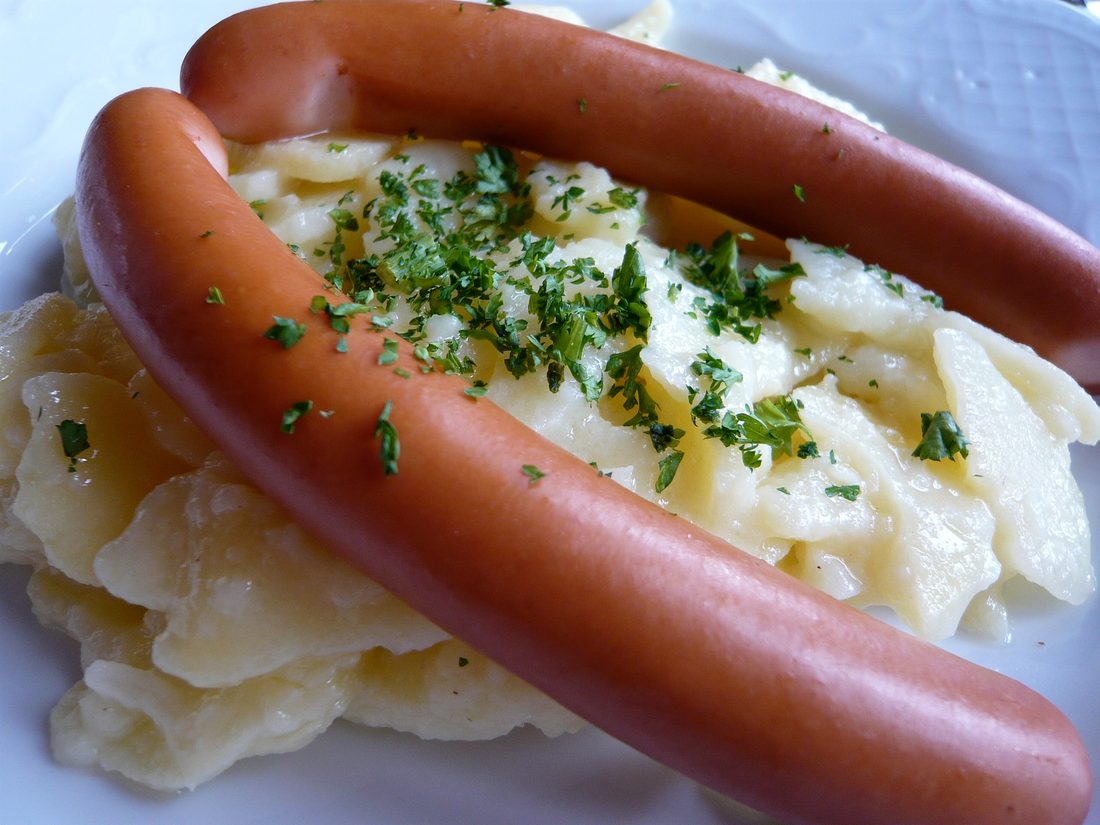
Then comes the trick I think is genuinely clever, the one that gave us the word skinless. You’d think a “skinless” hot dog was extruded naked, but it wasn’t — not at first. The emulsion is stuffed into a long cellulose casing, a tube made from processed plant fiber, and the links are cooked and smoked inside it until the surface proteins set into a firm skin of their own. Then a machine runs down the line, slits the cellulose, and peels it off — leaving a self-supporting cylinder of cooked emulsion with a “skin” that’s really just its own set surface. The casing did its job holding the shape while the meat cooked, and then it was thrown away. A skinless frank is a sausage that wore a casing long enough to learn how to stand up, and then took it off.
Sit with what that whole system represents, because it’s the hinge of this page. The bowl chopper erases the grain. The cellulose casing erases the gut. What comes out the other end is not a link — a thing a person made, with a particular animal’s particular fat in a particular gut — it’s a product, identical to the ten thousand before it and the ten thousand after, made by machines from a batter designed by food scientists to hit a spec. The sausage stopped being a craft object and became a manufactured one. Not worse, necessarily. But different in kind, and the difference is the thing this whole program is about.
What the factory actually changed
So let me put the trade in one place, plainly, gains and losses side by side, because the honest version is neither “industrial food is poison” nor “industrial food is fine.” It’s a bargain, and you should be able to see both sides of it.
| Before the factory | After the factory | |
|---|---|---|
| Consistency | Every batch different — the butcher’s hand, the day’s meat | Every frank identical, coast to coast, year-round |
| Cost | A skilled trade, seasonal, tied to slaughter | Pennies — trim, water, starch, mechanically separated meat |
| Safety | Trust your butcher and your nose | Federal inspection, verified, since 1906 |
| Supply | Whatever the season and the region gave | Any sausage, any month, anywhere |
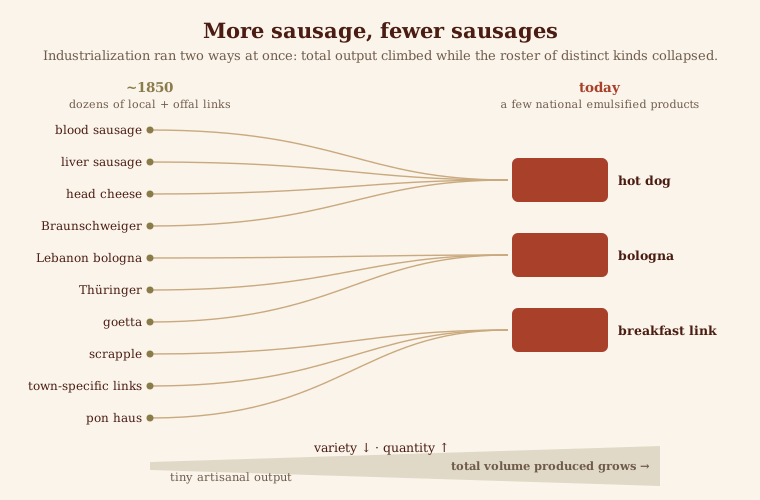
| Variety | A thousand local links — blood, liver, head, offal, town by town | A handful of national products |
Look at that last row, because it’s the one that costs us, and it’s the one nobody put on a ballot. The gains — consistency, cheapness, safety, year-round supply — are real and I won’t pretend otherwise; my own kids grew up eating supermarket hot dogs and they’re fine. But the loss is the entire subject of this history. The blood sausages, the liver sausages, the head cheeses, the town-specific link that only one butcher in one valley made — the whole wild branching tree I’ve spent twenty-five pages drawing — got squeezed out. Not banned, not lost to a plague, just quietly out-competed by a few national emulsified products that were cheaper and more consistent and available in July. America, more than almost any country, gave up the offal branch: the blood and the liver and the head, the parts that spoil first and taste most of a place. We traded them for a clean pink cylinder that tastes of nothing in particular and never, ever varies.
That branch we gave up gets its own treatment on blood and offal, and it’s worth reading right after this, because it’s the clearest single measure of what the factory cost. The industrial sausage didn’t ruin the sausage. It did something quieter and, to me, sadder — it flattened it. It took a landscape and made it a parking lot: perfectly serviceable, extremely efficient, and identical everywhere, which is exactly the thing a landscape is not supposed to be.
What’s actually in a hot dog: the folklore versus the label
And now we arrive at the modern anxiety, the “do you know what’s in a hot dog” conversation that everyone has had, and I want to handle it carefully, because it’s a place where people are right to be uneasy and almost entirely wrong about why. The disgust is aimed at the wrong facts. Let me sort the folklore from what’s actually on the label, because the truth is duller and more reassuring than the myth — and getting duped by the myth means you never see the real trade, which is the flavor-and-variety one above, not a horror-movie one.
“There’s pink slime in your hot dogs.” This is the big one, and it’s a category error. “Pink slime” is the nickname — coined in a 2002 internal USDA email, blown up by reporting in 2009 and television coverage in 2012 — for a product called Lean Finely Textured Beef (LFTB). LFTB is made by taking beef trimmings, warming them, spinning them in a centrifuge to separate the last lean meat from the fat, and treating the result with a puff of ammonium hydroxide gas to knock down E. coli. Here’s the thing: it goes into ground beef — your hamburger, up to about 15 percent — not into hot dogs. It’s a beef product for ground beef. When people say “pink slime hot dogs,” they’ve welded together two different anxieties into one that doesn’t exist. The paste in a hot dog is a different thing made by a different process, which brings us to:
Mechanically Separated Meat (MSM) — this is the real one, the paste that actually does go into some hot dogs, and it’s worth understanding precisely instead of recoiling from vaguely. MSM is made by forcing bones with the meat still attached under high pressure through a sieve, recovering the last bits of edible tissue as a paste. It’s a bone-recovery process (LFTB is a trim process; sieve versus centrifuge; bone versus trim — genuinely different things). And it is regulated, tightly. USDA rules say a hot dog must contain not less than 15 percent skeletal muscle; mechanically separated pork is capped at 20 percent of the product; and mechanically separated beef has been banned from human food entirely since 2004, as a precaution against BSE. So the paste is real, it’s in there, and it exists inside a fence of federal limits — not the free-for-all the folklore imagines.
“Hot dogs are made of lips and assholes.” You’ve heard it. It comes from pop culture, not from law — the line is Dan Aykroyd’s in the 1988 movie The Great Outdoors (“Lips and assholes!”), amplified by a viral “How It’s Made” clip decades later. It is a joke that hardened into a belief, exactly like the myths I cleared off the origins page at the very start of this history. And it’s false on the facts: a U.S. hot dog cannot be lips and sphincters, because it must be at least 15 percent raw skeletal muscle, and any organ byproducts that are used — heart, kidney, liver — must be named on the label (“with variety meats” or “with byproducts”). Snouts, lips, and sphincters aren’t on the allowed byproduct list at all. The honest ingredient list of a standard hot dog is: trim, fat, water, some MSM, curing salt, and spice. Not glamorous. Not offal-horror either. Just a cheap, regulated, emulsified sausage.
Here’s why I bother correcting all of this instead of just letting people be grossed out. The folklore — pink slime, lips and assholes — lets you feel like you understand the industrial sausage while completely missing what’s actually wrong with it. Nothing in a hot dog will hurt you. It’s inspected, it’s limited, it’s safe; that’s the 1906 law working exactly as designed. The real cost of the industrial sausage isn’t a disgusting secret ingredient. It’s the thing on the variety row of that table — a whole world of local, offal-rich, particular sausages traded for a clean uniform tube. People sense that something was lost and aim their disgust at a myth, when the truth is quieter and more damning: nothing hidden is in your hot dog. That’s the problem. There’s nothing much in it at all.
Which is exactly why I still make my own
So here we are, at the end of the history, and I can finally say the thing this whole section has been walking toward.
The factory won. Let me be completely clear-eyed about that. If your metric is safe, cheap, consistent, and available in July, the industrial sausage beats mine on every count and it isn’t close. I cannot make a hot dog for what a hot dog costs. I cannot guarantee, the way a federal inspector can, that every link off my smoker is identical to the last. A machine in Chicago does the mechanical part of my craft ten thousand times faster than I do, and the result is perfectly safe to eat. If sausage were only a delivery system for cheap safe protein, there would be no reason on earth to stand at a bench and make it by hand, and this program would not exist.
But that’s the whole point of everything you’ve just read. Sausage was never only a delivery system for cheap safe protein. It was Homer reaching for a blood paunch to describe a restless mind. It was a Roman word that seeded half of Europe’s kitchens. It was thirty Polish varieties under one noun, and a kosher tradition inventing whole new sausages out of a prohibition, and an immigrant in a West Virginia coal town wrapping pepperoni in bread because it kept without a cold room, and a hunter adding pork fat back to a lean deer, and a Korean town turning a can of Army Spam into something it now eats for pleasure. Every one of those is a particular answer by particular people to the universal problem — and every one of them is exactly the thing the factory flattened. The industrial sausage is what you get when you optimize sausage for cost and safety and forget it was ever about a place.
When I stand at my bench and grind a nearly-frozen pork butt through the coarse plate, and pack it into a hog casing, and stage it up through the smoke the way I spent years reverse-engineering from the memory of my grandfather’s kielbasa — I am not making a better hot dog than the factory. I’m making a different kind of thing than the factory can make at all. I’m making the local sausage. The particular one. The one with my hand in it and one specific animal’s fat and a spice bill I chose and a smoke I tended, the one that will never be identical to the last batch because I am not a bowl chopper and I don’t want to be. Forty years of that is its own kind of history — my own forty years of it — and it’s the direct descendant of everything in these twenty-five pages and the direct refusal of this last one.
That’s the case, and it’s the case the rest of this program is built to teach. The factory made the safe, cheap, uniform sausage so you don’t have to. What it can’t make is yours.
This is the last page of the sausage history — both the old world and the wider world of it, from Homer’s blood paunch to the Chicago disassembly line. The history ends where the making begins. From here the program turns from where sausage came from to how you make it: the equipment that grinds and stuffs it, the ingredients and cures that preserve and flavor it, the making itself, and the curing that carries a fresh link into a shelf-stable one — the same hurdles the first herder solved by feel, done now on purpose. The frank that Chicago industrialized traces back to Germany; the variety the factory flattened lives on in blood and offal; the whole shape of the family is on the family tree; and my own hand-built links are in the collection — search hot dog, frankfurter, bologna, and summer sausage. Start where you like; it all comes back to the hub.
Comments (0)