Mexico: Chorizo Is Two Different Foods Wearing One Name
I’ll open this one the way I opened Poland — with the personal part, because it’s why the page exists. When I was in Mexico I ate chorizo constantly. Not as a novelty; as a default. It went into everything, at every hour: scrambled with eggs in the morning, crumbled over melted cheese, tucked into a taco with a little potato, cooked down until the fat ran orange and pooled in the pan. I got used to it the way you get used to a thing that’s just around. And then I came home to Michigan, went looking for it, and couldn’t find it. Not the real thing.
That gap is the reason I make my own. It isn’t a hobbyist’s flourish — it’s the only way I get the chorizo I actually want, because the chorizo I want is a category of food that mostly doesn’t survive the trip to an American grocery shelf. Understanding why it doesn’t survive is the whole content of this page, and it turns on a correction that food writing gets wrong more often than it gets it right.
Mexican chorizo and Spanish chorizo are not two versions of one sausage. They are two different foods that happen to share a name.
That sentence is on my personal must-not-get-wrong list, and I want to earn it slowly, because it’s the kind of thing everybody nods along to and then immediately forgets the moment they’re standing at a deli counter.
The one correction the whole page turns on
Here’s the split, stated as bluntly as I can make it.
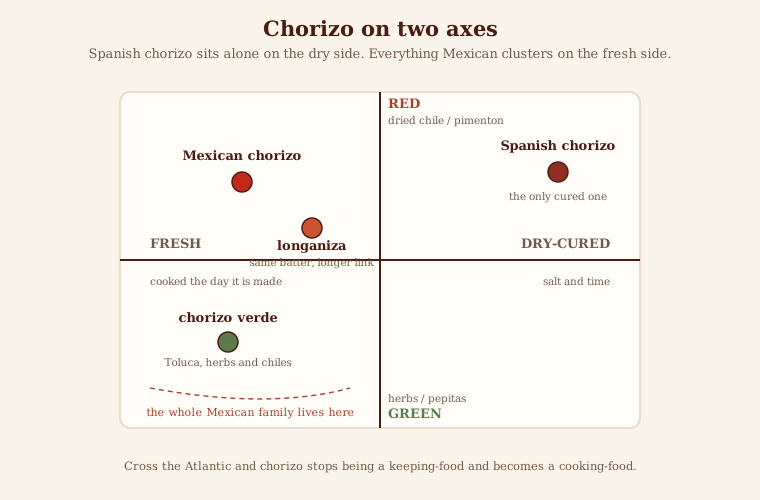
Spanish chorizo is dry-cured and sliced. It’s fermented and air-dried the way a salami is. It comes out firm, sometimes hard, with a clean cut face. You slice it thin and eat it as it is — no pan, no heat required. Its deep brick-red color and its smoky-sweet flavor come from pimentón, Spanish smoked paprika, which is a ground dried pepper, not a fresh chile. It’s cured charcuterie. It’s shelf-stable. It’s a keeping food, built to last.
Mexican chorizo is fresh and bulk. It’s a soft, raw, ground sausage — often sold loose, or in a casing you’re meant to strip off and throw away. You squeeze the meat out, crumble it into a hot pan, and cook it, because it is raw pork and must be cooked before you eat it. Its character comes from dried chiles — ancho, guajillo, pasilla — plus vinegar, garlic, cumin, and oregano, which give it that tangy, bold, genuinely spicy punch. It’s ground sausage-meat. It spoils like ground sausage-meat. It is not built to last at all.
Put those side by side and you see they don’t sit on a spectrum. One is a preservation format; the other is a fresh grind. One you slice; the other you crumble. One is ready to eat cold; the other will make you sick if you eat it that way. They are as different as prosciutto is from a raw breakfast link — and nobody would call those two versions of the same thing just because they’re both pork.
The reason they share a name is history, not similarity. When Spanish speakers brought chorizo — the word and the idea of a paprika-spiced pork sausage — across the Atlantic, the thing that grew up in Mexico kept the name and changed nearly everything else about itself. Same word, new food. It’s the exact trap the Poland page walks through with “kielbasa,” except here it’s worse, because both objects genuinely exist, both are genuinely called chorizo, and they’re sold three feet apart in the same store.
The comparison, laid out flat
If you take nothing else from this page, take this table. It’s the thing I wish somebody had handed me the first time I stood in an American supermarket trying to figure out why the chorizo in my hand wasn’t the chorizo in my memory.
| Spanish chorizo | Mexican chorizo | |
|---|---|---|
| Category of food | Dry-cured charcuterie | Fresh ground sausage |
| State when you buy it | Firm to hard, fully cured | Soft, raw, often loose or squeezable |
| Do you cook it? | No — ready to eat as-is | Yes — must be cooked before eating |
| How you serve it | Sliced thin | Crumbled into a hot pan |
| Where the color/flavor comes from | Pimentón (smoked paprika — a dried, ground pepper) | Dried chiles (ancho, guajillo, pasilla) + vinegar, garlic, cumin, oregano |
| Fermented / aged? | Yes — fermented and air-dried like salami | No — made and cooked fresh |
| Shelf life | Long; shelf-stable | Short; refrigerate and use, like any raw grind |
| Texture on the plate | Sliceable, holds its shape | Loose curds and rendered orange fat |
| What it’s kin to | A salami | A raw sausage forcemeat |
Notice that almost every row disagrees. That’s the point. If this were one sausage with a regional accent, most of the rows would match and one or two would differ. Instead you’ve got two products that overlap on the word “chorizo,” the animal (pork), and the presence of red pepper — and diverge on literally everything that determines how you store it, handle it, and eat it. That’s not a variant. That’s two categories.
Why I can’t just buy it — the split is the answer
Here’s where the correction stops being trivia and starts being the reason there’s flour on my hands most weekends.
A dry-cured Spanish chorizo is engineered to travel. That’s what curing is for. You can put it in a box, send it across an ocean, leave it on a shelf for weeks, and it arrives intact — that’s the entire evolutionary purpose of drying a sausage. So the chorizo that shows up reliably in American stores is very often the Spanish kind, or something styled after it, precisely because it’s the kind that survives a supply chain.
The fresh Mexican kind is the opposite animal. It’s raw ground pork. It has the shelf life of raw ground pork. It doesn’t ship well, it doesn’t keep, and it can’t sit in a display case for a week — so what fills that gap on the American shelf is, too often, a soft plastic tube of low-grade “chorizo” that’s more emulsified filler and food coloring than the loose, chile-forward, properly-spiced grind I ate in Mexico. The good stuff — real dried chiles, a real grind, real vinegar tang — doesn’t scale into a national cold chain the way a cured stick does.
So the categorical split I spent the last section drawing is not an academic distinction. It’s the direct, mechanical reason I can’t buy what I want. The very thing that makes real Mexican chorizo good — that it’s fresh — is the thing that keeps it off my shelf. And the fix for a fresh sausage you can’t buy is the oldest fix there is: you make it fresh, yourself, the day you want it. That’s not me being a purist. That’s me responding to a distribution problem with the one tool that actually solves it, which is a grinder and an afternoon. If you want to skip to the doing, my Mexican chorizo recipe is in the collection, and it exists for exactly this reason.
The pig came on a ship, and it landed in Toluca
Now step back, because Mexican chorizo is a perfect little case study in the thing this whole Wider World section is about — the way 1492 rewrote the food map of two hemispheres at once. I lay the mechanism out in full on the Columbian Exchange page, so I won’t repeat it all here, but the short version is essential to understanding chorizo, so here’s the piece that matters:
There was no pig in the Americas before the Spanish brought one. Not one domestic pig on either continent. The peccary — the pig-like animal native to the Americas — is a different family of animal entirely and was never domesticated, so it isn’t the ancestor of anything. Every pork sausage in the New World, chorizo included, descends from pigs that crossed the Atlantic by ship. Meanwhile the chile — the defining spice of Mexican chorizo — was already here, native to the Americas, one of the oldest crops in the hemisphere.
So Mexican chorizo is a genuinely post-1492 invention, assembled from both directions of the exchange: a Spanish sausage technique, married to a pig that arrived from across the ocean, seasoned with a chile that was under everyone’s feet the whole time. Neither the animal nor the method is ancient in the Americas; the dried-chile base is the local half of the marriage. The sausage literally could not have existed before the two hemispheres collided.
And you can pin it to a place and nearly to a year. Hernán Cortés brought his own pigs, cattle, and sheep to the Valle de Toluca by about 1525 — his personal livestock, driven up into the high valley west of what’s now Mexico City. Pigs, of everything the Spanish carried, adapted and bred fastest in the New World, and by the end of the 1500s Toluca had become the chorizo capital of Mexico — and the capital of longaniza, chicharrón, and blood sausage besides. There’s a clean, datable line running from Cortés’s herd to a specific sausage town, and Toluca is still the name you’ll hear when Mexicans talk about where the country’s best chorizo comes from. When I say the abstract story of the Columbian Exchange becomes dinner in Mexico, this is what I mean: it becomes a real town with a real reputation for a real sausage, and it started with one man’s pigs in one high valley around 1525.
Longaniza, and the honest mess of telling it apart
Right next to chorizo on that same Toluca reputation sits longaniza, and this is the part where I have to be honest with you instead of tidy, because the tidy version would be a lie.
You’ll read, confidently, that longaniza is the longer, thinner one — made in long continuous links rather than short twisted ones — and often differently spiced than chorizo. That much is a fair general tendency: longaniza really does trend longer and more linked, and it’s frequently seasoned to a different profile. But the moment anyone tells you exactly how the two differ, the sources start contradicting each other, and I’m not going to pretend they don’t.
Here’s the actual state of it:
- Some sources say longaniza is milder and sweeter, with chorizo the spicier of the two.
- Mexico-specific sources say the opposite — that Mexican longaniza is hotter than chorizo.
- Another common line says chorizo is strictly pork while longaniza can be any meat, and that longaniza leans on black pepper where chorizo leans on paprika and chile — but even that flips depending on which state you’re standing in.
- And the picture only gets more scrambled once you leave Mexico. In Argentina and Spain, longaniza is anise-scented, mild, and sweet. In the Philippines, longganisa is often garlicky and sweet. In Mexico, it trends spicier. Same word, three different sausages.
So what’s the rule? There isn’t one. The only honest statement I can make is that the longaniza-versus-chorizo line is drawn regionally, not universally — it genuinely means different things in different places, and anybody who hands you a single crisp “longaniza is X, chorizo is Y” rule is flattening a real disagreement into a false certainty. The most defensible Mexico-specific thing I’ll commit to is this: in Mexico, both are fresh ground pork sausages, longaniza is usually the longer, uncased-or-long-linked form, it’s often (not always) the spicier of the two, and the boundary between the two blurs from state to state. That’s it. Where the sources fight, I’d rather show you the fight than pick a winner and pretend the argument’s settled — same principle I apply to the kiełbasa etymology, where the pretty answer and the true answer aren’t the same thing.
Chorizo verde: the green one, and it’s younger than you’d guess
Toluca has one more thing worth a section of its own, because it’s a real standout and it comes with a good correction attached: chorizo verde, green chorizo.
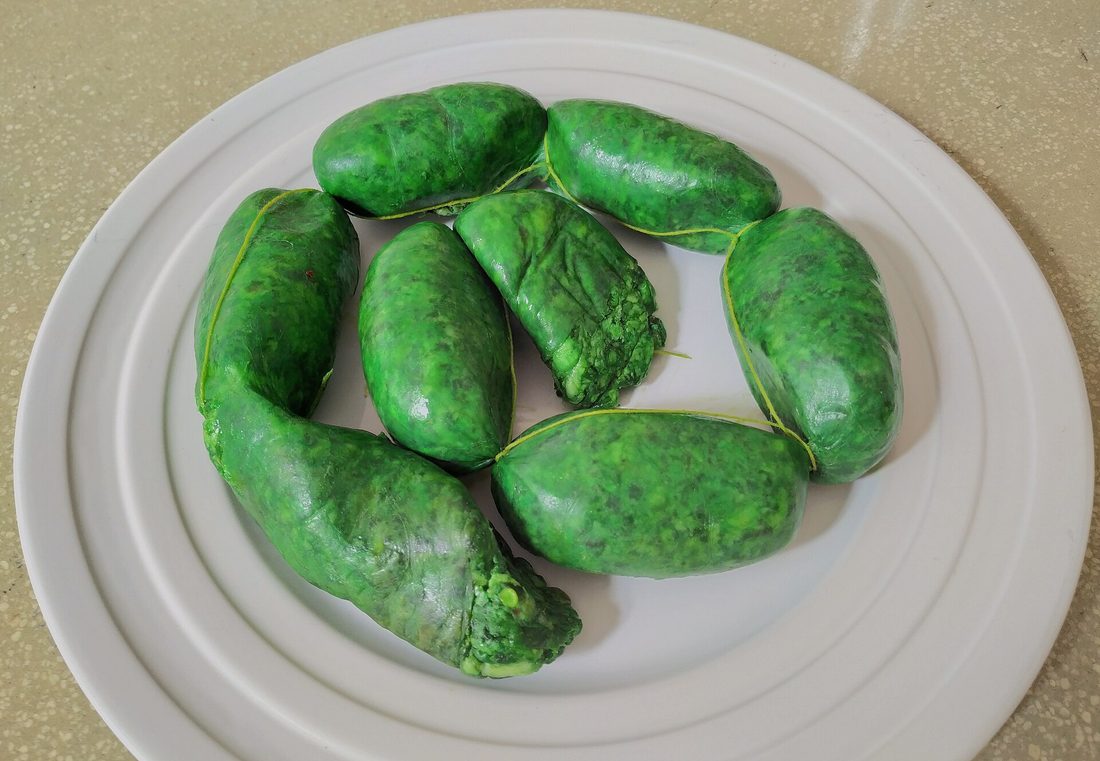
It’s green because it’s built on a fresh, mole-like paste of green things instead of the usual red dried-chile base — tomatillo, cilantro, parsley (sometimes spinach), fresh green chiles like serrano or jalapeño, toasted pumpkin seeds, and warm spices. Swap the whole red foundation of ordinary chorizo for that emerald purée and you get a sausage that fries up a startling, genuinely appetizing green, with a bright, herbaceous, nutty flavor that’s nothing like the red version. It’s native to the state of México, centered on Toluca, and it’s more or less unique to that region. When people who know Mexican sausage get enthusiastic, chorizo verde is often what they’re getting enthusiastic about.
Here’s the correction, and it’s a satisfying one: chorizo verde is not ancient. It reads like the kind of thing that ought to be some pre-Hispanic emerald tradition passed down through the centuries — the pumpkin seeds practically beg you to assume it — but it isn’t. By the best accounts it’s a 1960s–70s invention, created in small towns of the Valle de Toluca within living memory. There’s a plausible but softly-sourced story that it came about as a response to the rising price of pimentón and dried chiles — swap the expensive red base for cheap local green herbs — which I’ll flag as the likely-but-not-certain motive it is. But the two facts that hold up firmly are that it’s recent and it’s Toluca’s own. So the “traditional emerald sausage of Mexico” is really a living, twentieth-century regional innovation. I like that better than the folklore version, honestly. It means somebody, within the lifetime of people still cooking today, looked at the red sausage and reinvented it green — which is exactly the kind of thing that’s still happening to sausage everywhere, all the time.
Where the word comes from — which is to say, nobody’s certain
One more thread, and I’ll handle it the way I handle every etymology in this section: honestly, which means without a tidy bow.
The popular story is that chorizo comes down through Spanish from Medieval Latin salsicia, “sausage,” from Latin salsicus, “seasoned with salt,” ultimately from the ancient root for salt — the same salt-word that seeds “sauce,” “salami,” and half the vocabulary of preserved meat. It’s a clean, attractive derivation, and you’ll see it stated as fact all over the place.
But the honest state of the scholarship is unsettled. Trace it carefully and the Portuguese chouriço and Galician chourizo go back to an Old Galician-Portuguese form that the etymologists themselves label “of uncertain origin.” The salt-Latin chain is plausible — it may well be right — but it isn’t proven, and some etymologists reject the direct route. So I’ll give you the salt story as the leading guess, not the settled fact, and note plainly that the trail goes cold before it reaches a confident answer. What I won’t do is repeat the folk claims that chorizo comes from some exotic Greek root, or that the word “means red” — neither is supported, and both are the kind of confident nonsense that fills the vacuum where a real answer should be. A history that launders guesses into facts isn’t worth your time, and the true answer here is simply: we don’t know for sure, and I’d rather say so.
Back to the pan
So that’s the map I wish I’d had. Mexican chorizo isn’t a spicier Spanish chorizo — it’s a different category of food entirely, fresh where the other is cured, crumbled where the other is sliced, and that categorical difference is the exact reason the good version is so hard to buy in the States: fresh sausage doesn’t ship, so what reaches the shelf is either the cured Spanish type or a sad plastic tube. Its family sits mostly around Toluca, on pigs that Cortés drove up into the valley around 1525 and chiles that were already growing there — the Columbian Exchange turned into dinner. Its sibling, longaniza, refuses to be pinned down by any single rule, and I’ve told you that instead of faking one. And its most spectacular member, the green chorizo, is a twentieth-century invention wearing an ancient-looking coat.
For me all of it points back to the same place: the grinder. I ate this sausage every day in a country where it’s fresh and everywhere, I came home to a country where the fresh version barely exists, and the only real answer was to learn to make it. If you’re in the same boat — and if you’ve ever bought American “chorizo” and wondered why it wasn’t what you remembered, you probably are — the fix is the same one people have used since before there were refrigerators or supply chains: make the fresh thing fresh, the day you want it. My chorizo is the red, dried-chile, crumble-in-the-pan kind, because that’s the one I miss.
Part of the wider-world history of sausage. The pig that made every American pork sausage possible, and the chile that flavors this one, both crossed the ocean on the Columbian Exchange — start there. For the dry-cured original that lent Mexican chorizo only its name, see Spain and Portugal. The rest of the New World gets its own pages: South America, the Caribbean, and Cajun and Creole Louisiana. The whole family, and how these histories connect, is on the family tree.
Comments (0)