South America: The Third Chorizo, and the Fire That Cures It
This is the page where the joke finally lands. I’ve spent two pages now on a single word — chorizo — insisting that it names two completely different foods. On the Spain and Portugal page it was a dry-cured red stick you slice and eat cold, defined so hard by pimentón that a version without the paprika gets a different name. On the Mexico page it was a fresh, raw, crumble-in-the-pan grind bound by dried chiles and vinegar, a thing that spoils like the ground pork it is. Two foods, one word, and I made a whole page out of how nobody should ever confuse them.
And then you get to Argentina, and there’s a third one.
That’s not a figure of speech. Argentine chorizo — chorizo criollo — is a genuinely distinct third sausage, and it is not a variant of either of the other two. It isn’t the Spanish dry-cured kind. It isn’t the Mexican fresh-crumbled kind. It’s a coarse, fresh, whole grilling sausage that you cook over live coals and eat hot off the fire in a split roll. Same five-hundred-year-old word, third completely different object — a food a Spaniard slicing his cured chorizo and a Mexican crumbling his fresh one would both look at and not recognize.
Understanding why comes down to one substitution. Everywhere else in this history, the thing that makes a sausage keep — that lets it hang in a larder or ship across an ocean — is the cure: salt, time, drying, sometimes smoke, sometimes pimentón doing antioxidant work. In South America the sausage threw the cure out and put the fire in its place. Down here the sausage isn’t preserved to be eaten later; it’s grilled to be eaten now, and the grill does the flavor work that curing does everywhere else. The cure keeps a sausage; the coals transform one. Iberia’s genius was preservation. The Southern Cone kept the meats and kept the words and rebuilt the entire idea around fresh meat cooked immediately over wood. Same ancestry, inverted technique.
The three chorizos, laid flat
Let me put the payoff on the table before I earn it, because this table is the spine of the page and honestly the spine of the whole section. If you only take one thing from these three pages, take this: there is no single food called “chorizo.” There are three, and which one someone means depends entirely on which country’s kitchen they learned the word in.
| Spanish chorizo | Mexican chorizo | Argentine chorizo (chorizo criollo) | |
|---|---|---|---|
| What it is | Dry-cured charcuterie | Fresh ground sausage | Fresh grilling sausage |
| Form | Firm, sliceable stick | Soft, loose, often uncased | Coarse link in natural casing, grilled whole |
| Cured? | Yes — fermented, air-dried like salami | No — raw grind, cooked the day you make it | No — raw, but grilled fresh, never cured |
| The defining seasoning | Pimentón (smoked or sweet paprika) | Dried chiles + vinegar, garlic, cumin, oregano | Garlic, salt, pepper — no pimentón, not chile-hot |
| The meat | Pork | Pork | Pork + beef (cattle country leaves its mark) |
| How you eat it | Sliced thin, cold, as-is | Crumbled into a hot pan and cooked | Grilled over coals, split, served as choripán |
| Where the flavor comes from | The cure and the paprika | The chiles and the vinegar | The wood coals — the “smoke” is the fire, not curing |
| Nearest relative | A salami | A raw sausage forcemeat | A fresh Italian salsiccia |
Look down the rows and almost every single one disagrees across the three columns. That’s the entire point. If these were three accents of one sausage, most rows would match and one or two would differ. Instead you’ve got three products that share the word “chorizo,” the animal pork (though the Argentine adds beef), and the general fact of being a pork sausage — and they diverge on cure, form, seasoning, and how you physically get the thing into your mouth. That is not a spectrum. That is three categories flying one flag.
And notice the bottom row, because it’s the tell for this page: the nearest relative of the Argentine chorizo is not the Spanish chorizo it’s named after. It’s the fresh Italian sausage. Which is a clue, and I’ll come back to it, because the reason has a lot to do with who actually settled Argentina.
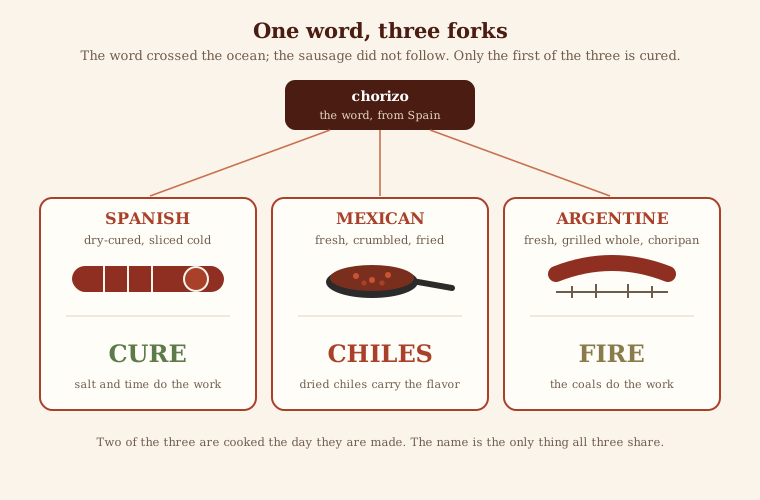
The correction at the center: it’s the wood, not the cure
Here’s the mistake I want to correct head-on, because it’s the one everybody makes, and I’ve heard it from people who cook well.
You bite into an Argentine chorizo off a proper parrilla, and it tastes faintly smoky, a little deep, a little woodsy under the garlic and the pork and the beef. And the natural thing to conclude — because you know the Spanish chorizo and you half-remember it’s “smoked” — is that this sausage is smoked or cured too, that the smokiness is in the sausage the way it’s in a Spanish chorizo made with La Vera pimentón.
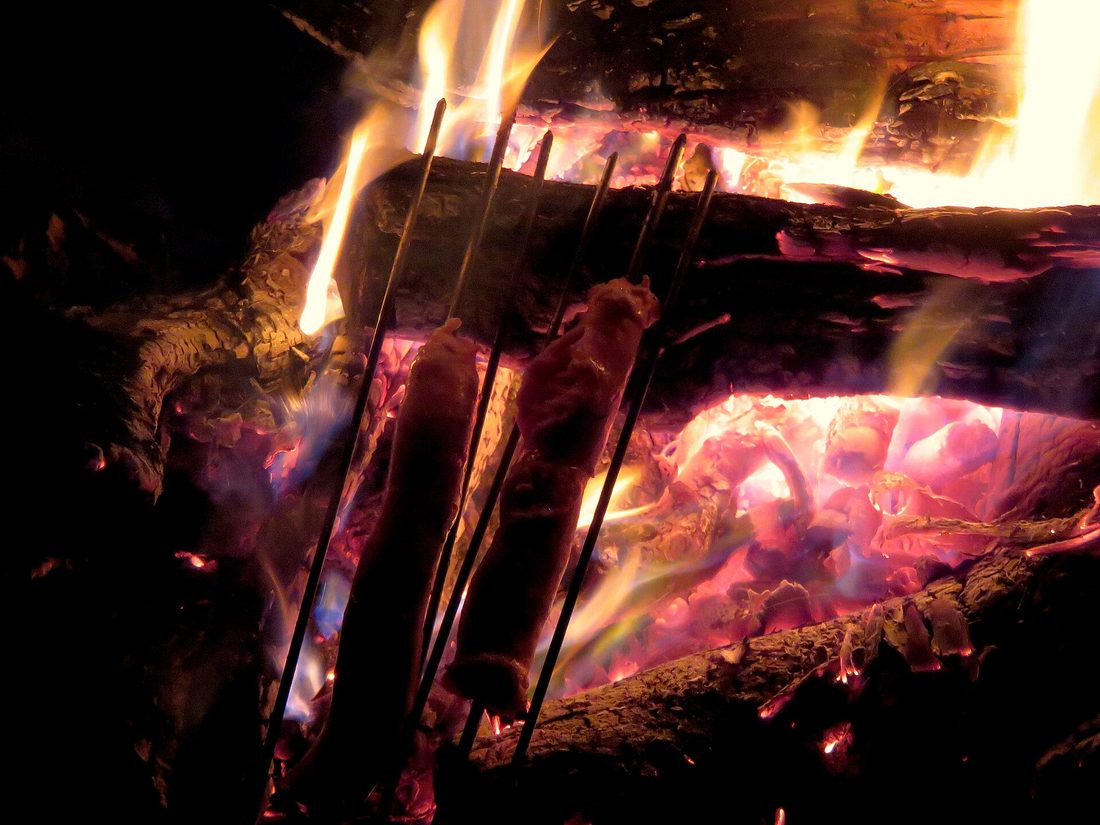
It isn’t. The Argentine chorizo is not smoked and not cured. The smoky taste is coming from the wood coals it’s grilling over, and from nothing else. There’s no pimentón in it doing what pimentón does in Spain — no smoked paprika riding a campfire flavor in on the spice. There’s no smokehouse in its past. It’s a raw fresh sausage, seasoned mostly with garlic, salt, and pepper, that you throw onto a grate over burning wood or hardwood charcoal, and the fire seasons it as it cooks. Pull that same sausage off the grill and pan-fry it instead and the smokiness largely vanishes, because it was never in the meat — it was in the smoke the meat sat in for fifteen minutes.
That’s the whole difference between this sausage and its cured cousins, in one sensory fact. A Spanish chorizo carries its flavor with it, sealed in by weeks of curing; you could eat it in a submarine. An Argentine chorizo has no flavor to carry until the moment of the fire, and then the fire gives it everything. One is a keeping food that happens to be delicious; the other keeps about as long as raw pork keeps, which is to say not long, because keeping was never the point. The coals are doing the job the cure does elsewhere — not preserving the meat, but transforming it — and that reframing is the single most useful thing on this page. Down here, fire is the technique.
What’s actually in it — pork, beef, and the Italian fingerprint
So if it isn’t pimentón and it isn’t chile heat, what is an Argentine chorizo?
Coarse-ground pork and beef, in a natural hog casing, seasoned simply — garlic, salt, black pepper, and depending on the maker a little paprika (for color, at a level nowhere near the Spanish dose), maybe wine or vinegar, sometimes a whisper of clove or nutmeg. That’s roughly it. It’s a plain, honest, garlicky fresh sausage, and its plainness is deliberate, because the grill is going to do the heavy lifting.
Two things in that description matter more than they look.
First, the beef. A Spanish or Mexican chorizo is pork, full stop. The Argentine one puts beef in the mix — commonly something on the order of a third beef, the rest pork, though every maker has a ratio and the sources describe it as “about a third,” not a fixed law, so I won’t hand you a number to trust to the gram. But the presence of beef is the signature, and it’s not an accident. Argentina is cattle country — one of the great beef nations on earth — so of course beef found its way into the national sausage. The land wrote itself into the recipe. That alone puts a wall between this sausage and the Spanish chorizo it’s named for: you cannot call something “the fresh version of Spanish chorizo” when it isn’t even all pork.
Second, that “nearest relative” line from the table. Because this sausage is pale-ish, coarse, garlicky, fresh, and grill-bound rather than red, cured, and paprika-driven, the food writers who describe it reach not for the Spanish chorizo as the comparison but for the fresh Italian sausage — the salsiccia. And that comparison is doing more work than a casual analogy. It’s a fingerprint. Argentina and Uruguay took in one of the largest Italian migrations anywhere in the world; whole swaths of Buenos Aires speech, food, and habit are Italian under a Spanish surface. So when the local chorizo comes out tasting and eating like a coarse Italian grilling sausage rather than like anything in Spain, that’s not a coincidence to shrug at — that’s the Italian community’s hand on the Spanish word. The word came from Spain. The sausage it now names was substantially built by Italians grilling over wood in the New World. (If you want the parent, the Italy page is where the fresh salsiccia and the whole grill-it-fresh Italian temperament come from.) I keep a couple of coarse fresh Italian-style sausages in my own collection and honestly the chorizo criollo lives right next to them in spirit, far closer than it lives to the dry Spanish stick.
One more correction while I’m here, because it’s the cleanest single sentence I can give you: calling Argentine chorizo “the fresh version of Spanish chorizo” is wrong twice over. It isn’t a version of Spanish chorizo (no pimentón, and there’s beef in it), and Spanish chorizo isn’t the fresh one to begin with — the Spanish one is the cured one. So the phrase manages to misdescribe both sausages in five words. The honest statement is the one the table makes: three separate sausages, one shared name.
Choripán: the sausage exists to be grilled
You can’t really understand the chorizo criollo without understanding what it’s for, and what it’s for is choripán.
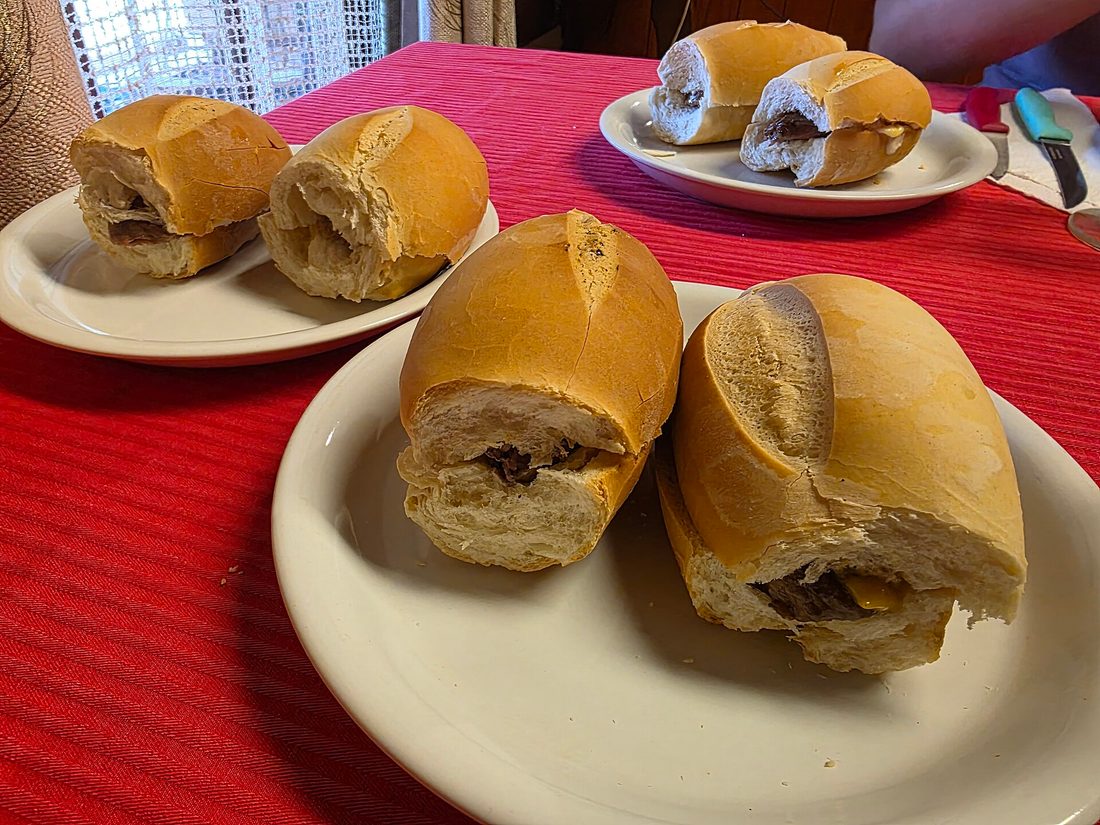
The word is exactly what it looks like: chorizo + pan, sausage plus bread. You grill the chorizo criollo whole over the coals, split it lengthwise — the classic cut is the mariposa, “butterfly,” where you slice it nearly through and open it flat so more surface hits the grate and crisps — lay it in a crusty split roll, and spoon chimichurri over it, that bright, sharp, garlic-and-parsley-and-vinegar-and-oregano sauce that is the other half of Argentine grilling. That’s choripán. It’s street food, stadium food, the thing sizzling on a cart outside the game and the first thing off the grill at a backyard cookout. It’s eaten across Argentina, Uruguay, and Chile, anywhere the fire and the roll and the sausage come together.
And here’s why it matters for the argument of this page: the sausage was designed for this. The whole point of leaving it fresh and uncured is so it can be grilled and eaten immediately, hot, its fat rendering into the crumb of the bread. A cured Spanish chorizo would be all wrong in a choripán — it’s already cooked, in a sense, already firm, made to be sliced cold, not griddled soft and juicy. The chorizo criollo is fresh precisely so that the fire has something to do. The design of the sausage and the way it’s eaten are the same decision. You don’t cure it, because you’re going to grill it; you grill it, because you didn’t cure it. The choripán isn’t a way of serving a sausage that happens to exist. The sausage exists to become a choripán. If you want to build the sauce that makes it, the chimichurri in my collection is the standard bright, raw, garlicky Argentine version, and it’s worth making for the choripán alone.
The asado: the grill is the context for everything
Step back from the single sausage and you find the thing that explains all of it: the asado.
The asado is the Argentine (and Uruguayan) live-fire barbecue, and calling it “barbecue” undersells it — it’s a whole social institution, a Sunday, a way people gather, cooked on the parrilla, the grill grate set over a bed of wood or hardwood coals. It is not a quick thing. Someone tends a wood fire down to embers, rakes the coals under the grate, and cooks slowly, unhurried, over hours, working through cut after cut. And the sausages are how it starts. The traditional running order — and I’ll flag this as custom rather than codified law, because it’s described everywhere as tradition, not rule — opens with the chorizos and the morcilla off the grill first, as the entrada, the opening bite while everyone’s gathering and the beef is still cooking; then the offal, the achuras — sweetbreads, chitterlings; and then, as the main event, the great beef cuts Argentina is famous for.
This is the context that makes the fresh sausage make sense. In a culture built entirely around cooking meat fresh over live coals for a crowd, of course the sausage is a fresh, grill-it-now sausage. The asado is why the Southern Cone rebuilt the sausage around fire instead of cure: the fire was already the center of everything, so the sausage moved to the center of the fire. Preservation solves the problem of eating meat when you can’t cook it now. The asado is a culture that always cooks it now.
Morcilla on the coals: Spain’s oldest sausage meets New-World fire
Right alongside the chorizos on that opening round of the parrilla sits morcilla, and it’s worth a section because it shows the same fire-not-cure story from a completely different angle.
Morcilla is blood sausage — pig’s blood and pork fat, often bound with rice or another grain, with onion and spices — and it comes straight down from the Spanish morcilla and Portuguese morcela the settlers carried over. I spend real time on the Spanish original over on the Spain page — the meatless, onion-and-rice Morcilla de Burgos especially — so I won’t re-run that here. What matters for South America is what happened to it when it got there: it went on the grill.
In Argentina and Uruguay the blood sausage is sold and eaten as morcilla parrillera — literally “grilling morcilla” — cooked right on the coals next to the chorizos. And that’s a genuinely new move. Blood sausage is one of the oldest and most conservative foods there is, a preservation-and-thrift sausage that runs back through this whole history to Homer’s stomach roasted on the coals on the origins page. Everywhere else it’s boiled, or fried, or steamed. On the asado it gets the live-fire treatment along with everything else, the casing crisping over the embers while the soft, rich interior warms through. It’s the same sausage Spain made for centuries — the same blood, the same fat, often the same rice — meeting a completely different cooking culture. Spain’s oldest sausage tradition, cooked the Southern Cone way. That’s the asado in miniature: it doesn’t invent new sausages so much as it takes the inherited ones and puts them all on the fire. If you want to make it, there’s a morcilla in the collection built on the Spanish rice-and-blood model, and it takes to a grill beautifully.
Longaniza in the Andes: the same fresh sausage, a second inherited name
Move west and up, out of the beef-and-grass pampas and into the Andes — Chile, Bolivia, Peru — and you meet longaniza, which is really the same fresh-grilled pork sausage story wearing a second Iberian name.
Longaniza is the longer, thinner one, from the same Spanish longaniza family that I’ve already flagged is a naming mess in Mexico, where it means something different in every state and something different again in the Philippines and Spain. The Andean version keeps to the pattern: a long, thin, fresh pork sausage, garlicky, grilled. In Chile especially it’s tied to Fiestas Patrias, the September 18th independence celebration, when longaniza gets grilled en masse for asados across the country and served — you guessed it — as choripán, split in a roll exactly like the chorizo. That’s the giveaway. Across South America the longaniza and the chorizo criollo blur into each other: two names inherited from Spain, one underlying idea, which is a fresh pork sausage cooked fresh over fire. Whether a given grilled link gets called chorizo or longaniza is often more about where you’re standing and how long and thin it is than about any deep difference in what it is or how it’s made.
I’ll be honest that the recipe details vary region to region and I’m not going to pretend there’s one Andean longaniza — there isn’t, any more than there’s one Mexican one. What’s solid is the shape of it: a fresh, grilled, Iberian-descended sausage that behaves like the chorizo criollo’s slimmer sibling and gets eaten the same way, off the same coals, in the same split roll. The word traveled; the fire stayed the constant.
Brazil: linguiça and the Portuguese fingerprint
Cross into Brazil and the accent changes, because Brazil wasn’t colonized by Spain. It was colonized by Portugal, and its dominant sausage carries the Portuguese fingerprint the way Argentina’s carries the Italian one.
That sausage is linguiça, brought by Portuguese colonizers in the 1500s — a smoked, cured pork sausage seasoned with garlic, onion, and paprika, the direct descendant of the Portuguese linguiça I cover over on the Spain and Portugal page (where the reliable distinction from its thicker cousin chouriço is thickness, and both lean on that Portuguese wine-and-garlic cure). This is the clean cross-Atlantic link: Brazil’s national sausage is a Portuguese sausage, carried over by settlers, and then made thoroughly Brazilian over five centuries — bolder garlic, deeper paprika, a splash of vinegar, its own regional forms. It’s the Portuguese voice in the New-World chorus, standing where the Spanish word stands in Argentina and the Spanish morcilla stands on the parrilla.
Note, though, that linguiça is a slightly different creature from the chorizo criollo in the technique argument I’ve been building. The Portuguese tradition it comes from does smoke and cure, so Brazilian linguiça is often genuinely smoked and cured, not purely fresh-grilled — the Portuguese fingerprint includes the Portuguese habit of smoking. But it also gets grilled constantly, thrown on the churrasco (Brazil’s own live-fire grilling tradition) alongside everything else, so it lives on both sides of the fire-versus-cure line depending on the maker and the moment. Brazil kept more of the Old-World cure than Argentina did, and grills it too.
There’s one more Brazilian wrinkle worth a sentence, and it’s a nice echo of the Italian thing back in Argentina: linguiça calabresa, “Calabrian linguiça,” is one of the most popular Brazilian types, and its name nods to Calabria in southern Italy — a second immigrant fingerprint, Italian this time, layered onto the Portuguese base. But I’ll be careful here, because the name is doing something subtler than it looks. Linguiça calabresa is a Brazilian style named for a Calabrian flavor profile; it is not proof of some direct sausage lineage physically imported from Calabria. Treat the “Calabrian” in the name as a heritage-and-flavor label, the way “German chocolate cake” isn’t German. What it genuinely signals is the same thing the Italian comparison signaled in Argentina: these are immigrant nations, and the immigrants left their names on the sausages. You can keep a linguiça in your collection on the Portuguese model and taste the whole Atlantic crossing in it.
The pig came on a ship
One foundation under all of this that’s easy to skip past: none of these sausages could have existed before 1492, because there was no pig here to make them from.
There was no domestic pig anywhere in the Americas before the Spanish and Portuguese brought one across. The peccary, the pig-like animal native to South America, is a different family entirely and was never domesticated, so it’s nobody’s ancestor. Every pork sausage on this page — the chorizo criollo, the morcilla, the Andean longaniza, the Brazilian linguiça — descends from pigs that crossed the Atlantic by ship in the decades after Columbus. I lay out that whole two-way biological upheaval on the Columbian Exchange page, and it’s the same story that gave Mexico its Toluca pigs: the animal is an immigrant, as much as the Spanish word and the Italian technique and the Portuguese cure are immigrants. So the South American sausage is entirely post-Columbian — a European animal, seasoned by European and immigrant hands, cooked over the local fire, in a place where five hundred years ago there was no pig to grind, no word to name it, and no chorizo of any of the three kinds. It’s all downstream of the ships.
And I want to be honest about what I can’t date. There is no firm founding year for chorizo criollo as a named Argentine product — the sources give it as long-established colonial-and-immigrant custom, not a thing with a birthday, and anyone who hands you a specific year invented it. I’d rather tell you the truth — this is a tradition that settled in over generations, out of Spanish stock and Italian technique and Argentine cattle and the culture of the asado — than fake a precision the record doesn’t support. The interesting fact isn’t a date anyway. It’s the substitution: the same word, a third sausage, and the fire doing the work the cure does everywhere else.
What South America teaches
Here’s the whole page in one idea. Three pages ago, in Iberia, the sausage was a triumph of preservation — cure it, dry it, dose it with pimentón, hang it in the larder, make it last. That’s why a Spanish chorizo can cross an ocean intact. The Southern Cone inherited all of it — the pigs, the words chorizo and longaniza and morcilla, the Spanish blood-sausage recipe, the Portuguese linguiça — and then quietly threw out the one thing that had been the whole point. It threw out the cure and put the fire in its place.
That’s the inversion. The Argentine chorizo isn’t preserved; it’s grilled. The morcilla goes on the coals instead of the larder. The longaniza is a Fiestas Patrias thing you cook fresh for a crowd. Even the Brazilian linguiça, which kept more of the Old-World smoke, spends its life on the churrasco. The unit of South American sausage isn’t the cured stick hanging to dry — it’s the sizzling link coming off the parrilla into a split roll with chimichurri on it. Same ancestry, opposite technique. Iberia’s answer to “what do you do with a pig” was preserve it. South America’s answer was put it on the fire, right now, and call everyone over.
And the word chorizo — the through-line of this whole section — reached the end of its long journey here as its third distinct self. Spain’s dry sliced stick, Mexico’s fresh crumbled grind, Argentina’s coarse grilled link. One word, three sausages, and the only thing all three truly share is that a Spaniard shipped both the word and the pig across the ocean, and then let go of the wheel. The family tree lays out how all three fit into the larger shape; and if you ever get confused about which chorizo a recipe means, the tell is right there in how it’s built — the fresh-versus-dry reading guide is the one to keep handy, because with chorizo, “fresh or dry” is the whole question.
Part of the wider-world history of sausage. This was the payoff of the “one word, three sausages” thread that runs from Spain (the dry-cured first chorizo) through Mexico (the fresh crumbled second) to here (the fresh grilled third). The pig that made all of it possible crossed on the Columbian Exchange. Next: the Caribbean, where Spain’s sausage grammar gets recolored not with paprika but with a New-World seed — achiote — and the record gets genuinely thin. The whole family, and how these histories connect, is on the family tree.
Comments (0)