Africa: One Continent, Three Different Answers
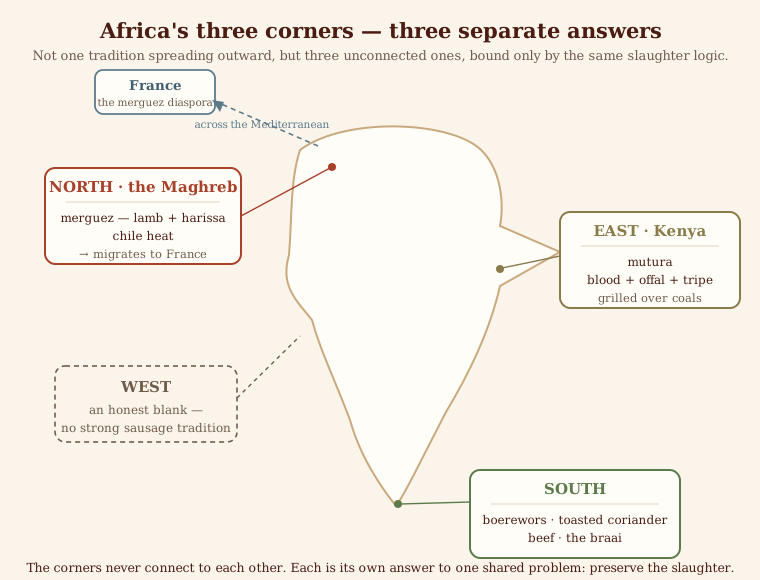
Africa is the page where “the sausage” stops being one thing. Everywhere else in this history I can point at a family — the Roman word branching across Europe, the pork-and-blood craft forking at the kosher wall, the Iberian chorizo sailing west. Those are stories about a single tradition spreading and mutating. Africa isn’t that. Africa is three different traditions that never really merged, sitting at three corners of a continent, each answering the same prehistoric question — the animal is dead all at once, how do we not waste it — in a language the other two wouldn’t recognize.
In the south, it’s an Afrikaner farm sausage built on beef the Columbian Exchange put on the veld, coiled a yard long and grilled over a fire, and the one flavor that separates it from every other beef sausage on earth is toasted coriander. In the north, it’s the Maghreb’s lamb-and-harissa world — the tradition that gave us merguez, which then packed up and became a French street food. In the east, on the Swahili coast and up into the Kenyan highlands, it’s a blood-and-offal grill sausage that uses the whole animal the way the oldest sausages everywhere always did. Coriander, harissa, and blood. Three corners, three answers.
I want to do this page honestly, and being honest means telling you where the record goes thin before I’ve even really started. West Africa — the whole enormous stretch from Senegal down to Nigeria and beyond — did not hand me a strong, named sausage to anchor a section on. I looked. I’ll come back to that gap and say plainly what I found and didn’t find, because a history that papers over its holes isn’t worth your time. But the three corners that do have a clear sausage are worth the trip, so let’s start in the south, with the one that’s actually written into law.
Boerewors: the sausage with a legal definition
Start with the name, because the name teaches the same lesson kielbasa taught. “Wors” is simply Afrikaans for “sausage.” Boere- means “farmer’s.” So boerewors is “farmer’s sausage” — not one specific exotic product with a proprietary recipe, but a whole category, a kind of thing, exactly the way kielbasa is just “sausage” in Polish and not a single item on a deli menu. Every time you meet a foreign sausage word that turns out to just mean “sausage,” you’re looking at a tradition confident enough that it never needed to specialize the noun. The farmers made the sausage. It didn’t need another name.
It descends from the Dutch farm sausage-making the settlers brought to the Cape — it’s a cousin of the Dutch verse worst, “fresh sausage” — and then it naturalized onto the animal the land actually offered. And here’s the first thread that ties this whole “Wider World” section together: the beef that boerewors is usually built on is itself a product of the Columbian Exchange era of animal movement. Cattle, sheep, pigs, the horse — none of the big Old World meat animals were native to the pre-Columbian Americas, and the same centuries of ship-borne livestock transfer that stocked the New World also moved European breeds down into southern Africa. Boerewors is a European sausage-making instinct, transplanted, and re-anchored on transplanted beef. A farm sausage with no fixed homeland animal — it took the one in front of it.
Now the part that makes boerewors genuinely unusual in this whole history: it is legally defined. Not “traditionally understood to contain,” not “usually made with” — actually written into South African regulation. You cannot put “boerewors” on a label unless the product meets a government specification.
What the law actually says — and the correction to get right
The specification is South African regulation R2718 of 1990, issued under the Foodstuffs, Cosmetics and Disinfectants Act. To be sold as boerewors, the sausage must:
| Requirement | The rule |
|---|---|
| Meat content | at least 90% meat — beef, pork, lamb/mutton, or goat, or a mix of them |
| Fat ceiling | no more than 30% of that meat content may be fat |
| No MRM | no mechanically recovered meat |
| Binders limited | cereal / starch (rusk, flour), soy and other binders strictly capped |
| Casing | must be in an edible casing |
Anything that misses these has to be sold as “braaiwors” or just “sausage.” Not boerewors. The name is protected the way a French AOC or an Italian DOP protects a regional food — miss the spec, lose the name.
Here’s the correction I want to nail, because it’s the single most misquoted fact about this sausage. You’ll see “90% meat” thrown around constantly, and it’s real — it’s a genuine legal minimum, not marketing puff. But “90% meat” is not “90% lean.” Read the two rules together. The law says at least 90% of the sausage is meat, and up to 30% of that meat may be fat. Do the arithmetic and a fully legal boerewors can be well over a quarter fat by weight and still proudly wear the name. That’s not a loophole — that’s the sausage working the way any good fresh sausage has to. A 10%-fat sausage would be dry, sad, and gray on the grill. The fat is where the flavor and the juice live. So when someone waves the “90% meat” figure at you as if it means this is some lean health food, they’ve misread the spec. It means 90% of it is meat rather than rusk and water, and a healthy slice of that meat is deliberately fat. State it precisely or don’t state it: 90% meat, of which up to 30% may be fat.
I love that this exists, honestly. Most of the sausages in this whole history are defined by custom, by a guild that’s five centuries gone, by “well, my grandfather made it this way.” Boerewors is defined by a number in a statute book. It’s the rare case where I can tell you exactly what disqualifies a fake, because a government wrote it down. That’s the medieval guild’s rule book — the same one that defined Nürnberger and Thüringer by law — wearing a modern national face.
Toasted coriander is the whole point
If R2718 is what makes it legally boerewors, toasted coriander seed is what makes it taste like boerewors. This is the one separating flavor, and it’s the thing to get right if you ever make it.
Coriander seed is the defining spice — and traditionally it’s toasted first, in a dry pan until it’s fragrant and just starting to color, then cracked or coarsely ground. Toasting matters. Raw coriander seed is bright, a little soapy-citrusy; toasted, it goes warm, nutty, almost orange-peel and roasted-nut. That toasted-coriander note is what your nose catches off a braai from across the yard and says boerewors, not “a beef sausage.” Around it sit the supporting players — cloves, nutmeg, black pepper, allspice, and vinegar — a warm, faintly sweet, faintly sharp spice profile that reads a little like a very restrained baking-spice cabinet aimed at meat. But coriander leads. Everything else is chorus.
(One small honesty flag: coriander-as-the-signature-spice is rock solid. The specific detail that it’s always toasted is the common and best treatment, but I wouldn’t swear it’s universal across every farm and butcher — plenty toast it, and toasting is clearly the traditional and better move, so that’s how I’d tell you to make it. )
Put the spec and the spice together and you’ve got the whole sausage in one line: beef (usually), fresh and raw and never dry-cured, at least 90% meat with a generous fat share, in an edible casing, and unmistakably scented with toasted coriander. That’s boerewors. Everything else is presentation — and the presentation is a big part of the point.
The coil, the braai, and the boerie roll
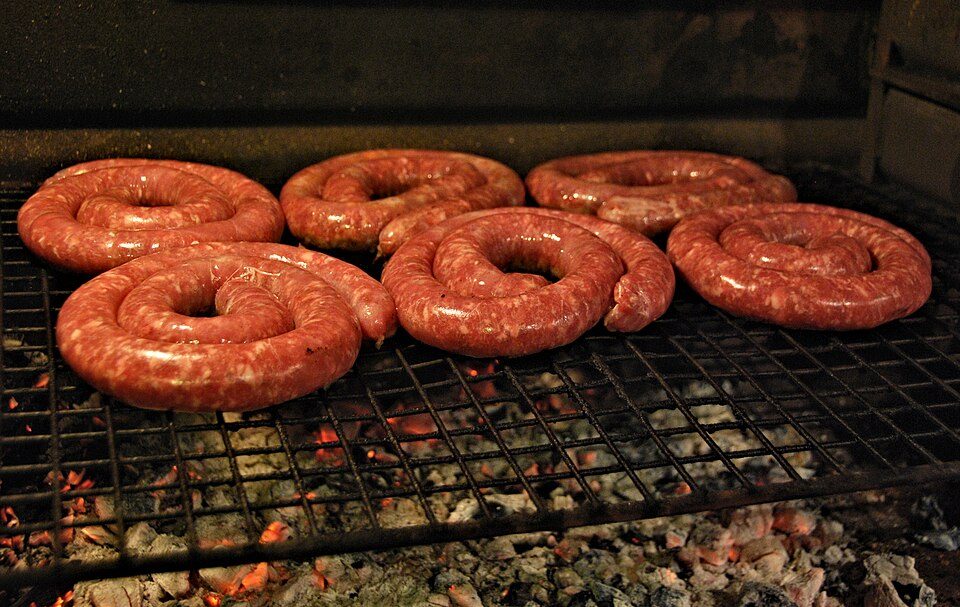
Boerewors isn’t stuffed into links. It’s stuffed into one long continuous rope and wound into a flat coil — a spiral the size of a dinner plate or bigger — and that coil goes straight onto the braai.
The braai is not incidental, and I want to be careful not to translate it away. Yes, it’s a barbecue in the sense of “cooking meat over live fire outdoors.” But calling a braai a barbecue is like calling Sunday dinner “a meal” — technically true and missing everything. The braai is a social institution in South Africa, a fixture of the culture the way a tailgate or a church potluck is here, and boerewors is one of its core foods. The coil is practical and ceremonial: a single unbroken spiral cooks evenly, flips in one motion with a couple of big forks or a grill basket, and lands on the table as one dramatic object you cut into wedges. Nobody’s fussing with a dozen little links falling through the grate.
And then there’s the boerie roll — boerewors’ answer to the hot dog. A length of the grilled coil, straightened out and laid in a soft roll, usually with a tomato-and-onion relish (a chakalaka or a simple sous). It’s the street-food, stadium, side-of-the-road version, and it’s exactly the move every great grilling sausage eventually makes: from the ceremonial center of the feast to a thing you eat standing up with one hand. The bratwurst did it, the Polish ring did it, merguez did it in France — and boerewors did it with the boerie roll.
If you want to build one, the recipe collection has boerewors to start from. The two things not to get wrong: toast the coriander, and don’t lean it out chasing that misread “90%” number. It’s a fresh sausage. It wants its fat.
The north: the lamb-and-harissa world, and how it became French
Now travel to the opposite corner. North Africa — the Maghreb, meaning Tunisia, Algeria, Morocco, and the broader Berber and Arab world across the top of the continent — is a completely different sausage universe from the veld, and it starts from a completely different animal.
I need to draw a clean line here first, because the marquee sausage of this region already has a home in this project. Merguez — the sausage itself, the recipe, the halal logic behind it — is covered in full on the kosher and halal page in the old-world history. That’s where it belongs, because merguez is one of the great examples of a tradition built by subtraction: take pork off the table, and the sheep-herding Maghreb answers with a lamb sausage stained red and built to flatter a strong meat. I’m not going to repeat that here. Go read it there; it’s one of my favorite pages in the whole thing.
What I want to do on this page is zoom out from the one sausage to the whole cooking world it came from, and then follow it on a journey the old-world page doesn’t take: across the Mediterranean and into France.
A cuisine built on lamb and bold spice
The Maghreb is sheep-and-goat country. Lamb and mutton were the dominant meats — the pig is out under halal, and the sheep is the animal the land supports. So the whole meat culture organizes around lamb, and that’s not a limitation, it’s an identity. When your default meat is a strong, fatty, characterful one, your seasoning evolves to work with it rather than hide behind it.
And that’s the second half of the Maghreb sausage identity: bold spicing as survival cooking, not luxury. Heavy seasoning in a hot climate isn’t decoration — spices, chile, garlic, and salt do real preservation work in a place without refrigeration, and they make the most of every scrap. The same waste-nothing logic that drives every sausage tradition on earth drives this one: the sheep is killed, and every usable part goes into a casing and gets seasoned hard.
Which brings us to the thread that stitches this page back to the pivot the whole “Wider World” section turns on. The heat and the red color of merguez come from harissa — the North African chile paste of ground red peppers, garlic, caraway, coriander, and oil. And chile is American. It is not an ancient Old World spice; it’s Capsicum, native to the Americas, and it could not have reached North Africa before Columbus carried peppers back across the Atlantic after 1493. So the Maghreb lamb tradition is genuinely ancient, but the fire in it is a post-Columbian graft. The lamb sausage came first, by centuries; the harissa that now defines its color and heat is a New World arrival dressed up as an immemorial local trait. I lay this out in full on the Columbian Exchange page — it’s the same story as chorizo’s pimentón and Hungary’s paprika, one American plant renamed in every country it landed in. Here it’s enough to flag the chronology: the sausage is old; the chile in it is not.
There’s a dating wrinkle worth being straight about. The first written merguez recipe is usually cited to the 13th century, in an anonymous Andalusi (Hispano-Muslim) cookery book — a genuinely early anchor, if it holds. But it’s a soft, single-citation date, so I’d hold it loosely. And notice it can’t be the whole story anyway, because a 13th-century recipe predates chile in the Old World — so whatever that early text described, the harissa version we now think of as definitive necessarily came later, after the chile arrived. Old sausage, newer fire.
A Maghreb sausage becomes a French street food
Here’s the journey I really wanted this page for, because it’s a beautiful example of a pattern that shows up again and again in the wider world: a sausage migrates with the people who make it, and naturalizes so completely in the new place that the new place claims it.
Through the twentieth century, large-scale migration from the Maghreb — Algeria especially, but also Tunisia and Morocco — brought North African families and North African cooking to France. And merguez came with them. It didn’t stay a niche immigrant specialty. It became, flatly, one of France’s most beloved sausages. You find it grilling in Parisian markets, hanging in Lyon boucheries, spitting fat on every summer grill in the country. The classic French street version is merguez grilled hard and fast, tucked into a baguette or a half-loaf with a pile of frites — the North African red sausage as French fast food. It’s just as at home in Belgium, and in parts of the UK with Maghrebi communities.
Sit with what that means. A halal lamb sausage, born in the sheep country of the Atlas Mountains and the Maghreb, built specifically around the constraint that its makers can’t eat pork — is now a fixture of French cuisine, eaten by millions of French people who’ve never thought about the dietary law that shaped it. That’s the exact same move the Polish ring made in the American Midwest, the same move the bratwurst made in Wisconsin, the same move boerewors made from farm to stadium in its boerie roll. The sausage travels with the diaspora, and then it belongs to everybody. If you want to grill some, merguez is in the collection — and the fat is the whole game, so make it with lamb fat and don’t lean it out.
The east: mutura, and a real sub-Saharan blood sausage
Now the third corner — and this one matters a lot to me for a specific reason. When people talk about “African sausage,” they almost always mean boerewors in the south or merguez-adjacent things in the north. Both of those, if you squint, have a European or a broader-Mediterranean thread running through them — Dutch farm sausage, Andalusi cookbooks, French grills. What I really wanted to find was a sausage that is natively sub-Saharan, that owes nothing to a European template, and that solves the ancient problem in the oldest way there is. I found it in East Africa, and it’s called mutura.
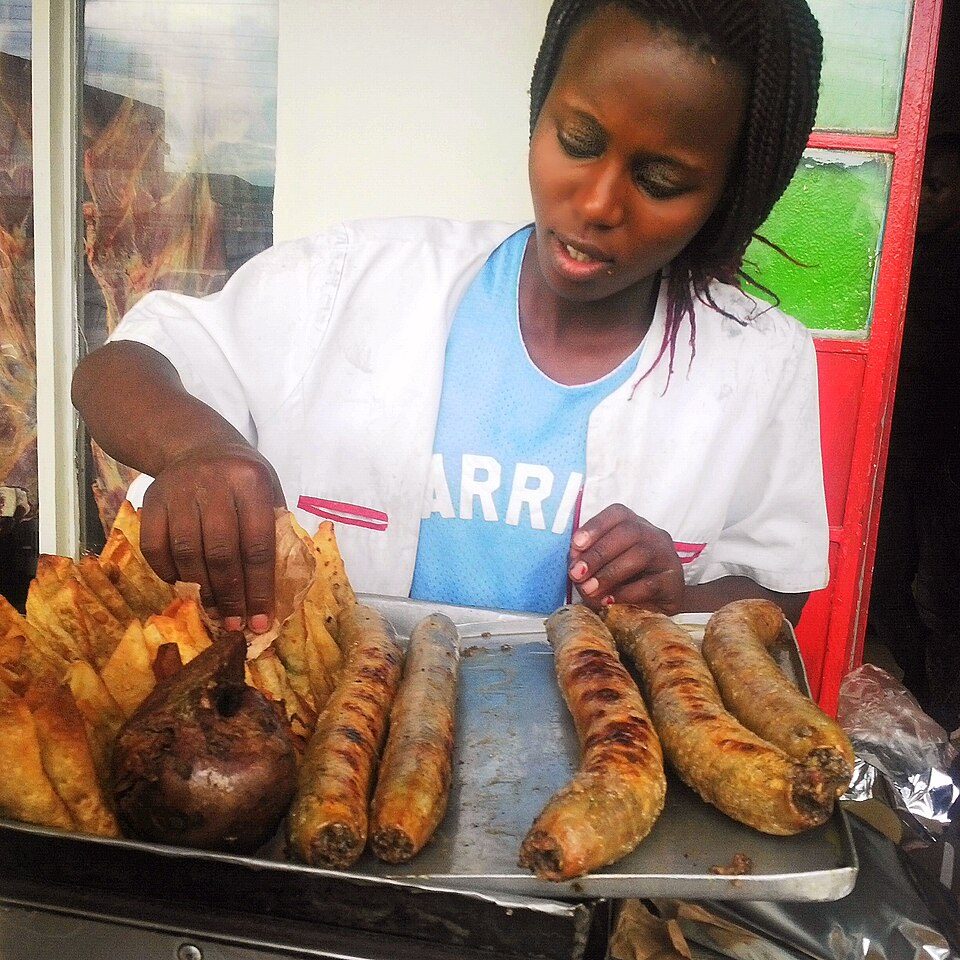
Mutura is Kenya’s traditional blood-and-offal sausage, nicknamed, simply, “African sausage.” And it is a genuine blood sausage in the full sense — it belongs to the same deep family as everything on the blood and offal page, the same family as Homer’s roasting paunch of fat and blood, the same family as Polish kaszanka and Irish black pudding. Different continent, identical logic.
Here’s the build. The casing is intestine. The filling is minced beef or goat, tripe and other offal, and cooked animal blood, seasoned with onion, chile, garlic, ginger, scallion, and cilantro. It’s stuffed, then grilled or roasted over a fire, and sliced crosswise into rounds. It’s classic street food — you’ll find it grilling at roadside stands and butcheries — and it’s eaten with kachumbari, the fresh tomato-onion-chile relish that does for mutura roughly what a sharp pickle does for a rich Northern European blood sausage: cuts the richness, wakes it up.
Culturally, mutura traces to the Agĩkũyũ (Kikuyu) community, and historically it was prepared by men for special occasions — dowry ceremonies and the like. That’s a detail I find quietly moving, because it’s the same status the blood sausage holds in a lot of cultures: the killing-day food, the thing made when an animal is actually slaughtered and every perishable part has to be used now or lost, elevated into ceremony precisely because a slaughter is an occasion.
And notice the chile in that seasoning list, because the thread runs through here too. Onion, garlic, ginger — old. But the chile in mutura is, once again, a post-Columbian arrival grafted onto a much older whole-animal African tradition. Same plant, same story as the harissa up north and the pimentón over in Iberia: an American Capsicum that reached East Africa on the trade routes and got folded into a use-everything sausage that predates it by who knows how long. The blood-and-offal grill is ancient; the heat on it is not.
What mutura gives this page — and this whole section — is the honest counterweight to the “African sausage = boerewors” reflex. Here’s a sub-Saharan sausage that uses the single most perishable part of the animal, the blood, in the first hour after slaughter, exactly the way the oldest sausages on every continent did. It’s the African entry in the great planetary family of blood sausage, and it belongs right alongside kaszanka and mustamakkara and black pudding on the blood and offal page: same whole-animal logic, different corner of the world.
The West African gap — said plainly
Now the honesty I promised at the top, because a good history tells you what it couldn’t find as clearly as what it could.
I went looking for a strong, named West African sausage — something from the vast belt running from Senegal and Mali down through Ghana and Nigeria — to anchor a fourth corner of this page. I did not find one. Not in the sources I trust. There are dried, cured sausages of the sujuk and merguez family scattered across the North African rim, up in the Maghreb and into Egypt, and those are real. But a dedicated, named, clearly-documented West African sausage tradition — the kind of thing I could point at the way I can point at boerewors or mutura — did not surface in this pass.
I want to be careful about what that does and doesn’t mean, because the temptation here is to do one of two dishonest things, and I won’t do either. I won’t fabricate a West African sausage to make the map look tidy — inventing a plausible-sounding traditional food and passing it off as documented is exactly the kind of confident-sounding rot I spend half this history clearing away. And I won’t conclude that West Africa “has no sausage,” either, because absence of evidence in my sources is not evidence of absence in the world. West African cuisines are deep, ancient, and enormously varied, and “I didn’t find a named sausage in an English-language pass” is a statement about my sources, not about West Africa. Whole-animal cooking, grilled meats, stuffed and wrapped preparations — the region has plenty. What I couldn’t do is put a specific, verifiable sausage name and description in front of you and stand behind it. So I’m leaving it as a marked gap rather than either inventing an anchor or writing the region off.
If you know one — a real, documented West African sausage with a name and a tradition behind it — I genuinely want to hear about it, because I’d rather fix this page than let a tidy story paper over a hole in what I know.
Three corners, one logic
So that’s the continent, and it refuses to resolve into a single sausage the way Poland or Iberia does. Line the three corners up and the differences are total:
| Region | Meat | Technique | The separating signature | |
|---|---|---|---|---|
| South | South Africa | beef (± pork, lamb) | fresh, coiled, grilled on the braai | toasted coriander + a 90%-meat legal floor |
| North | The Maghreb | lamb / mutton | fresh, grilled hard and fast | harissa — and it emigrated to become French |
| East | Kenya | beef / goat + tripe + blood | cooked fresh, grilled, sliced | a blood-and-offal grill sausage, chile-seasoned |
A coriander-scented beef coil, a red harissa lamb sausage that became a French sandwich, and a blood-and-tripe grill sausage eaten with tomato relish. Three foods that would not recognize each other as relatives if they met on a plate.
And yet. Underneath all three is the one logic this entire history keeps returning to, the one from the very first page: an animal is killed all at once, and the eating has to last, and the parts that spoil fastest have to be used first or lost. The Afrikaner farmer coiling beef on the veld, the Maghrebi butcher stuffing spiced lamb, the Kikuyu man filling an intestine with blood and offal for a dowry feast — they’re all running the same prehistoric preservation program, in three languages. The coriander, the harissa, and the blood are the accents. The grammar underneath is identical, and it’s the same grammar I’m running when I stuff a casing in Michigan. The sausage was invented over and over by people who never met, because the problem it solves is everywhere there are animals and no refrigerator. Africa just makes the point louder than most — here you can stand in three corners of one continent and watch three peoples answer the same question, and not one of them arrives at the same sausage.
This is the Africa page of the wider-world history of sausage — three corners of one continent, loosely bound by the same preserve-the-slaughter logic and divided by everything else. The American plant behind the harissa and the chile in mutura gets its full treatment on the Columbian Exchange page, the hinge this whole section turns on. From here the trail runs on to India and Goa, where the Portuguese left a pork sausage in a mostly-vegetarian land, and to Mexico, where the pig arrived by ship and collided with a chile that was already home. The whole family, and how these histories fit together, is laid out on the family tree.
Comments (0)