Japan and Korea: Fish Instead of Pork, Blood by Another Route, and Spam
Everywhere else in this history, the sausage is a story about abundance — an autumn slaughter, a hog too big to eat before it spoils, a surplus of blood and fat and trimmings that has to be locked into a casing before it turns. That is the engine under origins, under Poland, under every keeping sausage I make in my own smokehouse. Northeast Asia breaks the pattern, and that is exactly why it belongs in this section. Here the sausage is a story about shortage.
Japan had no pork-sausage tradition to speak of and, after the war, a sea full of protein it couldn’t sell fresh — so it made a sausage out of fish. Korea had a stuffed-intestine sausage that is genuinely old, then lost most of the meat out of it when a war left the country too poor to fill it, and replaced the filling with cheap glass noodles. And into both countries came the single most consequential piece of processed meat in the twentieth century — a can of American pork shoulder and ham with a key on the lid — carried, like the Roman marching sausage and the Polish smokehouse before it, on the back of a moving army. Two of these are sausages by any definition. The third is Spam, which is a sausage that gave up on the casing. All three are ledgers of scarcity, and if you read them that way they tell you more about the twentieth century than most history books do.
Let me take them in that order.
Gyoniku: the pink sausage in the plastic tube
Walk into a Japanese convenience store or a supermarket refrigerator case and you will find, hanging on a peg or lined up in a tray, a stubby sausage sealed in a tight orange-red plastic tube with a little aluminum clip crimping each end. You twist the clip, peel the casing back like a banana, and eat it out of hand. It is shelf-stable, it is cheap, it is a lunchbox staple and a fishing-trip snack, and it is not made of pork or beef. It is gyoniku — 魚肉ソーセージ, literally “fish-meat sausage” — and it is one of the most quietly revealing foods in this entire history.
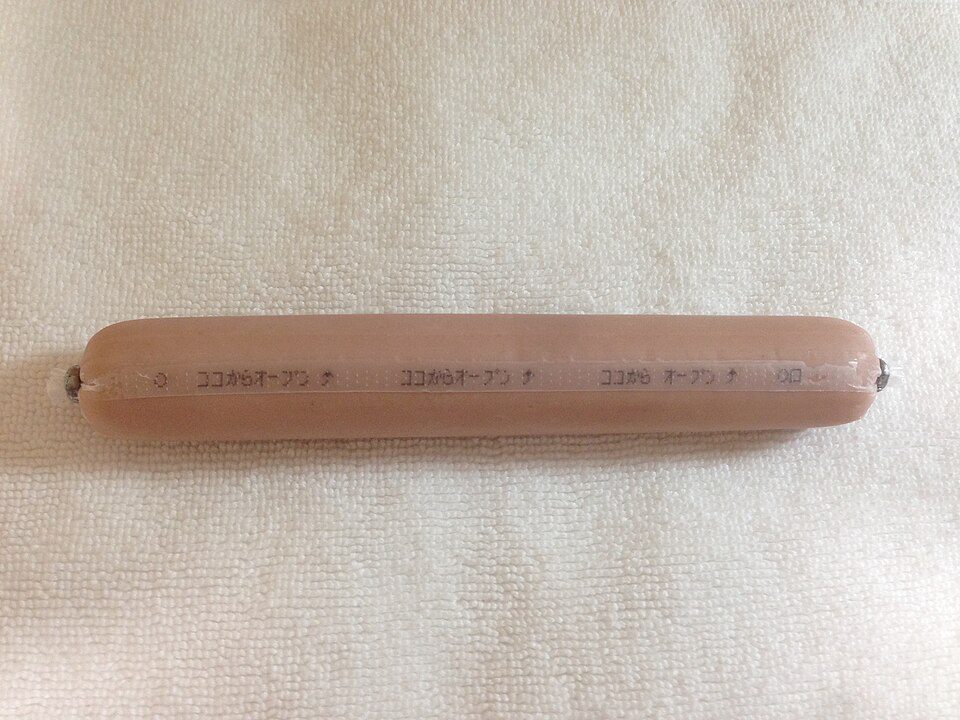
Start with what it actually is, because the construction is the whole point. Gyoniku is a surimi sausage — surimi being the washed, minced, salt-worked fish paste that also becomes kamaboko, imitation crab, and every other springy white fish product Japan makes so well. You take that paste, season it, force it into a casing, and heat-set it. The casing is not a gut and not a fibrous rind; it is a colored plastic film — historically a chlorinated-rubber or vinylidene-chloride or nylon material — and the color is not decoration. The orange-red tint is there to shield the pale fish paste from UV light, which would otherwise discolor it on a store shelf. That is a genuinely different design philosophy from any sausage I make. My casings breathe, take smoke, and let water out. This casing is a barrier — it exists to keep light and air away from a product engineered to sit at room temperature for months. It is a sausage built by food technologists, not by a butcher.
And the fish inside has changed with whatever the ocean was giving up cheaply at the time. Across its history gyoniku has been made from Alaska pollock, marlin, yellowfin and bigeye tuna, mackerel, shark, whale, and squid — a roll call that reads less like a recipe and more like a fishing fleet’s logbook. That flexibility is the tell. This is not a sausage in pursuit of a flavor. It is a sausage in pursuit of a use for protein that would otherwise be wasted, and it will take whatever protein is going.
Why fish, and why then
The honest answer to “why did Japan make a fish sausage” is economics, and it is worth getting the economics right because there is a much more dramatic story attached to this sausage that the record does not support. I’ll get to that story in a minute. First, the boring, documented, true version.
Postwar Japan had a protein shortage and very little in the way of a domestic pork-sausage culture to lean on. What it did have was a fishing industry running flat out and, crucially, a commercial-whaling industry approaching its peak, plus a growing surplus of Alaska pollock — a mild, abundant, cheap white fish that is perfect surimi stock and not worth much sold as fillets. Put those together and fish sausage almost designs itself: it converts low-value, super-abundant marine protein into a stable, sellable, protein-dense food at a moment when the country badly needed cheap protein. Nippon Suisan — one of the big Japanese fisheries companies — did the postwar research into fish-and-whale ham and sausage that turned this from an idea into a product on a shelf.
It is worth saying that people had tried before and failed. There were fish-sausage studies as far back as 1925, and a Dr. W. Shimizu made a tuna ham in 1938 — but these early attempts didn’t take. What changed after the war was not the cleverness of the idea; it was the economics. The surplus was there, the protein hunger was there, and the industrial capacity was there. By the 1960s, at the very height of Japanese commercial whaling, gyoniku had become what the Japanese call a “people’s food” — genuinely everyday, genuinely everywhere.
The date is a real conflict, and I’ll give you both
Here is a small honesty note, because this history lives and dies on getting these things right rather than picking the tidy version. Sources disagree on when gyoniku was first created, and I’m not going to paper over it. One account puts the first creation in 1949. The more commonly cited record credits Seinan Kaihatsu Co. with the first commercial mass-production in 1951, with industrial production ramping through the 1950s to use up that surplus pollock. So the honest framing is: created in the late 1940s, industrialized in the early-to-mid 1950s — and if you need a single tidy date, you can’t have one, because the two live sources give 1949 and 1951 and neither is obviously wrong.
What is not in dispute is the arc after that. Production peaked in 1965 at around 180,000 metric tons — a staggering amount of fish sausage — and then declined as Japan got richer and whaling wound down, stabilizing since the 1990s at somewhere around 60,000 to 70,000 tons a year. The shape of that curve is the shape of the whole story: it rose with scarcity and whaling and fell with prosperity. A poor, protein-hungry country made an enormous amount of fish sausage; a rich one makes a modest, nostalgic amount.
The atomic-tuna story — which I do not get to tell you as fact
Now the dramatic version, and the reason I’ve been careful to lay the real economics down first.
There is a story — a good story, the kind that spreads because it’s vivid — that fish sausage was born from a nuclear accident. In 1954, the Japanese tuna boat Lucky Dragon 5 (第五福竜丸) was showered with radioactive fallout from the American Castle Bravo hydrogen-bomb test at Bikini Atoll. Its crew was sickened, one man later died, and the catch was contaminated. The retelling goes that “atomic tuna” became unsellable as sashimi, the fish markets panicked, and processors diverted all that suddenly worthless tuna into cooked, canned, disguised forms — including fish sausage. It’s a hell of a story: the pink convenience-store snack as a child of the bomb.
I can’t tell you that’s true, because the documented record doesn’t support it, and I’d be inventing a causal link that the sources simply don’t make. The encyclopedic history of gyoniku makes no mention of Lucky Dragon, of Bikini, or of any radiation-driven diversion of tuna into sausage. It credits the mundane driver — surplus pollock and the whaling peak — that I described above. The timing is genuinely suggestive: industrial fish sausage and the 1954 tuna scare overlap, and it’s easy to see how the two got welded together in the retelling. But suggestive overlap is not causation, and I went looking for a source that ties them and did not find one. So I’ll do what this whole history tries to do with a good story that can’t be sourced: flag it as an unverified popular claim, not a fact, and let the documented economics carry the weight. If the radiation scare pushed tuna toward the sausage tube, it did so on top of a fish-sausage industry that already existed for pollock-and-whale reasons — and nobody has shown even that much. Believe the pollock. Be suspicious of the bomb.
Soondae: blood by another route
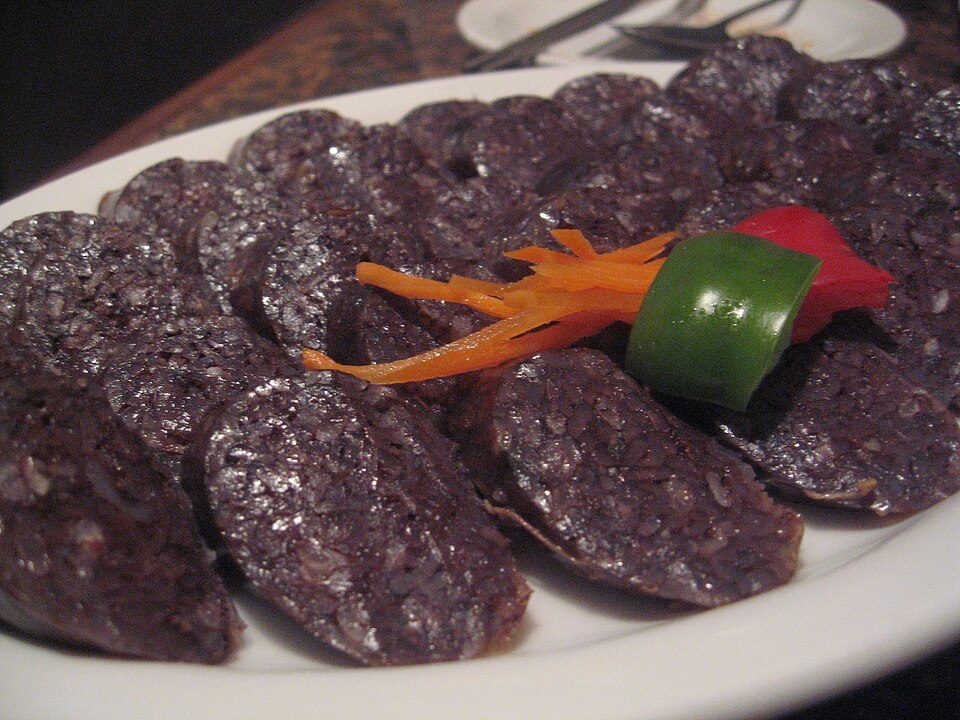
Cross the Sea of Japan to Korea and you find a sausage that looks, at first glance, like the most familiar thing in this whole section — a length of intestine, stuffed, steamed, sliced. Soondae (순대; you’ll also see it romanized sundae, which is a spelling that has caused more than one confused search-engine result) is Korean blood sausage. Pig or cow intestine, stuffed with a mix of pork blood, dangmyeon (sweet-potato glass noodles), glutinous rice, and aromatics — scallion, garlic, perilla. You buy it steaming from a market stall, sliced into coins, often with a little pile of salt or a spiced dip and a few pieces of steamed pig offal alongside.
If you come to it from European blood sausage — from my own Irish black pudding or from Poland’s buckwheat-bound kaszanka — the first thing you notice is how light it is. Modern soondae is often only around 10 to 15 percent blood. That’s a fraction of what goes into a European boudin noir, and it’s the reason people who find black pudding challenging often find soondae approachable — it’s springier, milder, more about the noodle-and-rice body than the iron tang of the blood. That difference in blood ratio is not a small aesthetic thing. It’s a fingerprint of the sausage’s real history, and the real history contains two corrections that matter.
Correction one: “independently invented” is a claim I can’t make
The instinct all through this history — the one I laid out on the origins page — is that sausage was invented over and over by people who never met, because the problem it solves is universal. Salt, a casing, a fire, blood that spoils in hours: put those together anywhere people keep animals and you get a sausage. That instinct is mostly right, and it’s why I resist any “it all began in one place” story.
But it can be overapplied, and Korean blood sausage is exactly where I have to be careful, because the tidy “Korea independently invented its own blood sausage” line is not something the record settles. There’s a live scholarly thread that traces stuffed-intestine sausage technique on the peninsula to the 13th-century Mongol invasions — the period when nomadic Central-Asian foodways collided with Korean cooking. If that’s right, soondae isn’t a parallel independent invention at all; it’s a transmission, an import that arrived with the same mobile steppe cultures that carried so much else east and west. And that would tie it, interestingly, to the very same current I trace on the Balkans and Turkey page — the Central-Asian and Ottoman line that moved blood sausage and ground-meat kofta traditions across a huge span of Eurasia. A steppe vector that reached the Balkans in one direction could have reached Korea in the other. That’s a genuinely appealing symmetry, and I want to be honest that its appeal is not evidence.
So here’s where the record actually stands. Written references to stuffed-intestine sausage in Korea are old and solid — they appear in nineteenth-century cookbooks, the Gyuhap Chongseo of 1809 and the late-1800s Siuijeonseo among them. That much is well attested. But whether soondae is an independent Korean development or a Mongol-era Central-Asian import, the sources do not resolve. Both are on the table. The Mongol-transmission account is real but soft. So I’m not going to tell you soondae was “invented independently,” and I’m not going to tell you it definitely came in with the Mongols either. I’m going to tell you the truth, which is that it’s an old Korean sausage of contested origin, and that the contest is between local invention and Central-Asian transmission, with the evidence not strong enough to close it. A history that launders a good guess into a fact isn’t worth your time — I said that on the Poland page and I mean it here too.
Correction two: the sausage you eat today is younger than you think
The second correction is sharper and better documented, and it’s the one that reorganizes how you should think about the whole dish. The glass-noodle soondae that most Koreans eat today is not ancient. It’s a post-war adaptation, and the reason is meat scarcity.
Here’s the mechanism. An older stuffed-intestine sausage would have been carried by blood and, where you could afford it, minced meat. But after the Korean War (1950–53) left the country devastated and poor, meat was expensive and scarce — and cooks did what cooks always do under scarcity, which is substitute. Out went the costly minced pork; in came cheap dangmyeon, the sweet-potato glass noodles that now define the texture of the thing. The springy, noodle-heavy, only-lightly-bloody soondae in the market stall today is a 1950s cost-driven adaptation, not a relic of the Gyuhap Chongseo.
This is exactly parallel to what I told you happens with grain in European blood sausage — the filler is the cheap local calorie, and it tells you the economy as much as the country. Poland’s kaszanka reaches for buckwheat; Ireland reaches for oats and barley; here, postwar Korea reaches for sweet-potato starch noodles. But the timing is the shocking part. “Ancient stuffed intestine, yes; the cellophane-noodle soondae you’re eating, no” — those are two different objects separated by centuries, and the second one is younger than my father. When someone tells you the soondae at the market is an ancient Korean tradition unchanged for a thousand years, they’ve collapsed that distance, the same way people collapse thirteen centuries when they call lap cheong ancient. The intestine and the technique are old. The noodles are a wound from a war.
That’s the through-line, and it’s a brutal one: Korea’s blood sausage got lighter because the country got poorer. The 10-to-15-percent blood figure, the noodle-forward body, the mildness that makes it beginner-friendly — read one way, those are charming. Read honestly, they’re the fingerprints of a mid-century meat shortage worked into a national snack. The dish is delicious. It’s also a ledger.
Spam, and how a can rewired a cuisine
Which brings me to the third thing, and the one that isn’t a sausage at all — except that it is, in every way that matters to this history.
If you’ve read the other pages in this section, you know the argument I keep coming back to: sausage travels with power. The Roman lucanica rode the legions across Europe and seeded half a continent’s sausage vocabulary. The Polish smokehouse crossed the Atlantic in steerage and landed in the auto plants of my own Michigan. The pattern is always the same — a preserved meat moves on the back of an army or an empire, and it rewrites what the people at the destination eat. Twentieth-century Northeast Asia is where that pattern gets its most literal, most recent, and in some ways most poignant expression, and the vehicle is a blue can with a key.
Spam — Hormel’s canned spiced pork shoulder and ham, a bulk-emulsion cured meat that is, functionally, a sausage that gave up on its casing in favor of a rectangular tin — entered both Japan and Korea the way every sausage in this history entered somewhere new: with a military. It came in the mess kits and supply chains of the United States armed forces, and it stayed. In Okinawa it became embedded so deeply that it’s now a genuine pillar of the local cooking — the pork-and-egg plates, the Spam that turns up in dishes an outsider would swear were centuries old. In Korea it became so prized in the lean postwar years that it turned into a gift — to this day, boxed Spam gift sets are a respectable thing to give at holidays, a fossil of the era when a can of American pork was one of the most valuable things you could put on a table.
And in Korea it produced the dish that closes this page, because it’s the whole argument on a single plate.
Budae jjigae: the whole story in one pot
Budae jjigae (부대찌개) means “army-base stew,” and it earns the name honestly. After the Korean War, near the U.S. military bases — the town of Uijeongbu is the one usually credited — Koreans facing real scarcity took what the bases produced: surplus and scavenged American military rations. Spam. Hot dogs. Canned ham. Processed cheese. Canned beans. And they did not eat these things as Americans ate them. They dropped them into a pot with kimchi and gochujang and made them into a fierce, red, spicy Korean stew — often with a nest of instant ramen noodles thrown in at the end, and sometimes, in a detail I find perfect, a slice of American processed cheese melting on top.
Look at what that dish is. It is American processed meat — frankfurters and Spam, the industrial descendants of the exact sausage tradition this whole history has been tracing — dropped into a Korean flavor base and made to serve a Korean table under postwar scarcity. It is the industrial canned-meat story meeting the Korean palate at the precise point of contact where an army’s surplus fed a hungry population. It is not a sausage. But it is the frankfurter-and-Spam end of the same “American processed meat reached Asia on the back of a war” story that gyoniku and postwar soondae are telling in their own registers — and it sits naturally beside them for exactly that reason. Every ingredient in the pot is a scarcity decision. The Spam is there because it was what the base threw out; the ramen is there because it was cheap; the gochujang is there because that’s the flavor of home, and home refused to be replaced even when the protein came out of an American can.
Budae jjigae is a beloved dish now — comfort food, ordered by choice by people who could afford anything. But like the noodle in the soondae and the fish in the gyoniku tube, it started as a way to not waste what was available and not go hungry on the parts nobody planned to eat. Which is, if you go all the way back to the very first page, exactly what a sausage has always been — a preservation machine that happens to be delicious, where the deliciousness came second. The pig survives into February; the pollock becomes a lunchbox snack; the intestine gets stuffed with cheap noodles; the base’s surplus Spam becomes a stew a country now loves. Different animals, different centuries, same human move.
What Northeast Asia adds to the family tree
So this page doesn’t give you a proud old regional sausage with a guild and a rulebook, the way Germany does. It gives you something more useful for understanding what sausage actually is, stripped of romance: three answers to scarcity, made by three peoples at the moment they had the least.
Japan had no pork-sausage culture and a sea full of protein it couldn’t sell fresh, so it invented a fish sausage in a light-proof plastic tube and made 180,000 tons of it at the bottom of its poverty and the top of its whaling. Korea had an old blood sausage of genuinely contested origin — maybe homegrown, maybe carried in by the Mongols — and when a war left it too poor to fill that sausage with meat, it filled it with glass noodles instead, and that improvised, impoverished version is the one the whole world now knows as soondae. And into both countries an American army carried a can of pork that a Korean town turned into a stew it now eats for pleasure.
Fish instead of pork. Blood by another route, and less of it than there used to be. And Spam — the sausage that traded its casing for a tin and then, like every sausage before it, followed an army to a new country and changed what the people there eat. The constraint that shaped kosher and halal blood-sausage traditions was religious law; here the constraint is simpler and more universal — it’s just poverty, and the ocean, and who had the guns. But the response is the one this whole history keeps making: take what you have, lock it into a form that keeps and feeds people, and let the deliciousness catch up later. It always does.
Part of the wider-world history of sausage. Next: China — the sugar-and-wine axis of the south, and the smoked, garlicky Harbin sausage the railway carried in from Europe — and Southeast Asia, the spectrum from fresh herb to raw ferment. The canned-and-industrial thread that runs under Spam and gyoniku alike has its own page at the industrial sausage. Soondae and the blood-sausage family sit together on blood and offal; the whole shape of the family is on the family tree.
Comments (0)