Southeast Asia: Four Answers to What a Sausage Is For
Everywhere else in this history, I can hand you a region and a single organizing idea. Iberia is the pimentón line. China is the sugar-and-wine axis and the smoked northern exception. Southeast Asia won’t sit still for that, and after years of making these sausages I’ve decided the refusal is the point. This is the one region where four sausages sitting on the same night-market grill are four genuinely different answers to the question the whole origins page opened with — what is a sausage for.
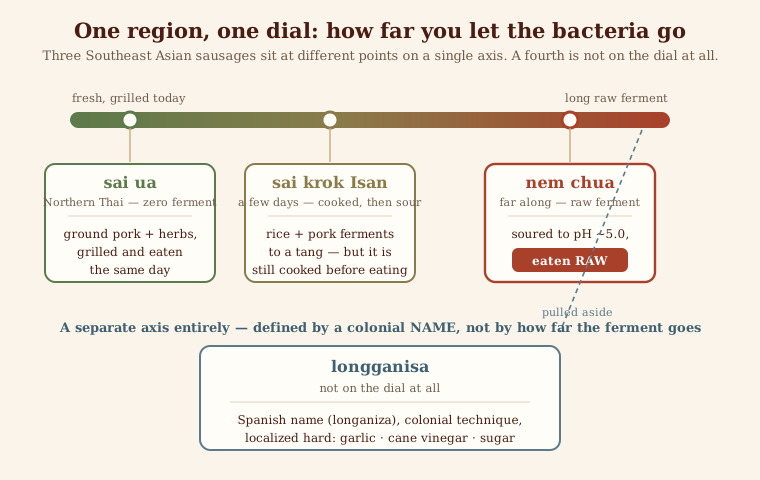
The clean way to see it is as a dial, and the dial is how far you let the bacteria go. Turn it all the way down and you get sai ua, the northern Thai herb sausage that never ferments at all — you pound fresh aromatics into pork and grill it that afternoon. Turn it up a few days and you get sai krok Isan, where cooked rice feeds a deliberate sour ferment and the tang is the dish. Turn it up further, and past a line most makers would never cross, and you get nem chua — Vietnamese pork that ferments raw and gets eaten raw, where the acid is doing safety work, not just flavor work. And then, off the dial entirely, there’s longganisa, the Filipino sausage whose defining fingerprint isn’t fermentation at all. It’s Spanish colonialism. It’s the same New-World-chili, Iberian-ship story I told on the Spain and Portugal page, landed in the Pacific.
Fresh herb, sour ferment, raw ferment, colonial sweet. One region, four philosophies. Let me walk the dial.
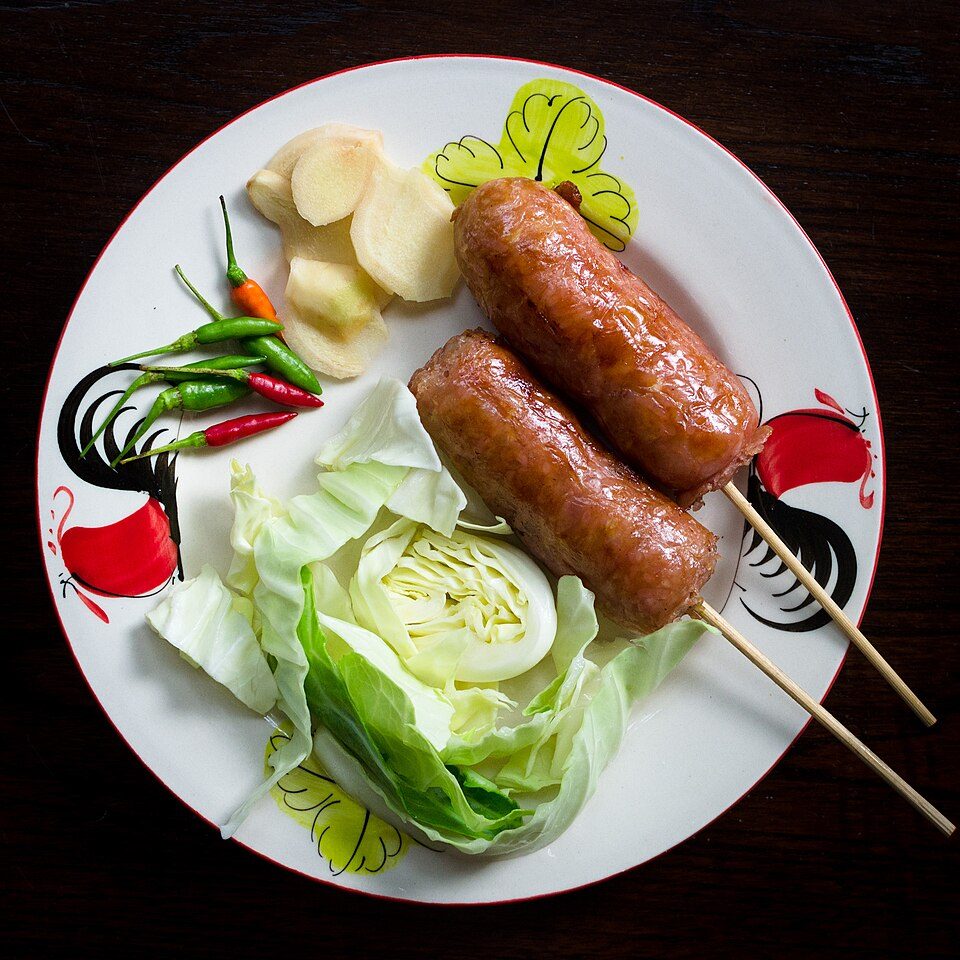
Sai ua: the sausage you eat before anything can happen to it
Sai ua (ไส้อั่ว) is the northern Thai and Lao herb sausage, the coiled one you see hissing on a grill over charcoal in Chiang Mai, and it is the simplest thing on this page to describe and the hardest to get right. It’s coarsely chopped fatty pork pounded together with a fresh aromatic paste — lemongrass, galangal, makrut lime leaf, shallot, cilantro root, chili, garlic, turmeric, and fish sauce — stuffed into casing and grilled fresh. That’s it. No cure, no dry-down, no ferment. You make it and you eat it, and the whole architecture of the sausage assumes you’re going to.
This is the teaching point that separates sai ua from everything else in this section, so I’ll say it plainly: sai ua is a fresh sausage. In the taxonomy I use on the family tree, it sits right next to a fresh breakfast link or a Mexican chorizo — it’s in the category defined by cook it soon, eat it soon, not the category defined by salt and time and controlled decay. Everything else on this page is a preservation technology. Sai ua is a flavor technology that happens to be shaped like a sausage. The casing here isn’t a keeping-vessel; it’s a way to grill a fistful of fragrant forcemeat without it falling through the grate.
The thing I had to learn the hard way is that the herbs are fresh, and fresh is not a garnish word here — it’s structural. Every one of those aromatics is a bright, volatile, perishable plant compound: lemongrass oil, the pine-and-citrus of makrut lime, raw galangal’s sharp medicinal bite. Those flavors don’t survive drying or fermentation; they’d fade or turn under a cure. So the sausage has to be eaten while they’re still loud, which is why it’s a fresh sausage. Try to make sai ua and hold it for a week and you haven’t preserved it, you’ve just let its whole reason for existing evaporate. The one I make gets built and grilled the same day, and the pork stays coarse and cold right up to the grinder — same discipline as any fresh sausage, because a fat smear kills the texture here as fast as it kills a kielbasa. If you want to build one, there are a few sai ua recipes in my collection, and the note I’d give a first-timer is: over-buy the lemongrass. It’s the spine.
Now the honest part, because it’s the reason a page like this exists. You’ll read, in a lot of travel writing and recipe intros, that sai ua is an ancient royal Lanna dish — a delicacy of the old northern Thai kingdom, sometimes traced to the Lao royal court and to the chef Phia Sing, who’s often credited with “first recording” it. Treat all of that as folklore, not documented history. Phia Sing was real and did compile a mid-twentieth-century Lao cookbook, so it’s plausible his book records a version of the dish — but “recorded a recipe in the 1900s” is a long way from “invented by the royal court centuries ago,” and the ancient-Lanna lineage is the kind of romantic origin story that attaches itself to every good regional food without a document behind it. I love sai ua and I’m happy to tell you it comes from the Lanna cultural zone of northern Thailand and northern Laos — that geography is solid. What I won’t do is hand you a royal pedigree I can’t source. The sausage doesn’t need it. A fresh lemongrass sausage grilled over coals is a complete argument for itself.
Sai krok Isan: the sour is engineered, not spoiled
Turn the dial up. Sai krok Isan (ไส้กรอกอีสาน) is the sausage of Isan, the northeastern region of Thailand, and it’s the one that surprises Westerners the most, because it’s sour — a bright, tangy, almost yogurt-adjacent tang — and it’s sour on purpose.
Here’s the construction. You grind pork, mix it with cooked glutinous (sticky) rice, garlic, and salt, stuff it into casing, and then you let it sit — a couple of days, often three or four, frequently out in the warm air or the sun. During those days the rice does its job. The cooked starch is a fermentable substrate, and the native lactic-acid bacteria go to work on it, throwing off lactic acid and dropping the pH, and that is where the sour comes from. Then you grill the little links, usually into tight bite-sized bulbs, and eat them hot with raw cabbage, ginger, peanuts, and bird’s-eye chilies.
The correction I want on the record is right there in the mechanism: the sourness in sai krok Isan is engineered, not a sign of spoilage. This trips people up because in most of the Western kitchen, “the meat went sour sitting out for three days” is an alarm, not a recipe step. But this is a controlled lactic fermentation — the same family of process that makes sauerkraut and yogurt and a Genoa salami tangy — and the rice is the clever part. Lean pork doesn’t have much sugar for the bacteria to eat, so left alone it ferments slowly and unreliably. Add cooked rice and you’ve dosed the mix with carbohydrate, a feedstock that lets the lactic bacteria acidify fast and hard enough to both make the flavor and out-compete the organisms you don’t want. The rice is fermentation fuel wearing the disguise of a filler. The region runs a whole family of these sour-pork ferments — naem and som preparations built on the same idea — and once you see the rice as substrate rather than stretcher, the whole category clicks.
I’ll flag the limit of what I can tell you, though, because the responsible move here is to be clear about which claims rest on what. The fact of the ferment — rice as substrate, lactic acid as the source of the tang, the intended-sourness of the finished sausage — is well attested across food writing and matches exactly what happens when I make it. What I can’t hand you is the species-level microbiology. Sai krok Isan hasn’t been characterized in the peer-reviewed literature the way its Vietnamese cousin has; I know the mechanism is a rice-fed lactic ferment, but I can’t name you the exact bacterial lineup with the confidence I’m about to bring to nem chua. So take the biology here as sound in outline and thin on detail, and don’t let anyone sell you a precise starter-culture story about sai krok as if it were settled science.
One more thing that matters for the dial: sai krok Isan is still cooked before you eat it. It ferments, it goes sour, but then it hits the grill. That’s what makes it the safe middle of the spectrum — the ferment builds flavor and a first layer of acid protection, and then heat finishes the safety job. Hold that thought, because the next sausage takes the one step sai krok Isan doesn’t. You can find sai krok versions in the collection, and if you’ve never had a sour grilled sausage, this is the gateway.
Nem chua: the food-safety page
Nem chua is where this section earns its keep, because nem chua is the sausage that does the thing every instinct in a Western meat kitchen screams against: it ferments raw pork at room temperature and then you eat it raw. No cooking step. And it’s genuinely one of the highest-risk traditional ferments in the region — and also, made correctly, a real and safe and delicious food. Holding both of those true at once, precisely, is the whole job here, so I’m going to slow down.
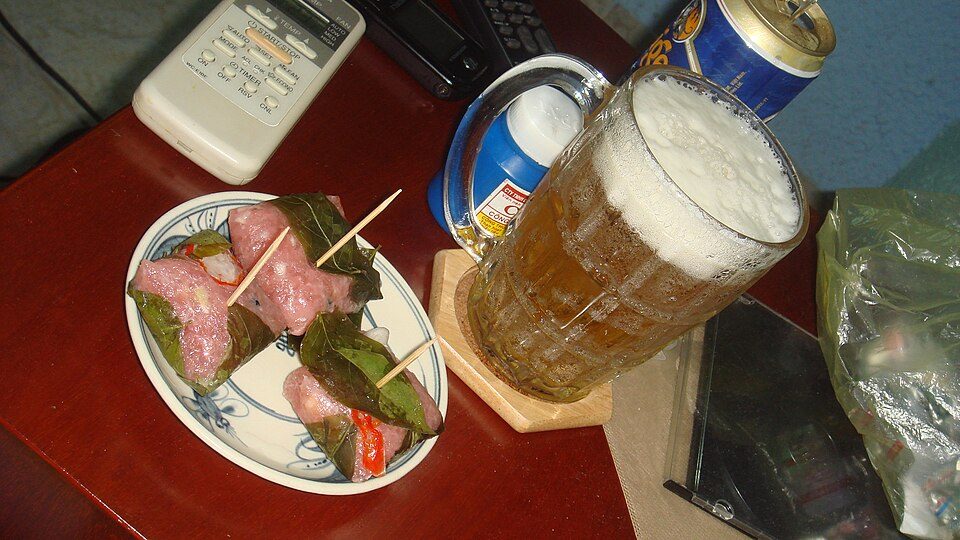
First, what it is. Minced raw pork, shredded cooked pork skin (for that snappy translucent texture), garlic, chili, sugar, and salt, packed tight and wrapped in banana leaves, then left to ferment at room temperature for roughly three to five days. It comes out sour, funky, garlicky, a little chewy, faintly pink, and it’s eaten straight — no heat. It’s strongly associated with Thanh Hóa Province in Vietnam. Push the ferment further and you get the sharply sour nem chua; stop it early and you get a milder, sweeter nem. Either way, the finished sausage never sees a pan before it hits your mouth.
Now the part the internet gets wrong, and the part I most want a fellow maker to understand, because the popular explanation is not just incomplete — it’s dangerously reassuring. The internet’s version is “the acid kills everything.” That is wrong, and believing it will hurt someone. Here’s the precise version.
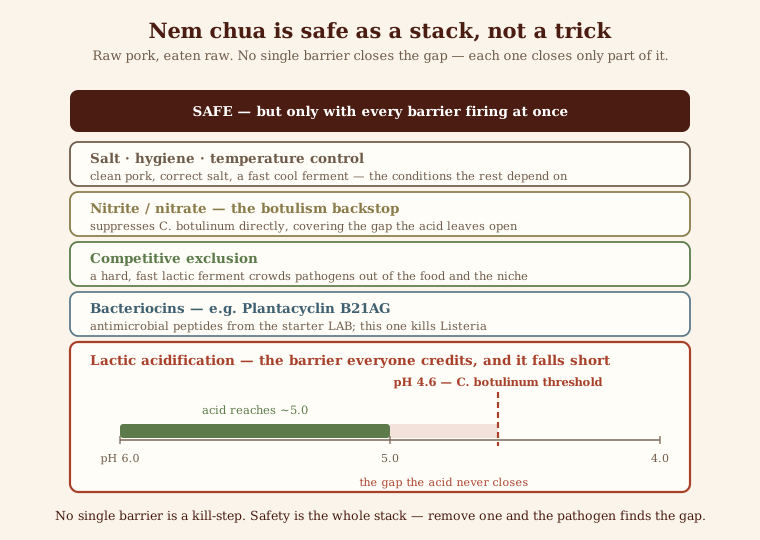
Nem chua’s finished pH lands around 5.0. That number is the whole story, so look at it hard. The pH that reliably shuts down Clostridium botulinum — the botulism organism, the one that can grow anaerobically inside a tightly packed, banana-leaf-wrapped sausage — is 4.6. Nem chua at pH 5.0 is sitting above that line. The acid alone does not get low enough to be a botulism kill-step. So if acid isn’t the safety system, what is? The answer is that there is no single safety system. Nem chua is a multi-hurdle food — several partial barriers stacked so that what one misses another catches:
- Lactic-acid fermentation. Lactic-acid bacteria — Pediococcus pentosaceus, Weissella cibaria, Lactococcus lactis, and others — eat the sugar, drop the pH to ~5.0, and, just as importantly, out-compete pathogens for space and food. That competitive exclusion is a real barrier even where the acid itself falls short.
- Bacteriocins. The lactic bacteria secrete antimicrobial peptides — protein weapons aimed at other bacteria. Nem chua is the source of one that’s genuinely remarkable: Plantacyclin B21AG, isolated from nem chua by researchers at RMIT, which punches holes in the membranes of target bacteria and is effective even against Listeria — the pathogen that shrugs off refrigeration and freezing and is exactly what you’d fear in a cold, ready-to-eat, uncooked meat. The compound is unusually tough, too, stable across a wide pH range and after heating.
- Salt, and — in most modern and commercial recipes — curing salt (nitrite/nitrate). The nitrite is the direct answer to the botulism gap the acid leaves open: it suppresses C. botulinum and fixes the pink color. This is the same nitrite chemistry I’m careful about everywhere in this program — read reading a recipe for how Cure #1 actually works and why “no nitrites added” celery-powder sausages are still nitrite sausages by another route.
Put those together and you have the honest picture: nem chua is safe when it’s made correctly, by several overlapping barriers acting at once — lactic acidification plus bacteriocins plus competitive exclusion plus usually nitrite plus hygiene and temperature control. It is emphatically not made safe by a magic acid trick, and it is not risk-free. Food-safety reviews of Southeast Asian ferments specifically name short-ferment raw pork sausage among the highest-risk traditional products, and many commercial packages tell you outright to cook the thing for about twenty minutes before eating. That advisory is the tell: a food that’s genuinely safe raw doesn’t ship with cooking instructions.
So how do I hold the two truths together? Like this. Nem chua is a real, safe, extraordinary food in the hands of makers running all the hurdles — clean pork, correct salt and nitrite, a reliable fast ferment, temperature control. It is also a food where a home cook who’s absorbed the “acid makes it safe” folklore and skips the nitrite, or lets the ferment stall warm and slow instead of fast and hard, has quietly removed the barriers doing the real work. The romance of nem chua is that it eats raw pork and lives. The reality is that it eats raw pork and lives because a stack of invisible systems is all firing at once, and the moment you believe any one of them is the whole story, you’ve misunderstood the sausage in the exact way that gets people sick. This is the Vietnamese fermented-pork tradition at its most impressive and its most demanding, and it’s why I treat it as the safety teaching moment of the whole Wider World section.
Longganisa: the sausage that isn’t about fermentation at all
The fourth sausage doesn’t belong on the dial, and that’s the point of putting it here. Longganisa is the Filipino pork sausage, and its defining fingerprint has nothing to do with how far you let the bacteria go. Its fingerprint is a name — a Spanish name — and behind the name is the same colonial machinery I laid out on the Spain and Portugal page, reaching all the way across the Pacific.
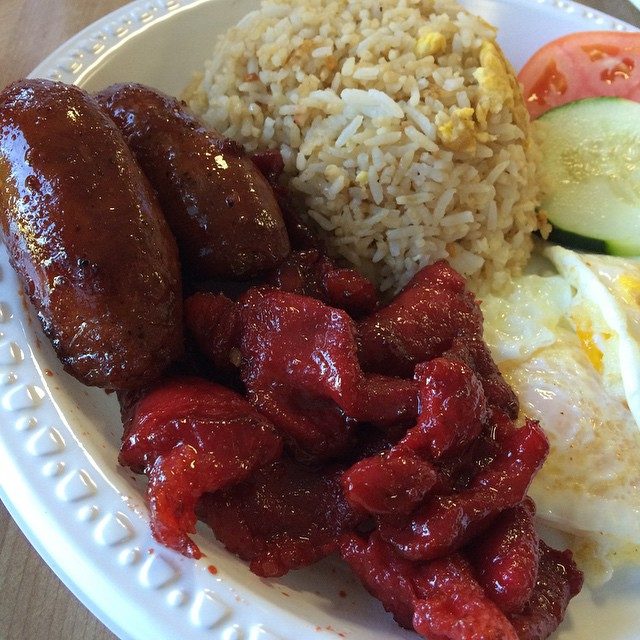
Start with the word, because the word is the evidence. Longganisa descends directly from Spanish longaniza, the long thin cousin of chorizo, and it arrived in the Philippines the way chorizo arrived in Goa and longaniza arrived in Mexico — on Spanish ships, under Spanish colonization, from the 1500s onward. This is the Iberian pork-sausage tradition following the Spanish empire’s trade routes and planting a European sausage word in a Southeast Asian mouth. When I trace the longganisa in my collection back up its own family tree, the trunk runs straight to the same peninsula that gave us chorizo and salchichón and longaniza.
But — and this is the honest framing, the one that keeps this from being a lazy “it’s just Spanish sausage” story — longganisa is not purely Spanish, and it’s not purely native either. The name and the technique are colonial imports; the ingredients got localized hard. Filipino cooks rebuilt the sausage around garlic, cane/sugarcane vinegar, and sugar — the flavors of the archipelago, not of Extremadura. And there’s a second thread often cited alongside the Spanish one: Chinese traders, a long-standing presence in the islands, are credited with influence on the curing technique itself. So the accurate sentence is: Spanish name, colonial technique, Chinese curing influence, thoroughly localized ingredients. A single origin label would be a lie in either direction.
Where longganisa really pays off — where it earns the phrase “the Spanish colonial fingerprint” — is that it splits into two families, and the split is exactly the kind of split that runs through Iberian sausage. There isn’t one longganisa any more than there’s one chorizo; there are hundreds of local styles. But under all of them run two organizing types:
- Hamonado — the sweet style, sugar-forward, its name a cousin of jamón/hamón and the sweet-cured idea. The marquee example is Pampanga longganisa, the sweet one.
- De recado — the garlicky, savory style, little to no sugar, built on garlic and vinegar and salt. The marquee example is Vigan longganisa: salty, garlicky, sharp with cane vinegar.
| Hamonado | De recado | |
|---|---|---|
| Defining character | Sweet, sugar-forward | Garlicky / savory, sour with vinegar |
| Sugar | High | Little to none |
| Marquee style | Pampanga | Vigan |
| The one-line rule | The sweet longganisa | Garlic, vinegar, salt — no sugar to hide behind |
Set a sweet Pampanga longganisa next to a garlicky Vigan and you’ve got a controlled experiment in one country — same Spanish-rooted sausage, same pork and casing, and the whole personality swinging on whether sugar or garlic is running the show. That sweet-versus-savory fork is real structure, not a north-south cliché, and it’s the durable way to read the whole sprawling Filipino sausage case. (The local variety goes much further — Lucban longganisa reaches for oregano, some styles carry paprika — but the hamonado/de recado axis is the backbone that holds.)
And notice what this sausage tells you about the dial. Everything else on this page is organized by fermentation — none, some, or all-the-way-raw. Longganisa is organized by empire. It’s the outlier that proves the region isn’t reducible to one idea, because the thing that most defines the Filipino sausage is a decision made in Madrid, not a decision made by bacteria.
The chili underneath all four
There’s one ingredient standing quietly under this entire page, and it’s the same one that repainted Spain. Every one of these sausages leans on chili — the bird’s-eye heat in sai ua and sai krok Isan, the chili in nem chua, the heat in half the longganisa styles — and none of that chili is native to Southeast Asia. It’s a New-World plant, carried across the Pacific on the very same Iberian ships that carried the word longaniza. That’s not a coincidence I get to wave at; it’s the Columbian Exchange, and it reached Asia as surely as it reached the Balkans. I pick that thread up on its own page, because “the chili in your Thai sausage sailed from Mexico” is one of the great quiet facts of food history and it deserves more than a footnote.
What Southeast Asia teaches
Step back and the region tells you something the tidy single-idea regions can’t. A sausage is not one thing. Four of them can share a grill and a night market and a base of pork and chili and be four different answers to the oldest question in this history — the origins-page question of what the stuffed gut is for.
Sai ua says: a sausage is for flavor, right now — pack it with the brightest fresh herbs you can pound and eat it before anything can happen to them. Sai krok Isan says: a sausage is for controlled sourness — feed the bacteria rice, let them work a few days, then cook it. Nem chua says: a sausage is for eating raw meat safely, if you’re disciplined enough to run every barrier at once — and it will punish you if you mistake the acid for the whole system. And longganisa says: a sausage is a passport stamp — proof of who sailed through, what they left behind, and how thoroughly the locals made it their own.
Fresh herb, sour ferment, raw ferment, colonial sweet. That’s not a region with a theme. That’s four philosophies of preservation and flavor and identity, standing shoulder to shoulder, and the fact that they won’t collapse into one idea is exactly why this is my favorite page to have made in the whole Wider World section. The full shape of how all of this fits together lives on the family tree, and the master hub for the whole project is here.
This is the third page of the wider-world history of sausage. Sibling pages: China, where the sausage map splits into a sweet wind-dried south and a smoked, European-railway north; Japan and Korea, where the headline sausages are ledgers of scarcity — fish instead of pork, blood by another route, and Spam by way of war; and the Columbian Exchange, the New-World chili whose ships seeded the heat in half the sausages on this page. The whole family is laid out on the family tree; the master hub is here.
Comments (0)