American Regional: You Can Read the Immigrant Off the Bread
There’s no such thing as an American sausage, and that’s the most American thing about it. What we have instead is a map — every wave of immigrants that came off a boat carried a sausage in its head, landed in a particular city, and then had to build that sausage out of whatever the New World actually put on the shelf. The technique crossed the ocean intact. The ingredients got substituted on arrival. And because the substitution was local — corn here, oats there, a hard roll in one town and a coal-miner’s lunch pail in the next — you can very often stand over an American sausage and read the immigrant right off of it.
I’ve made sausage for forty years and traveled through every state doing it, and this is the through-line I keep coming back to when people ask me what “American” sausage even means. It means an immigrant doing arithmetic with what he had. His grandmother’s recipe called for buckwheat; the cheap grain in Pennsylvania was corn, so the sausage went yellow. Another family’s version wanted the same scrap-and-grain loaf, but they landed in Cincinnati where the German community leaned on oats, so their loaf went nubbly with pinhead oats instead. Same idea, different grain — and the grain tells you the city.
Let me start there, with the single cleanest example of the whole thesis, because two loaves that are basically the same dish will show you the entire logic of this page.
The grain tells the city: scrapple versus goetta
Here are two foods that are, structurally, the same thing: a thrift loaf of pork scraps and grain, chilled solid, sliced, and fried crisp in the morning. One is scrapple, the breakfast institution of the Pennsylvania Dutch country. The other is goetta (say it “GET-uh”), the breakfast institution of greater Cincinnati. They come from the same German instinct and solve the same problem — use every scrap of butchering day and stretch the meat with cheap grain — and yet nobody would confuse a slice of one for a slice of the other, because the binder is different, and the binder is the tell.
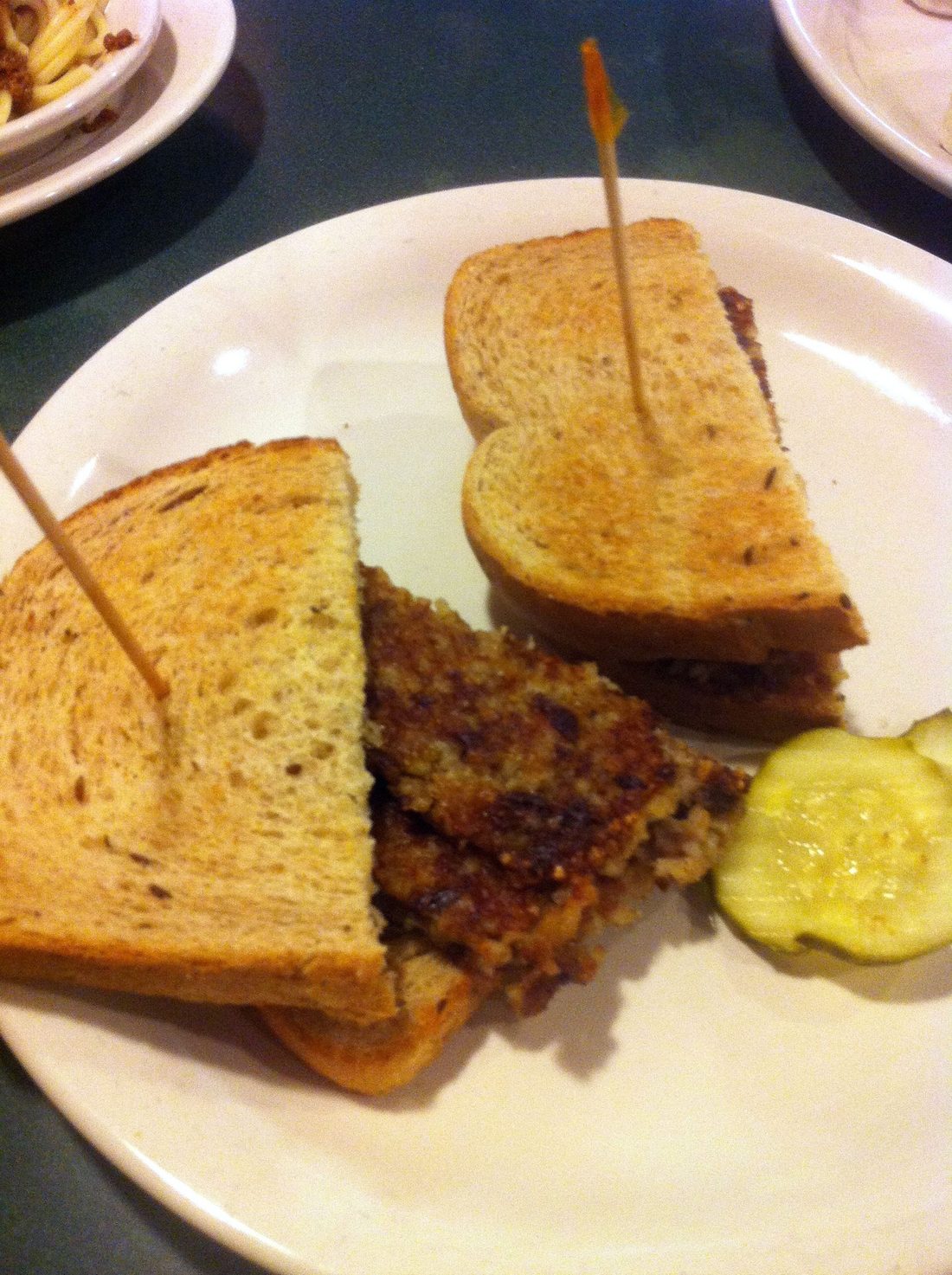
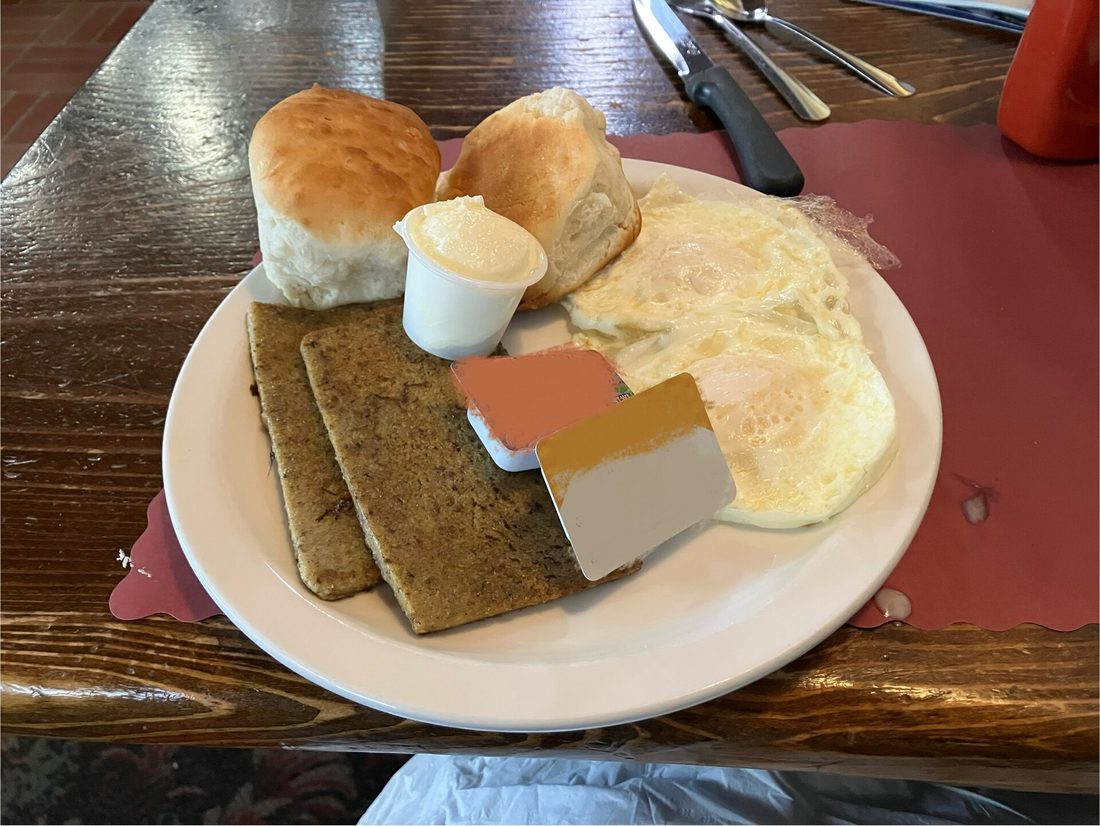
| Scrapple | Goetta | |
|---|---|---|
| Where | Pennsylvania Dutch country (SE / south-central PA) | Greater Cincinnati (and Northern Kentucky) |
| Immigrant source | Palatine Germans, fled the Rhineland in the 1680s–90s | Northwest Germans (Oldenburg, Hannover, Westphalia), 19th c. |
| The meat | Pork scraps, often head meat and offal | Pork and beef |
| The grain — the tell | Cornmeal, plus wheat and/or buckwheat flour | Coarse steel-cut (pinhead) oats |
| Seasoning | Sage, marjoram, thyme, black pepper | Onion, bay, savory-leaning spice |
| Form | Chilled loaf, sliced, pan-fried | Chilled loaf, sliced, fried crisp |
| Invented | Adapted in America from German panhaas | Invented in Cincinnati — not brought from Germany |
Read the grain row and you’ve read the map. Cornmeal says Pennsylvania Dutch. Steel-cut oats say Cincinnati German. It’s that reliable. If you’re handed an unlabeled slice and it’s got the fine, mush-like, faintly sweet body of cornmeal, you’re eating a Philadelphia-corridor breakfast. If it’s got the chewy, nubbly texture of whole pinhead oats, someone’s grandmother came from northwest Germany to the Ohio River.
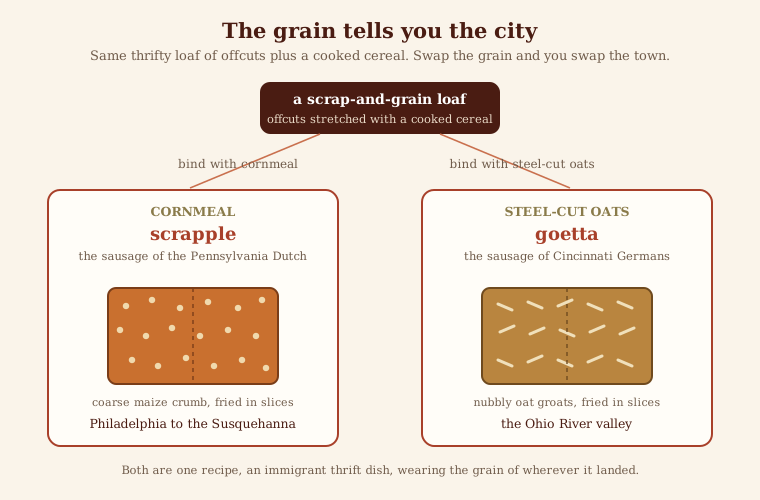
A couple of corrections come stapled to that table, and they’re the good part.
First: goetta was invented in Cincinnati. It is not a German dish that got carried over — Germans in Germany don’t make goetta and would look at you blankly if you asked for it. It’s an American sausage-loaf that German-Americans built in Ohio out of their own tradition and the cheap oats in front of them. The concept is German; the object is Cincinnati. There’s a Goettafest every year and a big commercial name (Glier’s) to prove how thoroughly it belongs to that one river valley and nowhere else.
Second, and this is the one I like best, because it’s a tiny echo of a huge history: the German original had no corn in it at all. Both scrapple and goetta descend from a German dish called panhaas — “pan rabbit,” which is a butcher’s joke, the way “Welsh rabbit” is cheese and “prairie oyster” isn’t an oyster. Panhaas was a scrap-and-buckwheat pudding, poured into a pan to set and then fried in slices. When the Palatine Germans brought panhaas to Pennsylvania, they reached for the cheapest, most abundant grain around them — and in the New World that was corn, a plant that did not exist in Europe until Columbus. So the cornmeal in scrapple isn’t heritage. It’s the single most American thing on the plate: a Columbian-exchange crop that walked into a German recipe the moment that recipe touched American soil. The buckwheat in the old country was the tradition; the corn is the adaptation. Which is exactly why the grain is diagnostic — the immigrant kept the method and swapped the local grain, and the swap is legible three centuries later.
I make both, and the technique is genuinely a sausage-maker’s technique even though there’s no casing in sight. You’re building a bound emulsion of meat and starch and stock, seasoning it hard because it’s going to be sliced cold and needs the flavor to carry through frying, and relying on the grain to set the whole thing into something sliceable. If you want to try either, the collection has starting points for scrapple and goetta, and I’d tell you the same thing I tell everyone: season it more aggressively than feels right, because the cold and the fry both mute it. This whole thrift-and-offal instinct — the head meat, the blood, the connective bits cooked down and stretched with grain — is a family I’ve written about on its own blood and offal page, because it’s the oldest logic in sausage and it deserves the room.
Wisconsin: the beer brat and the German diaspora up north
Move the map north and west and the immigrant changes and so does the sausage. German immigrants poured into Wisconsin something like 150 years ago and brought fresh bratwurst — pork, or pork blended with veal or beef, ground coarse and stuffed fresh, the kind of link you cook and eat, not the kind you cure and keep. And they didn’t just bring the sausage; they brought a whole civic religion around grilling it.
Sheboygan, Wisconsin calls itself the Bratwurst Capital of the World and has the vocabulary to back the claim. Up there you don’t have a cookout, you have a “brat fry” — and “frying,” confusingly, means grilling over charcoal. The classic serve is a brat (or two — a “double,” because one is for amateurs) on a hard roll, a semmel they’ll call a “brat bun,” dressed with butter, raw onion, brown mustard, and a pickle. Sheboygan’s Brat Days festival has run since 1953, and the local boom really dates to the 1920s, when home refrigerators showed up and extended how long a fresh sausage could sit before it had to be eaten. That’s the same quiet mechanism that shapes half the sausages in this section — a preservation constraint loosening, and a tradition rushing into the space it left.
Now the part everybody wants me to state as gospel, and I won’t quite: the beer brat. The signature Wisconsin move is to simmer the brats in a bath of beer and onions (and often a knob of butter) either before the grill or after, so they take on the beer and stay juicy through the fire. I want to be honest about what I know here. The technique is real, well-attested, and genuinely regional — nobody’s making that up, and it works; a beer-and-onion bath is a great way to carry a big batch of brats through a tailgate without drying them into hockey pucks. But the origin story of the beer bath — who first thought of it, when, in which tavern — I have never seen pinned to a source I’d trust. So treat the beer brat as a well-established regional practice, not a dated invention with a founder. It’s the kind of thing that probably emerged in a hundred backyards at once, the way good techniques usually do, and the neat origin tale is likely folklore backfilled later. If you want to build one, start with a straightforward fresh bratwurst and add the beer bath as a finishing move, not a marinade — the beer does more for a hot brat resting than for a raw one soaking.
West Virginia: the sausage baked into the bread
Now the cleverest one, and my favorite piece of the whole American map, because it’s a sausage that solved a very specific problem for a very specific person: the pepperoni roll.
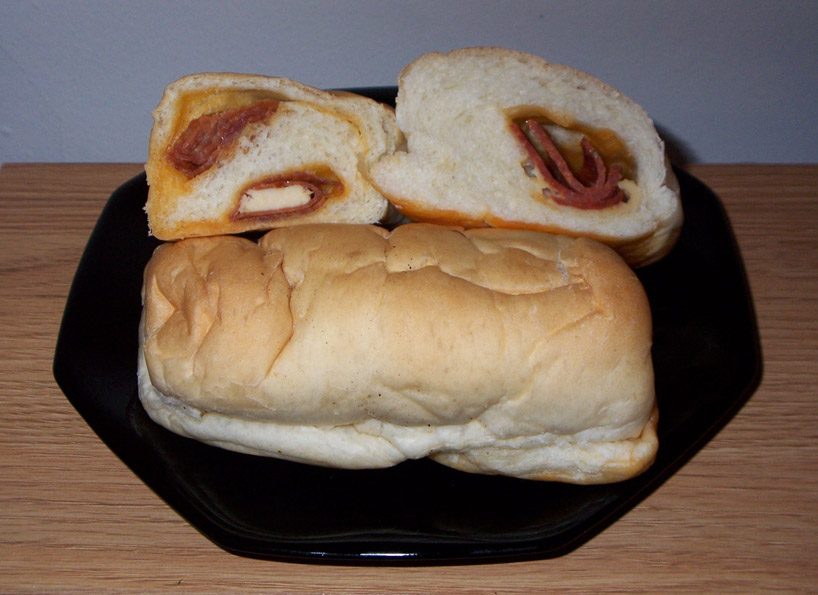
Southern Italians came to the coalfields of West Virginia to mine, and a miner’s lunch has hard constraints. It has to survive hours in a pail in a mine with no way to keep it cold, and it has to be eaten with filthy hands in the dark without unwrapping anything fussy. The pepperoni roll is the answer, and it’s beautifully direct: you bake sticks or slices of pepperoni right inside a soft Italian bread roll, so that as it bakes the spiced fat renders out of the sausage and soaks into the crumb. The result needs no refrigeration — the bread is the packaging and the sausage is already cured — and a man could pack it dry, carry it down, and eat it cold and delicious. It is, functionally, the same idea as every keeping-sausage in this whole history, except the keeping medium is a loaf of bread instead of a casing.
It’s credited to Giuseppe “Joseph” Argiro, a Calabrian miner who became a baker, and to the Country Club Bakery in Fairmont, West Virginia. It’s now the official state food of West Virginia, which tells you how deep it runs there — you’ll find pepperoni rolls at every gas station and church sale in the state and almost nowhere outside it.
On the date, I’m going to do the honest thing rather than the tidy thing. You’ll see “invented in 1927” stated flatly all over the place, and you’ll also see a fuzzier range of 1927 to 1938, and Argiro is tied to more than one bakery in some tellings. The 1927-at-the-Country-Club line is the standard version and it’s probably close, but it isn’t airtight, so I’ll say it landed around 1927 at the Country Club Bakery in Fairmont and leave the exact year loose. The origin and the function — Italian coal-miner food, sausage sealed into bread so it keeps — are rock solid. The specific year is the soft part, and I’d rather tell you that than launder a guess into a fact. The bread-and-cured-pork logic here is a straight descendant of the Italian tradition that gave us pepperoni in the first place, transplanted whole into an Appalachian mine.
The hot dog: a German sausage that put on American clothes
And then there’s the big one, the sausage most people would name if you asked them for an American sausage — which is funny, because it isn’t one. The hot dog is a German sausage that got Americanized on the street.
The ancestry is not in dispute and it points straight back across the ocean. The frank descends from two Old-World city sausages: the frankfurter, from Frankfurt, and the wiener, from Wien — Vienna. Both are pure examples of the German Brühwurst family: a smooth, fine, cured pork batter stuffed into a thin casing and gently scalded until it sets into that springy snap. I go deep on how that family actually works — the raw emulsion, the batter that cooks in the casing — on the Germany page, and the whole “who owns the name, Frankfurt or Vienna” fight is really the same name-migration story that runs all through the old Habsburg lands. The point for this page is that the object we call a hot dog arrived in America already fully formed as a German sausage. What America added wasn’t the sausage. It was the bun, the cart, the toppings, and the mythology.
German immigrants were selling “dachshund sausages” off New York carts from the 1860s. The famous names — Charles Feltman starting a Coney Island stand around 1871, Nathan Handwerker (a former Feltman employee) opening Nathan’s Famous in 1916 and undercutting Feltman’s dime with a nickel dog — are part of the folklore, and I’ll get to how much of it holds up in a minute, because some of it doesn’t. But the sausage itself is German, and the naming and the legends are American embroidery on top.
What America genuinely invented is the regional style. The same plain frank, dressed a dozen incompatible ways by a dozen cities, each convinced its way is the only correct one. Here’s the map that matters:
| Style | The frank | The build | The tell |
|---|---|---|---|
| Chicago | All-beef | Steamed poppy-seed bun, “dragged through the garden” | Yellow mustard, chopped onion, bright-green relish, tomato wedges, dill spear, sport peppers, celery salt — and never ketchup |
| New York “dirty water” | All-beef | Held in a spiced brine tank on a cart (hence “dirty water”) | Sauerkraut, spicy brown mustard, a tomato-onion sauce |
| Coney / Detroit | Natural-casing frank | Split bun under all-meat beanless chili | Coney sauce, diced white onion, yellow mustard — a Michigan institution despite the name |
| DC half-smoke | Coarse half-beef, half-pork smoked sausage | Split and griddled, under chili | Spicier and coarser than a hot dog; Ben’s Chili Bowl is the landmark |
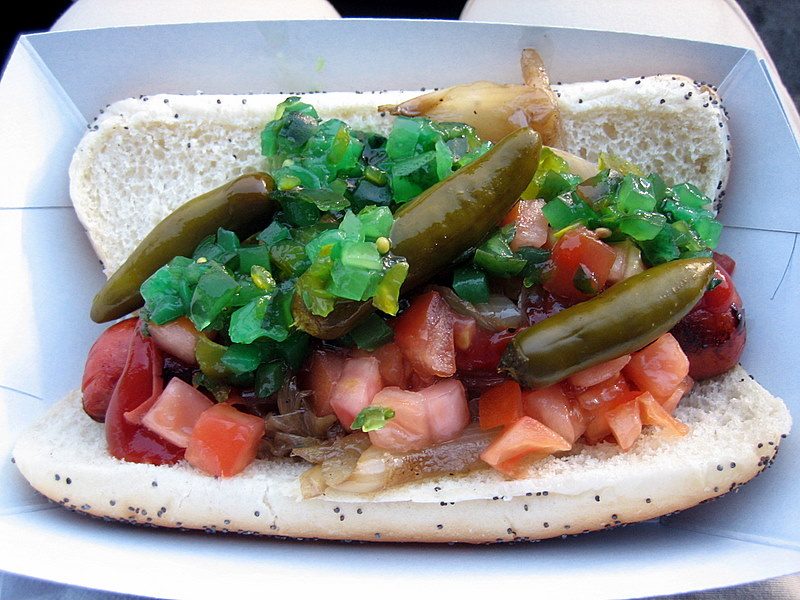
Every one of those is the same German frankfurter underneath, localized past recognition by the toppings and the bun. The Chicago dog’s no-ketchup rule is enforced with a seriousness that borders on the theological. The New York cart’s “dirty water” is just the spiced holding brine, and it’s a term of affection, not a complaint. And the two at the bottom of that table each carry a wrinkle worth stopping on.
The Coney, and it happens to be mine
The Coney dog carries a geographic joke in its name: it’s called a Coney — after Coney Island, New York — but it is a Michigan institution, my home state’s signature dog, and it’s widely believed to have originated in Detroit, inspired by the idea of Coney Island rather than actually from it. A Coney is a natural-casing frank under a beanless, all-meat chili called Coney sauce, with diced white onion and a stripe of yellow mustard. And within Michigan there’s a genuine schism: Detroit-style and Flint-style Coney sauces are made differently and argued about by people who mean it — Flint’s tends drier and more finely ground, Detroit’s looser and wetter — and I’m not going to referee that here, or claim a single inventor, because the honest record doesn’t support one.
What I’ll say plainly, and only what’s true: this is my state’s dog. I grew up in Michigan, I still live here, and the Coney is simply part of the landscape the way it isn’t anywhere else in the country. Being a sausage maker, I have opinions about the frank under all that chili — a real natural casing matters, because the snap is half the point and a skinless dog can’t give it to you — but the Coney is one of the few sausages in this whole history where I don’t have to reach across an ocean or a century to feel a connection to it. It’s the hometown entry on the immigrant map, and it earned its place on it honestly: German frank, Greek-immigrant chili-dog tradition, dropped in Detroit, and now unmistakably Michigan’s own.
The DC half-smoke, and a “half” nobody can explain
The Washington, D.C. half-smoke is a coarsely ground, half-beef and half-pork smoked sausage — spicier and coarser than a hot dog, closer to a proper sausage than a frank — split down the middle and griddled, then buried under chili, mustard, and onions. Ben’s Chili Bowl has been the landmark for it since 1958. It’s a genuinely distinct regional sausage and worth seeking out.
And nobody can tell you what the “half” means. I’ve seen three explanations offered with equal confidence, and I can’t resolve it, so I’ll just lay them out: maybe it’s half beef, half pork (the meat blend); maybe it’s half-smoked (smoked and then finished on the griddle rather than fully smoked); maybe it’s the split-down-the-middle grill cut that halves the sausage lengthwise. All three are plausible, none is proven, and the honest answer is that the origin of the name is unresolved. I’d rather hand you three live possibilities than pick the prettiest and pretend the question is closed.
The folklore, sorted from the history
This is the part of the page I care about most, because the hot dog attracts more confidently-repeated nonsense than almost any food in America, and a history that launders folklore into fact isn’t worth your time. So let me flag the big ones as folklore.
The dachshund cartoon that named the hot dog never existed. You’ve heard this one: at a 1901 New York Polo Grounds game, the sports cartoonist Tad Dorgan draws a dachshund in a bun, can’t spell “dachshund,” writes “hot dog” instead, and coins the term. It’s a great story and it’s a fabrication — Gerald Cohen, who wrote the actual book on the phrase’s history, calls it exactly that. It fails on its own facts three times over: Dorgan didn’t move to New York until 1903, so he wasn’t at a 1901 New York game; the famous cartoon has never been found by anyone, ever, despite generations of people looking; and “hot dog” was already in print as college slang in the 1890s (Yale, 1894–95) before Dorgan could have coined anything. The likeliest real origin is duller and funnier: “hot dog” started as a joke, linking the thin German sausage to the Germans’ thin dogs, with a genuine undercurrent of the old suspicion that cheap sausage might actually contain dog. No single cartoonist named it.
The Feltman “invention” is romanticized. Charles Feltman is popularly credited with inventing the Coney Island hot dog cart in 1871, and it’s repeated as settled fact. But the historian Bruce Kraig, who wrote Man Bites Dog, says there is no good evidence of Feltman’s sausage cart — the origin is at least partly a nice story the industry tells about itself. The German sausage on a bun sold from New York carts is real and documented from the 1860s; the tidy “Feltman invented it on Coney Island in 1871” is legend, and I’ll treat it as legend.
And the half-smoke “half,” which I already flagged, belongs on this list too: three explanations, none confirmed, don’t pick one.
None of this diminishes the sausages. The frank is a real German sausage with a real German pedigree; the Coney and the half-smoke and the Chicago dog are real regional creations worth eating and arguing about. What’s fake is the mythology bolted onto them — the specific inventor, the specific cartoon, the specific year — and the fake parts always have the same shape: a satisfying single origin where the truth is messier, older, and more collective. That’s the pattern under this whole page. American sausages didn’t get invented by one clever person on a dated afternoon. They got assembled, over generations, by immigrants substituting the local grain for the old-country one and by cities dressing the same frank a dozen stubborn ways.
You can read all of it off the plate if you know how to look. The corn in the scrapple and the oats in the goetta. The beer in the Wisconsin brat and the bread around the West Virginia pepperoni. The chili on the Michigan Coney and the poppy seeds on the Chicago bun. Each one is an immigrant doing math with what the New World gave him, and the arithmetic is still legible on the table in front of you.
Part of the wider-world history of sausage. Next: the frontier, where wild meat is too lean to be a sausage on its own and one American game animal carries a parasite that freezing won’t kill. See also industrial, where the Chicago packing house turned the butcher’s link into a factory’s output, and Cajun and Creole. For the ancestry of the frank, Germany; for the pepperoni, Italy; and for the diaspora pattern that shaped all of this, Poland and the East.
Comments (0)