India and Goa: Portugal's Pork Fingerprint on a Pork-Averse Subcontinent
Here is a puzzle I like to hand people who think a sausage is just a recipe. Take a subcontinent of well over a billion people where, broadly, the two largest religious traditions steer hard away from pork — Hindu avoidance on one side, an outright Muslim prohibition on the other — and then go looking for a fiery, vinegar-cured pork sausage. You would expect to find nothing. Instead you find one, alive and beloved and unmistakably itself, and it is sitting in almost exactly one place. Not scattered thinly across a whole country the way you’d expect a marginal food to be. Concentrated. Pooled. Sitting in the one corner where a European empire planted a church and left it there for four and a half centuries.
That place is Goa, on the Konkan coast, and the sausage is Goan chouriço — choris, Goa sausage, the local pork link that any Goan cook can describe in their sleep. It is a direct descendant of the Portuguese chouriço I’ve written about on the Iberian page, carried east on Portuguese ships and then rebuilt for a tropical coast that would have rotted the original. And its survival isn’t a culinary accident. It’s the cleanest case I know of three forces — religion, empire, and climate — jointly manufacturing a regional sausage and then protecting it. The map of the Goan sausage is, almost line for line, the map of Goan Catholicism. Let me show you why.
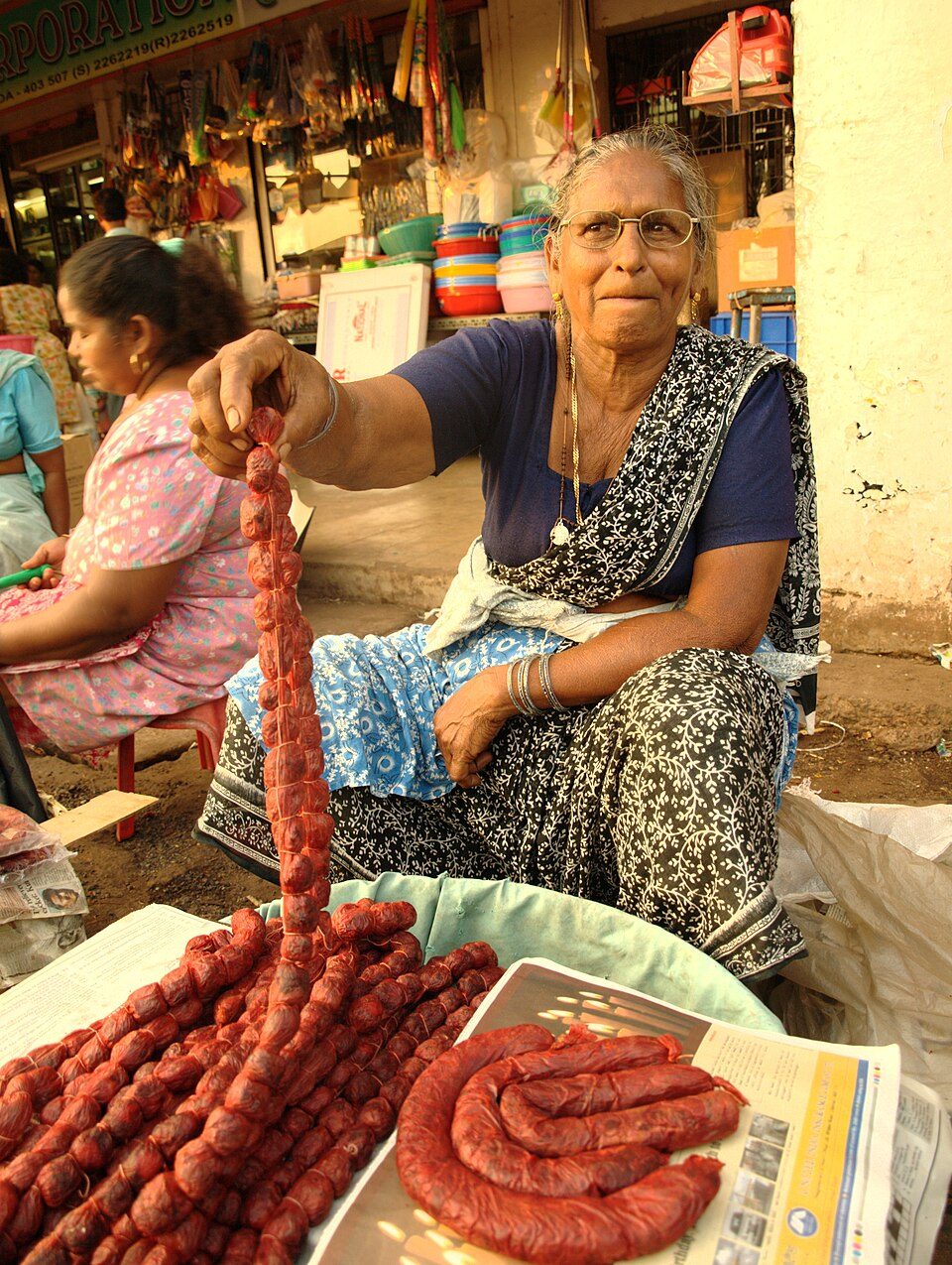
The one sausage that map should not exist
Start with the thing that makes this page worth writing: a cured pork sausage has no business thriving here, and it does anyway.
I want to be careful with the generalization, because the lazy version of it is wrong. People say “India doesn’t eat pork,” and that’s not true — it’s too flat. The honest statement is that the subcontinent is largely pork-averse: most of it avoids pork for religious reasons, Hindu and Muslim both, but there are real and important exceptions. Several Northeast Indian cuisines are enthusiastically porky. The Bombay East Indians, whom I’ll get to, eat pork. And Goa eats pork the way Poland eats it — as a cornerstone, not a novelty. So the rule is “largely pork-averse, with pockets,” and every one of those pockets has a story. Goa’s is the biggest and the clearest, and it has a date attached to a conquest and a church attached to the date.
The through-line for the whole page is this: the Goan sausage survives specifically because pork became a marker of Christian identity. Not because Goans happened to like it. Because eating it, curing it, hanging it in the kitchen said something about who you were — and that turns out to be one of the most durable reasons a food can have for existing. Iberia already taught me this lesson in reverse, and I’ll come back to that, because the alheira — the Portuguese “disguise sausage” that hid the absence of pork — is the exact photographic negative of what happened in Goa.
A Portuguese sausage that survived by conversion
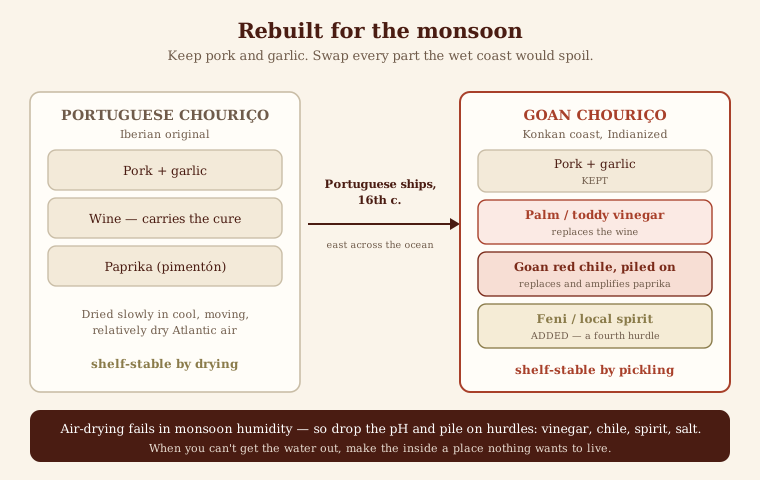
The lineage back to Iberia is not folklore — it’s one of the best-attested transmission stories in this whole section. Portuguese mariners and settlers brought chouriço east: pork, garlic, wine, paprika, cured and hung, exactly the sausage I make on the Iberian side of my collection. Over roughly 450 years of Portuguese rule it became something you’d call Indo-Portuguese — recognizably the same idea, thoroughly rebuilt in local materials. If you’ve read my Spain and Portugal page you already have the ancestor in your head: the thicker of the two Portuguese workhorse sausages, cured as much with wine and garlic as with paprika. Hold that picture, because the Goan version keeps the skeleton and swaps out almost every soft part.
I won’t re-teach chouriço basics here — that’s what the Iberian page is for. What matters on this page is the transformation, and it happened for a reason you can feel the moment you think about the weather.
Why vinegar and chile: a climate correction, not a whim
This is the correction I most want a fellow maker to take away, because it reframes the Goan sausage from “spicy Indian food” into what it actually is: a preservation problem solved with the ingredients the coast had.
Think about what a Portuguese chouriço relies on to keep. It’s an air-dried, or air-dried-and-lightly-smoked, sausage. It loses water slowly in cool, moving, relatively dry Atlantic air, firms up, and becomes shelf-stable because its water activity has dropped far enough that microbes can’t work. That’s the whole engineering. Now put that sausage on the Konkan coast in the monsoon. Warm. Wet. Humidity that sits at the top of the gauge for months. The European method simply fails — the sausage will not dry, because the air around it is already saturated, and instead of curing it spoils.
So Goan cooks did what makers everywhere do when one preservation hurdle stops working: they leaned harder on the others. If you can’t lower water activity by drying, you lower pH by acidifying, and you pile on antimicrobials, and you salt aggressively. Concretely, the Goan sausage is pickled hard where the Portuguese one was dried:
- Palm or toddy vinegar does the acidifying that the dry Atlantic air used to do. This is the single biggest change — the sourness isn’t a flavor flourish, it’s the safety system. Acid the meat down far enough and you’ve made it hostile to spoilage organisms that the failed drying would otherwise have let run.
- Feni, or another local spirit, adds alcohol as a second hurdle — another thing bacteria don’t like, and a solvent that carries spice and helps the cure penetrate.
- A heavy Goan red-chile-and-spice mix — chile, plus cumin and turmeric and the rest — steps into the role paprika played in Portugal, but turned up to a heat and quantity Iberia never used. The chile isn’t only for eating pleasure; capsaicin-rich chile paste laid into a cured meat is doing antimicrobial work too, the same reason so many hot-climate preserved foods are aggressively spiced.
Put those together and you get the signature Goan profile: sour, hot, deep brick-red, and shelf-stable in conditions that would have turned a European sausage green. The vinegar-and-chile bite that a first-timer reads as “wow, this is fierce” is the exact same move a Spaniard makes with pimentón and a Pole makes with cold and smoke — it’s the sausage doing preservation with whatever the climate handed the cook. I’ve spent enough years watching humidity wreck a dry-cure to have real respect for that pivot. When you can’t get water out, you make the inside a place nothing wants to live. Vinegar, alcohol, salt, chile: four hurdles standing in for the one — drying — that the monsoon took away.
That vinegar-forward, chile-forward Goan hand isn’t confined to the sausage, either. It’s the whole Goan Catholic pantry — it’s why vindaloo (from Portuguese carne de vinha d’alhos, “meat in wine-and-garlic,” with the wine long since become vinegar) and sorpotel taste the way they do. The sausage is just the cured, hangable member of that vinegar-and-pork family.
The chile in it is American
One detail on that chile is worth stopping on, because it ties this page to a much bigger thread. The chile that gives Goan chouriço its heat and its red is not native to India. It’s American — a New-World plant that only reached the subcontinent after 1492, carried around the globe by the same Portuguese and Spanish trade that carried the sausage. Before that ocean crossing, the Old World’s heat came from black pepper and long pepper and ginger, not from capsicum.
So the Goan sausage is a double import stacked on itself: a Portuguese sausage, reddened and heated by an American chile, both of them landing on an Indian coast within a century of each other and fusing into something that now reads as quintessentially “Indian.” I unpack that whole global chile migration — the same event that turned Iberian sausage from white-and-black into red — on the Columbian Exchange page. For here, the point is just that the “fiery Indian sausage” owes its fire to a plant that was growing in the Americas, unknown to Asia, at the moment Vasco da Gama first made landfall. There is nothing ancient about that heat. It’s five hundred years old, tops, and it arrived by ship.
Pork as Christian identity: the alheira, inverted
Now the heart of it — the reason the sausage is here and almost nowhere else on the subcontinent.
In Portuguese Catholic culture, pork carried religious weight. That’s not a Goan invention; it goes straight back to the Iberian Peninsula, where after the Reconquista pork became a marker of Christian identity — a way of eating that quietly announced you were neither Jewish nor Muslim, both of whom abstained from it. Eating pork, curing pork, hanging pork in your rafters was, in that charged post-Reconquista world, a statement. I told the sharpest version of that story on the Iberian page — the alheira, the sausage that conversos built out of poultry and bread to look like a pork chouriço so a suspicious neighbor would see cured sausages hanging and assume the household was Old-Christian. Pork was so loaded a signal that people engineered a fake pork sausage precisely to broadcast the right religious identity.
Goa is that same logic — turned exactly inside out.
In Trás-os-Montes, pork was the thing you had to appear to eat, so the disguise sausage hid the absence of it. In Goa, pork was the thing you got to proudly eat, so the Goan Catholic community adopted it as a dietary cornerstone and never let it go. The alheira wore a pork costume over non-pork meat to survive suspicion. The Goan chouriço wears its pork openly, as a badge. Same currency — pork as an emblem of Christian identity — spent in opposite directions on opposite sides of the world. One hides, one flaunts. I find that pairing almost too neat to be true, and yet the sources line up on it: in both places the sausage is doing identity work, not just dinner. That’s the same theme that runs through the whole kosher-and-halal page, where a food law deletes pork and reorganizes an entire cuisine around the hole. Food as a marker of who you are is one of the oldest jobs a sausage has ever had, older than refrigeration, and Goa is one of its clearest surviving demonstrations.
There’s a climate assist to the identity story, too, and it’s worth naming because it made the pork habit practical, not just symbolic. In the monsoon, fresh meat was scarce and hard to keep — which is exactly when a hard-cured, vinegar-pickled, shelf-stable pork sausage earns its place in the kitchen. So Goan Catholics had both a reason to keep pork (it said who they were) and a use for it that fit the weather (a preserved link you could eat when nothing fresh would survive). Identity and utility pulled in the same direction. That’s a strong combination, and it’s why the sausage didn’t just appear under Portuguese rule but stuck around long after the Portuguese left in 1961.
“1510” is a conquest, not a birthday
A correction, because you’ll see this number thrown around as if it were a founding date for the sausage. Afonso de Albuquerque took Goa for Portugal in 1510. You’ll read that the sausage was “introduced in 1510,” and some tellings slide from there into treating 1510 as the year Goan chouriço was born, the way you’d cite a vintage.
Don’t. 1510 is a conquest date, not a sausage’s birth certificate. It marks when Portuguese rule — and therefore Portuguese pork culture, Portuguese Catholicism, and eventually Portuguese sausage — established itself on that coast. But the Goan sausage as it actually exists is the product of the centuries that followed: the slow substitution of palm vinegar for wine, the adoption of the American chile once it arrived, the accumulation of a local spice hand, the fusing of European technique with Konkan ingredients. That’s not a 1510 event. That’s a 400-year process. The honest way to say it is “introduced with Portuguese rule from 1510 and Indianized over roughly 450 years” — a lineage with a starting gun, not a single dated invention. I flag it because dating a sausage to the year a fort fell is exactly the kind of tidy-sounding fact that this whole history has taught me to distrust.
The Bombay East Indians and their bottle masala
Goa is the loud case. There’s a quieter parallel worth a paragraph, and I’ll keep it short and honest, because the documentation thins out fast once you leave Goa.
The East Indians are Mumbai’s native Catholic community — the name is a bit of a trap, since it has nothing to do with the eastern side of India; they adopted it in the British era to distinguish themselves from later-arriving Catholic migrants after the British took the city. Their cuisine braids Portuguese, British, and Maharashtrian threads, and it includes a spiced pork sausage of its own, built not on a Goan chile mix but on their signature bottle masala — a roasted, ground spice blend that can run to something like thirty ingredients, mixed once a year and bottled, hence the name.
I present this as a parallel Catholic-Indian pork tradition, not a copy of Goan chouriço. Same underlying logic — a Christian community on a largely pork-averse coast keeping a pork sausage as part of its foodway — but a different spice fingerprint and a different city. It’s real, and the community and its bottle masala are well enough attested. Where I have to hedge is the sausage recipe’s specific history: that rests largely on community and recipe blogs, not on anything I’d call solid documentation. So take the East Indian sausage as a genuine and lovely parallel case, not as a thing I can source to the standard I’d hold Goa to.
The Anglo-Indian footnote
There’s one more colonial fingerprint, fainter still, and I’ll flag it as faint. Anglo-Indian cooking — the cuisine of the mixed British-and-Indian community — carries English-style pork and beef sausages adapted with Indian spice: the other colonial hand, British rather than Portuguese, pressing a European sausage into an Indian kitchen. It’s a nice counterpoint to the Portuguese story — two empires, two sausages, same pattern of a European link localized with subcontinental spice. But the sourcing here is thin and bloggy, and I won’t build anything on it. Treat it as a one-line footnote: the British left a sausage smudge on India too, alongside the Portuguese one, and the Portuguese one — because it landed in a place where a whole community’s identity latched onto it — is the one that grew into something you can still buy by the string in a Goan market.
Don’t flatten it into “India doesn’t eat pork”
Before I close, the correction that guards against the whole page being misread. It’s tempting to frame all of this as “the one pork sausage in a country that doesn’t eat pork,” and that overshoots the truth in a way that erases real people. The subcontinent is largely pork-averse, driven by Hindu avoidance and Muslim prohibition — but Goa eats pork, the Bombay East Indians eat pork, several Northeast Indian tribal cuisines eat pork with gusto, and there are other pockets besides. So the accurate telling is not “India doesn’t eat pork, except Goa.” It’s “most of the subcontinent avoids pork, and the places that embrace it — Goa loudest among them — tend to be exactly the places where a non-Hindu, non-Muslim community put down roots.” The sausage isn’t an exception to an absolute rule. It’s the visible tip of one of several real communities, and it happens to be the tip with the church, the empire, and the four-hundred-year paper trail behind it.
What Goa teaches
Step back and the Goan sausage delivers the tightest lesson in this whole Wider World section, because it isolates three variables and shows each one doing its job.
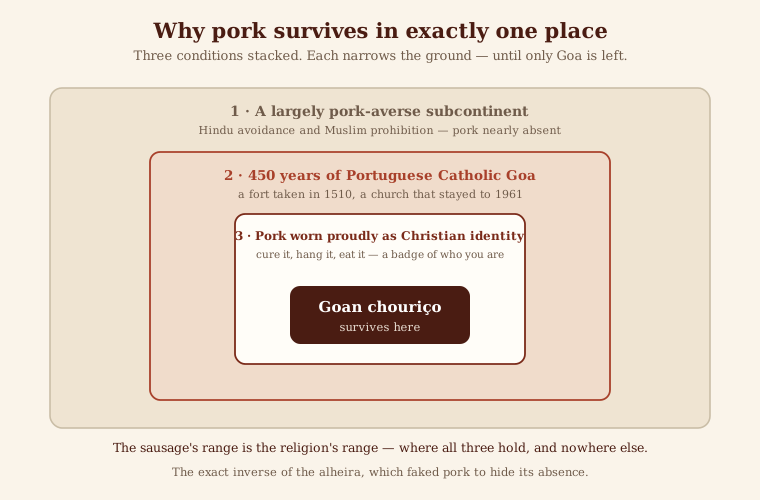
Religion decides whether the sausage exists at all — pork survives here because it became Christian identity, worn proudly where the alheira wore anti-pork camouflage. Empire decides where it exists — the sausage’s range is the range of 450 years of Portuguese Catholic rule, which is why you find it pooled in Goa and Bombay and not smeared evenly across the map. And climate decides what it tastes like — the monsoon killed European air-drying, so vinegar, feni, salt, and an American chile stood in for the missing hurdle, and the sour-hot-red profile that reads as pure Indian fire is really a preservation adaptation wearing a flavor’s clothing.
That’s the thing I keep relearning across this entire history: a sausage is never just a recipe. It’s a decision about time, made under a specific sky, by a specific people, for reasons that are half stomach and half self. Goa says all three of those at once, in a single vinegar-soaked, chile-red link. The whole family, and how these branches connect, is laid out on the family tree; the master hub is here; and if you want to build in this direction, the collection has a Goan sausage, the ancestral chouriço, and the vindaloo that shares its vinegar-and-pork soul.
This is one page of the wider-world history of sausage. Next: the Columbian Exchange, where I follow that American chile all the way around the planet and watch it turn sausages red on four continents — the same seed that reddened Iberian chorizo and set Goan chouriço on fire. The rest of the far-flung branches — Southeast Asia and Africa — sit alongside this one, and the whole shape lives on the family tree.
Comments (0)