Cajun and Creole: Two French Words, a German Smokehouse, and a Sausage Full of Rice
This is the page I’ve been waiting to write, because it’s the one closest to my own bench. I have six andouille recipes in my collection and I make boudin, and I have made both of them enough times to have opinions about grind and smoke and how wet the rice should be when it goes in. So when I tell you that most of what gets said about Louisiana sausage is confused, I’m not saying it from the outside. I’m saying it as a guy who has stuffed a lot of pork shoulder into a lot of casings under the name “andouille” and never once put a length of pig intestine in any of it.
Over on the France page I laid out the word andouille and how it names three completely different sausages, and I promised you that the Louisiana branch would get its full treatment here rather than there. This is that treatment. I’m not going to re-derive the etymology — go read the France page if you want the Latin, it’s a good story and it belongs over there — because the point of this page isn’t where the word came from. It’s what Louisiana did with two French words after they got off the boat. And what Louisiana did is one of the great transformations in all of sausage history: it kept the French names andouille and boudin, and it hung them on two sausages that a French charcutier wouldn’t recognize, built by a different people, around a different grain, over a different smoke.
Here’s the whole page in one sentence, and then we’ll walk it: Cajun andouille is partly German, and Cajun boudin is a rice sausage. Both of those are corrections to things nearly everyone believes, and both of them are true.
The correction that reorganizes everything: andouille is not just French
Let me hit the big one first, because it’s the one I care most about.
You will hear — I’ve heard it my whole cooking life, and I half-believed it for years — that Cajun andouille is just French andouille that crossed the Atlantic. French word, French colonists, French Louisiana, done. It’s tidy, it sounds obviously right, and it is wrong in a way that erases the two most interesting things about the sausage.
Start with what Cajun andouille actually is, at the bench, in my hands. It is a coarse, heavily smoked pork-shoulder sausage. Chunks of lean pork butt — I’m talking chunks, not a fine grind, sometimes hand-cut so you get that irregular, muscular texture — seasoned simply with garlic, salt, black pepper, and cayenne, stuffed into a casing, and then smoked for hours over smoldering hardwood, traditionally pecan, often a heavy double smoke. That’s it. That’s the sausage that goes into gumbo and jambalaya and red beans and rice and gives them their backbone.
Now hold that next to the French andouille de Vire I described on the other page — a tripe-and-chitterling sausage, cold-smoked, sliced cold, offal from end to end, the guts are the meat. They are not the same food. They are not variants of the same food. The Cajun version is muscle meat where the French version is intestine; it’s hot-smoked where the French is cold-smoked; it’s a cooking sausage where the French is a charcuterie-board sausage. What they share is a spelling, and almost literally nothing else. I have never put a chitterling in an andouille and I never will, and that’s not me taking a shortcut — it’s me making the actual Louisiana sausage, which never had chitterlings in it to begin with.
So if it’s not French andouille that emigrated, where did this sausage come from? Here’s the part that makes it a great story instead of just a correction.
The German Coast
Go up the Mississippi from New Orleans and you hit a stretch of river parishes — St. John the Baptist and St. Charles — that has been called, since the early 1700s, the Côte des Allemands. The German Coast. Rhineland Germans settled it, and they brought the one thing that Germans bring to every place they land: sausage-making and smoking as a serious, systematic craft. That craft, run through French and Black Creole cooking, sitting on top of Louisiana’s cheap and abundant pork, is where Cajun andouille came from.
The peppery heat and that characteristic heavy pecan smoke are a German boucherie inheritance, not a French one. Think about what that means for the genealogy. Cajun andouille is: a French word, wrapped around a pork-shoulder sausage, that owes its defining technique — the heavy preserving smoke — to German butchers, working in a French-Louisiana place, in a food culture that Black and Creole cooks shaped as much as anyone. That’s three or four cultures braided into a single link, and “it’s just French andouille that crossed the ocean” erases all of them but one. It keeps the French flag flying over a sausage that is at least as much German as French, and that is why I keep hammering it.
LaPlace, down in St. John the Baptist Parish, is the heart of it — it took the title “Andouille Capital of the World” in 1972, and if you drive through you’ll see andouille smokehouses the way you’d see barbecue joints in Texas. The commercial anchor everybody points to is the Jacob family. Their own account — and I want to flag this clearly as their account, the company’s history rather than an independently verified fact — is that the Jacobs came from Germany in the 1750s, that Nelson and Camille Jacob opened a store in 1928 and were “the first to make and sell andouille commercially,” and that they moved the operation to LaPlace in 1947. The “first commercial” claim is the kind of thing a business says about itself, so take it as heritage marketing rather than settled record. But the shape of it — German family, German name, andouille in LaPlace — tells you exactly which tradition this sausage sits in. It’s a German name on a German-smoked sausage in the capital of French-named Louisiana pork.
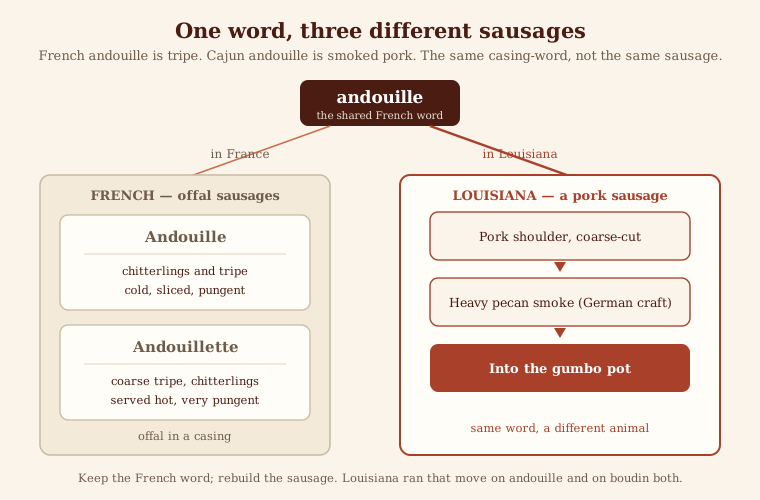
If you want the version I actually make, it’s at /recipes/?q=andouille. Just know, when you search that word, that you’re looking for the great-grandchild of a French word and a German technique, not a French sausage.
The second correction: boudin is a rice sausage
Now the other French word Louisiana kept and rebuilt, and this one hits my own recipe collection, so I have to be honest about a fix I need to make in my own files.
French boudin, by the 1300s, split two ways: boudin noir, the blood sausage, and boudin blanc, a smooth, pale, delicate sausage of finely worked white meat, milk or cream, sometimes bread, poached gently and eaten soft — a charcuterie showpiece, the kind of thing that shows up on a Christmas table in France. That’s the French boudin blanc. Keep its picture in your head, because Louisiana is about to hand you something with the same name that is nothing like it.
Cajun boudin is, at its core, “dirty rice in a casing.” It’s pork — traditionally with a good measure of pork liver in the mix, which is where a lot of its savor comes from — cooked down with onions and the trinity and cayenne, then bound with a big proportion of cooked rice, and stuffed into casings and gently steamed or simmered so it’s ready to eat warm. You squeeze it out of the casing as often as you slice it. Rice is the tell. Rice is the whole difference. A French boudin blanc has no rice in it and would be horrified at the suggestion; a Cajun boudin without rice isn’t Cajun boudin.
And here’s the part I love, because it’s datable, which so little of folk food history is: the first recorded reference to rice in boudin shows up in the Lafayette Daily Advertiser in 1939. Commercial boudin sales in Acadiana trace to roughly the 1920s through 1940s. So we can actually watch the sausage become itself in the record — the French paste sausage arriving with colonization, and then Louisiana Creolizing it so thoroughly that by the mid-twentieth century the defining ingredient is a grain that was never in the French original. There would be no Cajun boudin without French boudin, sure. But it is fundamentally a different sausage, and the thing that made it different is rice. It’s the same move as the andouille, run a second time: keep the word, rebuild the thing.
The mislabel in my own collection
I have to stop and own something here, because this dive’s whole ethic is that the corrections are the product, and the correction lands on my own shelf.
I have two recipes filed as boudin blanc in my collection. On any normal Louisiana reading, those are almost certainly Cajun rice boudin, not French boudin blanc — which is one of the most common mislabels in all of American sausage-making. “Boudin blanc” in a Cajun context just means the ordinary white boudin, the pork-and-rice everyday kind with no blood in it, as opposed to boudin rouge. It has nothing to do with the French milk-and-veal paste. The two sausages share a name and a color word and not one thing else. I’m flagging it here in plain sight rather than quietly “fixing” it, because I want to actually look at those two recipes before I rename anything — if they’ve got rice and liver and cayenne, they’re Cajun boudin and the label is wrong, and I’ll correct it. If by some chance one really is a French-style poached paste, it stays. But I’d bet the pig on rice.
“Hot boudin” is not a third kind
While we’re clearing up boudin vocabulary, kill one more piece of confusion before it starts. You’ll hear “hot boudin,” most famously in the old Cajun rhyme — hot boudin, cold couche-couche, come on gal and shake yo’ pooch — and it’s easy to assume “hot boudin” is a distinct type of sausage sitting alongside boudin blanc and boudin rouge. It isn’t. “Hot” means spicy-and-warm, not a separate sausage. It’s the same white pork-and-rice boudin, seasoned with cayenne and eaten hot out of the steamer at the meat market counter. It’s a serving state and a spice level, not a category. Boudin blanc (Cajun sense) and hot boudin are the same thing described two different ways.
Make one at /recipes/?q=boudin — and if you’ve only ever had the French kind, or worse, only read about the French kind, be ready for a completely different animal.
Boudin rouge, and why it (almost) disappeared for a real reason
There’s a third boudin, and its near-extinction tells you more about Louisiana food than any recipe could.
Boudin rouge is the blood boudin — the same pork-and-rice base, plus fresh pig’s blood, which turns it deep crimson and gives it that dense, metallic, iron-rich richness that blood sausage has everywhere in the world. It’s the Louisiana member of the great blood-sausage family, cousin to the French boudin noir, the Spanish and Portuguese morcillas, the British and Irish black puddings — all of which get their proper treatment on the blood and offal page, so I’ll keep it short here and just point you there.
What matters on this page is why boudin rouge nearly vanished, because the usual telling gets it wrong. It didn’t fade because tastes got squeamish or because it went out of fashion. It faded for a concrete, documentable reason: you need fresh pig’s blood to make it, and collecting fresh blood ran headlong into modern health codes. Once you can’t legally collect and sell fresh blood, you can’t make boudin rouge, full stop. And the place where you used to get that blood — the communal hog kill where the animal was opened and the blood caught within the hour — is exactly the institution that collapsed in the mid-twentieth century. So boudin rouge didn’t die of neglect. It died because its two necessary conditions, fresh blood and the boucherie, both got regulated and modernized out from under it. That’s a sausage killed by a health code and a refrigerator, not by a change of heart. It’s the same short clock that governs every blood sausage: you make it at the killing, from the blood of the killing, or you don’t make it at all.
The boucherie: the engine under all of it
I keep mentioning the boucherie, and it’s time to give it the center of the page, because it’s not a footnote to Cajun sausage — it’s the thing that produced Cajun sausage. Everything on this page comes out of it.
The boucherie was the communal hog butchery, and it was the social and economic engine of rural Acadiana before refrigeration. Here’s how it worked: several families took turns supplying a pig. On the appointed day — usually cold weather, when a fresh-killed hog could be worked safely — everybody gathered at one household, killed and broke down the animal together, and used every single part of it, that day and into the following weeks. Nothing was wasted, because in a world without a freezer, waste was the same as starving.
And this is the beautiful thing, the reason the boucherie explains the whole page: each product on this page is the boucherie’s answer to a different part of the hog.
| The part of the hog | What the boucherie made of it | On this page |
|---|---|---|
| Fresh muscle meat, eaten that day | Roasts, backbone stew, fresh sausage | — |
| Lean shoulder, chopped and hand-stuffed | Andouille — smoked hard to preserve it | the German smoke |
| Trimmings, organ meat, and rice | Boudin (blanc/hot) — stretch the pig with grain | the rice sausage |
| Fresh blood, caught at the kill | Boudin rouge — made within the hour | the blood boudin |
| Skin and fat back | Cracklins (gratons) — fried in the hog’s own lard | below |
| Shoulder strips, seasoned and smoked | Tasso — a seasoning meat, not a link | below |
Read that column top to bottom and you understand the sausages instantly. The heavy smoke on the andouille was preservation — no refrigeration, so smoke it hard and it keeps. The rice in the boudin was extension — stretch a limited amount of pig and offal across more meals with a cheap, abundant grain. The blood boudin was speed — use the single most perishable thing the animal has, right now, before it spoils. Three different sausages, three different answers to the same question: what do you do with a whole hog and no way to keep it cold? The boucherie asked that question every winter, and the answers are still on Louisiana plates.
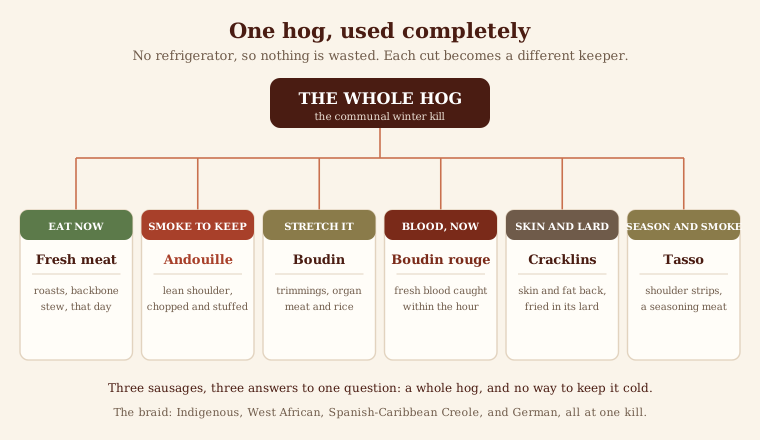
And here’s the cultural point that ties this page back to the rest of the section: the boucherie’s braid is Indigenous, West African, Spanish-Caribbean Creole, and German, all at one hog kill. That’s the same multi-strand colonial braid the Caribbean page describes on the islands, transplanted to the bayou. The Germans brought the smoke, the Africans and Creoles brought seasoning and technique, the Spanish-Caribbean connection brought the rice-and-pork instinct, and the whole thing ran on a French social framework in a French-named place. Louisiana sausage is a braid, and the boucherie is where the strands got woven.
The working boucherie — the necessity — died by the mid-twentieth century, killed by exactly the forces that killed boudin rouge: refrigeration, the supermarket, and the health code. What survives today is the boucherie as celebration — a heritage event with music and food and a crowd, a way of remembering the thing rather than needing it. But every andouille smoker and every boudin counter in Acadiana is a piece of it still running commercially, which is more than most old foodways can say.
Tasso and cracklins: the boucherie’s other children (and one of them is not a sausage)
Two more products come off the same hog, and I want to include them because they’re inseparable from the andouille-and-boudin story, even though I have to be straight about a category line.
Tasso gets grouped with andouille and boudin as Louisiana’s “pork trinity,” and it belongs in that company at the table — but I have to flag it plainly: tasso is not technically a sausage. It’s seasoned, smoked pork — traditionally strips of shoulder or trim, rubbed heavily with cayenne, garlic, and spice, and smoked. There’s no grinding, no stuffing, no casing. It’s a cured-and-smoked meat, not a link. And it’s not really eaten on its own the way you’d eat a sausage; it’s a seasoning meat, chopped small and thrown into gumbo, red beans, greens, or these days a tasso mac and cheese, where it does the flavoring work that a ham hock or a piece of bacon might do elsewhere. So enjoy it, cook with it, group it with andouille and boudin all you like — just don’t call it a sausage, because it isn’t one, and this dive doesn’t let a shared table blur a real category line.
Cracklins — gratons or grattons in French — are the other one, and they’re not a sausage either, but they’re the purest expression of the boucherie’s use-everything ethic. Pork skin, usually with a layer of fat and sometimes a little meat left on, cut up and fried in hog lard until it pops and puffs and floats. The old test is that they’re done “when they pop and form eyes.” They’re the by-product that proves the point: at a boucherie, even the skin became food, fried in the animal’s own rendered fat. Nothing left over. Nothing wasted.
What I take from all this to my own bench
I make Cajun andouille and boudin in Michigan, a long way from any German Coast smokehouse or any winter boucherie, and you might reasonably ask what a communal hog kill on the Mississippi in 1750 has to do with my Tuesday grind day. More than you’d think — two things, same as the French page left me with two things.
The first is the andouille lesson, which is really the lesson of this whole wider-world section: a name can hide a completely different sausage, and it will fool you if you let it. Cajun andouille kept a French word and quietly became a German-smoked pork-shoulder sausage. Cajun boudin kept a French word and quietly became a rice sausage. In both cases the tidy story — “it’s the French one that crossed the ocean” — is confident, satisfying, and wrong, and it erases the actual people who made the actual food. So when I hear a food name now, I’ve trained myself to stop and ask two questions before I believe anything: what is it actually made of, and who actually made it what it is? Ask those about andouille and the answer comes back pork shoulder and German butchers, not chitterlings and Normandy. Ask them about my own two “boudin blanc” recipes and the answer is probably rice, not a French milk paste. Half the myths in food fall apart the second you ask those two questions at the bench instead of taking the name’s word for it.
The second is the boucherie logic — the use-everything, waste-nothing, the-technique-is-a-response-to-the-constraint way of thinking. I have a freezer and a grocery store, so I don’t need to smoke my andouille to preserve it or stretch my boudin with rice to make the pig go further. But I do both anyway, because the technique is the sausage. Take the smoke off the andouille and you’ve got seasoned pork; take the rice out of the boudin and you’ve got a liver-and-pork mush with no name. The constraints created the flavor, and the flavor outlived the constraints. That’s the deepest thing the boucherie has to teach a modern maker: the old necessities are gone, but the sausages they invented are worth making for their own sake, exactly as they were, smoke and rice and all.
That’s Cajun and Creole sausage: two French words, a German smokehouse, and a casing full of rice. Andouille kept the word and took the German smoke; boudin kept the word and took the Louisiana rice; boudin rouge kept the blood and lost the fight with the health code; and the boucherie underneath all of it is the engine that made every one of them make sense. It’s my favorite corner of the whole family, and now you know why the words on the label were lying to you the whole time — and what they were lying about.
The whole sprawling family — how this Louisiana branch grew out of the French word and the German craft, and how it sits beside its cousins — is laid out on the family tree. The blood side of the story lives on blood and offal. And my own six andouilles and my boudin are in the collection, where the mislabeled “boudin blanc” pair is waiting for me to go fix it.
Part of the wider-world history of sausage. Next: Mexico — where chorizo becomes a fresh, crumbled, chile-and-vinegar sausage that shares only a word with the Spanish dry-cured kind, the same name-collision trick this page just watched Louisiana play with “andouille.” See also American regional and the frontier, where more European sausages became something new on this side of the ocean.
Comments (0)