The Columbian Exchange: The Sausage Map of the Americas Did Not Exist Before 1492
Everything in this section of the history turns on one date, so I want to put it at the very top and then spend the rest of the page earning it. Before 1492, there was no such thing as an American sausage — not a chorizo, not an andouille, not a boudin, not a longaniza — because the animal you make them out of had never set foot on the two continents. There was no pig here. And in the same stroke, half of what we think of as “Old World” sausage flavor didn’t exist over there yet either, because the plant that gives it heat and color was growing only on this side of the ocean and nobody in Spain, Hungary, or Calabria had ever tasted it.
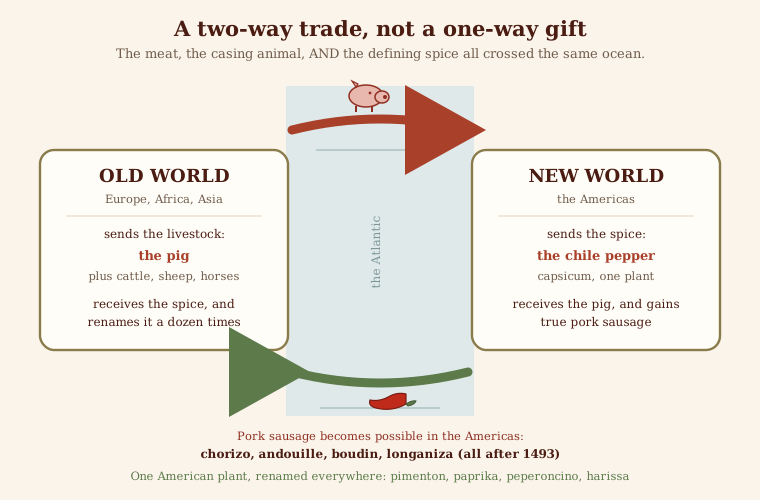
That is the pivot. When Columbus’s ships started crossing back and forth, the exchange ran both ways at once, and it rewrote sausage on every continent that had one. The Old World shipped the meat west. The New World shipped the spice east. And within a couple of generations, the two halves of a sausage that people now swear is ancient and local — the pork and the paprika, the pig and the pepper — had traded hemispheres and met up again in a form that had never existed before.
I’ve been at a grinder for forty years, and this is the single most reorganizing fact I know about the craft. It’s the hinge that every other page in this “wider world” section hangs off of. Every American sausage I’ll write about — Mexican chorizo, Cajun andouille and boudin, the sausages of South America — is downstream of the crossing described on this page. So let me lay out what actually crossed, which way, and when, and then flag honestly the parts where the exact dates are still argued over. Because the corrections are the whole point of this history, and there are good ones here.
The one fact that starts everything: there was no pig in the pre-Columbian Americas
Here is the plain statement, and it’s as solid as anything in this section: there were no domestic pigs anywhere in the Americas before Columbus. None. Not in Mexico, not in the Andes, not on the plains, not in the Caribbean. The whole family of true swine — Suidae, the animal every pork sausage on earth is made from — simply did not live in the Western Hemisphere. The peoples of the Americas raised turkeys, guinea pigs (which are rodents, not pigs, name notwithstanding), muscovy ducks, dogs in some places, and in the Andes the llama and alpaca. What they did not have, anywhere, was a pig.
The pig arrived by ship, and we can pin the trip. Columbus carried eight pigs from the Canary Islands on his second voyage, in 1493, reportedly at Queen Isabella’s insistence, and landed them in the Caribbean. Of all the livestock the Spanish brought, the pig was the runaway success — it adapted fastest, foraged on anything, and bred faster than anything else they turned loose. Within decades feral and semi-feral hogs had spread across the islands and onto the mainland ahead of the colonists themselves. On the North American mainland the swine came later; the herds Hernando de Soto drove through the Southeast in 1539 are usually cited as the first pigs to walk the future United States, and they were the descendants of exactly this Iberian stock. There’s even a genetic tail to the story: studies of the old “Criollo” pigs of Latin America still read a lasting Iberian signature in their DNA. The pig that got off the boat left its fingerprints in every pig that came after.
Sit with what that means for sausage. A sausage is, at its heart, a pig taken apart and put back together to last the winter — I make that argument at length back on the origins page. So if there was no pig, there was no pork sausage, and there could not have been. Every chorizo, every longaniza, every andouille, every boudin, every chaurice and linguiça made anywhere in the Americas descends from animals that arrived by sail after 1493. The Mexican chorizo I build in my own kitchen because I can’t buy a decent one in the States; the Cajun andouille I love; the Puerto Rican longaniza; the Argentine and Brazilian pork sausages — all of it is post-1493. The American sausage map is not old. It’s younger than the Sistine Chapel ceiling.
That’s not a knock on any of it. A tradition doesn’t have to be ancient to be real, and five hundred years is plenty of time to build something magnificent — the old-world chorizo homeland itself only got its defining ingredient in the same window, as we’re about to see. But it does mean that when someone tells you a New World pork sausage is a “pre-Columbian tradition,” they’ve said something that can’t be true. There was nothing to grind.
The peccary is not a pig, and it’s worth getting right
Now the correction that catches people out, because the Americas did have a pig-shaped animal, and it’s easy to assume that was the ancestor. It wasn’t.
The animal is the peccary — the javelina, if you’re from the Southwest — and it belongs to a separate family, Tayassuidae, not to the true swine of Suidae. It looks porcine at a glance: same rough body plan, snout, tusks, a taste for rooting. But it’s a different branch of the tree entirely, the way a jackrabbit is not a hare’s identical twin. Peccaries were hunted across the Americas for thousands of years, and in some places they were tamed enough to keep around a village. But they were never domesticated — never turned into a herd animal you breed, pen, fatten, and slaughter on a schedule — and, critically, no American pork sausage descends from them.
So the clean way to say it is this: peccary is not pig. The presence of a wild, pig-like animal in the pre-Columbian Americas does not give you a pre-Columbian pork sausage, any more than the presence of wild boar in a forest gives you salami. Domestication is the whole trick — the herd, the winter surplus, the fat animal you can plan a slaughter around — and the peccary was never brought across that line. Every domestic pig in the Americas, without exception, walked down a gangplank.
Cattle, sheep, and the horse crossed too
The pig gets the headline because pork carries most of the world’s sausage, but it wasn’t traveling alone. None of the major Old World meat and traction animals lived in the pre-Columbian Americas either — no cattle, no sheep, no goats, and, in a twist people find hard to believe, no horse. Horses had actually evolved in the Americas and then gone extinct here around ten thousand years back; the Spanish didn’t introduce the horse so much as re-introduce it to a continent it had vanished from. All of them crossed west in the same decades as the pig, and, freed of their Old World predators and diseases, their herds exploded across grasslands that had never grazed anything like them.
That matters for sausage beyond just the pork. The cattle that crossed are the reason beef can carry a sausage in the Americas at all, and the sheep are the reason lamb can. When I get to the South American and African pages, there are proud beef-and-lamb sausage traditions built entirely on animals the Exchange delivered — South African boerewors leans on beef; the Southern Cone runs on cattle. And there’s a quieter dependency most people never think about: the casing. A natural-cased sausage needs the guts of a slaughtered animal, and if the animal itself is an import, so is the casing. The pig didn’t just bring the meat across the ocean. It brought the wrapper.
The chile went the other way — and it became “the heat” in half the Old World’s sausages
Here’s where the exchange stops being a one-way delivery and becomes the two-way trade that makes this the pivot page. While the pig was sailing west, a plant was sailing east, and it did just as much to rewrite sausage on the far shore.
Chile — capsicum — is American. Every hot pepper and every sweet paprika pepper on earth traces to a wild ancestor in the Americas; a phylogenetic study a few years back places the origin in the Andes of western and northwestern South America, and Native Americans were already growing domesticated chiles by roughly 5000 BC, which makes it one of the oldest crops in the hemisphere. It is as American as the turkey. And it had never been seen, smelled, or tasted anywhere in Europe, Africa, or Asia before Columbus.
It crossed fast. The firm record has capsicum reaching Spain in 1493, brought back from Columbus’s second voyage by the fleet’s physician, Diego Álvarez Chanca, who wrote about the pepper’s medicinal punch. Once it landed it did something no sausage-maker would have predicted: it was received as an ornamental and a monastery curiosity. Europeans thought it was too fierce for an ordinary palate. Monks grew it in cloister gardens and cooked with it as a cheap stand-in for black pepper, which at the time was a costly import that came the long way around from Asia. A poor man couldn’t afford peppercorns; he could grow a chile bush. That “poor-man’s-pepper” arc — ornamental toy, then cheap substitute, then a naturalized crop nobody remembers importing — repeats almost word for word in every country the plant landed in. It’s the same story Hungary tells about paprika, which I’ll hand off in a second.
Now watch the plant fan out into a dozen “national” spices, each of which people now assume is ancient and local:
- Spain turned it into pimentón. The peppers were cultivated in the La Vera valley of Extremadura from the sixteenth century, and milled pepper powder worked its way into general Spanish cooking in the seventeenth. La Vera’s October is rainy, no good for sun-drying, so producers dried the peppers over smoldering oak fires for a week or two — and that smoke is why pimentón de la Vera is smoked, and why Spanish chorizo is that deep brick red with a whiff of woodsmoke. Which means chorizo’s whole defining color and flavor is a post-1493 American import, not some ancient Iberian birthright. I put the full pimentón story on the Spain and Portugal page; the point here is just that the thread starts on this page, on a ship.
- Hungary turned it into paprika, delivered up through the Ottoman frontier rather than straight from Spain. The plant went from the Americas to Iberia to the Ottoman world and got carried into the Hungarian plain by the Turks. Paprika is the pepper the Austria-Hungary page is built around, so I won’t retell it — but it’s the same American plant under a different name.
- Calabria turned it into peperoncino, and packed it by the fistful into pork. Chile reached Spanish-controlled southern Italy in the first half of the sixteenth century, and ‘nduja — the spreadable, fire-red Calabrian sausage — dates its origins to that same century, when farmers loaded the poorer cuts of pork with all the chile they could, for flavor and because in a region with no refrigeration the pepper helped the thing keep. The heat is functional as well as delicious; it’s doing preservation work.
- The Maghreb built it into harissa, the chile paste that colors and fires merguez, and Anatolia and the Balkans folded it into the red pepper that runs through sujuk. Both of those are older lamb-and-beef sausage traditions with a post-Columbian chile grafted on. The merguez thread I pick up on the Africa page.
So here’s the correction I most want to leave you with, because popular food writing gets it wrong constantly: paprika, pimentón, peperoncino, cayenne, and the chile in harissa are not old Old World spices. They are one American plant — Capsicum — that crossed the ocean after 1493 and got a new name in every country it settled in. You will read, all the time, that Hungarian paprika or Spanish smoked paprika is “ancient.” It cannot be. It is younger than the ocean crossing that carried the seed. The pepper that defines chorizo is exactly as old in Spain as the pig is in Mexico — both of them arrived on the same fleets, going opposite directions.
What crossed which way — the whole exchange on one table
I keep this table taped up in my head whenever I think about any sausage made after 1500, because it sorts out which half of the recipe came from where.
| Direction | What crossed | What it did to sausage |
|---|---|---|
| Old World → New World | The pig (Suidae) — 8 head, second voyage, 1493 | Made every American pork sausage possible: chorizo, longaniza, andouille, boudin, chaurice, linguiça — all post-1493 |
| Old World → New World | Cattle | The beef in New World beef sausages; also hides and casings |
| Old World → New World | Sheep and goats | The lamb and mutton in New World sausage; more casings |
| Old World → New World | The horse (re-introduced) | Herding at scale on the open range — the ranching that fed the meat supply |
| New World → Old World | Chile / capsicum | Became pimentón (Spain), paprika (Hungary), peperoncino / ‘nduja (Calabria), harissa (Maghreb), the red in sujuk — “the heat” of half the Old World’s sausages |
Read it top to bottom and the shape of the thing jumps out. The meat, the casing animal, and the defining spice all crossed the ocean — the first two heading one way, the last one heading the other, and the whole cast meeting back up in the New World to make sausages that had no ancestor. That’s the sentence I’d carve over the door of this section: before 1492 the Americas had no pig, no cattle, no sheep, and the Old World had no chile; after 1492 the meat, the casing animal, and the defining spice had all crossed, and the sausage map of both hemispheres was redrawn.
Where the abstraction becomes dinner: Mexican chorizo
If you want to see the whole crossing collapse into a single sausage you can hold in your hand, look at Mexican chorizo — which is my sausage, in the sense that I ate it constantly when I was in Mexico and I build my own now because a good one is next to impossible to find in the States. I go deep on it on its own page, but it belongs here too, because it is the exchange made edible.
Mexican chorizo is a Columbian-Exchange product through and through: Spanish sausage technique, plus American dried chiles, wrapped around a pig that Cortés brought across the Atlantic. The pork half arrived by ship — Cortés is recorded landing his personal pigs, cattle, and sheep in the Valle de Toluca by 1525, and by the end of that century Toluca was the chorizo capital of Mexico, a direct line you can draw from the deck of a Spanish ship to a specific sausage town. The chile half was already standing in the ground, the oldest thing on the plate, waiting five thousand years for the pig to show up so it could be a sausage. Neither half is complete on its own. The chorizo is the handshake.
And here’s the correction that lives on the Mexico page but is worth planting here so it doesn’t surprise you later: Mexican chorizo and Spanish chorizo are not two versions of one sausage — they are different categories of food that happen to share a name. Spanish chorizo is dry-cured and sliced, firm, ready to eat, its color coming from that smoked pimentón we just tracked across the ocean. Mexican chorizo is fresh and raw, squeezed out of its casing and crumbled into a hot pan, built on dried chiles and vinegar and cumin, and it must be cooked. One is cured charcuterie; the other is raw ground sausage-meat. They took the same name across the Atlantic and then became different things — which, if you think about it, is the most Columbian-Exchange thing a sausage could possibly do.
The dates I won’t pretend to have nailed down
I promised honesty about what’s solid and what’s still argued, and there are a few live disputes here that I’d rather show you than paper over. The big facts — no American pig before Columbus, chile is American, the pig came on the 1493 voyage — those are as firm as history gets. But when you push for the exact year the pepper reached each corner of the Old World, the sources start disagreeing, and I’m not going to invent a tidy answer where there isn’t one.
- Chile’s arrival in Spain: 1493 is firm; “third voyage” is not. The strong record has the pepper coming back with Chanca on the second voyage in 1493. But some accounts tied to the La Vera pimentón story say Columbus brought peppers on his third trip, later handing them to the Jerónimo monks at the Monastery of Yuste in Extremadura. The monastery-cultivation part is fine and probably true; the “third trip” date conflicts with the well-documented second-voyage record, so I take 1493, second voyage as the firm anchor and treat the third-voyage line as a soft detail that got repeated until it looked official.
- Chile’s arrival in Hungary: somewhere in the sixteenth century, but the year is contested. One convention hangs the introduction on the aftermath of the Battle of Mohács in 1526, when the Ottomans pushed into the Hungarian plain. A separate, stronger source has paprika in use in Hungary by 1569. Both are sixteenth century, both credit Ottoman delivery — the mechanism is solid, the year is soft. I state both and assert neither, and the fuller argument lives on the Austria-Hungary page where paprika belongs.
- Chile’s arrival in Calabria: roughly 1526, softly. The pepper reached Spanish-controlled Italy in the first half of the sixteenth century, with about 1526 as the figure that gets cited, and ‘nduja’s origins sit in that same century. Directionally certain, precisely fuzzy.
None of that wobble touches the spine of the page. Whether paprika reached Hungary in 1526 or 1569, it still can’t be older than the 1493 ocean crossing that first brought the plant to Spain — the argument is over which decade, not whether. The pepper is American either way. The pig is an import either way. The American sausage map is post-Columbian either way. The disputed years are the fine grain of a fact whose shape is not in doubt.
Why this is the page everything else turns on
I’ve made a lot of sausage, and I’ve read a lot of confident nonsense about where it comes from. The thing that finally organized it for me was realizing that 1492 is not one event in sausage history — it’s the fault line that the whole modern map of the craft is built along. Before it, the Old World and the New World each had their own sausages, sealed off from each other, and neither had ever tasted the other’s defining ingredient. After it, the pig and the chile had traded oceans, and out of that trade came a whole hemisphere’s worth of sausages that simply had not existed a generation earlier — and, going the other way, a “traditional” Old World heat that turns out to be an American import wearing a local name.
So when you make a chorizo, a boudin, an andouille — you are not doing an old-country thing that happens to have crossed the water. You are making a sausage that was invented by the crossing, out of a pig that sailed one way and a pepper that had been waiting on this shore for five thousand years. That’s the story every other page in this section tells a piece of. This is where it starts.
This is the pivot page of the wider-world history of sausage — the crossing that made all the rest possible. From here the pig and the chile go to work: next, Mexico, where the collision becomes chorizo on a hot pan; then Cajun and Creole Louisiana and South America, each a different descendant of the same eight pigs. The chile’s own journey east continues on Spain and Portugal and Austria-Hungary. The whole family, and how these histories fit together, is laid out on the family tree.
Comments (0)