China: Follow the Sugar, Follow the Smoke
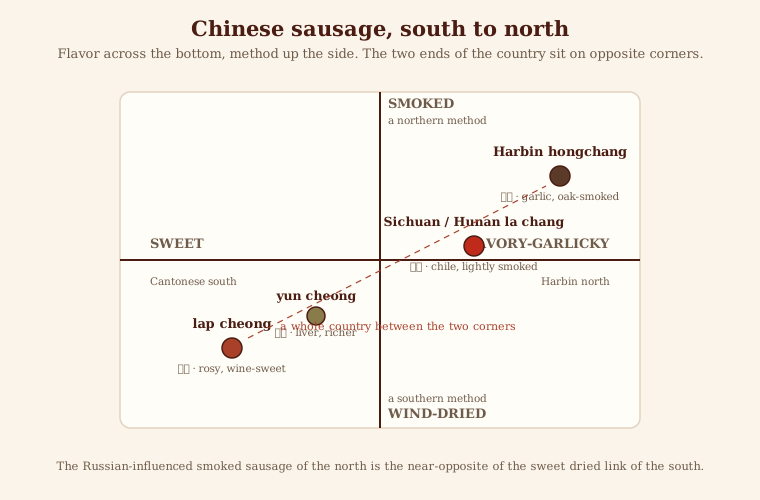
Here is the whole page in one sentence, and I’ll spend the rest of it earning the sentence: the entire map of Chinese sausage is drawn by two decisions — one about flavor and one about technique — and if you learn to read those two decisions you never need to memorize a single regional name again. The flavor decision is sweet. The technique decision is dry versus smoked. Get those two axes in your head and Chinese sausage stops being an intimidating list of characters and becomes a logic you can feel with your hands.
I make lap cheong. Not often, and not as well as the shops in a real Chinatown do, but often enough to have learned the thing that surprised me most about it: a Cantonese sausage is not built like any European sausage I grew up making. There is no smoke. There is, most of the time, no fermentation tang. There is sugar, which no sausage my grandfather ever touched had in it, and there is wine — a specific, perfumed, distilled wine that most English-language recipes get flatly wrong. So let me build this page around those two things, sugar and wine, and then show you the one place in China where the whole southern logic gets stood on its head — a smoked sausage in the frozen north whose name is, I am not kidding, “Lithuanian.”
Before any of that, the correction that clears the ground, because it’s the same shape as the ground-clearing I did on the origins page.
The number is 1,500 years, not 5,000
You will read, constantly, that Chinese sausage is “5,000 years old.” Treat that number the way you’d treat a butcher who won’t tell you where his pork came from — politely, and with your guard up.
The 5,000 comes from “5,000 years of Chinese civilization,” a phrase about a whole culture that has been quietly slid over onto one sausage. It does not survive being asked for a source. The first Chinese sausage anybody actually wrote down is in the Qimin Yaoshu, the sixth-century agricultural manual I go through in detail on the origins page — a mutton sausage, around 544 CE, chopped and spiced and stuffed into sheep gut. That’s roughly 1,500 years of documented history. It is a magnificent, genuinely ancient record. It is not five thousand years, and there’s no textual evidence for a Chinese sausage before about 300 CE at all.
I labor this because the real number is better. Fifteen hundred years is old enough that the sausage predates most of what people think of as Chinese cuisine — no chili yet (that’s a Columbian Exchange arrival, and a story I tell on its own page), a different world of spice and technique. A sausage that old doesn’t need a fake 5,000 to be impressive. It just needs telling honestly. And the same page reminds you of the other correction that belongs to origins and not here: lap cheong, the famous sweet one, is not the ancient one. The sweet cured pork version is credited to a Canton congee-shop owner around 1894. So when we talk about lap cheong below, we are talking about a sausage younger than the light bulb, riding on top of a fifteen-century-old tradition of stuffing cured meat into gut. Both true at once.
Ground cleared. Now the sugar.
Lap cheong, and the axis of sweet
Lap cheong (臘腸) is the glossy, deep-red, faintly translucent Cantonese pork sausage you’ve seen hanging in strings in every Chinatown window, or vacuum-sealed in flat cellophane packs at the Asian grocery. In Mandarin the same two characters read la chang; in the south, in Cantonese, it’s lap cheong, and that difference in pronunciation is going to turn out to matter a lot, so file it. The broader Mandarin word for this whole family of cured sausage is larou-adjacent — larou (臘肉) proper is cured slab pork, the belly and the cuts, while lachang is the stuffed sausage form of the same curing tradition. Same root, same 臘 character, and that character is the key to the whole thing.
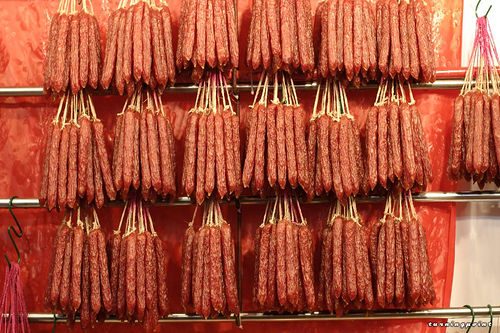
臘 (lap / la) means, roughly, “the twelfth lunar month,” the deep of winter, the season of cured provisions. So lap cheong reads out to something like “winter sausage” or “waxed-month intestine” — the sausage you make when the year is closing and the air has gone cold and dry, which is exactly the air you need to make it. The name is the method. This is a cold-weather, dry-air preservation sausage, and everything about how it’s built follows from that.
Here is how it’s built, and here is where a European sausage maker’s assumptions start breaking:
- Coarsely chopped pork and pork fat. Not a fine emulsion — you want distinct pieces, lean and fat kept somewhat separate so the finished sausage has that mosaic of ruby lean and translucent fat. The fat is a big fraction, and it’s supposed to be; when it dries it goes glassy and sweet.
- Sugar. A real, meaningful amount of it. This is the part that stopped me cold the first time. Every keeping sausage I learned as a kid was built on salt and smoke and, later, cure. Sugar was a background note if it was there at all. In lap cheong the sweetness is a lead flavor, balanced against salt and soy, and it isn’t a garnish — the sugar is doing preservation work too, tying up water the way salt does.
- Soy sauce, for color and for that deep savory salt.
- Rice wine — and one particular rose-scented spirit. This is the flavor fingerprint, and it’s the thing English recipes get wrong. I’m giving it its own section below because it deserves one.
And then, the technique decision: you air-dry it. You wind-dry it. You do not smoke it. The Cantonese hang these sausages in the cold, moving, dry winter air until they firm up and lose water and concentrate. No smokehouse. No fire. The preservation is salt plus sugar plus soy pulling water out, and then the dry moving air finishing the job. When I tell you the northern sausage later is smoked, I want you to feel how deep a difference that is — it’s not a garnish-level difference, it’s two entirely different answers to the question “how do I keep this pork from spoiling.”
The classic way to eat it, and the one I always come back to, is in clay-pot rice — bou zai faan (煲仔飯). You lay sliced lap cheong on top of rice as it cooks in a clay pot, and the sausage fat renders straight down into the grains, and the bottom of the pot forms a crackling browned crust that soaks up all of that sweet, winey, porky fat. If you have never had lap cheong doing its job, that’s the dish where it does it — the sausage is almost a seasoning for the rice rather than a thing you eat on its own. You can pull lap cheong recipes and clay-pot rice out of the collection if you want to try it.
The wine is a spirit, not a syrup — the “rose water” mistake
This is the correction I most want practitioners to carry away, because it’s the kind of small wrong thing that ruins a batch if you follow the recipe literally.
The perfume that defines Cantonese lap cheong — the thing that makes it smell like lap cheong and not just sweet cured pork — is Mei Gui Lu Jiu (玫瑰露酒). And a huge number of English-language recipes and articles translate that as “rose water.”
It is not rose water.
Rose water is a floral distillate you’d sprinkle into a Middle Eastern syrup or a Persian rice pudding — water carrying rose aromatics, no alcohol, sweet and soft and low. Mei Gui Lu Jiu is a distilled liquor. It’s a baijiu — a Chinese sorghum spirit, high-proof, hard-hitting grain alcohol — that has been infused with rose. It is a rose spirit or a rose wine, closer in spirit (pun intended) to a flavored vodka than to anything you’d call “water.” Rendering it “rose water” flattens a distilled rose liquor down into a floral syrup, and if you took that translation at face value and reached for the rose water at the baking aisle, you’d be building your sausage with the wrong ingredient class entirely — no alcohol, wrong intensity, wrong everything.
Why does the alcohol matter, not just the rose? Because the spirit is doing several jobs at once, the way alcohol does in a lot of cured meats. It carries aroma compounds that water can’t. It contributes to the surface environment as the sausage dries. And the rose riding on top of that high-proof base gives lap cheong its signature high, sweet, almost cosmetic-floral top note that sits over the pork and the soy. Take away the spirit and you’ve taken away the delivery vehicle for the whole perfume.
So the honest description of the lap cheong flavor axis is: sugar + rice wine / rose spirit + soy sauce, air-dried. Sweet, salty, winey, floral, and never smoky. If you see “rose water” in a lap cheong recipe, mentally swap it for “rose-infused baijiu” and you’ll be closer to what the sausage actually is. I’ll be honest about the one thing I won’t give you: a single canonical sugar-to-wine ratio. The recipe blogs vary wildly on the exact proportions, and I’m not going to print one number and pretend it’s the authentic formula when it isn’t settled. The identity of the ingredients is solid; the exact grams are a matter of house style, and every shop’s is a little different.
Yun cheong, the duck-liver cousin
There’s a second Cantonese sausage that hangs right next to the standard lap cheong and is worth knowing because it’s a genuinely different animal, not just a variant: yun cheong (膶腸), the liver sausage.
Where standard lap cheong is that bright translucent ruby, yun cheong is darker — brown, deep, more savory and mineral. The difference is liver: it’s made with pork liver, or often duck liver, worked in alongside the pork and pork fat. Same basic method — cured with sugar and wine and soy, wind-dried, not smoked — but the liver turns the color brown and pushes the flavor toward something deeper and more organ-forward, richer and less purely sweet than its pink sibling. If you’ve had a lap cheong that seemed unusually dark and savory, there’s a good chance it was yun cheong, or a mixed string with both. In a clay-pot rice, a slice or two of yun cheong among the lap cheong gives you that deeper backbone under the sweetness.
There’s a nice little language detail attached to this sausage, though I’ll flag it as folk-linguistics rather than hand it to you as fact. The straightforward character for “liver” is 肝 (gon), but gon sounds like the Cantonese word for “dry” or “empty” — an unlucky thing to name a food, especially a food of prosperity and abundance. So the story goes that Cantonese substitutes the character 膶 (yun), which carries a “moist / rich” connotation instead. It’s a charming detail and it fits the well-documented Cantonese habit of dodging unlucky homophones in food names — but I haven’t found a firm scholarly source nailing it down, so take it as a good story about how the sausage got its name, not as settled etymology.
The split: south wind-dries, north smokes
Now the big structural point of the whole page, the one the through-line hangs on.
Chinese sausage is not one tradition. There are at least two, and they are near-opposites, and the cleanest way to see it is a table. Everything above has been the southern, Cantonese, wind-dried, sweet line. Here’s how it sits against its northern opposite:
| South (Cantonese) — lap cheong | North — Harbin red sausage / hongchang | |
|---|---|---|
| Preservation | Air-dried / wind-dried in cold dry winter air | Smoked |
| Flavor lead | Sweet — sugar, rose spirit, soy | Savory, garlicky, meaty |
| Fat | Distinct glassy fat, big fraction | Emulsified European-style |
| Ancestry | Indigenous south-Chinese cured-meat tradition, ~1,500 yrs | 20th-century European transplant |
| Arrived by | (native) | The Russian-built railway, ~1900s |
| The word | lap cheong (Cantonese) | hongchang / lidaosi |
That last column is one of my favorite stories in this whole “wider world” section, so it gets its own heading. But sit with the table for a second first. The two most important Chinese sausages are physical inverses of each other. One is sweet and dried; the other is savory and smoked. One is old and indigenous; the other is barely a century old and walked in from Europe. If you only remember one thing about Chinese sausage, remember that it has two opposite poles — and that the northern pole is an immigrant.
(A footnote so I’m not lying by omission: the south isn’t only sweet. Sichuan and Hunan make their own cured la chang too, and theirs runs smoky and chili-hot rather than sweet — a chili that, again, only arrives with the Columbian Exchange. So “south = sweet, north = smoked” is the clean spine, and Sichuan-Hunan is the interesting middle case where the south borrows smoke and heat. The two-pole map is the frame; real geography always has a middle.)
Harbin red sausage: the sausage named “Lithuanian”
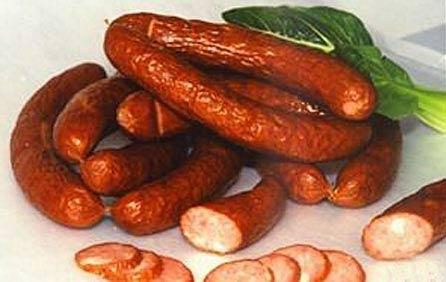
Up in the far northeast of China, in Manchuria, on the Songhua River, sits the city of Harbin. And Harbin makes a sausage that has no business, on first glance, being Chinese at all: Harbin red sausage — hongchang (紅腸), “red sausage.” It is a smoked pork sausage. It’s garlicky. It’s emulsified in the European style. It tastes, frankly, like something you’d find in a Baltic or Russian deli, because that is exactly where it came from — and the name proves it.
Because the other name for this sausage, the local name, is lidaosi (里道斯, also written 立道斯**)**. And lidaosi is not a Chinese word at all. It’s a transliteration — a Chinese phonetic spelling of the Russian колбаса литовская, kolbasa litovskaya, which means “Lithuanian sausage.”
Read that again, because it’s the whole thing. The Chinese name for this Chinese sausage is a Chinese pronunciation of the Russian words for “Lithuanian sausage.” The European origin isn’t a footnote you have to dig for — it is baked into the name the sausage carries in Harbin to this day. Lidaosi. Litovskaya. Lithuanian. You can hear Europe inside the Chinese word.
Here’s how it got there, and it’s one of the great “Europe reached China” stories. In the 1890s, Imperial Russia built the Chinese Eastern Railway across Manchuria — a rail line to shortcut the route to Vladivostok, cutting straight through northeastern China. Where the line crossed the Songhua River, a sleepy settlement exploded into a cosmopolitan boomtown, essentially a Russian-built city on Chinese soil, full of Russian engineers and merchants and workers and the whole apparatus of a European city dropped into Manchuria. That city was Harbin. And with the Europeans came European foodways — including cured and smoked meat.
The sausage itself is credited to the Churin company — in Chinese Qiulin, 秋林 — a trading house founded by the Siberian merchant Ivan Yakovlevich Churin, which ran a smokehouse in Harbin’s Daoli District. The people who actually made the sausage, who brought the curing and the smoking technique, are said to have been Lithuanian workers — hence litovskaya, hence lidaosi. Local production of the red sausage is usually dated to around 1909, with a Russian-run “European meat products” workshop as its predecessor from about 1900.
Now, an honesty note, because the corrections are the product here as everywhere in this section: the outline of this story is solid — Russian railway, Churin smokehouse, Lithuanian workers, European technique, the lidaosi = kolbasa litovskaya etymology — and it’s corroborated across multiple independent sources. But the precise year, that 1909, rests mostly on Chinese-language secondary sources and blogs, not on a primary document I can put in front of you. So take the mechanism as firmly established and the exact date as approximate. Somewhere around the first decade of the twentieth century, in a Russian-built railway boomtown, Lithuanian workers in a Siberian merchant’s smokehouse taught Harbin to make a smoked European sausage, and it stuck, and it became genuinely beloved across northern China. That’s the durable version.
And it stuck — that’s the part that makes it more than a curiosity. Harbin red sausage isn’t a museum piece or a tourist novelty. It’s an everyday food across the northeast, sold in the Qiulin shops and countless imitators, eaten sliced cold or in soups, a genuine pillar of the regional diet. An entire region of China cures its identity sausage by smoking it, in the European manner, because of a railway and a smokehouse and a crew of Lithuanians a hundred-some years ago.
This is why Harbin belongs on the same page as lap cheong and not off in some appendix. It’s the physical inverse of the Cantonese sausage in every dimension — smoked not dried, garlicky not sweet, European not Cantonese, an immigrant not a native — and holding the two of them up side by side is the single best way to understand that “Chinese sausage” is not one thing. And it hooks straight back to the old world: the same Baltic and Lithuanian sausage tradition I write about on the Nordics and Baltics page put down a root ten thousand kilometers away in Manchuria and grew a Chinese name for a Lithuanian sausage. If you ever wanted proof that these regional histories are one connected web and not a set of sealed boxes, it’s a smoked sausage in Harbin with a Russian word for “Lithuanian” spelled out in Chinese characters.
What the two poles teach a sausage maker
Let me bring it back to the bench, because I promised you a logic you could feel with your hands, not just a set of facts.
The two poles of Chinese sausage are two clean answers to the one question every sausage is an answer to — the question I keep coming back to across this whole history: how do you keep the meat from spoiling before you can eat it? Salt is the constant; it’s the floor under every sausage on earth. But past salt, you get to choose your hurdles, and China’s two traditions chose differently.
The south chose dryness. Sugar and salt and soy pull the water out, and then cold, dry, moving winter air — the “wind” in wind-dried — finishes the job, dropping the water activity until bacteria can’t get going. No smoke, because in that climate and that tradition you didn’t need it; the dry air did the work. The sweetness isn’t a decoration on top of the preservation — the sugar is part of the preservation, tying up water right alongside the salt. That’s the deep reason a keeping sausage in Guangdong can afford to be sweet in a way my grandfather’s kielbasa never was: down there, sugar is a preservative wearing a flavor’s clothes.
The north chose smoke. Harbin, and the Europeans who built it, brought the smokehouse tradition — the same tradition I run in my own backyard, the same one behind every sausage in my collection that sees a fire. Smoke lays antimicrobial phenols on the surface, dries the casing, and buys keeping time in a cold climate. It’s a completely different preservation philosophy, and it walked in on a railroad.
Neither is more “authentic” than the other. The wind-dried sweet southern sausage is older and indigenous; the smoked savory northern one is younger and imported — but a hundred years is plenty long enough to be genuinely, unarguably Chinese. A food doesn’t need a birth certificate that predates the neighbors to belong to a place. Harbin red sausage belongs to Harbin as thoroughly as lap cheong belongs to Guangzhou, even though one of them still wears a Russian word for “Lithuanian” as its name.
So: follow the sugar, and you’re in the south, in the cold dry wind, with a sweet ruby sausage rendering its fat into a pot of rice. Follow the smoke, and you’re in the frozen northeast, in a railway boomtown, with a garlicky European sausage that learned to speak Chinese. Two poles, two answers, one country. Learn to read the two axes and you’ve read the map.
This is the China page of the wider-world history of sausage. Next, the ledger of scarcity: Japan and Korea, where the headline sausages are made of fish and glass noodles because that’s what a shortage left on the table. From there, Southeast Asia — fresh herb, sour ferment, and raw fermented pork — and the Columbian Exchange, the chili’s long walk into every cuisine on this page. The ancient Chinese sausage lives back on the origins page; Harbin’s Baltic root is on the Nordics and Baltics; and the whole family fits together on the family tree.
Comments (0)