The Frontier: Making Sausage Out of What You Shot
This is the page I have the most standing to write, because this is what I actually do. I hunt — deer, bear, wild goose, wild turkey, rabbit, squirrel — and I turn a good part of what I bring home into sausage. Venison bratwurst, smoked wild goose, bear summer sausage, wild turkey Italian, a rabbit-and-pork link when the freezer’s got rabbit in it. So when I tell you the frontier sausage is a different animal from the farm sausage on the old-world pages, I don’t mean it romantically. I mean it solves two problems the farm sausage never had to, and one of them can put you in the hospital.
The first problem is fat, or the lack of it. Wild meat is too lean to be a sausage on its own — a straight venison link is dry, crumbly jerky-in-a-casing that won’t hold together. The second problem is a parasite. Some of the animals a hunter takes — the omnivores and the carnivores, bear above all — carry Trichinella, and the version of it that lives up here in the cold country is not killed by freezing. That second fact is the single most important thing on this page, it runs against the pork rule almost everyone carries in their head, and I’m going to spend real space on it, because it’s on my own bear recipe and I want it dead right.
Let me take the two problems in order — the easy one first, because it’s just craft, and then the one that’s a matter of not getting sick.
Lean meat won’t be a sausage: the fat you have to add back
Deer is about the leanest red meat you’ll ever grind. That’s a virtue on the plate — a venison backstrap is a beautiful, clean piece of eating — but it’s a liability in the stuffer. A sausage is an emulsion of lean and fat, and the fat isn’t there for richness first. It’s structure. Fat coats the protein strands, keeps them from binding into a dense rubber, carries the fat-soluble spice, and holds moisture so the finished link is a sausage and not a stick of dried leather. Grind pure venison, season it, stuff it, and cook it, and you’ll get something you could use to prop a door.
So you add pork fat back. Every serious wild-game maker does, and the near-universal fix is somewhere in the range of 20 to 33 percent pork — either fatty pork shoulder (butt), hard back fat, or in a pinch bacon. You’ll see it written as 75/25 venison-to-pork on the leaner end and 67/33 on the richer end, and honest recipes land all across that band depending on what they’re after. I want to be careful here, because you’ll read “add exactly one-third pork fat to game” stated as a law, and it isn’t one. It’s a range, and where you sit in it is a decision about the sausage you want.
| Game (lean) | Added pork | Roughly | What you get |
|---|---|---|---|
| Venison, elk, moose | ~25% | 75/25 | Leaner snack stick; firmer bite; less forgiving of overcooking |
| Venison, most red game | ~30% | 70/30 | The comfortable middle for summer sausage |
| Venison, goose, rabbit, richer sticks | ~33% | 67/33 | Moister, rounder; better for a slow-smoked stick that has to survive the smoker |
A couple of practitioner notes that took me a while to internalize. First, the leaner your game and the harder your processing, the more fat you want — a snack stick that’s going to spend hours in the smoker losing water needs the moisture reserve, so lean goose or a hard-smoked venison stick wants to sit at the top of that range, not the bottom. Second, the fat you add matters as much as the amount: hard back fat stays defined and gives you that clean fleck in a slice, where shoulder fat is softer and disappears into the grind. And third — this is the one that bites people — the same rule from every other page in this section applies here with a vengeance: keep it cold. Lean game is unforgiving, and a fat smear on a low-fat batter shows up as a greasy, hollow, chalky texture that you can’t cook your way out of. My rule off the grinding notes is meat near frozen, around 30°F, before it ever touches the plate. Warm venison and warm pork fat is how you turn thirty dollars of ingredients into dog treats.
The cure and the tang: one mechanism, two jobs
A venison summer sausage or snack stick isn’t just ground meat and fat. It’s a cured, fermented product, and both of those words are doing safety work, not just flavor work.
The cure is Cure #1 — sodium nitrite at 6.25 percent, cut with salt and dyed pink so you don’t mistake it for table salt. It’s here for color and for the cured flavor, but the reason it’s non-negotiable in a slow, warm-processed sausage is that it protects against Clostridium botulinum during the hours the meat spends in the danger zone while it smokes and ferments. This is the same Cure #1, not Cure #2, not Tender Quick distinction I harp on elsewhere — a summer sausage that gets cooked doesn’t want the nitrate reservoir of Cure #2; it wants the straight nitrite of #1.
The tang is the other half, and here’s the correction most people need: that bright, sour bite in a good summer sausage is not a spice. It’s fermentation. Lactic-acid bacteria — either a starter culture like Bactoferm, or a shortcut like Fermento, encapsulated citric acid, GDL, or even buttermilk powder — eat the sugar you added and drop the pH. That pH drop is the tang, and the same pH drop is what preserves the sausage and makes it shelf-stable. You cannot separate the two. The flavor you’re tasting is the safety mechanism working. This is exactly the logic I lay out for the old-world keeping sausages over on the Nordics and Baltics — ferment equals tang equals keeps, all one thing — and it’s why “summer sausage” is called that: it was made in the cold months, dried and stored, and eaten in summer without a cold room, back when that was the whole point.
That’s the venison sausage in one paragraph: lean meat, pork fat added back for structure, Cure #1 against botulism, a ferment for tang and shelf life. Hold that template, because it’s the frame for everything else a hunter makes — right up until you get to bear, where one more rule overrides all of it.
The keeping tradition is old, and it’s mine
Before the safety talk, I want to place this in a longer line, because the wild-game sausage isn’t a modern novelty — it’s one of the oldest ideas there is. A hunter kills an animal all at once, in the cold months, often far from home, and the meat has to last and has to travel. That’s the same prehistoric problem the very first sausages solved: an animal is killed all at once and the eating has to stretch. The frontier just kept solving it after most of the world had refrigerators.
You can see it in the old-world hunter’s sausages — the Polish myśliwska, juniper-scented pork sticks built to ride in a coat pocket through a day in the woods; the smoked, dried keeping links of the northern forests. Those were designed by and for people who spent the cold months outdoors, and when I make a batch of snack sticks to throw in a pack, I’m doing a thing that has an unbroken line back centuries. My whole wild-game corner of the collection is really a modern chapter of that tradition — I’ve just got a stuffer, a calibrated smoker, and a probe thermometer where my great-grandfather’s equivalent had a knife, a fire, and his hands.
Goose and the wild fowl
The waterfowl sausage sits a little apart, and I’ll be honest about what I can and can’t source. Smoked wild goose sausage is a real and common thing among hunters — I make it — and the logic is the same lean-game math: goose breast is dark, lean, strong-flavored, a little livery, and it wants pork fat blended in exactly like venison does, usually toward the richer end of that range and then smoked to tame the wildness. What I cannot hand you is a clean documented history of goose sausage the way I can trace kielbasa or bratwurst — there’s plenty of recipe, not much record. So I’ll present it as what it honestly is: a living hunter’s practice, the way a lot of us use up a season’s worth of dark waterfowl, and not a dish with a dated origin story I’d have to invent to give you.
One safety note that matters precisely because it’s different from the bear discussion coming up: waterfowl is not a trichinosis vector. Birds don’t carry it. Goose sausage is ordinary poultry-temperature handling — cook it through, keep it clean and cold on the way there — not the special case the bear demands. Don’t let the bear rules on the rest of this page bleed onto your goose. They’re different animals with different risks, and treating them the same is its own kind of error.
Reindeer: the frontier sausage as an everyday food
Before the safety section, one more piece of the tradition that surprises people: reindeer sausage is a genuine, everyday Alaskan staple, not a tourist gimmick. Reindeer and caribou are the same species — Rangifer tarandus — and in Alaska the meat gets ground into sausage as a matter of course. Reindeer hot dogs are an Anchorage street-cart institution; it’s normal food up there, not a curiosity.
And the reason it’s on this page is that it runs on the exact same math as my venison: reindeer is lean game, so it’s blended with pork and beef to make a workable sausage. The commercial makers have been at it for decades — Alaska Sausage & Seafood built its reindeer line off a German founder’s recipe going back to 1963, and Indian Valley Meats has processed game since 1976. What I like about the reindeer example is that it’s the commercial face of the frontier sausage: the same lean-meat-plus-added-fat problem I solve one deer at a time, solved at scale, on a cart, for people who eat it for lunch. The frontier sausage didn’t stay in the backwoods. It grew up into a business.
Bear, and the parasite that freezing won’t kill
Now the one that isn’t craft. This is the safety-critical core of the page, it’s on my own Bear Summer Sausage recipe, and I’m going to state it as plainly as I know how, because getting it wrong is the kind of wrong that hospitalizes people.
Bear meat is the number-one source of trichinellosis in the United States. In one CDC tally of 84 U.S. cases from 2008 to 2012, 41 of them — nearly half — came from bear meat. Black bears are common carriers. If you’re going to make bear sausage, you have accepted that you are working with the highest-risk game meat there is, and everything about how you finish it has to reflect that.
Here’s the part that catches even experienced hunters, because it inverts the rule they learned for pork. Most of us grew up on “freeze pork to kill trichinosis” — and for the pork parasite, Trichinella spiralis, that’s roughly true; standard freezing does the job. It does not work on bear. The species in bears and in Arctic and northern game are Trichinella nativa and the related genotype T6, and those are freeze-resistant. They are adapted to survive in animals that spend their lives frozen. Freezing does not reliably kill them.
This isn’t theory. The CDC documented a 2022 cluster — six people across Arizona, Minnesota, and South Dakota — who got sick from bear meat that had been frozen for about 45 days. Frozen a month and a half, and it still infected everyone who ate it undercooked. Freezing is not a kill step for bear. Write that on the inside of your skull.
So what does kill it? Heat, and only heat. The one reliable kill step is cooking the meat to a verified internal temperature of 165°F (74°C). That’s the CDC’s line, stated flat out after a 2023 North Carolina outbreak in which ten people got sick at a gathering where the bear was served undercooked: cooking wild game to an internal temperature of at least 165°F is necessary to kill Trichinella, and — their words — freezing might not be sufficient. In that outbreak the median time to getting sick was about three weeks, and nine of the ten came down with the facial swelling that’s a classic sign. A thermometer in the thickest part of the meat, reading 165°F, verified — that is the whole defense.
Why this is a sausage problem, not just a steak problem
Here’s where it gets specific to what we do on this page, and it’s the sentence I most need you to walk away with.
Curing, smoking, drying, and fermentation do not kill Trichinella. None of them. The parasite dies from temperature, full stop. It does not care about your pH, it does not care about your salt, it does not care that the sausage spent hours in the smoke and days losing water. A cold-smoked, air-dried, low-pH sausage that never reached a high enough internal temperature is exactly as dangerous as a raw bear steak — and it looks safe, because it looks and tastes like every other finished summer sausage you’ve made.
That’s the trap. A normal venison summer sausage or snack stick is a semi-dry product — you ferment it, you smoke it, you take it to a moderate internal temperature, and the low pH and reduced moisture do the preserving. That endpoint is fine for deer, because deer are not a trichinosis risk. But if that sausage is made from bear, the ordinary summer-sausage endpoint is not enough, because none of the steps that make it a summer sausage touch the parasite. A bear summer sausage must be taken all the way to a verified 165°F internal — every time, no exceptions. That is different from the endpoint you’d use for the same recipe in venison, and it is the single most important instruction on my bear recipe. You are not making a semi-dry fermented sausage that happens to be bear. You are making a fully cooked sausage that also happens to be fermented and smoked, and the cook to 165°F is the line between food and a parasite delivery system.
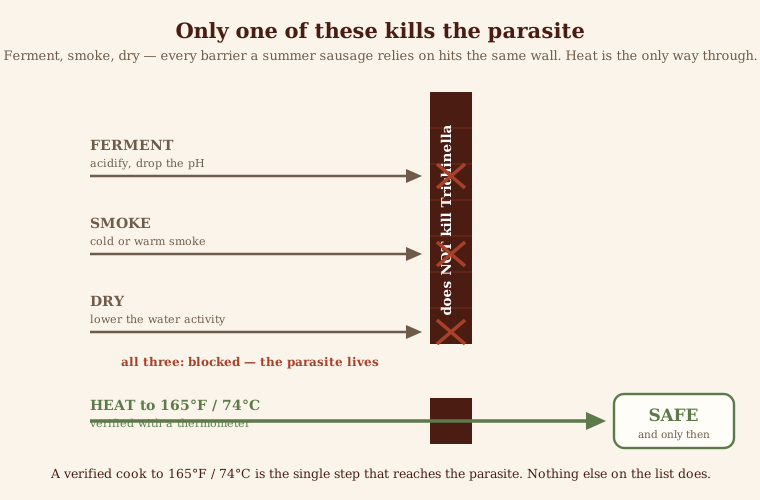
I want to add one honest note, and then close the door on it. You may run into a figure floating around that the parasite is inactivated at a lower temperature in the lab, and some cooks chase lower targets with long holds. I’m not going to print that number here, and I don’t cook bear to it. The reason is practical as much as it is cautious: getting a whole ground, stuffed sausage uniformly to any verified temperature is exactly the hard part — the center of a fat stick lags the surface badly — and the public-health number, the one every agency stands behind, is 165°F. On my own recipes and on any page anyone else might read and follow, that’s the only number that belongs in print. Use 165°F. Verify it with a thermometer, in the coldest part of the thickest link. Don’t improvise on this one.
Which game carries which risk
Because the whole point is don’t treat all game the same, here’s the sorting laid out. This is the table I wish someone had handed me early:
| Game | Trichinosis risk | The real constraint | Endpoint |
|---|---|---|---|
| Bear | High — the #1 U.S. source | Freeze-resistant T. nativa/T6; freezing does not kill it; no cure/smoke/ferment/dry kills it | Cook to a verified 165°F internal, every time |
| Wild boar / feral hog | Real; can carry Trichinella | Same parasite family; treat like bear, not like farm pork | Cook to a verified 165°F internal |
| Venison, elk, moose | Negligible — herbivores | Not a parasite problem at all; the issue is texture (too lean) | Normal semi-dry summer-sausage endpoint is fine |
| Rabbit, squirrel | Not a trichinosis vector | Ordinary clean-and-cold game handling (tularemia is the separate small-game caution — wear gloves field-dressing) | Cook through |
| Wild goose, turkey, waterfowl | Not a trichinosis vector — birds don’t carry it | Ordinary poultry-temperature handling | Cook through as poultry |
Read that top row and that third row together, because the contrast is the whole lesson. Bear and venison sit at opposite ends. With bear, the fat you add is a texture nicety and the temperature is a matter of not getting sick. With venison, there is no meaningful trichinosis risk at all — deer are herbivores, and trichinosis in venison is exceedingly rare — so the fat you add is only a texture-and-binding decision and nothing more. Don’t let the fear of bear make you paranoid about deer, and for God’s sake don’t let the ease of deer make you casual about bear. They are not the same, and the entire craft of the frontier sausage is knowing which animal you’re holding and what it demands.
What the frontier sausage really is
Strip it down and the frontier sausage is the old preservation machine, still running, adapted to two things the farm never faced. The meat is too lean, so you add fat back — a range, 20 to 33 percent pork, chosen for the sausage you want, kept cold so it doesn’t smear. And some of the animals carry a parasite that the cold won’t kill, so for bear you throw out the semi-dry playbook and cook the thing all the way through to a verified 165°F, because none of the other steps you trust will do it for you.
Everything else is the same craft I bring to any sausage: Cure #1 against botulism, a ferment for tang and keeping, a good grind on cold meat, patience in the smoke. But those two frontier facts — add the fat, verify the temperature — are the ones that separate a hunter who makes good sausage from a hunter who makes a mistake. I’ve been at this a long time, on my own deer and my own bear and my own geese, and I’ll tell you the truth: the fat ratio you’ll learn by feel in a season or two. The 165°F on bear you learn first, and you never, ever relax it.
Part of the wider world of sausage. Next: American regional — the immigrant map of U.S. sausage, where you can read the newcomer off the binder and the bread — and then industrial, where the factory made sausage cheap, safe, and identical by throwing away everything local about it. The Cajun branch gets its own page: Cajun and Creole. My own wild-game links live in the collection — search venison, summer sausage, goose, and bear.
Comments (0)