Beyond the Big Three
China, Japan and Korea get their own pages because they are the three traditions that diverged furthest from each other. But soy sauce travelled with Chinese migration everywhere in maritime Asia, and in several places it became something a Chinese cook would not recognise.
The pattern is consistent enough to state as a rule: the process stayed, the sweetener changed.
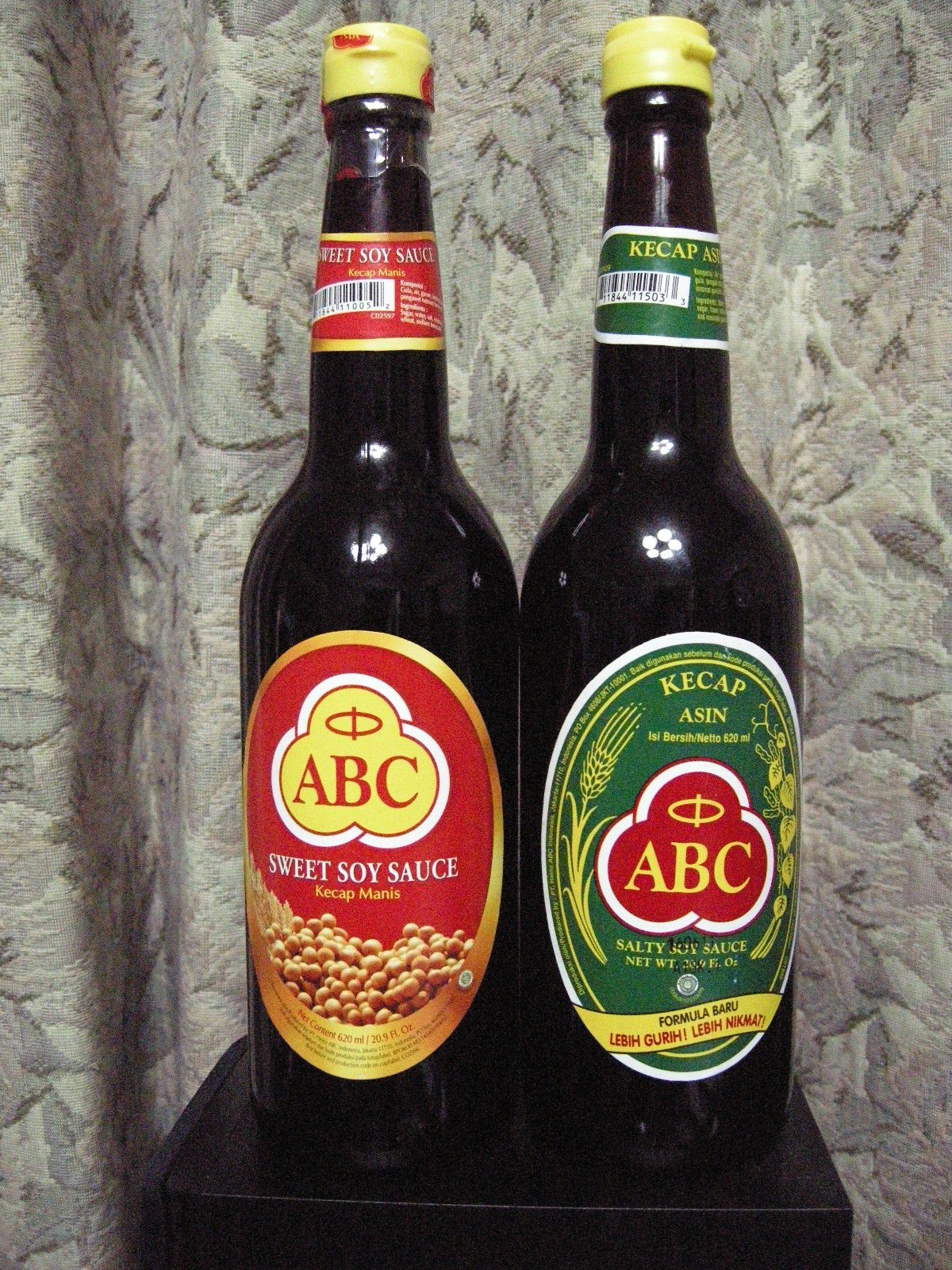
Indonesia: kecap, and the sweetest branch of the family
Indonesian kecap is the most radical divergence in the whole family, and the one most likely to surprise a cook expecting soy sauce.
Two products share the name:
- Kecap asin — “salty kecap.” Recognisably soy sauce: thin, dark, salty, close to a Chinese light soy.
- Kecap manis — “sweet kecap.” Thick, black, syrupy and intensely sweet, loaded with palm sugar (gula jawa) and usually aromatics such as star anise, galangal and garlic. It pours like molasses.
⭐ Kecap manis is not soy sauce with sugar stirred in. The sugar is added during production and is the dominant ingredient by mass in many formulations — which is why it behaves like a glaze rather than a seasoning. It caramelises, it burns, and it does in one step what a Chinese cook does with dark soy plus rock sugar.
Indonesian production also commonly uses a different mould — Aspergillus wentii — rather than A. oryzae, and works from black soybeans in traditional practice.
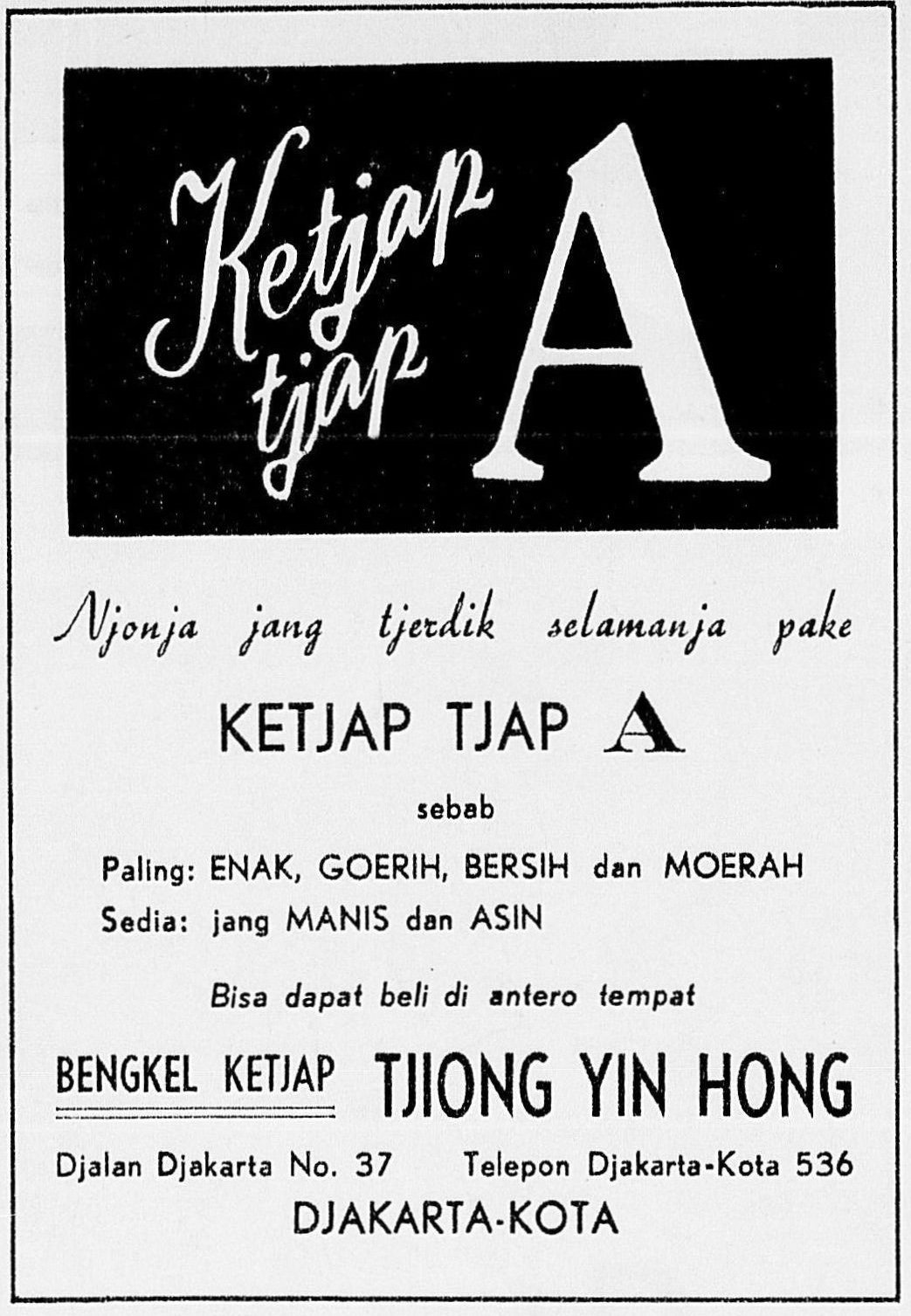
The advertisement above, from a 1943 Japanese-occupation-era Indonesian paper, sells “jang MANIS dan ASIN” — the sweet and the salty — from a Chinese-owned works in Jakarta. It is a neat compression of the whole history: a Chinese process, an Indonesian sweetener, a Dutch-orthography trade name, printed under a Japanese administration.
It is used in nasi goreng, mie goreng, satay marinades and dipping sauces, babi kecap, and as a table condiment poured over almost anything. ⚠ It is not a substitute for soy sauce and soy sauce is not a substitute for it. A dish calling for kecap manis and given Japanese shoyu will be salty, thin and wrong.
Taiwan: black bean, and a different bean entirely
Taiwan’s distinctive product is 蔭油 (in-iu in Taiwanese), made from black soybeans rather than yellow, typically without wheat, and fermented dry and slow in open earthenware jars rather than in a liquid mash.
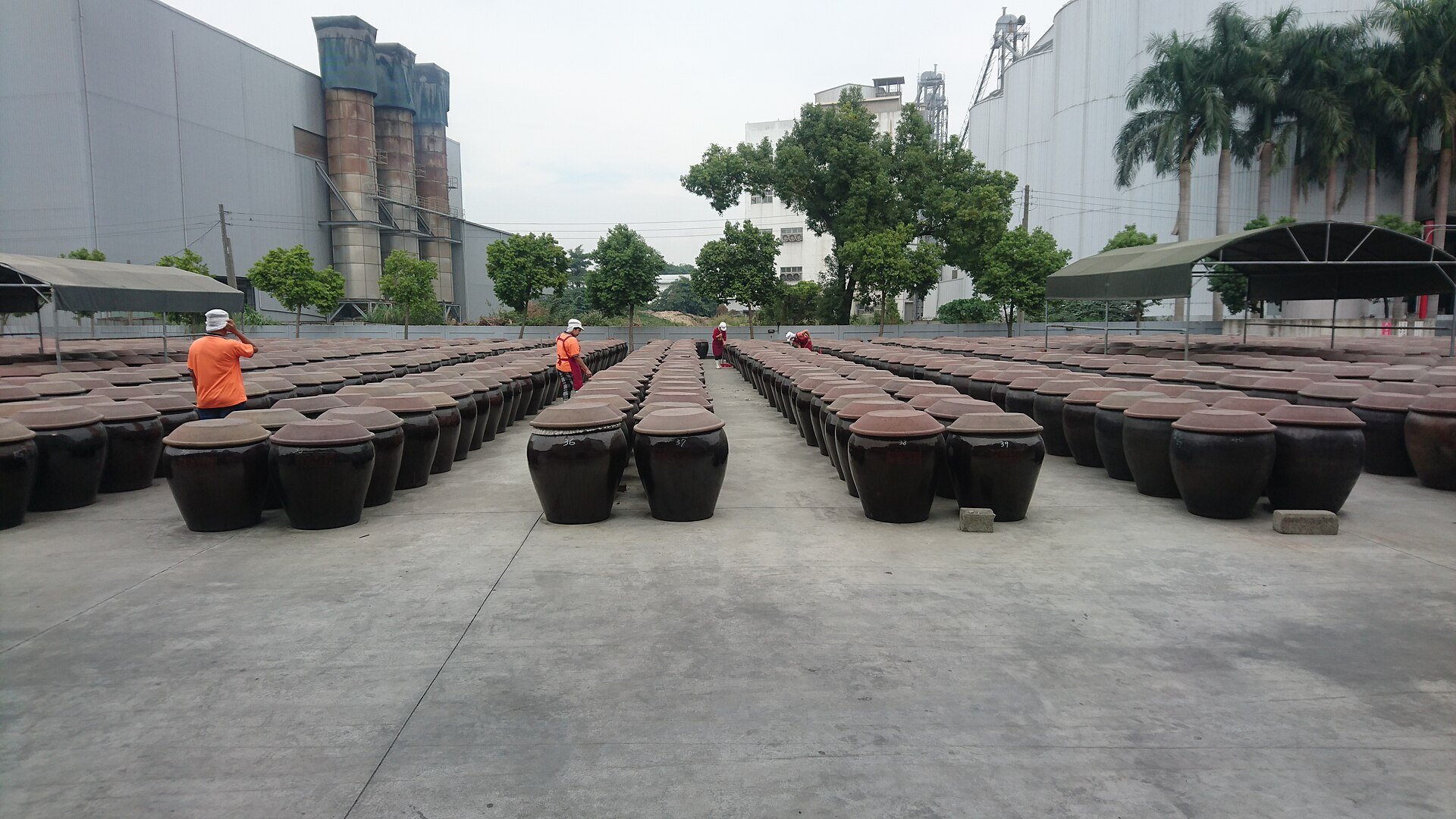
The photograph above shows jars maturing at Siluo, in Yunlin county, the town most associated with the style. The jars stand outdoors, uncovered to the sun by day, for months — a temperature cycle that is part of the method rather than an economy.
The result is thicker, less salty and noticeably sweeter and more rounded than a mainland light soy, and it is often sold in a thickened form (蔭油膏) for dipping. (The broad outline here is well attested; specific production figures were not verified for this dive.)
The rest of the map
- Philippines — toyo. Thin, salty, and typically lighter than Chinese light soy. Its defining use is toyomansi — toyo with calamansi juice — which is less a recipe than a reflex, and which makes the case that soy sauce wants acid as much as it wants fat.
- Vietnam — xì dầu / nước tương. Vietnamese usage is complicated by the fact that fish sauce occupies the seasoning role soy sauce holds elsewhere, so soy sauce is used more narrowly — with tofu, in vegetarian and Buddhist cooking, and in Chinese-influenced dishes.
- Malaysia and Singapore — kicap. Both kicap lemak (thick and sweet, close to kecap manis) and kicap cair (thin and salty), reflecting the Indonesian and Chinese influences meeting.
- Burma, Thailand, Cambodia. Soy sauce is present, usually in Chinese-derived dishes, and usually secondary to fish sauce.
- Hawaii. A distinct local shoyu culture grew from Japanese plantation migration, and it is the reason “shoyu chicken” is an American regional dish.
The contamination story that came with the spread
One thing did travel with the industrialisation of soy sauce across Asia, and it is not a flavour: acid-hydrolysed production, and the 3-MCPD contamination that comes with it.
Surveys through the late 1990s and 2000s found the problem regionally distributed, and the regulatory responses were regional too. Taiwan’s Department of Health reported in 2002 that 10 of 212 sampled soy sauces — just under 5% of the market — exceeded the safety limit for 3-MCPD. Comparable findings came from Vietnam, Bulgaria, Brazil, the United Kingdom, Singapore and the United States.
⭐ The distribution of the problem follows the production method, not the country. Wherever acid hydrolysis was used as a shortcut, the contaminant appeared; wherever the sauce was brewed, it did not. That argument is made properly on brewed and chemical.
The pattern worth naming
Set the whole map side by side and one variable does almost all of the work:
| Place | Base | What was added |
|---|---|---|
| China | Soy + wheat flour | Caramel and sugar, in the dark styles |
| Japan | Soy + roasted wheat | Nothing, in koikuchi; amazake in usukuchi |
| Korea | Soy only, no grain | Nothing |
| Indonesia | Soy, often black | Palm sugar, heavily |
| Taiwan | Black soy, often no wheat | Sugar, moderately |
⭐ The ferment is nearly a constant. What each culture changed was the sugar — whether to include a starch source at all, and whether to sweeten the finished liquid. Korea removed the grain entirely and got the most savoury sauce in Asia. Indonesia added the most sugar and got something closer to a syrup. Everything between those two poles is a dial setting.
In this dive: The story · How it is made · Tamari and shoyu · The Japanese types · Chinese soy sauces · Korean ganjang · Beyond the big three · Brewed and chemical · Salt, time and aging · The gluten question · Buying, storing and using · Corrections
Comments (0)