Chinese Soy Sauces: A Different Tradition, Not a Variant
Chinese soy sauce is routinely described in English as though it were a regional accent of the Japanese product. It is the other way round — Chinese 醬油 (jiangyou) is the original, and the Japanese sauces are the branch — and more importantly the two are used according to completely different logic.
Japanese cooking generally reaches for one soy sauce and adjusts everything else around it. Chinese cooking reaches for two or three at once, each doing a job the others cannot, and the jobs are salt, colour and aroma, kept deliberately separate.
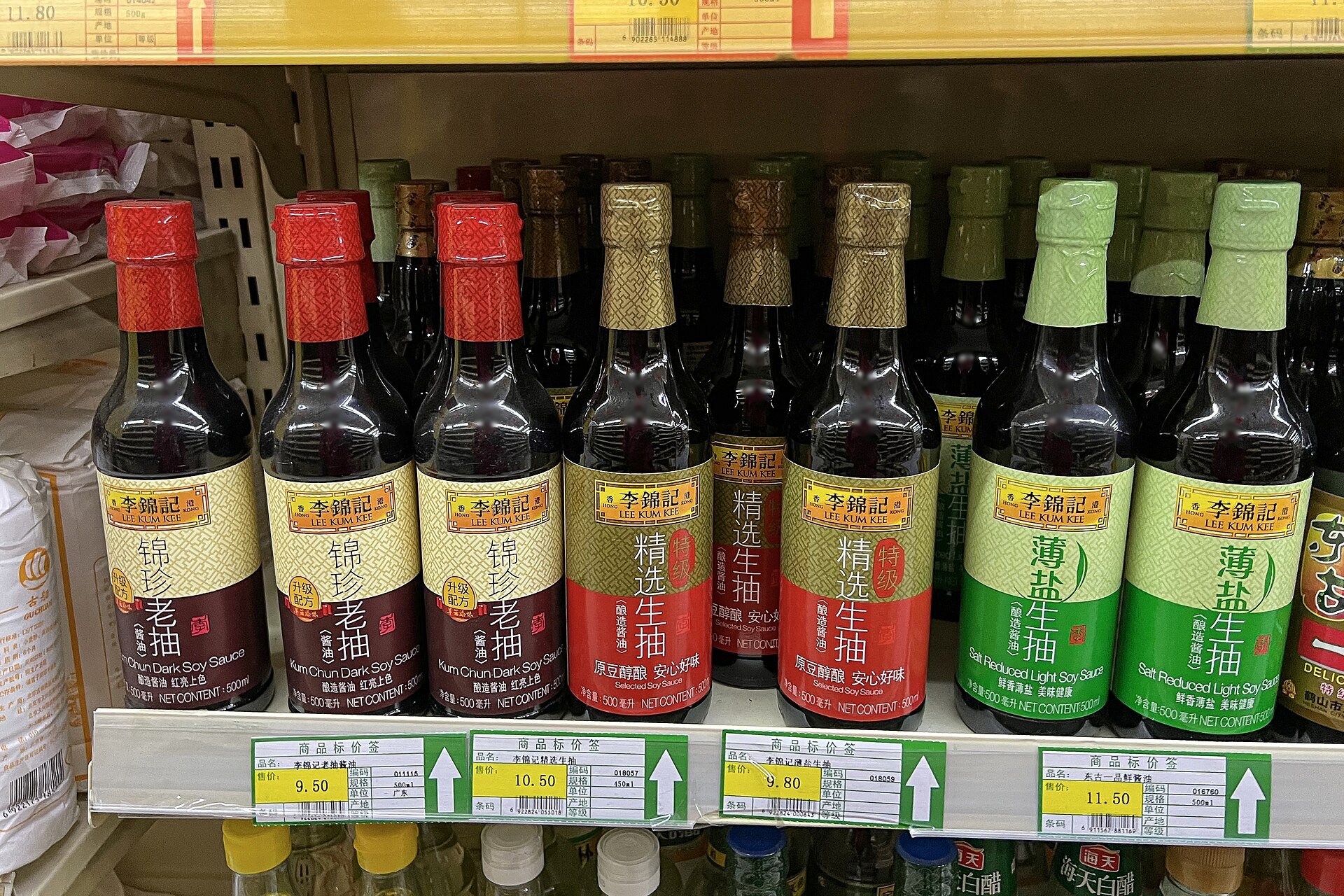
Light soy — 生抽, the one that seasons
生抽 (shēng chōu), “fresh draw.” Thin, translucent, reddish-brown, and salty. This is the workhorse and the default: if a Chinese recipe says “soy sauce” without qualification, this is what it means.
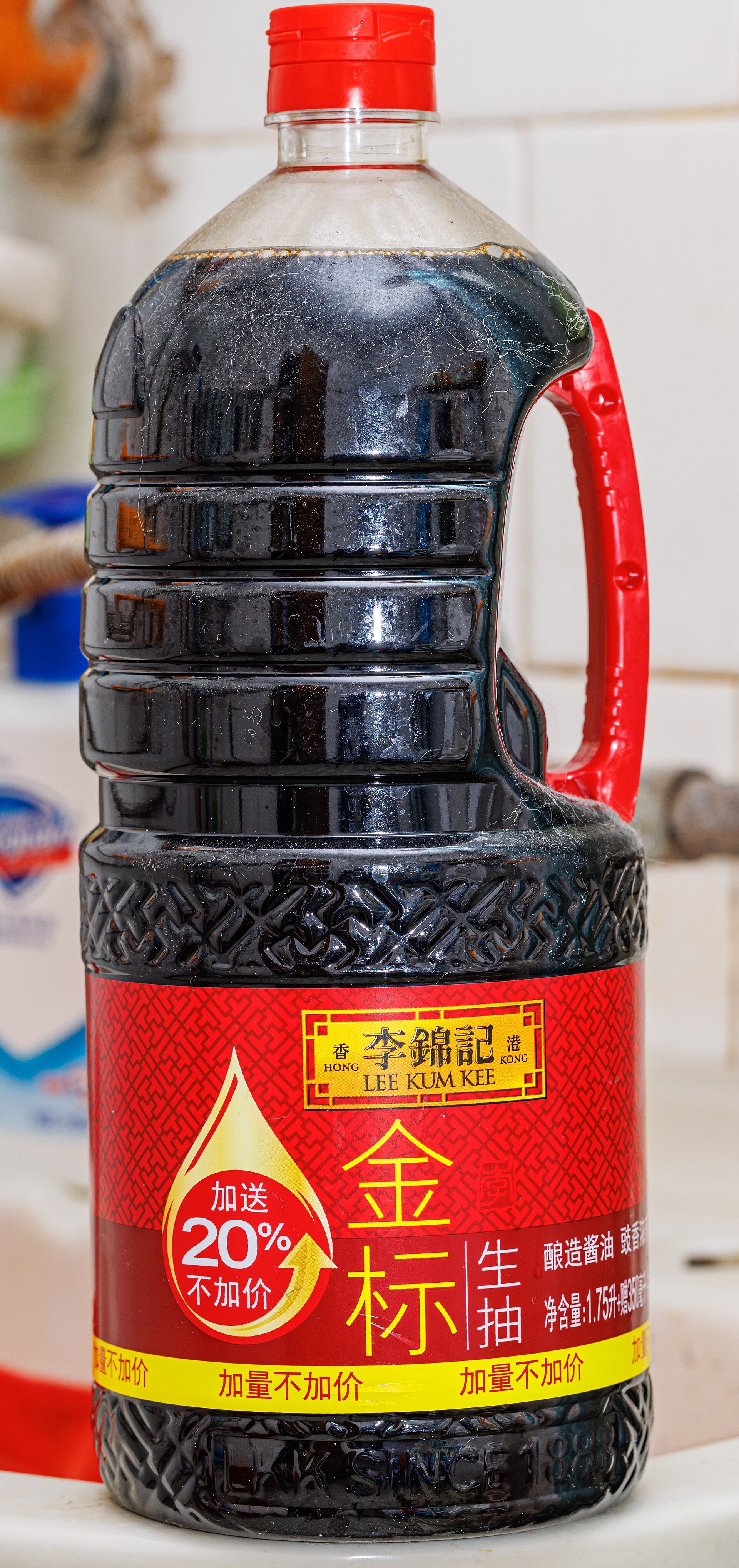
The name refers to the first draw from the fermentation vessel, in the same sense as a first pressing. Premium grades push this further — 頭抽 (tóu chōu), “head draw,” is the first extraction only, and is sold as a finishing sauce.
It is used for salt and savour, and it is not used for colour. A dish seasoned only with light soy stays pale.
Dark soy — 老抽, and the correction
老抽 (lǎo chōu), “old draw.” Thicker, darker, syrupy, distinctly less salty on the tongue, and used in small quantities, for colour. It is what makes red-cooked pork red-brown, what gives lo mein its glossy tan, and what a stir-fry is missing when it looks grey.
The standard English explanation is that dark soy is light soy that has been aged longer. This is the claim to examine, because it is at best a half-truth.
Here is the ingredient panel of a mainstream Hong Kong dark soy sauce:
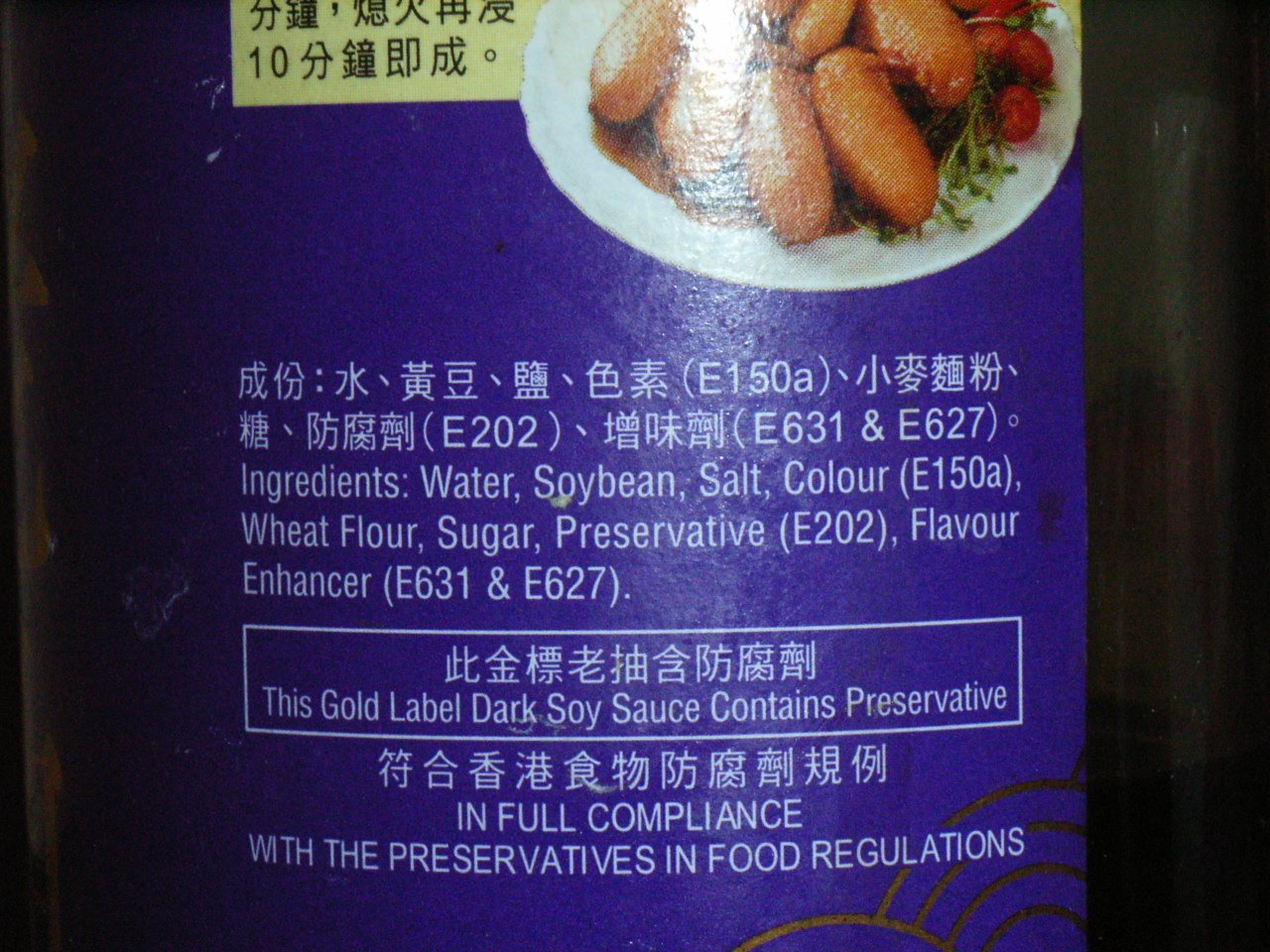
Ingredients: Water, Soybean, Salt, Colour (E150a), Wheat Flour, Sugar, Preservative (E202), Flavour Enhancer (E631 & E627).
🔴 The colour is the fourth ingredient — ahead of the wheat and ahead of the sugar. E150a is plain caramel colour. On this bottle, the darkness is added, not earned; it is a pigment, declared as one.
What the sources actually say, stated plainly, because they disagree:
- Wikipedia’s account is that dark soy is aged longer and “is often sweetened by adding molasses or other sweetening agents.”
- A widely-read practical source describes it as “thicker and sweeter than light soy sauce, as it often contains added sugar,” and notes it carries roughly 15% more sodium than light soy despite tasting less salty — the sweetness masks it.
- The bottle above says caramel colour, wheat flour and sugar, and says nothing about age.
⭐ The reconcilable version: some dark soys genuinely are aged longer, and essentially all of them are also coloured and sweetened. Extended ageing does darken soy sauce through Maillard chemistry — that part is real. But on a supermarket bottle the colour is overwhelmingly from E150a, and the useful conclusion for a cook is blunt: darkness is not evidence of age. A pale expensive sauce may be far older than a black cheap one.
⚠ Note two other things on that panel. E202 is potassium sorbate, a preservative. E631 and E627 are disodium inosinate and guanylate — the nucleotides that multiply the effect of glutamate. This bottle has had its umami topped up.
Mushroom dark soy — 草菇老抽
草菇老抽 (cǎogū lǎo chōu), straw-mushroom dark soy: dark soy sauce infused with straw mushroom extract.
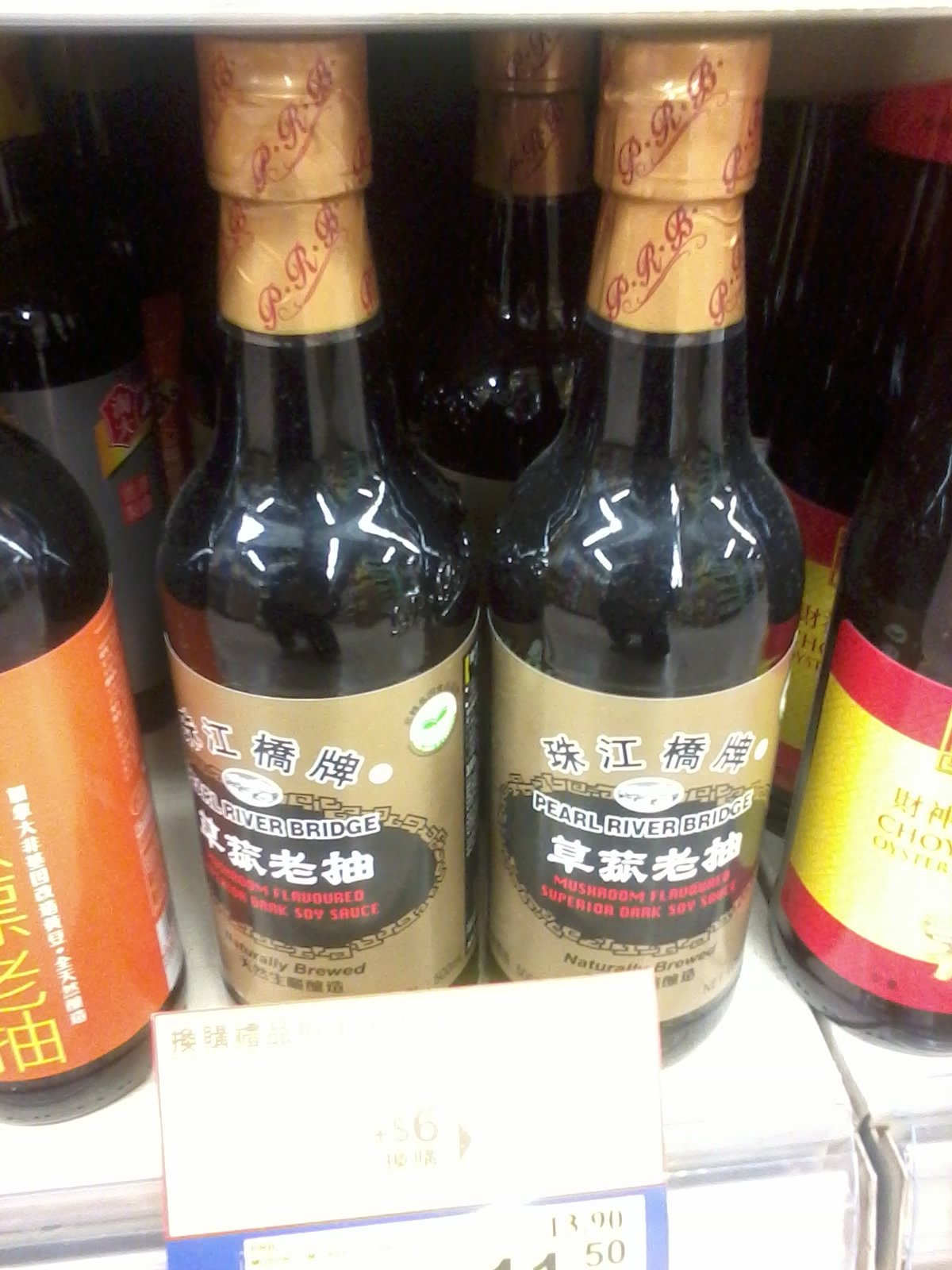
It is not a novelty. Mushrooms bring guanylate, and guanylate and glutamate are synergistic — together they produce far more perceived savour than either does alone. Mushroom dark soy is a dark soy sauce that has had its umami raised by the same mechanism the E631/E627 additives imitate, arrived at by infusion instead.
It is used exactly as ordinary dark soy is, and it is a straightforward upgrade in braises, red-cooked dishes and anything with actual mushrooms in it.
The rest of the Chinese shelf
- 蒸魚豉油 (zhēng yú chǐ yóu) — “steamed fish soy sauce.” A light soy seasoned with sugar, and usually with aromatics and stock. Formulated for one job: the sauce poured over a whole steamed fish, where straight soy would be too harsh. Genuinely worth owning; it is also excellent over steamed egg custard.
- 醬油王 (jiàngyóu wáng) — “soy sauce king,” a marketing grade rather than a technical one, generally meaning a premium seasoned light soy.
- 雙璜 / double-fermented — the Chinese analogue of Japanese saishikomi, brewed a second time on finished sauce.
- Sweetened dark soys from Hong Kong makers, closer in spirit to Indonesian kecap manis.
What the label is required to tell you
China regulates this ground, and the regulation is more useful than anything on a Western bottle.
Under national standard GB/T 18186 a bottle must declare which of two things it is:
| Chinese | Meaning |
|---|---|
| 釀造醬油 | Brewed soy sauce — fermented |
| 配制醬油 | Prepared / blended soy sauce — containing acid-hydrolysed hydrolysate |
🔴 That distinction is mandatory and printed. There is no equivalent requirement in the United States, which is the whole subject of brewed and chemical.
And then the number that actually measures quality: amino acid nitrogen, 氨基酸态氮, in g/100 mL.
| Grade | Amino acid nitrogen |
|---|---|
| 特级 Special | ≥ 0.80 |
| 一级 First | ≥ 0.70 |
| 二级 Second | ≥ 0.55 |
| 三级 Third | ≥ 0.40 |
⭐ This is the single most useful figure printed on any soy sauce bottle in the world. It measures how thoroughly the soybean protein was broken down, which is a direct proxy for time and raw-material quality — and unlike colour, it cannot be faked with caramel.
Two structural differences from Japanese practice
The wheat. Chinese soy sauce is frequently described in English as wheat-free, in contrast to Japanese shoyu. It generally is not. The standard Chinese formulation uses wheat flour — or wheat bran — as the carbohydrate source, against Japan’s roasted, cracked whole wheat. The proportion is lower and the treatment is different, which is part of why the flavours diverge, but the wheat is there. The label photographed above lists it. No Chinese soy sauce should be assumed gluten-free.
The fermentation method. Two named industrial processes divide the market:
- High-salt dilute-state (高盐稀态) — a liquid mash, high salt, long fermentation. Takes roughly three times as long and makes markedly better sauce.
- Low-salt solid-state (低盐固态) — a solid mash, less salt, much faster, and noticeably poorer.
Premium producers advertise the high-salt dilute method. It is the closest Chinese equivalent to the honjōzō claim on a Japanese bottle.
In this dive: The story · How it is made · Tamari and shoyu · The Japanese types · Chinese soy sauces · Korean ganjang · Beyond the big three · Brewed and chemical · Salt, time and aging · The gluten question · Buying, storing and using · Corrections
Comments (0)