The Story: From *Jiang* to the Bottle on the Table
Soy sauce is the oldest condiment still in daily industrial production anywhere in the world, and its history is not a straight line from China to Japan to the supermarket. It is a history of one idea — salt a protein, let moulds and bacteria take it apart, drink the liquid — being reinvented at least four times, in four countries, with four different sets of raw materials.
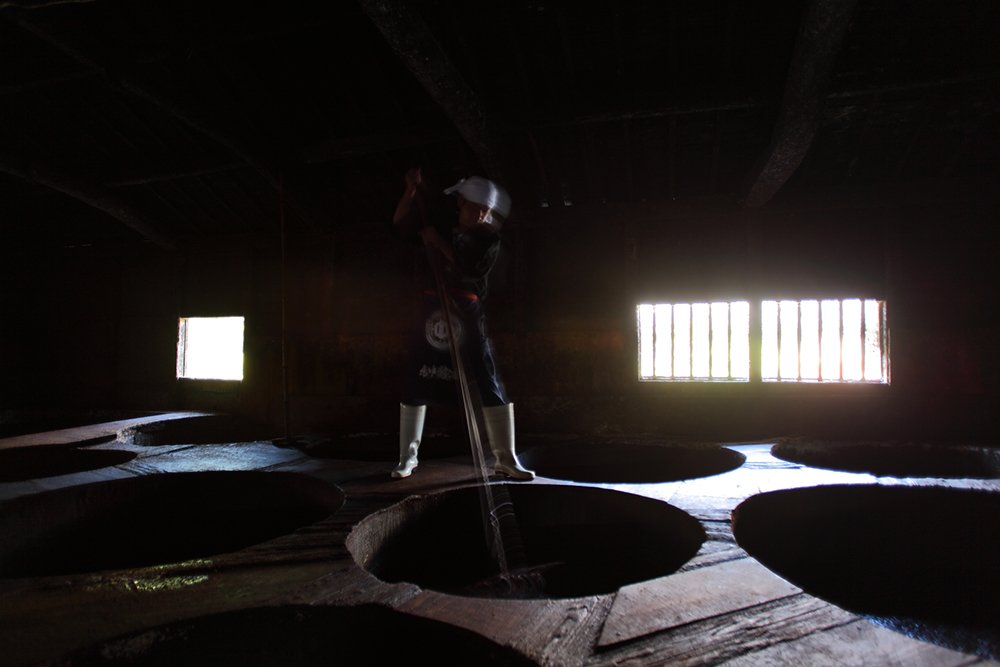
It began as a way of storing meat
The Chinese ancestor is 醬 (jiang) — a salted, fermented paste. The earliest jiang were not soybean products at all. They were meat and fish pastes, salted heavily and left to break down, and soybeans arrived later as the cheap substitute that turned out to be better.
That order matters, because it explains the shape of the finished product. Soy sauce tastes the way it does because it is standing in for a meat ferment, and the compounds it accumulates — free glutamate above all — are the compounds that make meat taste of meat.
The documentary trail, as far as it can be followed:
| Date | Text | What it shows |
|---|---|---|
| 160 CE | Simin Yueling (四民月令), Cui Shi | Mentions qingjiang (清醬), “clear jiang” — the earliest named ancestor of the liquid |
| 544 CE | Qimin Yaoshu (齊民要術), Jia Sixie | The earliest known description of how to make it — chapters on jiang, on salted and unsalted fermented black soybeans, and on several sauces |
| Song dynasty | Shanjia Qinggong (山家清供), Lin Hong | The earliest known use of the modern word 醬油 (jiangyou) — literally “jiang oil” |
⭐ The naming is the tell. For roughly a thousand years the liquid had no name of its own — it was “the clear part of the paste.” Only in the Song does it become 醬油, a thing you buy rather than a stage of something else. The condiment now recognisable as soy sauce is younger than the process that makes it by about a millennium.
Japan: hishio, and a monk with a recipe
The Chinese jiang reached Japan as 醤 (hishio), and for centuries Japanese fermented-bean products were pastes rather than liquids.
The traditional account of the turn is specific and is told at every brewery in Wakayama: in 1254, the Zen priest Kakushin (1207–1298) returned from China to Kishū with the method for Kinzanji miso, a miso fermented with summer vegetables, and taught it to the villagers of Yuasa. Making it, they noticed a dark liquid pooling in the vats — and that liquid was better than the paste.
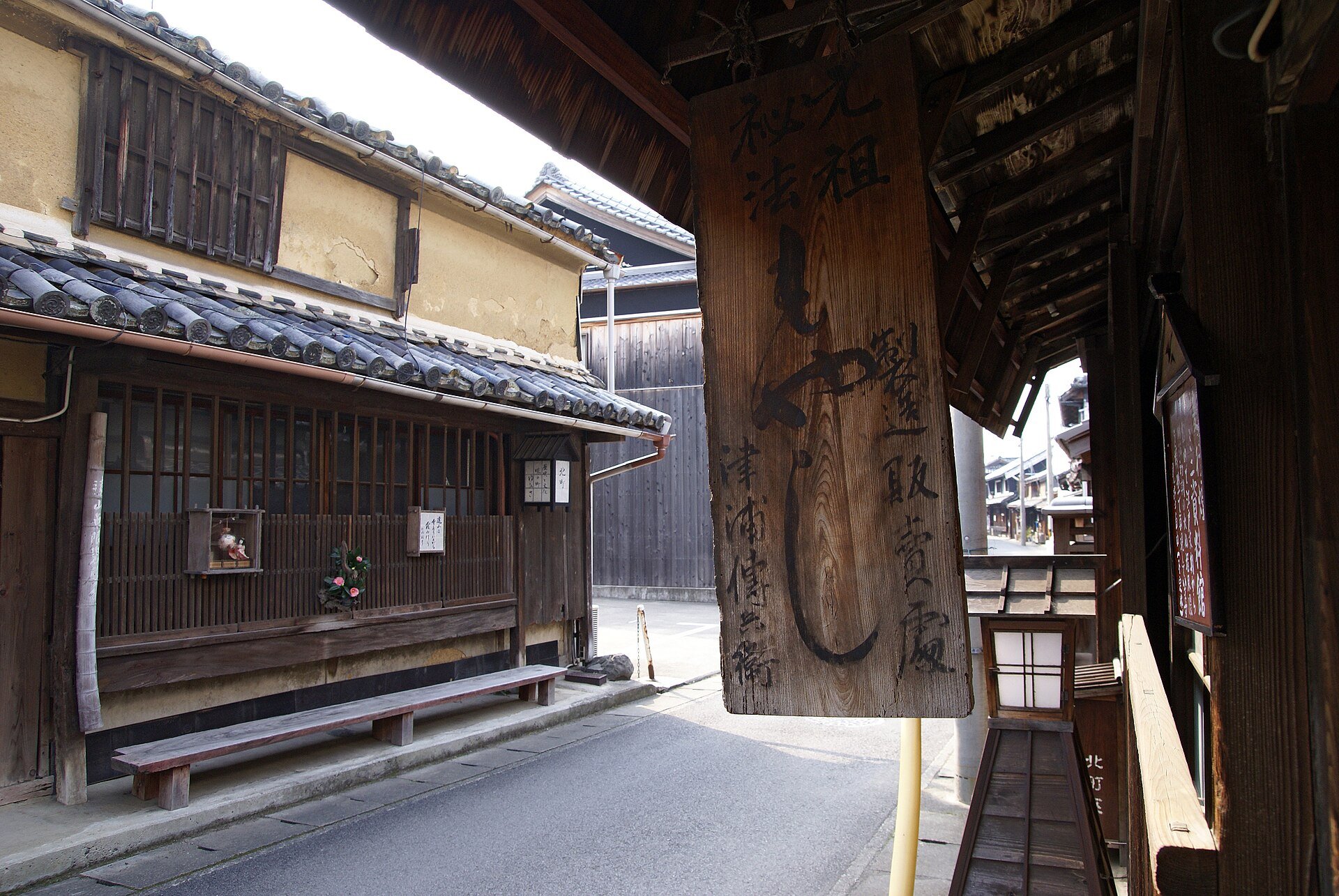
⚠ This is a traditional account, and it should be read as one. It is presented as settled history by Japan Heritage, by the town of Yuasa and by the breweries themselves; no source consulted here disputes it, but neither did any source consulted here demonstrate it from thirteenth-century documents. What is solidly attested is weaker and later: Yuasa was producing soy sauce commercially by at least the mid-sixteenth century, and has not stopped since.
What the story does capture correctly is the mechanism, and that mechanism is not in doubt: the first soy sauce anywhere was the run-off from a paste, not a thing brewed on purpose. That is the subject of the tamari page, and it is the single most misunderstood fact in the whole subject.
1603: two words, two products
The best piece of evidence in this dive is a dictionary.
The Vocabulario da Lingoa de Iapam, compiled by Jesuit missionaries and printed at Nagasaki in 1603, is a Japanese–Portuguese dictionary of about 32,000 entries, written by people who had to explain Japanese food to Europeans who had never seen it. It contains an entry for shoyu:

Xoyu. Hum licor que responde a vinagre, mas he salgado, & serue para temperar o comer que por outro nome se chama Sutate.
“Shoyu. A liquor that answers to vinegar, but is salty, and serves to season food; by another name it is called sutate.”
It also contains a completely separate entry for tamari — with a completely different definition, one written in terms of where the liquid comes from rather than what it tastes like. That entry is reproduced and translated on the tamari page, because it settles an argument.
⭐ Two headwords, two definitions, 1603. Whatever else is true, tamari and shoyu were not the same product four hundred years ago, and the modern habit of treating one as a variety of the other is a recent simplification.
The Vocabulario also records something easy to miss: shoyu is defined by comparison to vinegar. To a European palate in 1603 the salient quality was not saltiness or savour — it was that here was a dark, sharp, pungent liquid that you shook onto food, and Europe’s only reference point for that was the vinegar cruet.
Edo, and the birth of the modern bottle
Soy sauce became an industry in the Edo period, and it did so for a reason that has nothing to do with taste: Edo grew into one of the largest cities on earth and had to be fed from a distance.
The two towns that supplied it — Noda and Chōshi, both on rivers running into Edo Bay — had the three things a soy sauce town needs: soybeans and wheat from the Kantō plain, salt, and water transport to the market. The same logic put Tatsuno on the Ibo River in Hyōgo, and Shōdoshima in the Inland Sea.
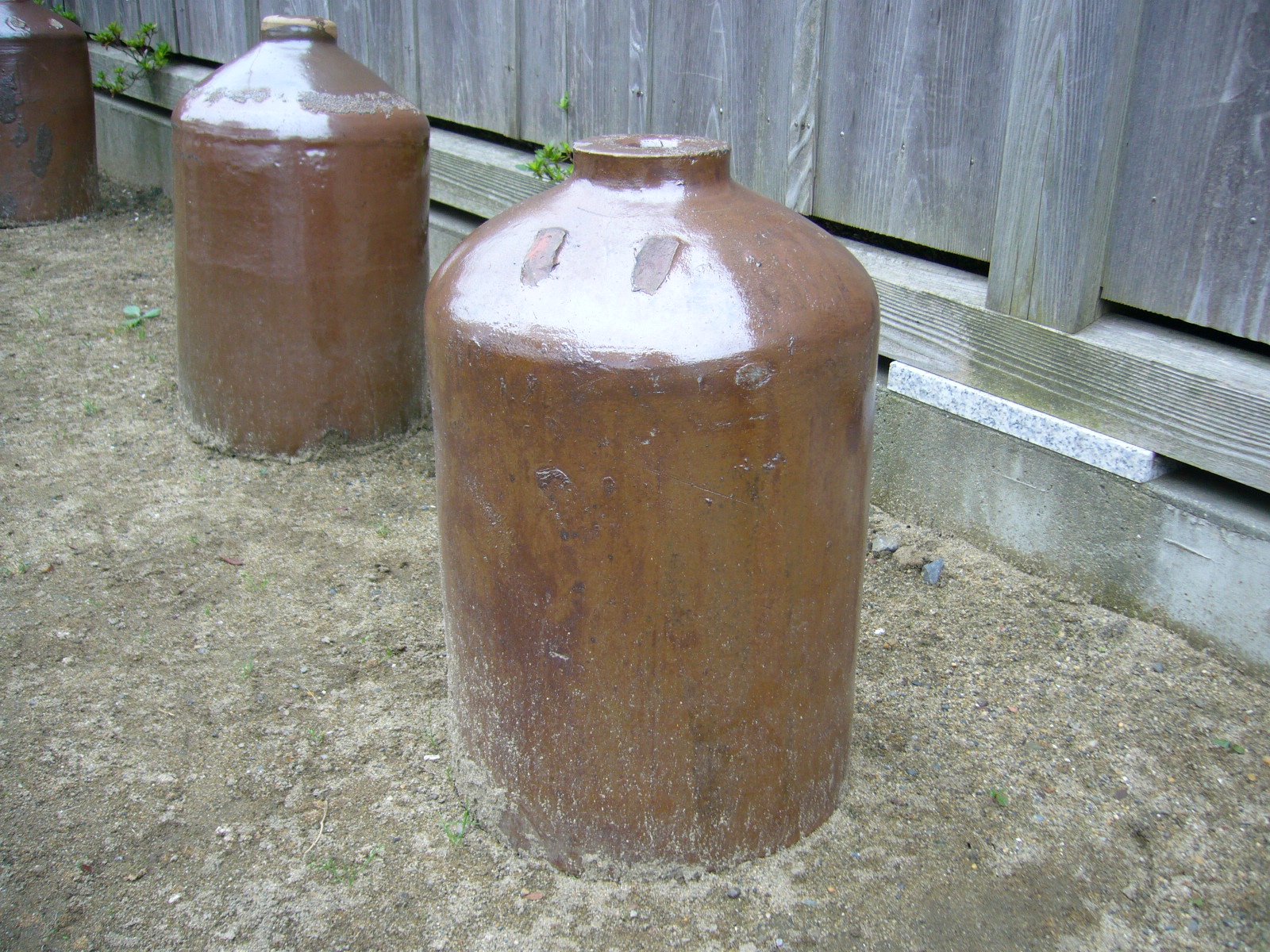
The vessel changed with the market. Soy sauce moved first in wooden barrels, then in the heavy glazed ceramic jugs above, and only much later in glass. The familiar shape — the small, dark, table-top bottle with a red cap — is a twentieth-century invention aimed at a household rather than a kitchen.
Out of Asia
Soy sauce was one of the first Asian processed foods to travel, and it travelled early:
- The Dutch East India Company shipped it from Japan to Batavia, to India and on to Europe in the seventeenth and eighteenth centuries, where it was expensive, exotic, and used much as a modern cook uses Worcestershire sauce.
- It reached the European table as a component of other sauces rather than as a condiment in its own right — which is exactly what Worcestershire sauce turned out to be doing, from a different direction, with fermented anchovies and tamarind.
- Indonesia received the process through Chinese migration and took it somewhere else entirely, sweetening it with palm sugar into kecap manis — and the English word ketchup is generally traced back through Malay kicap to a Hokkien term for a fermented brine. (That etymology is widely repeated and was not independently verified here; the exact source word is disputed.)
- The United States got brewed soy sauce late. What most American kitchens had for much of the twentieth century was not brewed at all — it was hydrolysed soy protein with caramel colouring, which is its own story.
What the history is actually for
Three things follow from all of this, and each one is load-bearing later in this dive:
- Soy sauce is a liquid that escaped from a paste. Miso, doenjang and jiang are not relatives of soy sauce; they are its parents, and in Korea they are still made in the same jar at the same time.
- The traditions diverged before they were written down. Chinese, Japanese and Korean soy sauces are not variations on a theme. They use different organisms, different grains and different vessels, and they are best understood as three separate answers to one question.
- Everything that looks like a rule is usually a regulation, and regulations are national. Nearly every confident claim about what soy sauce “is” turns out to be true in one country and false in the next.
In this dive: The story · How it is made · Tamari and shoyu · The Japanese types · Chinese soy sauces · Korean ganjang · Beyond the big three · Brewed and chemical · Salt, time and aging · The gluten question · Buying, storing and using · Corrections
Comments (0)