Worcestershire Around the World
This is my favorite page in the whole dive, because it’s the one I lived. I’ve been lucky enough to eat across every state in this country and more than thirty others, and Worcestershire kept following me around the globe wearing different clothes. A little Worcester, England bottle from 1837 rode the British Empire out into the world, and everywhere it landed, people made it their own — renamed it, thickened it, sweetened it, and folded it so deeply into the local cooking that plenty of folks don’t even know it started in a druggist’s shop in the English Midlands.
Here’s the quick map before we travel. If you want the origin story behind all of this, it’s on the history page; the ingredient logic that makes these adaptations possible is on the ingredients page.
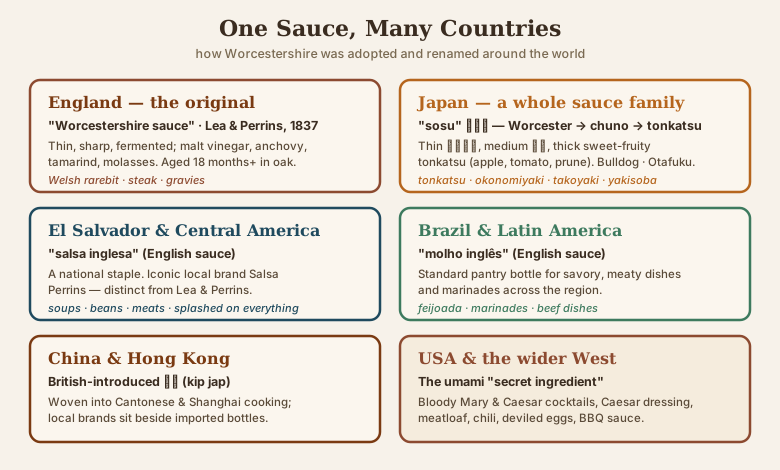
The world’s Worcestershire, at a glance
| Country / region | Local name | Character | Typical uses |
|---|---|---|---|
| England (origin) | Worcestershire sauce | Thin, sharp, aged, fermented | Welsh rarebit, steak, gravies, cheese on toast |
| Japan | sōsu (ソース) — Worcester, chūnō, tonkatsu | A family: thin → medium → thick sweet-fruity | Tonkatsu, okonomiyaki, takoyaki, yakisoba, korokke |
| El Salvador / Central America | salsa inglesa (“English sauce”) | Thinner, tangy, everyday splash | Soups, beans, meats, rice — on almost everything |
| Brazil / Latin America | molho inglês (“English sauce”) | Standard savory umami bottle | Feijoada, marinades, beef dishes |
| China / Hong Kong | 喼汁 (kip jap) | British-introduced tangy cooking sauce | Cantonese and Shanghai dishes, dips |
| USA / wider West | Worcestershire (“the secret ingredient”) | Umami booster hiding in the background | Bloody Marys, Caesars, meatloaf, chili, BBQ |
Japan: a whole cuisine grew out of one bottle
No country ran further with Worcestershire than Japan, and I mean that literally — the Japanese built an entire sauce family on top of it. When Worcestershire arrived in the late nineteenth century, the fermented, umami-forward profile landed perfectly in a food culture that already loved fermented, umami-forward things. But it got adapted for Japanese tastes: less harsh, a little sweeter, thicker. The result is what’s simply called sōsu (ソース) — “sauce” — and it comes in a spectrum defined mostly by thickness and sweetness.
- ウスターソース (Worcester sauce) is the thin one, closest to the English original — sharp, runny, spicy.
- 中濃ソース (chūnō sauce) is the medium one, thicker and a touch sweeter, the everyday all-rounder in a huge number of Japanese home kitchens.
- とんかつソース / 濃厚ソース (tonkatsu / nōkō sauce) is the thick, dark, glossy, fruity end of the family. This is where it stops resembling the Lea & Perrins bottle at all. Tonkatsu sauce is loaded with vegetables and fruit — apple, tomato, prune, dates — which gives it a sweet, almost jammy body that clings to fried food.
The brands are institutions. Bulldog (ブルドック) is the one you picture — the little bulldog on a squat bottle, on tables all over Japan. Kagome makes a widely loved line, and Otafuku is the name in okonomiyaki sauce specifically. You meet these sauces everywhere the moment you sit down: brushed onto tonkatsu (the breaded pork cutlet that gave the thick sauce its name), drizzled in lattices over okonomiyaki and takoyaki, tossed through yakisoba, and poured over korokke (croquettes). I still remember the first okonomiyaki I had at a counter in Iwakuni — they painted the sauce on with a brush like they were glazing furniture, then crosshatched the mayo over it, and I understood immediately that this was a national art form, not a condiment.
If you want to taste the connection at home, I keep a Japanese-style Worcestershire in my rotation that heads in the thick, fruity tonkatsu direction. Making it yourself is the best way to feel just how far the sauce traveled from Worcester — same DNA, completely different animal. There’s more on why homemade beats the bottle on the why-homemade page.
El Salvador and Central America: salsa inglesa
Travel to El Salvador and Worcestershire is simply salsa inglesa — “English sauce” — and it’s absolutely everywhere. It goes into soups, over beans and rice, on meats, splashed across a plate with the same casual frequency an American might reach for hot sauce or ketchup. What surprised me was the brand culture. Alongside imported Lea & Perrins there’s an iconic local brand, Salsa Perrins, which despite the confusingly similar name is a distinct Salvadoran product, not Lea & Perrins. It’s a genuine pantry staple down there — you’ll see it on kitchen shelves and restaurant tables throughout the region. The Central American version tends to run thinner and tangier, a splash-it-on-everything sauce rather than a glaze.
Brazil and Latin America: molho inglês
Down in Brazil the very same idea gets the Portuguese name molho inglês — again, literally “English sauce.” It’s the standard savory-umami bottle in the pantry, and it turns up in the big meaty dishes: a few dashes deepen a pot of feijoada, it shows up in marinades, and it lends that background savoriness to beef dishes generally. The pattern across Latin America is consistent and kind of charming — the sauce kept the label of where it came from (“English sauce”), even as the cooking around it became thoroughly local.
China and Hong Kong: the British legacy
The British introduced Worcestershire to China through the treaty ports, and it settled in particularly around Hong Kong and the Cantonese south, where it’s known as 喼汁 (kip jap). You’ll find it used in some Cantonese and Shanghai cooking — as a dip, a marinade component, and a tangy accent — and there are local brands sold right alongside the imported bottles. It’s a smaller footprint than Japan’s sōsu explosion, but it’s a real one, and it’s another reminder of how the sauce traveled the empire’s trade routes and quietly naturalized wherever it landed.
And its home turf: the Western jobs it never gave up
For all its adventures abroad, Worcestershire never stopped doing its original Western work — it just did most of it invisibly. It’s the classic “secret ingredient,” the thing that makes people ask what did you put in this? A few of its enduring Western roles:
- Cocktails. It’s essential in a Bloody Mary and its Canadian cousin the Caesar (the clam-and-tomato Clamato version). That savory-tangy backbone in a good Bloody Mary is Worcestershire doing its quiet job.
- Caesar salad dressing. The anchovy note that makes a real Caesar dressing sing? Worcestershire is carrying part of that load — a neat little loop back to the sauce’s own anchovy heart.
- Welsh rarebit — the original savory British use, melted cheese sharpened with Worcestershire on toast.
- The American comfort canon — meatloaf, chili, deviled eggs, gravies, stews, and pretty much every backyard BBQ sauce worth the name. I lean on it constantly in my own BBQ sauces, and you can see why on the ingredients page.
If you want the full accounting of where a bottle of this ends up in my own kitchen — the marinades, the steaks, the Bloody Marys — I put all of that on how I use it. And if all this globe-trotting has you wanting to make a version of your own, start with the why-homemade page and the recipes it links; you can also just browse everything tagged worcestershire across the whole collection.
The thing I keep coming back to is how one little Worcester bottle became a genuinely global pantry staple, and how every culture that adopted it heard something slightly different in it — the Japanese heard a fruit-and-vegetable glaze, the Salvadorans heard an everyday splash, the British kept hearing melted cheese on toast. Same sauce. A whole world of ideas about what to do with it.
Comments (0)