The History of Worcestershire Sauce
There’s a bottle in almost every kitchen I’ve ever cooked in — squat, dark, wrapped in a paper label, with a mouthful of a name most people never quite spell right (it’s “WUUS-ter-sher,” by the way, not “wor-chester-shire”). I’ve splashed it into gravies and Bloody Marys for decades without giving it much thought. But once I started making my own and reading into where it actually came from, I fell hard for the story. It’s a two-hundred-year-old English tale wrapped around a two-thousand-year-old idea, and almost none of it happened the way the label would have you believe.
Two chemists on Broad Street
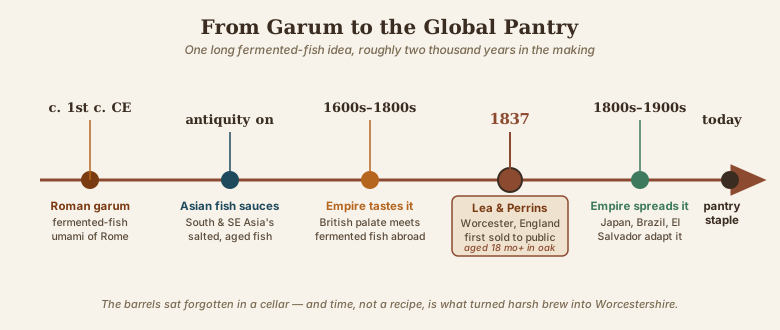
The sauce we know starts in Worcester, England, in the shop of two druggists — chemists, in the British sense — named John Wheeley Lea and William Henry Perrins. They ran a pharmacy on Broad Street, the kind of place that in the 1830s compounded medicines, ground spices, and sold all manner of preparations to the town. Their partnership, Lea & Perrins, first put the sauce on sale to the public in 1837, and it was commercialized through 1837–38. That’s the fixed, documented point in all of this: 1837, Worcester, two apothecaries who knew their way around a mortar and pestle.
Everything I love about the sauce follows from those two men being chemists rather than cooks. They thought in terms of extracts, tinctures, and aging — and it shows in the finished product, which behaves less like a condiment and more like a carefully compounded elixir.
The legend — and why I don’t quite buy it
Here’s the story every bottle-back and blog repeats. As it’s usually told, a nobleman — almost always named as Lord Sandys, said to be a former Governor of Bengal — came home to Worcestershire with a taste for a sauce he’d had in India, and asked Lea and Perrins to recreate it. They mixed up a batch, tasted it, found it harsh and frankly awful, and shoved the barrels down into the cellar to be forgotten. Months (or years) later, doing a clear-out, they rediscovered the barrels, tasted the contents on a whim — and found the harsh brew had transformed into something deep, mellow, and delicious. Eureka. A global condiment is born.
It’s a wonderful story. It’s also, as far as the historical record goes, largely apocryphal marketing. The researcher Brian Keogh, who went through Lea & Perrins’ own archives, found that the tidy Lord Sandys tale doesn’t hold up — there’s no solid evidence for the specific nobleman, the Bengal governorship, or the “recreate my Indian sauce” commission as the label tells it. It has the shape of a legend a company would happily let grow: aristocratic, exotic, serendipitous, flattering to the product. I flag it here not to be a killjoy but because the truth underneath is actually more interesting than the myth.
Because the real insight the story preserves is genuinely true: aging is what makes Worcestershire work. Whether or not any barrels were literally forgotten in a cellar, the sauce absolutely does start out sharp and disjointed and needs long fermentation and maturation to turn into itself. Time is the secret ingredient. Lea and Perrins, being chemists, understood — or figured out — that you couldn’t rush it, and to this day the classic formula is aged 18 months and up (some accounts say close to three years) in oak before it’s strained and bottled. Strip away the aristocrat and the cellar, and you’re left with the one fact that matters: this is a fermented sauce, and fermentation takes patience. I lean on exactly that idea when I make my own — see Why homemade is better and the fundamentals over on fermenting.
A much older idea: garum and the fish sauces of empire
What really hooked me is realizing Worcestershire isn’t an English invention at all — it’s the latest chapter in one of the oldest food ideas on earth. At its core, Worcestershire is a fermented, anchovy-based umami sauce. That puts it squarely in a lineage that runs back to the ancient Mediterranean.
The Romans were mad for garum (and its cousins liquamen, allec, and muria) — a sauce made by salting fish and fish guts and letting them ferment in the sun for weeks or months until they broke down into a clear, intensely savory amber liquid. They dosed nearly everything with it, the way we reach for salt. Garum was mass-produced in coastal factories from Spain to the Black Sea and shipped in amphorae all over the empire. It was, in the most literal sense, the umami of the ancient world — glutamates from fermented fish protein, the same deep-savory hit that anchovies give Worcestershire.
And it wasn’t only Rome. South and Southeast Asia developed their own great fermented fish sauces — the ancestors of today’s Thai nam pla and Vietnamese nước mắm — salting and aging fish into liquid gold along the same principle. When the British spread out across the world in the age of empire, they met these sauces abroad and brought the taste home. Worcestershire is what happened when that ancient anchovy-umami idea landed in an English chemist’s shop and got crossed with tamarind, malt vinegar, molasses, and a spice cabinet — a Roman idea in Victorian English dress. I get into exactly what goes in on the ingredients page.
| The same idea, different eras | |
|---|---|
| Roman garum | salted fish fermented into a clear savory liquid; used on everything |
| Asian fish sauces | nam pla, nước mắm — salted, aged fish; the umami base of a cuisine |
| Worcestershire (1837) | fermented anchovies + tamarind + vinegar + molasses + spice, aged in oak |
Riding the Empire to every pantry on earth
Once the sauce caught on, it traveled the way British goods traveled in the 19th century — on ships, everywhere the Empire reached. That’s the real engine behind Worcestershire becoming a global pantry staple rather than a Worcester curiosity. It went out to India, to the Caribbean, to Australia and New Zealand, to Hong Kong and beyond, and everywhere it landed the local cooks started adapting it. That worldwide adoption is a rich enough story that I gave it its own page — the Japanese sōsu dynasty, Salvadoran salsa inglesa, Brazilian molho inglês and more are all on around the world.
There’s a lovely artifact of that shipping era hiding in plain sight: the paper wrapper around the bottle. The usual story is that it dates from the days when the sauce was shipped long distances by sea, and the paper protected the bottle and label in transit (some say it also discreetly hid a not-especially-pretty sediment). Whatever the exact reason, it stuck, and that little paper sleeve is now one of the most recognizable pieces of packaging in the world — a Victorian shipping habit that survived into your refrigerator door.
Why the history matters at my stove
I don’t tell this story just because it’s a good yarn. Knowing that Worcestershire is a fermented anchovy sauce in the garum tradition completely changes how I cook with it. It tells me why a few drops deepen a chili or a pan gravy the way they do — it’s concentrated umami, the same lever a splash of fish sauce pulls. It tells me why the homemade version, given real time to age, tastes so much rounder than the flattened supermarket bottle. And it connects this one condiment to the whole world of savory cooking I love, from a Roman kitchen to a BBQ sauce mopped onto ribs in my backyard.
From here, I’d dig into what’s actually in it and how the formula drifted over two centuries, then why I make my own, how it went around the world, and finally how I use it every week. If you want to jump straight to a pot, the homemade Worcestershire sauce recipe is where I’d start.
Comments (0)