The Numbers: Coffee Shop & Bakery
Every dream of a corner café dies or survives on one page of arithmetic, so this is that page for my coffee shop and bakery. I’m an engineer by temperament — I want the whole business on a single sheet in dollars before I sign a lease — so I’ll lay out what it costs to build the place (a lean used build versus a full new one), what it burns every month, and the simple daypart math that tells me how many people have to walk through the door. Every figure here is a ballpark to sanity-check the model, not a quote. Build-out, equipment, coffee, flour, wages and permits all swing hard by region and by what you buy, so verify your own line items — and the licensing side with MDARD and your local health department — before you commit a dollar.
The three numbers I keep separate
There are three, and I never let them blur together in my head:
- Startup capital — the one-time money to build a licensed, working coffee shop and bakery.
- Monthly operating cost — what the shop burns every month whether I pull one shot or four hundred.
- Break-even — the covers per day where revenue finally crosses total cost.
Get all three on paper and the decision makes itself. This page is the money side of the plan; the gear side lives in the kitchen-equipment numbers, and the mobile arm of the same business has its own math in the food-truck numbers. The bakery is also the licensed commissary that lets the truck run, so these three pages are really one business plan in three windows.
Table A — Startup capital: lean build vs. full build
The biggest lever after the lease itself is whether I buy gear used or new. A patient shopper outfits the whole back-of-house for a third of a new build — restaurant auctions are full of deck ovens, mixers and reach-ins from shops that didn’t make it. I lay out exactly how I shop in buying used, and the full equipment detail is in the kitchen-equipment numbers. Here’s how the line items stack up for a small shop with a real bread program and a serious coffee bar.
| Line item | Lean / used build | Full / new build | Notes |
|---|---|---|---|
| Build-out / leasehold improvements | $25,000 | $90,000 | Plumbing, 3-phase electrical, HVAC, ADA restroom, floors, counters — the true budget-killer |
| Espresso machine (2-group) | $8,000 | $22,000 | Used Nuova Simonelli / La Marzocco Linea vs. new; the heart of the coffee bar |
| Grinder(s) — on-demand, 2 hoppers | $1,500 | $4,000 | A Mazzer-class doser per bean; grind matters as much as the machine |
| Batch brewer + hot-water tower | $1,200 | $3,000 | Fetco/Bunn drip plus a tower for the tea program |
| Water filtration / softener | $800 | $2,500 | Critical — protects the espresso boiler and makes the coffee taste right |
| Deck oven (stone hearth, steam injection) | $6,000 | $20,000 | Used single-deck vs. new double-deck; the gold standard for crust — see /breads/ovens/ |
| Convection oven | $2,500 | $8,000 | Even browning for pastry, cookies, muffins |
| Planetary / spiral mixer | $1,000 | $5,000 | Used Hobart lasts forever; spiral for high-hydration bread dough |
| Retarder-proofer | $1,500 | $5,000 | Overnight fermentation control — how you schedule the morning bake |
| Dough sheeter | $2,000 | $6,000 | For croissants and laminated pastry; huge labor saver |
| Reach-in refrigeration + freezer | $2,000 | $6,000 | Buy on compressor health, not looks |
| Refrigerated pastry display case | $1,500 | $5,000 | The front-of-house salesperson that never takes a break |
| Café furniture / seating | $3,000 | $12,000 | Tables, chairs, banquette; sets the room’s whole feel |
| POS + card readers | $600 | $3,000 | Tablet-based lean; full networked terminals + KDS |
| Signage (exterior + menu boards) | $1,500 | $6,000 | Blade sign, awning, backlit menu |
| Smallwares bundle | $3,000 | $8,000 | Portafilters, pitchers, sheet pans, scales, bench knives, thermometers — easy to underbudget |
| Initial inventory (beans, flour, butter, packaging) | $2,500 | $5,000 | First few weeks of dry goods and dairy |
| Total | ≈ $63,600 | ≈ $210,500 | Excludes any hood; a hooded gas oven adds a Type I hood + suppression |
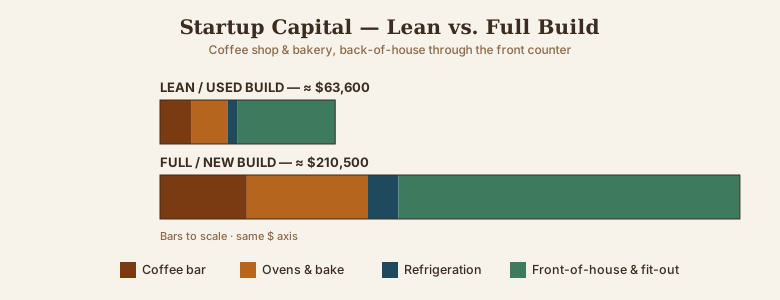
Two lines I’d underline. The build-out is the quiet giant — grease-trap plumbing, three-phase power for a deck oven and a two-group machine, an ADA restroom and code-legal floors will eat more than any single machine, and it’s the number contractors surprise you with. And the water filtration looks trivial at a few hundred to a few thousand dollars, but hard water scales an espresso boiler and ruins the coffee; it’s the cheapest insurance in the building. The lean column assumes I’m handy enough to shop auctions and do some install myself, exactly the argument in buying used; hire it all out and the two columns march toward each other.
Table B — Monthly operating cost
This is the number that goes quiet on people once the build excitement fades — a café-bakery is labor-heavy, and payroll is the line that dwarfs everything. Bakers start at 3 or 4 a.m., baristas cover the rush, someone works the counter all day, and my own draw sits on top. Here’s a representative month for a shop doing modest but healthy volume (~$76,700 in sales — see the daypart model below). I’ll drop my own actuals in over time; treat these as the shape of the thing.
| Monthly cost | Ballpark | Notes |
|---|---|---|
| Rent (1,500–2,000 sq ft retail) | $5,500 | Prime-ish foot-traffic location; varies wildly by town |
| Labor (bakers + baristas + counter + my draw) | $28,000 | The big one — ~36% of sales; a bakery and a café are both hands-on |
| Food COGS (flour, butter, sandwich fillings, jam) | $13,900 | Scales with bakery + lunch sales; protect it with tight portioning |
| Coffee COGS (beans, milk, cups, syrups) | $7,000 | ~$1 a drink — that’s ~80% gross margin on coffee, the best in the building |
| Utilities (deck oven + espresso are power-hungry) | $2,200 | A deck oven and a two-group machine pull serious amps; gas oven shifts the mix |
| Insurance | $700 | General + product liability, property |
| POS / card-processing fees (~2.7%) | $2,070 | Scales with card sales |
| Marketing | $600 | Local, social, the odd print run and event |
| Maintenance reserve | $500 | Refrigeration, boiler, oven gaskets, grinder burrs — set it aside monthly |
| Total | ≈ $60,500 | Roughly $37,500 fixed + ~$23,000 that scales with sales |
The line I want to call out is coffee COGS. A latte is maybe a dollar in beans, milk, cup and lid, and it sells for $5.50 — that’s better than 80% gross margin, the highest in the building. A tray of croissants can’t touch it: European butter, hours of a baker’s time and lamination make pastry a labor-and-ingredient business, and lunch sandwiches carry a real food cost. That contrast is the entire strategic point of putting a coffee bar and a bakery under one roof, and it’s why the next section splits revenue by line.
The daypart revenue model
A café-bakery earns in three waves across the day, plus two quiet lines that run all day. Here’s how I model a representative day over 26 operating days a month.
| Daypart | What sells | Covers/day | Avg ticket | Revenue/day |
|---|---|---|---|---|
| Morning | Coffee + a pastry (latte + croissant, cortado + muffin) | 150 | $7.50 | $1,125 |
| Lunch | A sandwich on our own bread + a coffee | 70 | $13.00 | $910 |
| Afternoon | Coffee + a cookie | 80 | $6.00 | $480 |
| All day — retail | Loaves of bread + jars of jam to take home | — | — | $250 |
| All day — wholesale | Bread sold to my food truck for its sandwiches | — | — | $100 |
| Daily total | ~300 café covers | ~$2,865 |
Over 26 days that’s roughly $74,500–$76,700 a month. Now split the same revenue by line and look at what each dollar actually keeps after its cost of goods — this is where the strategy shows up in ink:
| Line | Monthly revenue | Gross margin | Gross profit |
|---|---|---|---|
| Coffee & tea drinks | $35,100 | ~80% | $28,080 |
| Sandwiches (lunch) | $16,900 | ~65% | $10,985 |
| Bakery (pastry, cookies, muffins) | $15,600 | ~68% | $10,608 |
| Retail bread & jam | $6,500 | ~72% | $4,680 |
| Wholesale to the truck | $2,600 | ~55% | $1,430 |
| Total | $76,700 | ~73% blended | $55,783 |
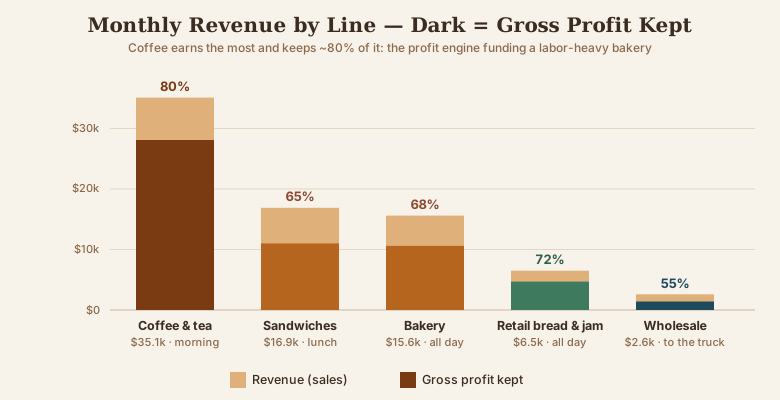
There’s the whole thesis in one picture. Coffee is the highest-margin item in the building and it’s also the highest-traffic one — the morning latte crowd is what fills the room. The bakery can’t match that margin, but the smell of fresh bread and a full pastry case is exactly what pulls the coffee crowd in and lifts every ticket with an add-on. High-margin, high-traffic coffee funds the labor-heavy bakery; the bakery’s draw and warmth sell more coffee. Neither half is as strong alone. And the bread does triple duty — sold by the loaf at retail, built into lunch sandwiches at a healthy markup, and sold wholesale to the truck so the same dough earns three different ways. That flywheel is the argument I make in full in bringing it together, and the coffee margins behind it are detailed in the coffee program.
Break-even — how few covers keep the lights on
With the model on paper I flip it around and ask the only question that matters on a slow Tuesday: how few people can I serve and still break even? Break-even is where revenue exactly covers all costs. Because food, coffee and card fees scale with sales, each cover contributes its ticket minus its variable cost.
The blended average ticket across ~300 café covers is about $9.50. Variable cost runs ~27% for
cost of goods plus 2.7% for card fees — call it 30% — so each cover contributes roughly 70% ×
$9.50 ≈ $6.65 toward fixed costs. My fixed load (rent, labor, utilities, insurance, marketing,
maintenance) is about $37,500 a month, or **$1,442 a day** across 26 days. So:
Break-even covers/day = $1,442 / $6.65 ≈ 217 covers/dayI need roughly 220 café covers a day just to cover costs; everything above that is profit. The model puts me at ~300, comfortably in the black — a healthy month nets about $16,000 before debt service and taxes ($76,700 revenue − $60,500 operating). That’s an operating margin around 20%, which lands closer to 10–12% net once you subtract a build loan and taxes — a normal, honest café number, not a lottery ticket. But the whole thing rides on that daily cover count, so it’s the one figure I’d tattoo on the inside of the roll-up door.
What moves the needle
Once the arithmetic is on paper, the levers are obvious:
- Protect the coffee mix. It’s 46% of revenue at 80% margin — the profit engine. Dial in the espresso, keep the line fast at the morning rush, and never let quality slip. Details in the coffee program.
- Make the bread work three times — retail loaves, lunch sandwiches, and wholesale to the truck. The same artisan dough earns at three different margins.
- Lift the ticket with an add-on, not a price hike — a cookie or a jar of jam on the way out is nearly pure margin on already-baked goods.
- Watch labor like a hawk. At ~36% of sales it’s the biggest cost and the easiest to bloat; smart scheduling around the dayparts is where the margin is won or lost.
Run your own version of all three tables with real local quotes before you buy anything — mine are here to prove the model, and the model says a used build with a strong coffee bar funding a real bread program, doing a couple hundred covers a day, genuinely pencils out. How the two halves and the truck feed each other is the whole story in bringing it together, and the parallel gear-cost logic is in the kitchen-equipment numbers.
Comments (0)