The Numbers: Truck Economics
A food truck lives or dies on arithmetic most people never do before they buy. I’m an engineer by temperament — I want the whole thing on one page in dollars before I sign anything — so this is the money page for the truck. I’ll lay out what it costs to get on the road (used versus new), what it costs to run every month, and the simple break-even math that tells me how many people I have to feed a day to keep the lights on. Every figure here is a ballpark to sanity-check the model, not a quote — trucks, equipment, permits and food costs swing wildly by region and by what you buy, so verify your own line items before you commit a dollar.
What “the numbers” actually are
There are three of them, and I keep them separate in my head:
- Startup cost — the one-time money to put a licensed, working truck on the street.
- Monthly operating cost — what it burns every month whether I sell one taco or a thousand.
- Break-even — the covers per day where revenue finally crosses total cost.
Get all three on paper and the decision makes itself. Skip them and you find out the hard way in month three. This page mirrors the same discipline I apply to the bricks-and-mortar side in the kitchen-equipment numbers; the two together are the real business plan.
Table A — Startup cost: used build vs. new build
The single biggest lever is the truck itself, and right behind it is whether you build the whole rig used or new. A clean used truck with a working kitchen already installed can save you thirty, forty thousand dollars over a new build — which is the whole argument I make in used vs. new. Here’s how the line items stack up.
| Line item | Lean / used build | New build |
|---|---|---|
| The unit (truck/trailer + galley) | $35,000 | $90,000 |
| Cooking equipment (griddle, fryer, ranges, refrigeration) | $6,000 (often included/used) | $18,000 |
| Generator / power (or shore-power setup) | $3,500 (used) | $9,000 |
| Type I hood + fire suppression (ANSUL) | $4,000 (existing/re-certified) | $12,000 |
| Water system (fresh + gray tanks, heater, pump, sinks) | $2,000 (existing) | $6,000 |
| Wrap / branding | $3,000 | $6,000 |
| POS + card reader | $500 | $1,500 |
| Permits / licensing / plan review | $2,500 | $3,500 |
| Initial inventory (food + packaging) | $1,500 | $2,500 |
| Insurance deposit / down payment | $1,500 | $2,000 |
| Total | ~$59,500 | ~$150,500 |
A few notes I’d underline. The hood and fire suppression is the line that hides on a cheap truck — a used rig with an already-installed, re-certifiable Type I hood and current ANSUL is worth real money, because installing one new is a five-figure job (this is a big reason I lean electric where I can; the ventilation logic is in electric vs. gas). Permits look small on this table but they’re slow — plan review and inspections gate your opening date, so budget time as well as money and read rules and regs before you buy. And the used column assumes you’re handy enough to do some of the fixing-up yourself; if you’re hiring all of it out, the two columns move toward each other.

Table B — Monthly operating cost
This is the number that scares people once the excitement wears off — the truck costs money to exist every month before it earns a cent. Here’s a representative month for a truck doing modest volume. I’ll drop my own actuals in over time; treat these as the shape of the thing.
| Monthly cost | Ballpark | Notes |
|---|---|---|
| Vehicle fuel | $500 | Driving to sites and events; varies hugely by radius |
| Propane / LP-gas | $250 | Cooking + water heat; near zero if you run electric off a generator |
| Commissary rent | $800 | Required licensed base; $0 if my coffee shop and bakery is the commissary |
| Insurance | $500 | Commercial auto + general liability + product liability |
| Permits / licensing (amortized) | $250 | Annual fees spread across the year |
| POS / card-processing fees | $600 | ~2.6–3% of card sales; scales with revenue |
| Ingredients (food cost) | $6,000 | Modeled at ~30% of revenue — see below |
| Labor | $4,500 | One or two people plus my own draw |
| Maintenance reserve | $400 | Generator, tires, refrigeration, hood cleaning — set it aside monthly |
| Total | ~$13,800 | Roughly $7,800 fixed + ~$6,000 that scales with sales |
The line I want to call out is commissary rent. A mobile unit is legally required to be tied to a licensed commissary for water, waste, storage and cleaning — a home kitchen doesn’t qualify. Renting commissary time runs several hundred to a thousand-plus a month. But if my bakery is the commissary, that line goes to roughly zero and the truck inherits a base it’s already paying for. That single overlap is worth thousands a year and is the financial spine of the combined model I lay out in the truck + the bakery.
Revenue and break-even math
Now the fun part — turning volume into money. The model is simple:
Average ticket × customers per day × service days per month = monthly revenue.
Say I run an $14 average ticket (a workhorse item, a loaded side, a cookie — the menu is engineered for exactly this in menus that sell), serve 120 customers a day, and work 22 service days a month:
$14 × 120 × 22 = $36,960 monthly revenueFrom that revenue I subtract the costs that eat it:
| Line | Amount | Basis |
|---|---|---|
| Revenue | $36,960 | $14 × 120 × 22 |
| − Food cost (30%) | −$11,088 | Ingredients scale with sales |
| − Card-processing (~3%) | −$1,109 | On card sales |
| − Labor | −$4,500 | Crew + my draw |
| − Fixed costs | −$7,800 | Commissary, insurance, fuel, propane, permits, maintenance |
| = Profit | ≈ $12,463 | Before taxes and owner reinvestment |
That’s a healthy month — but it assumes 120 covers a day, and the whole risk is on that number. So I flip it around and ask: how few customers can I serve and still break even?
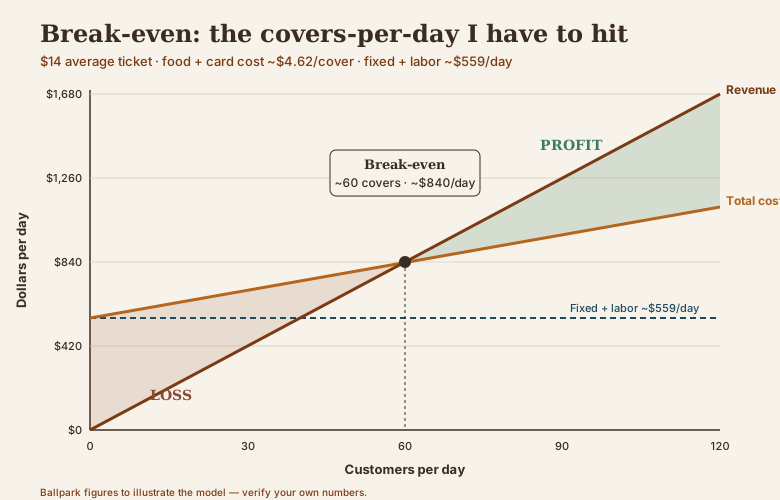
Break-even is where revenue exactly covers all costs. Because food cost and card fees scale with sales, each customer contributes their ticket minus their variable cost. At a $14 ticket, food cost of 30% ($4.20) and card fees of ~3% ($0.42), each cover contributes about $9.38 toward fixed costs and labor. My fixed-plus-labor load is roughly $12,300 a month, or about $559 a day across 22 service days. So:
Break-even covers/day = $559 / $9.38 ≈ 60 customers/daySo I need roughly 60 customers a day just to cover costs, and everything above that is profit. At 120 covers I’m comfortably in the black; at 60 I’m treading water; below that I’m losing money and need to fix my sites, my menu, or my prices. That single number — break-even covers per day — is the one I’d tattoo on the inside of the truck. The chart below shows revenue climbing past total cost right around that crossover.
What moves the needle
Once the model’s on paper, it’s obvious which levers actually matter:
- Kill the commissary rent by making the bakery the base — the biggest single fixed-cost win, and free if I’m building the shop anyway.
- Lift the average ticket with the bakery cross-sell (a cookie and a jar of jam on the way out) rather than by raising prices — pure margin on already-baked goods.
- Protect food cost at 28–35% through commissary prep and tight portioning; it’s the largest single cost and it scales, so a few points here is real money.
- Chase covers, not just ticket — a truck’s fixed costs are brutal at low volume and trivial at high volume, so the game is booking sites and events that put people in front of the window.
Run your own version of both tables with real local quotes before you buy anything — mine are here to prove the model, and the model says a used build tied to my coffee shop and bakery as its commissary, hitting a modest daily cover count, pencils out. The rest of the plan — how the two halves feed each other — is in the truck + the bakery, and the parallel build-cost logic for the shop itself is in the kitchen-equipment numbers.
Comments (0)