Rules & Regulations
This is the page I wish someone had handed me at the start, because the licensing is the part that sinks people who can cook. I’m in Michigan, so everything here is Michigan-specific — the agency, the license names, the cottage-food cap, the commissary rule. If you’re somewhere else the shape is similar but the details differ, and even in Michigan the rules and dollar figures move. So here’s the one caveat, said once and meant for the whole page: rules and figures change — verify the current requirements directly with MDARD (the Michigan Department of Agriculture & Rural Development) and your local health department before you build or buy anything. With that said, here’s the map I navigate.
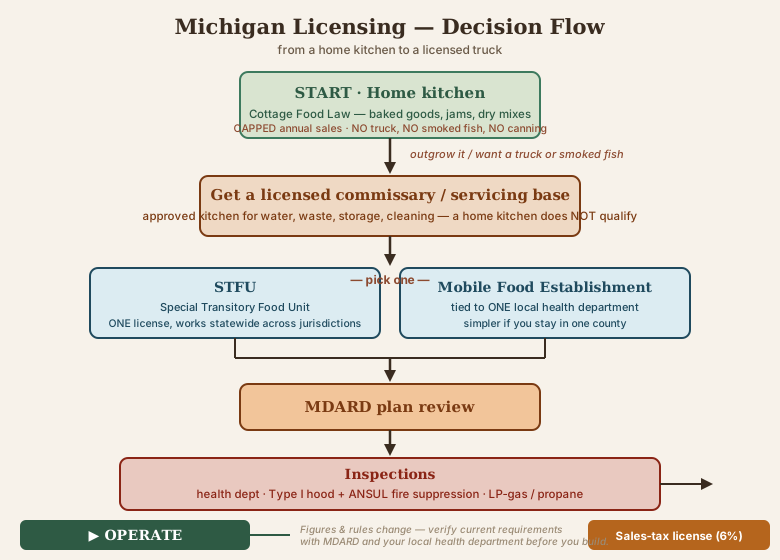
The whole path, at a glance — from a home kitchen to a licensed truck on the street:
The Michigan Cottage Food Law — and why it isn’t enough
Michigan’s Cottage Food Law is the on-ramp, and it’s genuinely useful: it lets you make certain non-hazardous foods in your own home kitchen — uninspected — and sell them directly to the consumer (farmers markets, roadside, direct sale). What it covers is the shelf-stable, low-risk stuff:
- Baked goods without cream or custard fillings — breads, cookies, many cakes, biscuits.
- Jams and jellies — the high-sugar, high-acid preserves that don’t need refrigeration.
- Dry mixes, candies, dry herbs, granola, and similar non-hazardous items.
The trade for skipping inspection is a required label. Every cottage-food item must be labeled with your name and address, the product name, the ingredients (in descending order by weight), allergens, net weight, and — the wording that has to appear verbatim — a statement that it was “made in a home kitchen that has not been inspected by the Michigan Department of Agriculture and Rural Development.” There’s also an annual gross-sales cap: historically $25,000, but as of writing that figure has been rising, so verify the current cap — don’t plan against an old number.
Here’s the crucial part for this whole section: a cooking food truck, and smoked fish, blow right past cottage food. Cottage food does not cover cooking or assembling food to order, it does not cover a mobile food establishment — a unit that fries, grills, or builds food on board — it does not cover low-acid canning, and it emphatically does not cover smoked fish or smoked meats, which are hazardous foods that require inspection and a HACCP plan (see smoked fish and meat and food safety). A truck that cooks outgrows cottage food almost immediately — which is exactly why the bakery and the cooking truck need real, licensed footing.
But — and this is the part almost everyone misses — cottage food does let you sell your packaged home-made goods from a stand or a truck. That single distinction opens a whole business that needs no license at all, so it’s worth its own section before we go further.
The cottage-only truck — packaged goods, no license, no commissary
There’s a real business hiding inside the cottage-food rules that most people walk right past, and it’s the cheapest legal way onto the street. Cottage food lets me sell my home-made, non-hazardous products directly to the consumer — and the law cares about what I’m selling and that the sale is direct, not about whether I’m standing behind a folding table, a farm stand, a cart, or a serving window built into a trailer. So I can load up packaged, labeled loaves, bagels, cookies, granola, dry mixes and jars of jam and jelly, park at a farmers market or a permitted event, and sell them straight to customers with no MDARD license, no commissary, and no inspection — because I’m still operating as a cottage food operation, not a food establishment. The “truck” here is really a rolling retail stand. A towed trailer with a sales window works exactly the same way: as long as what goes out the window is packaged home-baked goods sold direct, that window is a farm stand on wheels, not a licensed kitchen.
The bright line — the thing that ends the exemption the instant you cross it — is on-site food prep or service. The moment I cook, fry, grill, assemble, sample, or hot-hold anything on that unit — fry an egg, build a sandwich to order, heat a soup, hand out tastes of a hazardous food — I am no longer selling packaged cottage food; I’m running a mobile food establishment, and that pulls in the whole apparatus: an STFU or Mobile license, a licensed commissary, and the health, fire-suppression and LP-gas inspections below. Selling a wrapped loaf is cottage food. Slicing that loaf into a hot sandwich in the window is not.
So the cottage-only truck is a specific, honest business: a packaged artisan-bakery-and-preserves stand on wheels — fresh bread, bagels, cookies, granola and jars of jam sold at markets, roadside where zoning allows, and events. Its ceiling is the cottage-food ceiling: the annual gross-sales cap (verify the current figure), direct-to-consumer only (no wholesale, no reselling through stores), non-hazardous foods only (no smoked fish, no cut or prepped hazardous items, no cream or custard fillings, no low-acid canning), and everything pre-packaged and labeled with that “made in a home kitchen…” statement. Inside those walls it needs almost no capital and no license, which makes it a genuinely smart way to test recipes, build a name and bank cash before I ever build a commercial kitchen. I walk through that as the leanest on-ramp on starting in a truck and as a standalone model on the truck and the bakery. When I want to add the hot street food — the tacos, the smash burgers, the breakfast sandwiches on my own bread — that’s the moment the model has to graduate to a licensed commissary and a mobile license, which is the rest of this page.
A second kitchen at home — the garage question
A question I hear constantly, and asked myself: can I just build a second, nicer kitchen in the garage and run my cottage-food business out of that? The honest answer is usually no — and understanding why matters.
Cottage food is an exemption built around your ordinary home kitchen — the residential kitchen in the house you live in, the same one you cook your family’s dinner in. That domestic-kitchen premise is the whole reason the state lets it go uninspected. A separate, dedicated kitchen — one built out in the garage, a converted outbuilding, a second commercial-style kitchen on the property — generally stops being a “home kitchen” in the eyes of the rule and reads instead as a food-production facility. And a food-production facility isn’t exempt: it has to be a licensed kitchen — MDARD plan review, commercial construction (proper three-compartment and hand sinks, washable finishes, potable water and waste), and inspection. You don’t get the cottage exemption and a separate purpose-built kitchen; building the nicer separate kitchen is exactly what tips you out of cottage food and into licensing. There’s real nuance at the edges — an attached space you genuinely use as your everyday kitchen is grayer than a standalone production kitchen out back — so this is precisely the thing to put to MDARD and your local health department in plain language before you pour a slab.
Here’s the flip that turns the “no” into an opportunity, though: if I build that garage kitchen to code and get it licensed, it stops being a limitation and becomes the single most valuable asset in the plan. A licensed home-based commercial kitchen lets me blow through the cottage cap, do hot food and smoked fish and wholesale, and — the big one — serve as the commissary a cooking food truck legally requires. The same build that’s off-limits as an unlicensed cottage extension is a commissary-grade kitchen the moment it’s licensed. Two cautions ride along with that: the licensed route means the full commercial-kitchen cost (see the numbers), and a licensed commercial operation at a residence can collide with local zoning and home-occupation limits — a home cottage operation is usually an allowed home occupation, but a licensed food establishment on residential property is a different animal, so clear it with your township before you build.
The licensed food establishment and plan review
The moment you want a real commercial kitchen — my coffee shop and bakery — you’re into MDARD food-establishment licensing. That means a plan review: before you build or renovate, you submit your layout, equipment, plumbing, and finishes to the regulator, they review it against code, and only then do you build. Then the finished kitchen gets inspected and licensed before it opens, and re-inspected on a cycle after. Plan review feels like a hoop, but it’s the cheapest hoop — it’s far better to fix a plumbing or hood problem on paper than after it’s installed. This is the licensed kitchen the smoked fish and the wholesale-scale baking legally require.
Mobile food in Michigan — STFU vs. Mobile Food Establishment
For the truck itself, Michigan gives you two mobile paths, and picking the right one matters:
- STFU — Special Transitory Food Unit. This is the statewide license. One STFU lets you operate across multiple local jurisdictions in Michigan on a single license, which is exactly what you want if your model is chasing festivals and events around the state. For a truck that travels, this is usually the answer.
- Mobile Food Establishment. This license is tied to a single local health department’s jurisdiction. It can be simpler and cheaper if you’re staying put — one county, one town, a fixed weekday route — but it doesn’t travel with you across jurisdiction lines.
Both are real licenses with fees and inspections; the STFU trades a bit more process for the freedom to roam. If you’re weighing the truck itself and the format that fits, that’s why a truck and buying used vs. new.
The commissary / servicing-base requirement — and how the bakery solves it
This is the rule that surprises everyone and the one that ties the whole business together: a mobile food unit in Michigan must be tied to a licensed commissary (servicing base) — an approved commercial kitchen where the truck goes for potable water, waste disposal, food storage, and cleaning. And here’s the catch that stops a lot of first-timers cold: a home kitchen does not qualify as a commissary. You cannot base a licensed truck out of your house.
Which is precisely why the bakery and the truck reinforce each other. The bakery is the commissary. The licensed commercial kitchen I need anyway for the bread, bagels, smoked fish, and jam is the exact approved servicing base the truck’s license requires — potable water, grey-water disposal, cold storage, and a place to deep-clean the unit. One investment answers two legal requirements. I walk through that whole pairing on the truck and the bakery; for licensing purposes just hold onto the fact that the truck needs a licensed base, a home kitchen isn’t one, and a bakery is.
”But I’ve seen trucks with no kitchen behind them” — how those work
You’ve almost certainly watched a truck work a festival with no bakery, no restaurant, nothing visible behind it, and wondered how it’s legal. The answer is almost always that the base is real but invisible — a commissary is a servicing relationship on file with the regulator, not something parked at the curb. A few ways it actually plays out:
- They rent a commissary you never see. A shared-use commercial kitchen, a friendly restaurant’s kitchen after hours, a church, VFW, or school hall — the truck goes there before and after service for water, waste, food storage, and cleaning, then drives to the event with none of that in sight. You only ever see the window.
- They’re a restaurant’s mobile arm. A big share of trucks belong to an existing licensed restaurant, and that restaurant is the commissary. The truck is the restaurant on wheels.
- The event is the base. At fairs and festivals, vendors often run on a short, event-specific temporary food establishment permit and use the event’s shared facilities — central handwashing, potable water, waste, sometimes a commissary tent. For those days the festival is effectively the commissary, which is exactly why a booth or truck can look like it stands alone.
- It’s a cottage-food stand. If all that’s going out the window is packaged home-baked bread, cookies, and jam sold direct, there’s no commissary because there’s no food establishment at all — that’s the cottage-only truck described earlier on this page.
- The unit is highly self-contained. Michigan talks about a commissary or a servicing area. A truck carrying ample potable water, grey-water capacity, onboard refrigeration, and its own warewashing can shrink what the servicing area has to do — but it still names one on the license (somewhere to draw water, legally dump waste, and store and prep food).
And to be straight with you: some trucks are simply out of compliance. Enforcement is largely complaint-driven, so an unlicensed or under-serviced unit can run for a while — right until an inspector, a competitor, or a sick-customer complaint ends it. That’s not a model to copy; a licensed base is cheap insurance, and for my plan it’s the bakery I was building anyway. (Verify your own servicing arrangement with MDARD and the local health department — this is one they will absolutely ask about.)
Health, fire-suppression, and LP-gas inspections
Before you operate, and periodically after, the unit gets inspected. Three inspections matter:
- Health inspection — the health department checks the plumbing (fresh/grey tanks, the 3-compartment sink and separate hand sink, hot water), refrigeration and hot-holding temps, surfaces, and safe-food practices. The build details behind passing this are on fixing up a truck.
- Fire suppression — grease cooking requires a Type I hood with a wet-chemical (ANSUL) fire- suppression system, professionally installed and carrying a current inspection tag. An expired tag is a failure; keep it in date.
- LP-gas — the propane system gets its own inspection: tanks in date, regulators, hard lines, and a leak test. Gas is where inspectors are strictest, and rightly so.
Local zoning, township, and event permits
MDARD and the health department license the food; they don’t grant you the right to park and sell anywhere you like. That’s local, and it’s the patchwork that varies town to town:
- Zoning and township permits — where you may legally vend, hours, distance rules, whether you need a local vending permit at all.
- Fire marshal sign-off — many jurisdictions want the local fire marshal to bless the unit, separate from the state fire-suppression tag.
- Event and vending permits — festivals, fairs, and brewery lots often require their own permit or a per-event fee on top of everything else.
Expect this to differ everywhere you go. The statewide STFU smooths the food license across jurisdictions, but you’re still checking local zoning and fire sign-off in each new place you park.
Sales tax, business registration, and insurance
The back-office pieces that are easy to forget until they bite:
- Michigan sales-tax license. Prepared food is taxable in Michigan at 6%. You register with the state, collect the tax, and remit it. Get this before you sell.
- Business registration — form the entity (an LLC is common for the liability shield), get an EIN, open business banking, keep clean books.
- Insurance — general liability, commercial auto on the truck (or tow coverage on a trailer), and usually product liability. Events and commissaries will often require proof of coverage before they let you in.
Food-manager certification (ServSafe)
Finally, someone on the operation needs to be a certified food-protection manager — in practice a ServSafe Manager certification, which involves a course and a proctored exam and is renewed on a cycle. It’s a modest cost and genuinely worth it beyond the requirement: it’s the same temperature-and-cross-contamination discipline I lean on for smoking and preservation, formalized. Everyone handling food should understand it; at least one certified manager makes it official.
The summary table
| Requirement | What it is | Who / where |
|---|---|---|
| Cottage Food Law | Home-kitchen, non-hazardous, direct sale, capped (verify current cap) | Self-labeled, uninspected |
| Cottage-only truck/stand | Selling packaged cottage goods direct from a stand/cart/trailer — no cooking on board | No license, no commissary |
| Second home kitchen (e.g. garage) | A separate built-out kitchen is not a “home kitchen” → needs licensing; licensed, it can be the commissary | MDARD + local zoning |
| Food establishment license | Real commercial kitchen (the bakery) | MDARD + plan review + inspection |
| STFU | Statewide mobile license, multiple jurisdictions | MDARD / local HD |
| Mobile Food Establishment | Mobile license tied to one local jurisdiction | Local health department |
| Commissary / servicing base | Required licensed base for water, waste, storage — home kitchen ≠ commissary | The bakery serves as this |
| Health inspection | Plumbing, temps, surfaces, practices | Local health department |
| Fire suppression | Type I hood + ANSUL, tagged & current | Fire-suppression company + fire marshal |
| LP-gas inspection | Tanks, regulators, lines, leak test | LP-gas inspector |
| Local permits | Zoning, township, fire marshal, event/vending | Each locality |
| Sales-tax license | Prepared food taxable 6% | State of Michigan |
| Business + insurance | Entity, EIN, GL/auto/product coverage | You / insurer |
| Food-manager cert | ServSafe Manager | Certified individual |
None of this is meant to scare you off — it’s a checklist, not a wall, and every licensed truck on the road cleared it. Work it in order (cottage food to learn, then commissary, then mobile license, then plan review, then inspections, then sales tax, then operate), and lean on the fact that the bakery does double duty as your commissary. But do it with current information: call MDARD and your local health department, tell them your exact plan and unit, and confirm the figures and steps before you spend. For where the truck fits the bigger picture, see the truck and the bakery; for the food-safety fundamentals under all of it, food safety.
Comments (0)