The Truck + The Bakery
This is the page the whole plan has been building toward. Two ventures that look separate on the surface — a brick-and-mortar bakery and a food truck — are, done right, a single machine where each half makes the other half stronger. I didn’t arrive at this by accident. After years of eating my way through every US state and thirty-odd countries, cooking on my own commercial line, smoking my own meats and putting up my own jams, I kept noticing that the businesses that survived weren’t the ones with the best single idea — they were the ones where every part fed every other part. The bakery and the truck are that, on purpose. Here’s how they lock together.
The core idea: the bakery IS the commissary
Start with the legal reality, because it’s also the financial one. A mobile food unit in Michigan can’t operate out of thin air — it has to be tied to a licensed commissary, an approved commercial kitchen that supplies its water, takes its waste, stores its food, and gives it a place to be cleaned and serviced. A home kitchen does not qualify. Most truck operators rent commissary time from someone else and write a check for it every month (I model that cost in the truck’s numbers).
My coffee shop and bakery is a licensed food establishment already — inspected, plan-reviewed, plumbed, with the ovens and mixers and refrigeration and the water and waste systems a commissary needs. So the bakery is the commissary. The truck’s legal base is a building I’m already running. That single fact does two enormous things: it erases the truck’s largest fixed monthly cost, and it means the truck was, in a sense, always part of the bakery’s plan. The regulatory framing for both — MDARD licensing, the STFU mobile option, the commissary requirement — is in rules and regs, and the reason a serious operation outgrows cottage-food rules and needs this real licensing is spelled out there too. (Rules and figures change — verify the current requirements with MDARD and your local health department before you build.)
The truck is the storefront that moves
Now flip it around. A bakery sits still and waits for a neighborhood to walk in. The truck doesn’t wait — it drives to where the people already are: office parks at lunch, breweries at night, farmers markets on Saturday, festivals and fairs all summer. It’s the most cost-effective marketing the bakery could possibly buy, because it doesn’t just advertise the brand, it sells while it advertises.
And it doesn’t only sell cooked street food. The truck is a rolling storefront for the bakery’s products — the breads, the bagels, the cookies, the jars of jam — sold right alongside the tacos and smash burgers and breakfast sandwiches. Somebody eats a brisket grilled cheese on my sourdough, loves it, and buys a loaf to take home. Somebody’s kid gets a cookie and the parent grabs three more and a jar of jam. The full menu logic — workhorses, signature items, and the all-important bakery cross-sell — is laid out in menus that sell. Every cooked-food customer is a warm lead for a baked-goods sale, and every one of those sales carries the higher margin of a shelf-stable product I already made.
The flywheel
Put the two together and you get a flywheel — a loop where each turn makes the next turn easier.
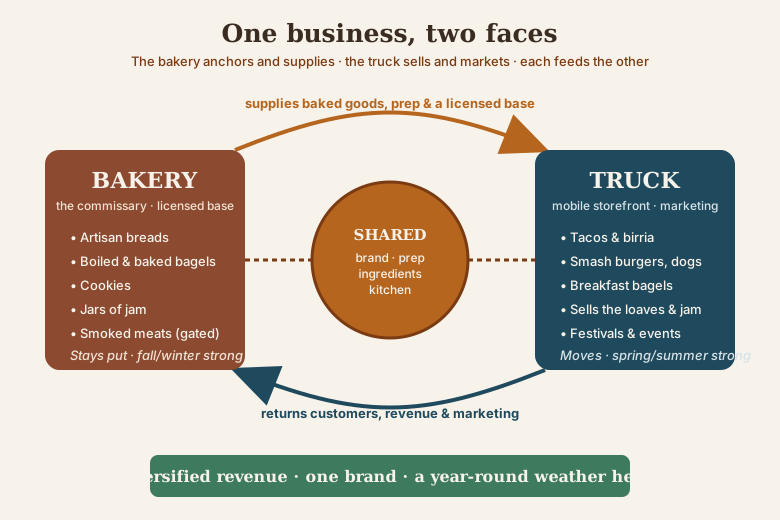
Here’s what’s actually spinning in that diagram:
- Shared prep and ingredients. The same doughs, braises, sauces and smoked meats serve both sides. I mix one big batch of dough and it becomes shop loaves and truck bagels. I braise one vat of birria and it feeds truck tacos and a shop lunch special. I buy flour, produce and meat at one volume, for one operation, at better prices. Nothing is duplicated; everything is leveraged.
- One brand, seen in two places. The truck at Saturday’s festival and the shop on Main Street are the same name, the same look, the same wrap and signage. A customer who meets me at an event knows exactly where to find me the rest of the week, and the person who walks past the shop daily recognizes the truck when it shows up at their office. Two touchpoints, one memory.
- Diversified revenue. Cooked street food, cooked shop food, retail baked goods, retail jam, catering, events. When one line is soft, another carries. I’m not betting the whole business on lunch rush or on foot traffic or on the weather.
- A weather and season hedge. This one’s underrated. A food truck is brutal in a Michigan January — nobody’s standing outside for a taco at fifteen degrees — but that’s exactly when a warm bakery with fresh bread and coffee is at its best. Then summer flips it: the shop is quiet in the heat while the truck is booked solid at every festival and market for miles. The two halves are counter-cyclical. When the truck slows, the shop carries; when the season peaks, the truck carries. I’ve smoothed out the calendar that sinks single-channel food businesses.
- Each side feeds the other’s customers. The truck sends festival crowds to the shop; the shop’s regulars follow the truck to events and hire it for their parties. The loop closes and then it compounds.
| Shared asset | Bakery role | Truck role | The win |
|---|---|---|---|
| Kitchen / commissary | Production + storefront | Legal base + prep station | Truck’s biggest fixed cost → ~$0 |
| Doughs & braises | Loaves, bagels, specials | Sandwiches, tacos, bao | One batch, two revenue streams |
| Purchasing | Volume ingredient buys | Draws from same inventory | Better prices, less waste |
| Brand & signage | Fixed storefront presence | Mobile marketing engine | One name, doubled exposure |
| Smoked meats | Deli/specials (safety-gated) | Featured truck specials | One smoker, two menus |
| Seasonality | Strong fall/winter | Strong spring/summer | Year-round smooth revenue |
The leanest model: a truck and no bakery (yet)
Before we sequence the two halves, it’s worth naming the model that has no bakery in it at all — because it’s where a lot of people (maybe me) actually start, and it’s the cheapest legal business in this whole dive. A cottage-food truck skips the commercial kitchen entirely. I bake bread, bagels and cookies and put up jam and jelly in my home kitchen under Michigan’s cottage food law, package and label it, and sell it direct from a stand, a cart, or a trailer with a sales window — at farmers markets, roadside, and events. No commercial lease, no commissary, no MDARD license, no inspection. It’s a genuine business: a mobile artisan-bakery-and-preserves stand, running entirely on what one person can bake at home.
Its ceiling is the cottage ceiling — an annual sales cap (verify the current figure), packaged direct sale only, non-hazardous foods only, and nothing cooked or assembled on board. So it can’t sell the hot street food that makes the rest of this dive tick; the moment I want to fry an egg or build a sandwich to order, I’ve become a licensed mobile establishment and I need the commissary and license from rules and regs. But as a starting point it’s unbeatable, and it graduates cleanly: the cottage truck proves the recipes, builds the name, and banks the cash, and then a licensed kitchen — even a garage kitchen built to code — turns it into the full flywheel above. Think of it as model zero: the truck before there’s a bakery, earning its way toward one.
And two things make even this lean version punch far above its weight:
- You can tow. A truck can pull a trailer, and that trailer earns its keep twice. It carries the smokers, the wood, and the generator — keeping the noise, heat and smoke off the cook line, and the smokers outdoors where the code and the smoke both want them — and it can carry a second sales window for the packaged bakery goods. Now I’m running two windows at once: hot food from the truck, fresh bread and jars of jam from the trailer. One rig, doubled capacity and a doubled point of sale.
- Home-baked bread is the whole edge. I can’t stress this enough. Nobody else’s truck is serving a brisket melt on its own fresh sourdough, or a breakfast sandwich on a bagel it boiled and baked that morning. The bakery doesn’t just bolt a retail line onto the truck — it makes every cooked item on the truck better than anything the truck parked next to me can put out. That’s why the menu is built on my own bread from the first line down.
Sequencing: which one first?
You rarely build both on day one, so the real question is order. There are three honest paths.
Truck first, shop later. Start with the truck because it’s cheaper to launch — a used build tied to a rented commissary gets me on the road and earning while I build a following, prove the recipes, and bank the cash and the customer list I’ll need to sign a lease. The catch: I’m paying someone else’s commissary rent until my own shop opens, and I don’t yet have the bakery’s production muscle behind me. This is the classic bootstrap, and it works.
Shop first, truck later. Open the bakery first, get it licensed and running as a real commercial kitchen, and then add the truck as an extension of a business that already has a base, a brand and a production line. The truck launches into a much stronger position — its commissary is free, its products are already made, its brand already exists — but the shop is the heavier, slower, more expensive thing to stand up first, and a bakery lease is a serious monthly commitment before the truck’s revenue exists to help carry it.
Both together. Build them as one project from the start, designing the kitchen as a commissary from the first blueprint and the truck as its mobile arm. Cleanest end state, highest peak capital requirement, most to manage at once.
Where I’m leaning: shop-anchored, truck-forward. The bakery is the thing I most want to build and the asset that unlocks everything else — it’s the commissary that makes the truck cheap, the production line that makes the cross-sell free, and the licensed base the whole model rests on. So my instinct is to get the shop stood up as a proper commissary-grade kitchen, then put the truck on the road as its mobile storefront and marketing engine — possibly running a modest used truck for events and overflow even a little ahead of the shop’s opening, so the brand is out earning and building a list while the buildout finishes. The precise order I’ll settle once I’ve walked real spaces and run the real shop numbers against the truck numbers — but the destination is the same either way: two doors, one brand, one kitchen, feeding each other.
Why this is the whole point
Every earlier page has been a piece of this. Why a truck and why I buy commercial explain the two halves on their own terms. Starting in a truck is the bridge between them. The menu is engineered around the cross-sell, and both sets of numbers only truly pencil out when the commissary line collapses to zero — which only happens when the bakery and the truck are one business.
That’s the machine. The bakery bakes and anchors and stays put; the truck sells and markets and moves; they share a kitchen, a brand, an inventory and a customer base; and each one covers for the other when the season or the weather turns. It’s not a bakery plus a truck. It’s one business wearing two faces, and that’s exactly what I intend to build.
Comments (0)