Around the World
Every English source will tell you that Thai son-in-law eggs are a castration threat — the mother-in-law fries two eggs to remind her daughter’s husband what could happen to his. It’s a great story. It’s in Atlas Obscura, it’s in Tasting Table, it’s the whole framing of the dish in English.
Go read the Thai sources and that story isn’t there. Not hedged, not secondary — absent. Thai Wikipedia doesn’t mention it. Thairath, a major Thai daily, doesn’t mention it. What they tell you instead is that a man wouldn’t eat his fish.
That’s this page. Once you go looking at marinated eggs outside China, Japan, and Korea, the pattern that shows up over and over isn’t a technique — it’s that the English-language story and the local story are different stories, and nobody checked.
A quick structural note first, because it prevents most of the confusion. The world’s marinated-egg traditions split into three mechanically different families, and conflating them is the most common error in English food writing:
- Steeped — a cooked, peeled egg sits in a liquid and absorbs it over hours to weeks. (Pickled eggs, Soleier, telur pindang.)
- Braised — the egg cooks in the sauce for minutes. Not marination. (Thịt kho trứng, adobong itlog.)
- Coated and fried — the egg is a vehicle for a crust. No marination at all. (Kwek kwek.)
Keep those straight and half the internet’s egg writing sorts itself out.
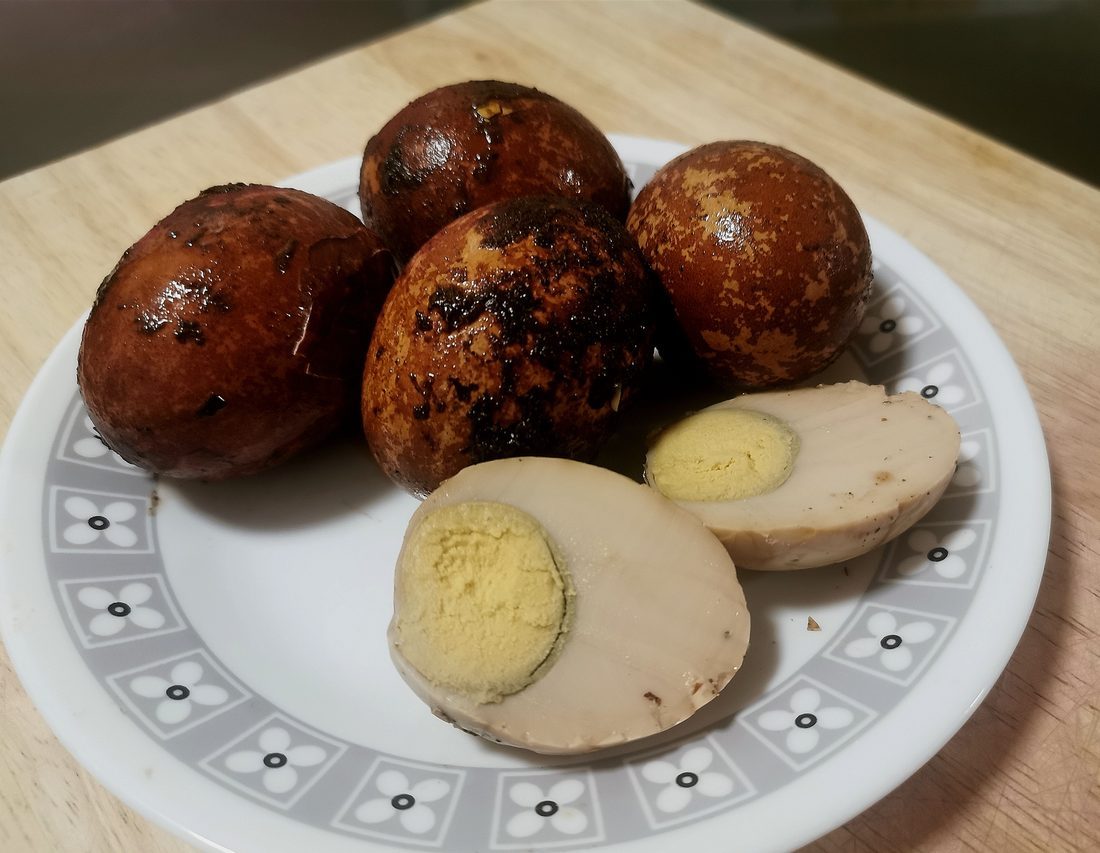
Telur pindang. The colour is shallot skins and tannic leaves, not tea — it is the tea egg’s cousin, arrived at independently.
Thailand: son-in-law eggs (ไข่ลูกเขย)
Boiled eggs, deep-fried until the whites blister into a golden crackled skin, then drowned in a tamarind–palm sugar–fish sauce syrup and topped with fried shallots and dried chilies. It is one of the great dishes. It is also, as far as I can tell, the victim of an anglophone invention.
🔴 The etymology correction
Here’s the sourcing, laid out flat:
| Source | Language | Castration story? |
|---|---|---|
| Thai Wikipedia, ไข่ลูกเขย | Thai | No — not mentioned at all |
| Thairath (major Thai daily) | Thai | No |
| Pantip threads | Thai | One of several, not dominant |
| Atlas Obscura | English | Yes — headline framing, “a veiled threat” |
| Tasting Table | English | Yes — “also a threat” |
| Daily Meal | English | Yes, but calls it “the mystery” |
| Wiktionary | English | Calque only, no origin claim |
The pattern is not subtle. The castration story is dominant in English and largely absent from Thai. That’s close to the signature of an anglophone invention, or at minimum an anglophone amplification of a minor variant.
(The pun does work, to be fair: ไข่ khai is genuinely slang for testicle in Thai. That’s what makes the joke land. It just isn’t what Thai sources say the dish is about.)
What the Thai sources say instead:
The nam pla wan story (Thai Wikipedia’s primary account, and the Pantip consensus). During sadao — neem shoot — season, the mother-in-law made น้ำปลาหวาน, nam pla wan, sweet fish sauce, to eat with grilled fish. The son-in-law wouldn’t eat the fish. So he cast about for something else to put the sauce on, tried a boiled egg, found it lacking, and fried the boiled egg instead. Everyone tried it, everyone liked it, nobody knew what to call it, so they named it after him.
The metaphor story (Thai Wikipedia secondary; Thairath’s main account). The name describes the flavor as an analogy for the son-in-law/mother-in-law relationship — 「หวานปนขมผสมกัน」, sweet mixed with a little bitter, requiring careful balance.
The cooking-contest story (surfaced from Thai sources by the blogger xinfully). A father-in-law sabotages his son-in-law in an omelette contest by boiling all the remaining eggs. The son-in-law improvises, fries them, invents the tamarind sauce, and impresses everyone.
Notice what stories one and three have in common: the son-in-law is the hero, not the victim. The English version makes him a man being threatened with mutilation over dinner. The Thai versions make him a picky eater who accidentally invented something good, or a guy who won.
The argument this page is making
Here is the part I haven’t seen anywhere else, and I want to be clear that this is an argument, not a citation. It’s the researcher’s inference and mine, and I’d rather label it than dress it up.
The nam pla wan story is mechanically self-corroborating.
Look at the sauce on a son-in-law egg: palm sugar, fish sauce, tamarind, fried shallot. That is nam pla wan. The dish is structurally a nam pla wan delivery vehicle. The origin story says “he needed something to eat with the nam pla wan, so he fried an egg” — and the dish that resulted is, to this day, an egg with nam pla wan on it.
The etymology and the recipe corroborate each other. The castration story explains the name and nothing about the food. The Thai story explains both.
No English source I can find makes that connection. It’s not proof — it’s an argument from mechanism, and a story can be internally coherent and still be folklore invented after the fact. But it is a considerably better argument than “it’s a threat, trust us.”
🔴 What is NOT FOUND
Everything else. There is no dating for the dish at all — no pre-20th-century attestation, no Thai cookbook or dictionary citation, no scholarly source documenting any of these origins, including the ones I just told you.
And no source connects it to Maria Guyomar de Pinha or the Portuguese egg-dessert legacy of Ayutthaya (foi thong and company). That link gets floated because Portugal did demonstrably leave egg desserts in Thailand — but there is nothing supporting it here and it should not be asserted.
So the honest line is not “the castration story is false.” It’s: the castration story is undocumented and probably anglophone, and so is every story that competes with it. All of them are urban legends. Some are better legends than others.
Recipe — Son-in-law eggs (serves 4, as part of a rice meal)
Eggs
- 6 eggs — duck eggs are traditional and better, bigger yolk, richer; chicken is fine
- Neutral oil for frying, about 1 inch / 2.5 cm deep
Sauce — this is nam pla wan
- 1/2 cup palm sugar, chopped (about 100 g)
- 3 tbsp tamarind concentrate, loosened with 3 tbsp water
- 2 tbsp fish sauce
- 1/4 cup water
Garnish
- 4 shallots, thinly sliced and fried crisp
- 4–6 dried red chilies, flashed whole in the oil about 20 seconds until darkened
- Coriander sprigs
- Boil the eggs. 8 minutes from boiling for a fully set but not chalky yolk; 6.5–7 minutes if you want it faintly fudgy. Ice bath, peel. Dry them completely. This is the whole ballgame — wet eggs spit violently.
- Fry the shallots at around 300°F / 150°C until golden, 4–6 minutes. Drain. Flash the chilies in the same oil, ~20 seconds. Out.
- Fry the eggs. Bring the oil to 350–360°F / 175–182°C. Lower them in gently, fry 3–5 minutes, rolling, until the whites blister gold and crackled. Drain. Even dry eggs pop. Use a splatter screen and stand back. I’m not being cute about this.
- Sauce. Wipe out a pan. Melt the palm sugar with the water over medium until dissolved and syrupy, ~3 minutes. Add tamarind and fish sauce. Simmer 3–5 minutes to a loose-honey consistency. Taste and balance — it should read aggressively sweet, then sour, then salty, in that order. More tamarind for sour, more fish sauce for salt.
- Halve the eggs, arrange cut side up, spoon the sauce over, top with the shallots, chilies, and coriander.
⚠ Two schools, and Thairath is in the second one:
- Fry-then-sauce — the standard, and what most Thai restaurants do. The sauce goes over at the end and the fried skin stays crisp.
- Simmer-in-sauce — Thairath’s traditional version simmers the eggs 10–15 minutes on low in the sauce, turned to coat. This is the only version where the dish is meaningfully braised. It trades crispness for penetration, and it’s the evidence that this dish is family (2), not just family (3).
Vietnam: thịt kho trứng
Pork belly and hard-boiled eggs braised in fresh coconut water with fish sauce and a dark caramel. With eggs it’s thịt kho trứng; the general dish is thịt kho tàu.
It’s a must-have of the Southern Vietnamese Tết feast, offered on the ancestral altar before the family eats. And the reason why is one of the best practical details in food:
You don’t cook on the first day of the new year. No labor, no work — the first day sets the tone for the whole year. So you make one enormous pot ahead of time that improves over several days and eats you through the holiday. The dish is engineered for reheating. That’s not a happy accident of the recipe; that’s the design brief.
⚠ Don’t flatten the regional split. Southern = sweeter, more sauce, fresh coconut water, big pork chunks. Northern = saltier, less sauce, the braising liquid may be plain water with no coconut at all, smaller chunks.
⚠ And “tàu” doesn’t mean “Chinese” the way people assume — but the dish plausibly is Chinese-derived. It’s believed to be an interpretation of Fujianese émigrés’ tau yu bak (豆油肉), soy sauce pork and eggs. Believed. Not established.
The caramel — nước màu
This is the part worth teaching properly, because it’s where home cooks fail.
Sugar and a little water, medium-low heat. Clear, then yellow, then dark amber. Pull it at dark amber going on mahogany — just short of where it smells acrid.
The point of taking it that far is that it must be BITTER, not sweet. An under-cooked caramel makes the whole braise cloying. The caramel is there for color and for a bitter backbone that offsets the fish sauce and the coconut. This is the single most misunderstood step in the dish, and the instinct to pull it early is exactly wrong.
It goes from perfect to burnt in seconds. Have your liquid ready. Adding liquid to hot caramel erupts — off heat, stand back.
Recipe — Thịt kho trứng (serves 6, Southern style)
- 2 lb / 900 g skin-on pork belly, in 1.5-inch / 4 cm cubes
- 8–10 eggs, hard-boiled (8 min) and peeled
- ~2 cups fresh young coconut water — not coconut milk, not sweetened
- 4–5 tbsp fish sauce
- 3 tbsp sugar (caramel) + 1 tbsp water
- 1 tbsp sugar (marinade)
- 4 shallots, minced; 3 garlic cloves, minced
- 1 tsp black pepper
- 2 whole red chilies (optional)
- Marinate the pork — a genuine marination step, 30 minutes to overnight, refrigerated: pork + shallots + garlic + 2 tbsp fish sauce + 1 tbsp sugar + pepper.
- Blanch (optional but traditional): cover with cold water, boil 2 minutes, drain, rinse. Gives a clean sauce.
- Caramel: 3 tbsp sugar + 1 tbsp water in the braising pot, medium-low, to dark amber, 5–8 minutes. Off heat.
- Add the pork, turn to coat, sear on medium ~5 minutes.
- Add the coconut water and remaining fish sauce to barely cover. Bring to a simmer and skim the scum thoroughly — this is why people’s kho comes out muddy.
- Braise low, uncovered or partly covered, 45 minutes.
- Add the peeled eggs. Braise a further 30–45 minutes, until the pork is spoon-tender and the sauce is glossy. About 1.5 hours total.
- Rest it overnight. Universally agreed: it is better on day two. The eggs keep taking color and the fat re-emulsifies.
⚠ The eggs go in LATE. Eggs braised the full 90 minutes turn rubbery and grey-ringed. The 30–45 minute window gives you color and flavor without wrecking the white. Plenty of blog recipes add them at the start. That’s wrong.
Safety: this is a braise, held hot then refrigerated. It’s not a pickle and it does not carry the botulism risk that pickled eggs do. Refrigerate within 2 hours; bring it to a full simmer each day you reheat it.
→ Trứng Kho (Vietnamese Braised Eggs)
Philippines: adobong itlog
Hard-boiled eggs simmered in the adobo base — vinegar, soy sauce, garlic, bay, peppercorns. Oyster sauce and onion are common modern additions.
Recipe (serves 4)
- 8 eggs, hard-boiled (8 min) and peeled
- 1/2 cup soy sauce
- 1/4 cup cane or coconut vinegar (white vinegar acceptable)
- 1/2 cup water
- 6 garlic cloves, crushed
- 3 bay leaves
- 1 tsp whole black peppercorns
- 1 tbsp brown sugar (optional, balances)
- oil
- Optionally fry the peeled eggs in a little oil until the skins blister golden. Most traditional versions do this, and it gives the sauce something to cling to. (Note the convergence with the Thai and Indonesian dishes on this page — fried-then-sauced boiled eggs are a pan-Southeast-Asian move, and once you notice it you see it everywhere.)
- Sauté the garlic in oil until golden. Add soy, water, bay, peppercorns. Simmer 5 minutes.
- Add the vinegar and DO NOT STIR. Boil uncovered 3–5 minutes. ⚠ This is the canonical adobo rule and it’s real: stirring or covering before the raw vinegar edge cooks off leaves a harsh acetic taste. It’s culinary convention rather than well-explained chemistry — the volatile acetic acid boils off. Treat it as technique, not physics.
- Sugar if using. Add the eggs, tumble gently, simmer 5–8 minutes only to glaze and take color.
- Rest it. Sources agree adobong itlog is better made a day ahead — and this is where it touches the steeped family: an overnight fridge rest in the sauce is a genuine short marination, and the eggs come out with a distinct amber ring.
→ Adobong Itlog (Filipino Adobo Eggs)
Kwek kwek is not a marinated egg
The most famous Filipino egg street food is not marinated, and I’d rather say that than pad the page with it.
Tokneneng = hard-boiled chicken or duck eggs in an orange batter, deep-fried. Kwek kwek = the same, with quail eggs. The orange is annatto (atsuete) — a natural colorant, cosmetic, not chili. There is no marinade. It’s a batter. Family (3), full stop.
⚠ Its etymology is also folklore, which is a pattern by now. “Tokneneng” allegedly comes from a 1978 Pinoy komiks called Batute where the character’s coinage meant “egg”; “kwek-kwek” allegedly imitates a duck. “Allegedly” is Wikipedia’s own word. A rival story has a balut vendor in Cubao dropping his stock and battering it rather than binning it — unsourced. 1970s Metro Manila dating is plausible and consistently repeated and 🔴 not documented anywhere I could reach.
Indonesia and Malaysia: telur pindang
This is the find. It’s real, it’s underreported, and it deserves better than it gets.
⭐ Pindang is a METHOD, not a dish. That’s the key that unlocks the whole thing. It means boiling in salt plus tannin-bearing plant material, and it’s applied to fish as much as to eggs. It is an indigenous Indonesian preservation technique, and the tannin is doing preservative work — not just coloring.
The tannin sources are the point, and they’re wonderfully specific: leftover shallot skins, teak leaves (daun jati), guava leaves (daun jambu), sometimes tea, sometimes soy sauce.
The teak-leaf detail is a genuine historical argument. Wikipedia notes that the use of teak leaf “might suggest its Javanese origin, since Java is famous for its teak wood for centuries.” Java’s teak is a real, centuries-old industry. The ingredient points at the terroir. That’s a much better kind of evidence than an origin anecdote.
Native to Java and Sumatra, now archipelago-wide, most prevalent in Central and East Java and South Sumatra (Palembang). Also in Malaysian Malay cooking. Served as part of tumpeng, nasi kuning, nasi campur; in Yogyakarta, alongside gudeg or plain steamed rice.
⚠ Do not call it “Indonesian tea eggs”
Several English sources do — one is literally titled “Javanese Tea Eggs.” It’s a false framing.
The default colorant is shallot skin and teak or guava leaf. Tea is the substitute, not the base. The resemblance to Chinese tea eggs is convergent evolution around tannin plus a cracked shell, not borrowing. Two traditions arrived at the same physics from different plants.
Which sets up the best rhyme on this page. Telur pindang colors its eggs with shallot skins. German Soleier — the brine eggs of Saxony, over in pickled eggs — color theirs with onion skins. Java and Saxony. Seven thousand miles apart, no plausible contact, and both of them reached for the free allium by-product that every kitchen in the world throws in the bin. Nobody taught anybody that. It’s just what’s on the counter.
Recipe — Telur Pindang (makes 10)
- 10 eggs
- The skins of 10–15 shallots — start saving them a week ahead. This is the authentic colorant.
- 10 guava leaves, or 5 teak leaves if you can get them, or 2 tbsp black tea as the acknowledged substitute
- 3 tbsp salt
- 2 tbsp soy sauce or kecap manis (optional, deepens the color)
- 3 bay leaves (daun salam), 2 crushed garlic cloves, 1 tsp coriander seed (optional aromatics)
- Water to cover
- Put the raw eggs in a pot with everything. Cover with water by an inch.
- Bring to a boil, drop to a bare simmer, cook 1 hour.
- Crack the shells all over with the back of a spoon — do not remove them. (Some cooks crack at 20 minutes instead, for deeper marbling.)
- Keep simmering on the lowest heat, 2–4 hours, topping up the water. Traditional practice runs to 8 hours, or overnight steeping off the heat. Longer = darker, saltier, firmer, more marbled.
- Cool in the liquid. Peel to reveal the marbling.
⚠ The long cook makes the white firm and slightly bouncy. That’s the intended texture. Don’t “fix” it.
Safety: the shells are cracked, but the egg is held hot for hours and then refrigerated — this is not the room-temperature anaerobic steep that gets people hurt. But cool it and refrigerate within 2 hours. Some traditional practice implies leaving the pot out overnight. Don’t. See keeping them.
→ Telur Pindang (Indonesian Marbled Eggs)
Telur bumbu bali, briefly
Hard-boiled eggs — fried first until the skins blister, that move again — simmered in bumbu bali: shallot, garlic, chili, ginger or galangal, candlenut, tomato, tamarind, kecap manis. Sweet, spicy, savory, with rice.
The non-negotiable step: blend the paste, then fry it 8–10 minutes until the raw smell goes and the oil splits out. Then tomatoes, kecap manis, tamarind water, salt or palm sugar; simmer 10 minutes; add the fried eggs; 10 minutes more.
⚠ Name caution. “Bumbu Bali” as a commercial category (boemboe Bali) is not straightforwardly a Balinese village dish — the label travels. One source asserts it originates in Bali “for generations,” which is 🔴 unsourced, and the phrase’s currency in Dutch-Indonesian cooking suggests a colonial-era codification instead. Cook the dish; hedge the origin.
And a technique worth stealing, from Myanmar
Burmese egg curry: eggs boiled, peeled, then deep-fried in turmeric oil until the whites blister into a gold crust, then simmered in an onion-tomato gravy. A curry-shop and breakfast staple.
The detail worth having is MiMi Aye’s: the onions are lightly caramelized in turmeric oil, the oil is then drained off and added back at the end. That’s the classic Burmese si byan — “the oil returns” — and it’s the defining move of Burmese curry.
🔴 I’m not printing a Burmese name for the dish, because I could not verify the script or the transliteration from a source I trust. Si byan / ဆီပြန် as a technique term is well attested. The specific dish name isn’t, here.
🔴 India: don’t invent a tradition
I want to be blunt about this one, because the temptation to fill the gap is enormous.
India is a sauce culture for eggs, not a marinade culture. Egg curry (anda curry), Kerala nadan mutta, Bengali dimer dalna, egg bhurji — all of these are eggs cooked in or added to a gravy. Family (2). There is no Indian equivalent of the steeped, days-long marinated egg.
You could dress egg curry up as “marinated” and nobody would call you on it. It isn’t, and I’m not going to.
Egg 65 — the closest thing, and it’s real, and it’s twenty minutes
Boiled eggs, often halved or scored, are marinated in ginger-garlic paste, red chili powder, turmeric, and salt — then coated in corn flour or maida, deep-fried, then tossed in a tempered sauce with curry leaves, green chili, onion, often ketchup.
So there is a marination step. It’s 10–30 minutes, and it’s a spice coating for adhesion and surface flavor. It is not a steep.
The honest framing: the only genuinely marinated egg in the Indian canon is marinated for twenty minutes and then deep-fried, which rather defeats the point.
⚠ The origin of “65” is contested and famously so — Bhurai’s Hotel in Chennai in 1965, or 65 chilies, or the 65th item on a menu, or a 1965 army canteen dish. 🔴 None of them is documented. And Egg 65 is derivative of Chicken 65 anyway, so the “65” argument isn’t really an egg question. One sentence and move on.
🔴 Chai-boiled eggs are a phantom
I went looking specifically for an Indian chai-boiled or tea-marinated egg tradition. Every single result came back Chinese tea eggs (茶叶蛋).
What exists is masala chai culture, and chai-and-egg-paratha as a breakfast pairing — eggs served alongside tea. Not eggs cooked in it.
Verdict: there is no attested Indian tradition of eggs marinated or boiled in chai. The tea-egg idea is Chinese. A masala-chai version is a modern fusion invention, and it would probably be excellent — that’s a completely different claim from it being heritage, and I’m only making the first one.
A negative finding, honestly stated, beats a fabricated section. This is one of maybe three places on this whole site where I can tell you with confidence that the obvious thing does not exist.
Read across all of this and the pattern that keeps surfacing isn’t culinary, it’s epistemic. The Thai dish has an English origin story its own country doesn’t tell. The Filipino street food has an etymology Wikipedia hedges with “allegedly.” The Indonesian technique gets renamed after a Chinese dish it has no relationship to. The Indian tradition doesn’t exist at all. In four out of five cases, the confident version in English is the one to distrust.
The eggs are great, though. That part’s solid.
Elsewhere: Marinated Eggs for the map · The Science for why the yolk does what it does · Japan and Korea for the two dishes everyone knows · Tea Eggs · Pickled Eggs, where the botulism story lives · Braised & Soy Eggs · Keeping Them
Sources & further reading
Thailand
- Thai Wikipedia — ไข่ลูกเขย — the nam pla wan story and the metaphor story. No castration story.
- Thairath — son-in-law eggs — the traditional simmer-in-sauce version, and the metaphor account.
- Pantip thread — the Thai forum consensus.
- xinfully — “Khai Luuk Khoei: tales of sons-in-law and their eggs” (2012) — the only English writer I found who actually went to the Thai sources. Files all the stories under urban legends. Right to.
- Wiktionary — son-in-law egg — calque, no origin claim.
- ⚠ The uncited castration story, cited here only as evidence of itself: Atlas Obscura · Tasting Table · Daily Meal
Vietnam
- Wikipedia — Caramelized pork and eggs — the Tết association and the tau yu bak derivation, flagged as “believed.”
- Viet World Kitchen (Andrea Nguyen) — pork and eggs simmered with coconut juice — the best English source on the dish.
Philippines
- Panlasang Pinoy — adobong itlog · Kawaling Pinoy · Recipes by Nora
- Wikipedia — Tokneneng — note its own “allegedly.” · Foxy Folksy — kwek kwek
Indonesia / Malaysia / Myanmar
- Wikipedia — Telur pindang — pindang-as-method, the teak-leaf argument, the Java/Sumatra origin.
- What To Cook Today · Daily Cooking Quest — telur pindang · V for Veggy
- Daily Cooking Quest — telur bumbu bali · Pisang Susu
- MiMi Aye — Burmese egg curry — author of Mandalay, the standard English-language Burmese source, and where the si byan detail comes from. · Grantourismo
India
- Vismai Food — Egg 65 · Home Cooking Show · Spice India Online
- Chai and egg paratha — eggs with tea, not in it. The nearest thing to a chai egg that actually exists.
Comments (0)