Why Anyone Marinates an Egg
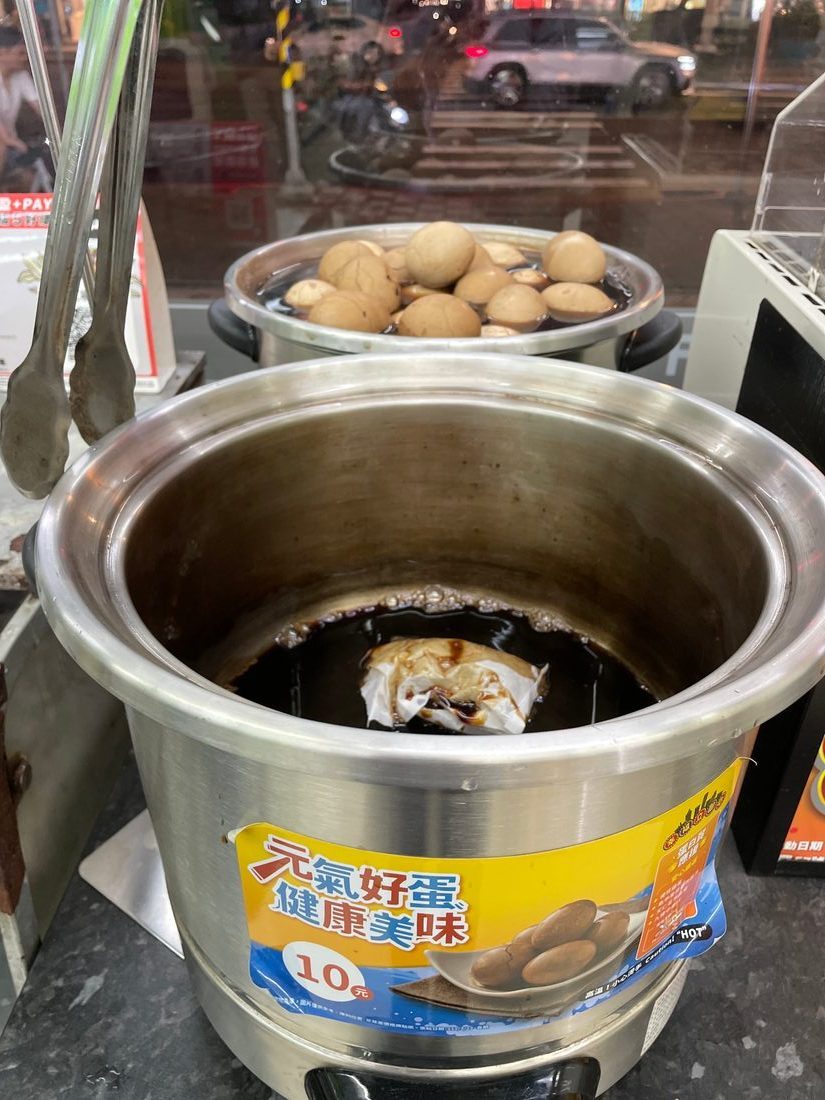
Nobody sat down and thought, “I bet an egg would be better if it tasted like tea.” Somebody had more eggs than they could eat before the eggs went bad, and they were hungry, and salt was cheap. That’s the whole origin. Everything else — the marbling, the star anise, the NT$10 warmer at a Taipei 7-Eleven at two in the morning — is what happened after the problem got solved and people kept doing it anyway because it turned out to taste good.
I’ve made tea eggs, I’ve made ramen eggs, and I’ve made the neon Western pickled eggs that sit in a jar on a bar. All three are the same move: cook an egg, then hold it in a seasoned liquid until the liquid wins. Once you’ve done it a few times you stop seeing three recipes and start seeing one technique with a couple of dials on it. That’s the real story of this whole family, and it’s the thing the “history of the tea egg” blog posts never get to, because they’re too busy repeating a mistranslation.
The oldest idea here: put an egg in something that will keep it, and let time do the rest.
The honest mechanism: an egg is a bomb with a timer
An egg is close to a perfect food and it is trying very hard to spoil. It’s warm, wet, nutrient-dense, pH-neutral — a bacteriological growth medium in a fragile calcium box. Its only real defense is the cuticle, the proteinaceous antimicrobial bloom over the shell. Wash it, wet it, scuff it, and the pores open and Salmonella walks in. On top of that, hens and ducks lay seasonally and in gluts, on a schedule nobody controls. So you get a windfall of the most perishable thing you own, at the exact moment you can’t eat it all.
Every Chinese egg tradition is one or more of four levers against that:
| Lever | Mechanism | Tradition |
|---|---|---|
| Salt | Lowers water activity by osmosis; denatures and dehydrates | 咸鸭蛋 salted duck egg |
| Alkali | Drives pH to 9–12, outside bacterial range; denatures protein without heat | 皮蛋 pidan |
| Heat + resalting | Repeated boiling sterilizes; salt and solutes accumulate | 茶叶蛋 tea egg, 滷蛋 lu dan |
| Fermentation / acid | Competitive microflora, plus alcohol and acid | 糟蛋 zaodan, grain-mash egg |
Note what is not on that list: tea. Tea is not the preservative. Tea brings tannin, color, and aroma. In a tea egg the actual preservation work is done by salt and by being boiled and held hot, over and over. Keep that in your pocket — it matters more than it sounds like it does.
The social facts follow straight from the chemistry, and they’re not romantic:
- This is protein for the poor. An egg is the cheapest complete protein a smallholder can produce. Preserving one turns a perishable windfall into a bankable asset.
- It’s portable. A cured egg is self-packaging, shelf-stable, and single-serving. That is exactly why it’s street food everywhere it exists — a vendor can hold inventory without refrigeration and sell one unit at a time to someone walking past.
- The numbers are the argument. Hou Xiangchuan’s 1981 paper reports membrane-coated century eggs keeping over 200 days in Nanjing during hot season, no refrigeration. That single figure is the entire case for the technology.
And here’s the thesis, which Hou states better than I can: Western egg preservation — waterglass, lime, varnish, cold storage — tries to keep the egg unchanged. Chinese methods, in his words, “preserve eggs in such a way as to cause chemical and physical changes in both egg white and yolk, imparting a new flavour that many people enjoy.”
The West preserved eggs to stop time. China preserved eggs to make something else.
The structural insight: it’s one continuum, and then it isn’t
Here is the thing worth knowing, and it took reading actual Chinese food-science writing rather than English listicles to see it.
The tea egg, the braised egg, the soy egg, and the Taiwanese iron egg are not four traditions. They’re one technique — boil the egg, then hold it in a hot seasoned liquid — with exactly two switches.
| Shell | Liquid | Result | |
|---|---|---|---|
| 茶葉蛋 tea egg | cracked, left on | tea + salt (+ modern soy, spices) | marbled surface, tea/spice aroma |
| 滷蛋 lu dan | peeled | lu shui master stock | uniform brown, deep spice |
| 醬油蛋 soy egg | peeled | soy, sugar, water, aromatics | uniform brown, sweet-salty |
| 鐵蛋 iron egg | peeled | braise, then roast, repeat | small, near-black, chewy |
The Taiwanese food site FoodNEXT says it flat out: the difference between a 滷蛋 and a 茶葉蛋 is whether the shell comes off. Swap tea leaves into a braising liquid and your lu dan is a tea egg. That’s it. That’s the whole distinction. The tea egg’s signature is the shell, not the tea — the marbling is a map of the fracture network in the shell, and it’s the one thing in the family you can’t get any other way.
The iron egg makes it explicit: an iron egg is a lu dan that never left the pot. Same egg, same liquid, more cycles. The family isn’t a set of categories, it’s a dial. And FoodNEXT also documents a modern 冷滷 (cold-braise) — cooked eggs just soaking in brine, no heat — which collapses the whole thing to egg + seasoned liquid + time. Which is a ramen egg. Which is a pickled egg. Which is what I’ve been making in my own kitchen without knowing I was standing in a 250-year-old argument.
But century eggs and salted duck eggs are genuinely a different thing. They aren’t cooked, they’re cured. Weeks to months, not hours. Alkali or salt does the work heat normally would. The protein gets restructured into a new substance. A tea egg spoils; a coated century egg keeps for 200 days. Lumping them all under “Chinese preserved eggs” is the standard listicle error, and it hides the interesting part. That’s why they get their own page.
And here’s the killer detail
Yuan Mei’s 1792 tea egg sits on the preservation side. The modern one doesn’t.
The 1792 recipe is a hundred eggs, salt, coarse tea, boiled a long time — bulk, salt-heavy, tannin-rich, made to keep. The modern tea egg is soy, star anise, cassia, five-spice, sitting in a heated cabinet, eaten within hours, backed by a refrigerated supply chain.
So the tea egg didn’t just get spicier over 230 years. It changed category. It started as a way to make a hundred eggs last and ended as a way to make one egg delicious at 2 a.m. The preservation logic that created it is vestigial now. The salt and the tannin are still in the pot; they just aren’t doing the job anymore. Refrigeration is.
That’s the arc for this whole section. Eggs were preserved because they spoiled and people were hungry. Refrigeration removed the reason. Every one of these foods survived anyway, because by the time the problem went away, the solution had become delicious.
The 1792 recipe, and what everyone gets wrong about it
The primary source is a good one. 袁枚 (Yuan Mei), 《隨園食單》 — Recipes from the Garden of Contentment — 1792, in the 點心單 (“snacks list”) chapter. The entry is titled 茶葉蛋, so the name itself is attested in 1792.
茶葉蛋 雞蛋百個,用鹽一兩、粗茶葉煮,兩枝線香為度。如蛋五十個,只用五錢鹽,照數加減。可作點心。
Tea eggs. One hundred eggs; use one liang of salt and coarse tea leaves, boiled for the span of two incense sticks. If fifty eggs, use only five qian of salt; increase or decrease in proportion. May be served as a snack.
Now go read any English blog’s “history of the tea egg” section. You’ll find this: “boiling ten eggs with 50 grams of salt and coarse tea leaves for approximately four hours.”
Every element of that is wrong. Not “roughly right.” Wrong. It’s a hundred eggs, not ten. It’s one liang of salt, not 50 grams. And it’s two incense sticks, not four hours.
That last one deserves its own paragraph, because the honest answer is that we don’t know how long two incense sticks is. 一炷香 was a real Buddhist and night-watch timekeeping unit, and it was never standardized. The most common reading puts one stick at about an hour, so two ≈ 2 hours. Some sources say half an hour, so ≈ 1 hour. Some scholars read it against a full 時辰 and get ≈ 4 hours. The reason is stated plainly by the sources themselves: incense was hand-made and unstandardized, and burn rate moves with wind, humidity, length, and how dry the stuff is.
So Yuan Mei’s tea eggs boiled somewhere between roughly 1 and 4 hours, and nobody can be more precise than that. The blog version’s “approximately four hours” lands at the extreme end of a range whose midpoint is about two, and presents it as precision it does not have. The honest sentence is: a long, slow boil, on the order of a couple of hours.
Three more things about that 1792 text that nobody mentions:
- No soy sauce. No spices. Just salt and coarse tea. The star anise, cassia, dark soy, five-spice tea egg you’re picturing is a later development. If someone tells you the spiced tea egg is an ancient recipe, they haven’t read the recipe.
- It doesn’t mention cracking the shells. The marbling — the single most recognizable feature of the modern tea egg, the thing I described as the family’s one unique trick two sections ago — is not in the earliest documented version. ⚠ NOT FOUND: when shell-cracking enters the record. That’s a real hole in the history of the dish’s signature feature, and I’m not going to paper over it with a guess. Same for the soy and the spices: NOT FOUND.
- It’s already scaled for volume and already framed as a snack (可作點心). A hundred eggs at a time, with instructions for scaling down. That’s not a home dish being written up. That reads like catering or vending quantity. The street-food character may be present at the very first attestation.
As for anything older: zh.wikipedia says it straight — “茶葉蛋的起源已難確切考證”, the origin is hard to verify precisely. Tang origins, Song origins, “originated in Zhejiang,” the scholars-boiling-eggs- in-the-teapot-by-the-Yangtze story: NOT FOUND, unsourced, and folklore respectively. Follow the Chinese encyclopedia’s lead and say you don’t know.
One source-hygiene note, because it bit me: searches on this topic surface Grokipedia repeatedly. It’s AI-generated and it confabulates specific-sounding historical detail. Several of the confident “late Qing urbanization, mobile vendors in Hangzhou and Shanghai” claims floating around trace there. Don’t cite it. I didn’t.
The 7-Eleven story, minus the fake statistic
You’ve seen the number: 7-Eleven Taiwan sells 40 million tea eggs a year. It’s everywhere.
Its actual status: English Wikipedia carries it tagged [citation needed], and the blog and
Facebook posts repeating it are downstream of Wikipedia. I went looking in Taiwanese press — 統一超商,
茶葉蛋, 銷售 — for any company or news figure for annual tea egg sales. NOT FOUND, in either
language. So I’m not printing it.
The real story is documented, sourced to a published book, and much better anyway.
徐重仁 (Hsu Chung-jen) ran 統一超商, 7-Eleven Taiwan. He needed food Taiwanese customers would actually buy, and the American playbook didn’t fit — “當時台灣的外食文化還不普及,” Taiwan’s eating-out culture wasn’t yet widespread. His reasoning was explicitly about localization: Japanese and Taiwanese eating habits are close, so start there.
Tea eggs became 7-Eleven Taiwan’s first exclusive food product, sold from 1987.
And here’s the payload. The American parent, Southland, resisted. To get tea eggs approved, Hsu had to agree to also stock drip coffee — which he already believed Taiwanese wouldn’t buy. He was right. “茶葉蛋大受歡迎,咖啡卻完全賣不出去” — the tea eggs were wildly popular; the coffee didn’t sell at all. The coffee was pulled after one year. The tea eggs stayed.
So: the American convenience-store format arrived in Taiwan, was told to sell coffee, and survived by selling a Qing-dynasty snack. The coffee failed. That chain now moves enormous quantities of coffee — the market was just thirty years early. (I’ve got a whole coffee section if you want to watch that particular vindication arrive on schedule.)
⚠ One caution: headlines say the tea eggs turned the chain’s profits from red to black. The 100th-store profitability milestone (1986) and the tea egg launch (1987) are adjacent, and the sources are a popular business book and its promotional excerpts. Tea eggs were emblematic of the turnaround and its most famous product. Sole cause? Not proven.
Current prices, for color: 7-Eleven’s standard tea egg is NT$10, held there long-term. FamilyMart NT$13. The premium 所長茶葉蛋 (“Sheriff’s tea egg”) NT$18. About thirty US cents for a hot egg that started as a famine technology.
Poverty tech becomes delicacy tech
That’s the shape of it. The egg was the cheapest complete protein available to people who didn’t have much. Preserving it was an act of household economics, done with the byproducts of building and heating — wood ash, lime, mud, salt — not with anything you’d call cooking ingredients. It made street food possible because it made refrigeration unnecessary.
Then refrigeration showed up and made the entire enterprise pointless.
And nobody stopped. The tea egg went into a heated cabinet in a convenience store. The salted duck egg yolk went into the mooncake, a luxury gift item. The master stock became a restaurant’s most valuable claimed asset. The century egg gets sold at a premium if its crystals are pretty enough. Every one of these is now a delicacy technology that was invented as a poverty technology, and the transition happened without anybody voting on it.
The pattern isn’t Chinese, either — it’s just best documented here. Indonesia has telur pindang: boil the egg, crack it, steep it in hot salty tannin. Same technique exactly, except the tannin comes from shallot skins, teak leaves, or guava leaves. Not tea. Which tells you what the tea egg actually is: an instance of a general technique that any culture with a tannin source can invent. Tea is China’s tannin. Teak leaves are Java’s. Nobody had to teach anybody.
There’s a version of this in every food tradition I’ve eaten my way through, and I’ve eaten in more than thirty countries. The preserved thing outlives the reason it was preserved. Then somebody’s grandkid puts it on a menu at a markup.
Where to go from here
- The science of the marinated egg — what’s actually happening in the pot.
- Tea eggs — including the crack, the membrane, and the grey-green ring.
- Braised and soy eggs — lu shui, master stocks, and why the “hundred-year stock” is a Ship of Theseus.
- Century eggs and salted duck eggs — the cured side, where the chemistry gets genuinely strange.
- Keeping them — how long yours actually last, which is not 200 days.
- Preservation — the wider family of the same argument.
Sources & further reading
- 袁枚 (Yuan Mei), 《隨園食單》, 1792 — the primary text. Full text at zh.wikisource and ctext. English: Sean J.S. Chen, Recipes from the Garden of Contentment (2018), the first complete translation.
- zh.wikipedia 茶葉蛋 — better than the English article; honest that the origin can’t be pinned down.
- 旺報 / China Times, 2014-04-13, “茶葉蛋誰發明?清代有記載”.
- Hou, X. (H.C. Hou), “Hunger and technology: Egg preservation in China,” Food and Nutrition Bulletin 3(2), 1981, UN University. DOI 10.1177/156482658100300209 — the foundational English source on process and numbers. Not reliable on history.
- 黃齡誼, FoodNEXT on the braised-egg continuum — the shell-on/shell-off point, and 冷滷.
- 佐宮圭 (Kei Samiya), 《台灣流通革命》, 天下雜誌, 2023 — the 7-Eleven history. Excerpted at 經理人 and 琅琅悅讀 / UDN. Further coverage: 天下雜誌, 風傳媒.
- Tea egg prices: Supertaste / TVBS, UDN.
- On the incense-stick unit: 當代中國, 香港輕新聞, 百度百科 一炷香.
- “Importance of eggshell cuticle composition and maturity for avoiding trans-shell Salmonella contamination in chicken eggs,” Food Control.
- FSIS Food Safety Guideline for Egg Products, USDA, 2020.
- English Wikipedia: Tea egg — where the
[citation needed]40 million figure lives, and the source of the telur pindang comparison. - English Wikipedia: Soy egg.
Comments (0)