Korea: Mayak Eggs & Jangjorim
There is a story going around the English-speaking internet that Korea banned the word “mayak.” It did not. I went and read the statute, and what it actually says is that a government official may recommend that you change your sign — and if you do, they will help pay for the new one. That is not a ban. That is a subsidy with a suggestion stapled to it.
I care about this because I like these eggs and I would rather write about them accurately than repeat a headline. So this page is two dishes and one correction, and the correction is the reason the page exists.
The two dishes are mayak gyeran (마약계란), soy-marinated eggs served over hot rice, and gyeran jangjorim (계란 장조림), soy-braised eggs that usually arrive alongside beef. Most English writing treats them as the same thing wearing different hats. They are opposite techniques. One is a cold steep. The other is a hot braise. Getting that wrong is the single most common error in this corner of food writing, and it is an easy one to stop making.
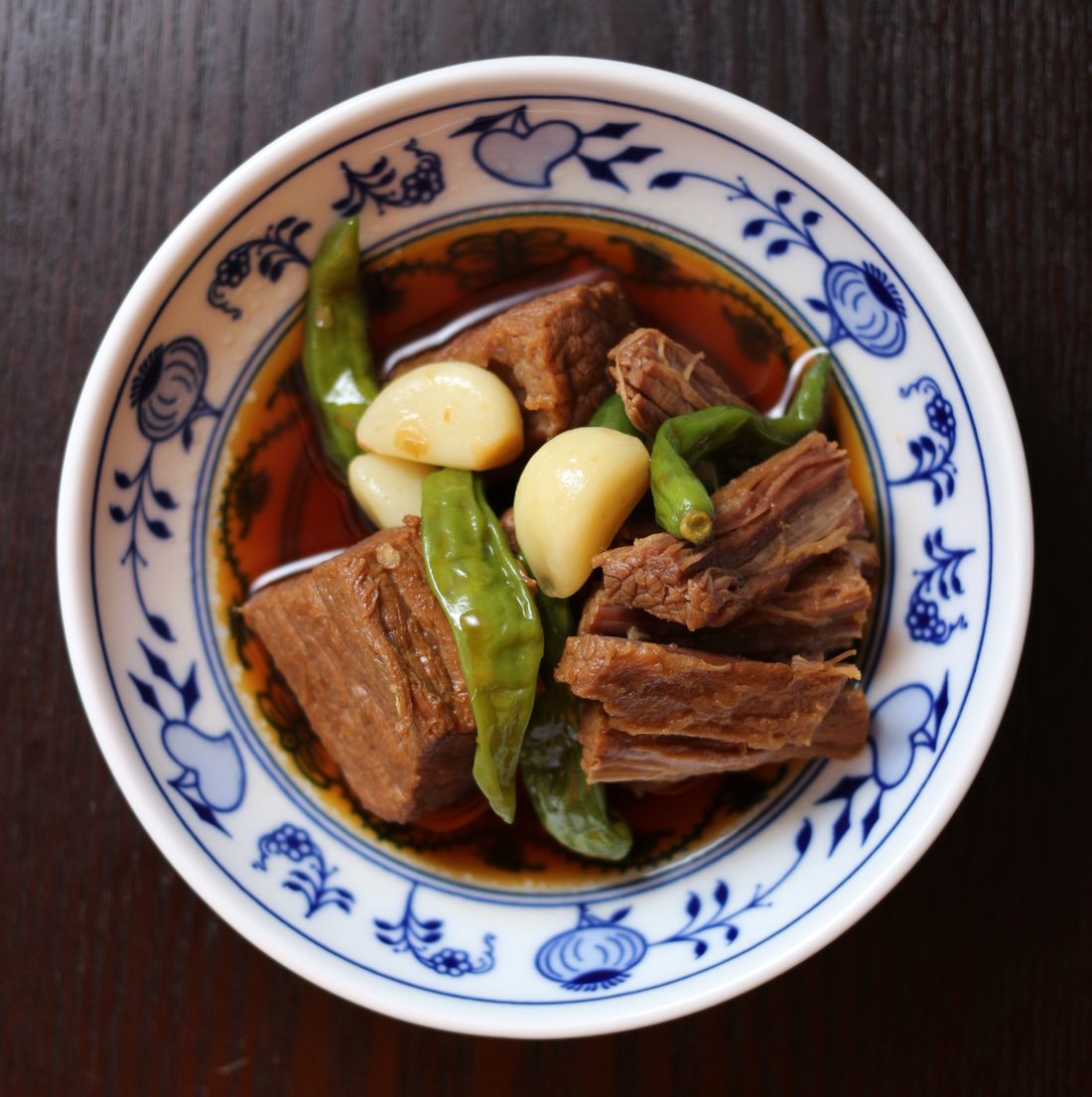
Jangjorim, not mayak eggs — braised, not steeped, and the two get blurred constantly in English. Note the liquid is served with it: Japan strains the marinade, Korea serves it.
Mayak gyeran — the “drug eggs”
Soft-boiled eggs, peeled, dropped into a marinade of soy sauce, kelp water, honey and brown sugar, plus a load of raw chopped onion, garlic, scallion, and fresh red chili. Overnight in the fridge. Serve halved over a bowl of hot rice, and — this is the part that matters — spoon the marinade and everything floating in it over the rice too.
The name means “narcotic eggs.” The joke is that you cannot stop eating them. That joke is doing more work than it looks like, and we will get to it.
Where the name actually came from
It did not start with eggs. This surprised me.
The prefix originates with 마약김밥 (mayak gimbap), from 모녀김밥 (Monyeo Gimbap, “Mother-and-Daughter Gimbap”) at 광장시장 (Gwangjang Market) in Seoul. The dish itself was just kkoma gimbap — little gimbap. The Korea Tourism Organization’s own writeup is clear that the shop did not name it. Young customers who ate it posted about it online, called it mayak gimbap because they could not stop, and the name stuck to the menu from the outside in.
From there it metastasized. Mayak tteokbokki. Mayak bread. Mayak hot dogs. And eventually mayak gyeran, which is a late borrower of an already-established slang formula.
That reframes the whole thing. It is not “Koreans call eggs drug eggs.” It is “an internet nickname coined by customers at one market stall in Seoul spread across Korean menus, and eggs caught it.”
⚠ NOT FOUND: the year 마약김밥 was coined. No source I have gives one. I am not going to make one up.
When did mayak gyeran get popular?
Recent. 2010s, with a clear surge around 2018, when Korean recipe platforms were tagging it as “the hot thing on SNS.” That is as precise as the evidence supports.
⚠ NOT FOUND: whether 백종원 (Baek Jong-won), the dominant Korean TV food personality, is the one who took it national. He has a recipe circulating, and TV popularization by Baek is the most plausible mechanism for a Korean home dish going nationwide — but I could not confirm the broadcast, the show, or the date. So I am not asserting it. Plausible-and-unverified is not the same as true.
🔴 The correction: nobody banned the word
Here is the actual sequence, verified against 국가법령정보센터, the Korean national statute database.
September 2022 — 국민의힘 lawmaker 권은희 (Kwon Eun-hee) introduces an amendment to the 식품 등의 표시·광고에 관한 법률 (Food Labeling and Advertising Act) restricting drug terminology in food names and advertising. The stated rationale is that the usage 「자칫 마약에 대한 잘못된 인식을 심어줄 수 있다」 — it can instill a mistaken perception of narcotics, particularly in children and adolescents.
2024-01-02 — 제8조의2 (Article 8-2) is newly established (신설). 2024-07-03 — Article 8-2 takes effect (시행).
And here is what Article 8-2 says. The Minister of Food and Drug Safety, or a mayor/governor/local head, may recommend (권고할 수 있다) that businesses not use, in labeling or advertising, terms for narcotics designated under the Narcotics Control Act — and similar expressions. The same article authorizes the government to subsidize the cost of changing signage, menus, and packaging.
Recommendation power. No prohibition. No penalty attached to the name.
Korean media ran it as a ban anyway:
- 「마약김밥 7월부터 못 쓴다」 — “Can’t use ‘mayak gimbap’ from July” (데일리팜)
- 「앞으로 ‘마약김밥’ 표현 못 쓴다」 — “From now on, ‘mayak gimbap’ can’t be used” (농민신문)
농민신문’s own body text contradicts its own headline. The article describes the law as 「…사용하지 않도록 권고하는 내용」 — content that recommends. The reporter got it right and the headline desk got it wrong, in the same piece, and the wrong half is the half that traveled.
Enforcement is outreach, not policing. On 2025-02-03 the MFDS announced 행정지도 (administrative guidance) covering 179 food businesses using mayak terms. Six regional offices visited them in person to explain the policy, recommend a change, and advertise the signage subsidy. One hundred seventy-nine businesses, nationwide, hand-visited. That is not a crackdown. That is a small team with a clipboard and a budget line.
And it is working anyway, because it started before the law did. Gwangjang Market vendors were dropping the name in October 2022 — nearly two years before Article 8-2 took effect — under public pressure, and reported about it with a shrug: 「“아쉽지만 할 수 없죠”」 — “It’s a shame, but what can you do.”
Korean opinion is not unanimous either. A columnist made the obvious “where is the line” argument under the headline 「‘붉은 악마’는 되는데 ‘마약 김밥’은 왜 안돼?」 — “‘Red Devils’ is fine but ‘mayak gimbap’ isn’t — why?” — invoking the Korean national football supporters’ club. That is a live argument, not a settled one.
So how should you hold this? The concern is real, official, and specifically about normalizing narcotics to minors in a country with unusually strict drug norms. It became law in 2024 as a carrot, not a stick. The press oversold it. Vendors moved first. Commentators disagree. And an English-language recipe page using the word “mayak” is not breaking any law — the statute binds Korean businesses’ labeling and advertising, by recommendation only.
But it is worth the paragraph. The name is genuinely contested in Korea, and every Anglophone recipe site I have seen handles it with a wink — “it’s just a nickname that hints at how irresistible they are!” — and no history at all. Readers can hold a whole thought. Give them the whole thought.
Recipe — Mayak gyeran
Adapted from My Korean Kitchen’s version, which is the best-specified one out there.
Eggs: 8 eggs, soft-boiled 6–7 minutes, straight into an ice bath, peeled.
Marinade:
- 1/3 cup soy sauce
- 1/2 cup kelp-infused water (dashima/kombu steeped in cold water)
- 2 tbsp honey
- 2 tbsp brown sugar
- 1 tbsp mirin
- 1/2 tbsp minced garlic
- 1/4 tsp ginger powder
- 50 g onion, finely chopped
- 20 g green onion, white part, finely chopped
- 1 red chili, seeds removed, finely chopped
Method: whisk the liquids until the sugar dissolves. Stir in the aromatics. Submerge the peeled eggs. Minimum overnight; 12 hours or more is better. If the eggs aren’t fully covered they will float and go two-tone — turn them at the 8–12 hour mark.
Storage: best within 3 days; up to 5–7 days refrigerated, airtight, fully submerged.
Serve: halved over hot rice, marinade and all, with gim flakes, sesame seeds, and more scallion if you like.
→ Mayak Eggs (Korean Marinated Eggs) is in the collection.
Gyeran jangjorim — the braised one
장조림 (jangjorim) = 장 (soy sauce) + 조림 (braised, simmered down). The verb is the entire point. It is a braise, not a steep.
And here is the framing most English sources miss: jangjorim is fundamentally a soy-braised beef dish, and the eggs are an addition to it. Korean Bapsang — about as good a source as exists in English — files it as “Jangjorim (Soy Braised Beef)” and lists “3 boiled eggs, peeled” under optional additions, next to shishito peppers and garlic cloves. So 계란장조림 is best understood as the egg-forward variant of a beef banchan, not a parallel invention to mayak eggs.
It is also a 밑반찬 (mitbanchan) — a keeping side dish. Deliberately salty, eaten in small amounts, economical: a little meat stretches to feed a family across a week. That is a completely different social function from mayak eggs, which are the centerpiece of the bowl.
| Mayak gyeran | Gyeran jangjorim | |
|---|---|---|
| Technique | Cold raw-marinade steep | Hot braise, eggs simmered in the sauce |
| The marinade itself | Never cooked | Boiled and reduced |
| Aromatics | Raw, chopped, stay in and get eaten | Cooked out, spent, mostly left behind |
| Core partner | Rice | Beef |
| Chili | Fresh raw red/green, prominent | Shishito (꽈리고추), braised, mild |
| Served | Cold, over rice, as the meal | Cold or room temp, as a keeping side |
| Age | Recent — 2010s | Established banchan |
Both are soy and eggs and rice. They are opposite techniques. Any source that calls mayak eggs “Korean braised eggs” has it exactly backwards.
⚠ NOT FOUND: how old jangjorim is
I could not date it. At all. No year, no first attestation, no cookbook citation — not for 계란장조림 and not for 장조림 generally.
And this bothers me more than the other gaps, because jangjorim is almost certainly the oldest dish on this page and it is the one I have nothing on. Mayak gyeran is a 2010s internet dish. Japan’s ramen egg is datable to 1992. Jangjorim is the genuine old-banchan tradition here, and it is a hole in my notes. The place to look would be 조선시대 조리서 — Joseon-era Korean cookbooks — and I have not been in them. If you know, tell me; I will fix this page.
I would rather print “I don’t know” than invent a century.
Recipe — Jangjorim with eggs
Following Korean Bapsang.
Meat and aromatic broth:
- 1.5 lb beef — eye round is common, but brisket, flank, or shank are better: more flavor, better texture
- 8 cups water
- 1/2 medium onion
- 2 scallions, white parts
- 6 oz Korean radish, in chunks
- 7 garlic cloves
- 3 thin ginger slices
- 1/2 tsp whole black peppercorns
Sauce:
- 5 tbsp soy sauce
- 2 tbsp soup soy sauce (국간장) — ⚠ not interchangeable with regular soy. Saltier, lighter in color.
- 3 tbsp sugar
- 3 tbsp rice wine or mirin
- 2.5 cups of the reserved cooking liquid
Optional: a 3-inch square of dried kelp; 10–12 shishito peppers; 3 boiled eggs, peeled.
- Cut the beef into 2–3 inch rectangles.
- Boil the aromatics in the water, covered, medium-high — 5 minutes.
- Add the beef, skim the scum, drop to medium, simmer covered — 30 minutes.
- Strain. Reserve 2.5 cups of the liquid.
- Return meat + reserved liquid + all sauce ingredients. Boil, then medium, covered, until tender — 20 minutes.
- Add the kelp, the shishitos, and the already-boiled, peeled eggs. Simmer covered 10 minutes.
- Cool in an airtight container, then refrigerate. Keeps up to 7 days.
- Shred the meat, spoon the sauce over.
⚠ The key technical note: the eggs are boiled separately in advance and only join for the final ten minutes. They are not braised from raw. The braise is for color and flavor penetration, not for cooking the egg — a long braise rubberizes the white and greens the yolk.
⚠ NOT FOUND: an authoritative boil time for those eggs before they enter the braise. Korean Bapsang says only “boiled eggs.” For a keeping banchan, a firmer yolk is traditional and practical — a jammy yolk will not survive a week in the fridge in salt — but that is my inference, not a sourced claim. Label it as mine.
🔴 The Japan/Korea difference is real — and it’s mechanical, not spiritual
Food writers love to reach for national character here. Japanese restraint versus Korean boldness. Zen minimalism versus generous excess. It is very tempting and it is almost entirely nonsense.
There is a real difference. It is this:
Japan strains the marinade. Korea serves it.
That is the whole thing. Everything true about the “philosophy” difference follows from that one mechanical fact, and everything false about it comes from reaching for national character instead.
Look at the recipes above. Mayak gyeran’s chopped onion, garlic, chili, and scallion stay in the marinade and go onto the rice. They are the dish. An ajitama marinade is a liquid — nothing gets spooned out of it. Same class of ingredient, opposite role. That is structural, and it is the sharpest line available on the subject.
The knock-on differences are all real and all downstream of it:
- The sweetener differs in kind. Japan reaches for mirin plus a little sugar — sweetness carried by a fermented rice product with glutamate along for the ride. Korea reaches for honey and brown sugar and mirin: sweeter, with a floral-molasses top note.
- Raw chili and raw garlic are in every mayak recipe and in no ajitama recipe I found. Because Japan’s aromatics have to survive being strained out, and Korea’s do not.
- Serving context. Ajitama is a component of a composed bowl. Mayak gyeran is the meal.
And here is the lazy claim to avoid
“Japan uses dashi, Korea doesn’t” is flatly false.
Mayak eggs are built on kelp-infused water. That is kombu broth. Korea’s own kelp instinct, reaching for exactly the same marine glutamate that a Japanese cook reaches for. Both cuisines go to kelp. The difference is what gets layered on top of the kelp, not whether the kelp is there.
This is the specific wrong thing a food writer would grab for, and it collapses the moment you read the ingredient list.
Two more places the generalization fails:
“Japanese restraint vs Korean excess” is a value judgment dressed as analysis — and it dies on its own best example. RecipeTin Japan’s ajitama contains soy, mirin, sake, sugar, water, and katsuobushi. Six things. That is not minimalism; it is a different maximalism. Japan front-loads fermented and marine umami. Korea front-loads allium and capsicum, plus kelp. Neither is restrained. They are differently populated.
And the comparison is chronologically unfair as usually framed. Ajitama (1992) is a professional restaurant dish, engineered by a kaiseki-trained chef for a composed bowl. Mayak gyeran (2010s) is a home dish that went viral, engineered to turn a bowl of rice into dinner. Much of the “philosophy” difference is really a restaurant-versus-home-cooking difference that happens to fall along a national line. And both are young — 1992 versus the 2010s. Neither is a tradition. The one genuinely old dish in the whole comparison is jangjorim, and I could not date it.
For the other half of the argument, go read Japan: The Ramen Egg, where the 1992 date and the chef who set it come with names attached. Or The Science if you want to know why the yolk behaves the way it does, Braised & Soy Eggs for the wider family, or back to Marinated Eggs for the map.
I have made ramen eggs a lot — my own ajitsuke tamago is built on tamari, and it is one of the few things on this site I will defend without hedging. Mayak eggs are the same trick pointed somewhere else entirely: instead of a clean liquid you strain and discard, you make a relish you eat. Once you have made both back to back, the “philosophy” argument stops being interesting, because you can see exactly where the difference lives. It lives in the strainer.
Sources & further reading
Primary / authoritative
- 국가법령정보센터 — 식품 등의 표시·광고에 관한 법률 — the statute itself. Article 8-2, 신설 2024-01-02, 시행 2024-07-03. This is the document that disproves the headlines.
- 대한민국 정책브리핑 — MFDS 행정지도 on 마약 food terms, 2025-02-03 — the 179-business in-person outreach campaign. Government primary source.
- 한국관광공사 / 대한민국 구석구석 — 광장시장, 마약김밥, 모녀김밥 — the customers-coined-it origin of the mayak prefix.
Korean press
- 한국경제 — the Kwon Eun-hee bill, September 2022
- 식품저널 — same bill
- 아시아경제, 2022-10-18 — Gwangjang vendors dropping the name, before the law
- 농민신문 — ⚠ headline says ban, body says recommend
- 데일리팜 — ⚠ “can’t use from July,” which is wrong
- 더칼럼니스트 — the dissent: “‘Red Devils’ is fine but ‘mayak gimbap’ isn’t?”
- Global Economic — 광장시장 / 모녀김밥
Recipes
- My Korean Kitchen (Sue) — Mayak Eggs — the source of the recipe above, and the one that shows the kelp water.
- Korean Bapsang (Hyosun) — Jangjorim (Soy Braised Beef) — the jangjorim recipe above, and the source that correctly files it as a beef dish.
- 만개의레시피 — 마약계란, the 2018 SNS moment
- Chef Chris Cho — Korean soy marinated eggs · Cookerru · Seonkyoung Longest — corroborating variants.
- RecipeTin Japan (Yumiko) — Ramen Egg — the six-ingredient ajitama that kills the “Japanese restraint” line.
Comments (0)