Braised & Soy Eggs — and the Rock Sugar Question
This page has an awkward job, so let me get it over with.
I went into this believing a set of things about rock sugar that I’d absorbed the way everybody absorbs them — from cooking writing, repeated confidently, never sourced. Yellow rock sugar caramelizes better. It’s less sweet. It gives that lacquer gloss. It doesn’t foam up and burn the way granulated does.
Most of that doesn’t survive checking. And the tradition is still right. Those two facts sit together more comfortably than you’d think, and sorting out how is what this page is actually about.
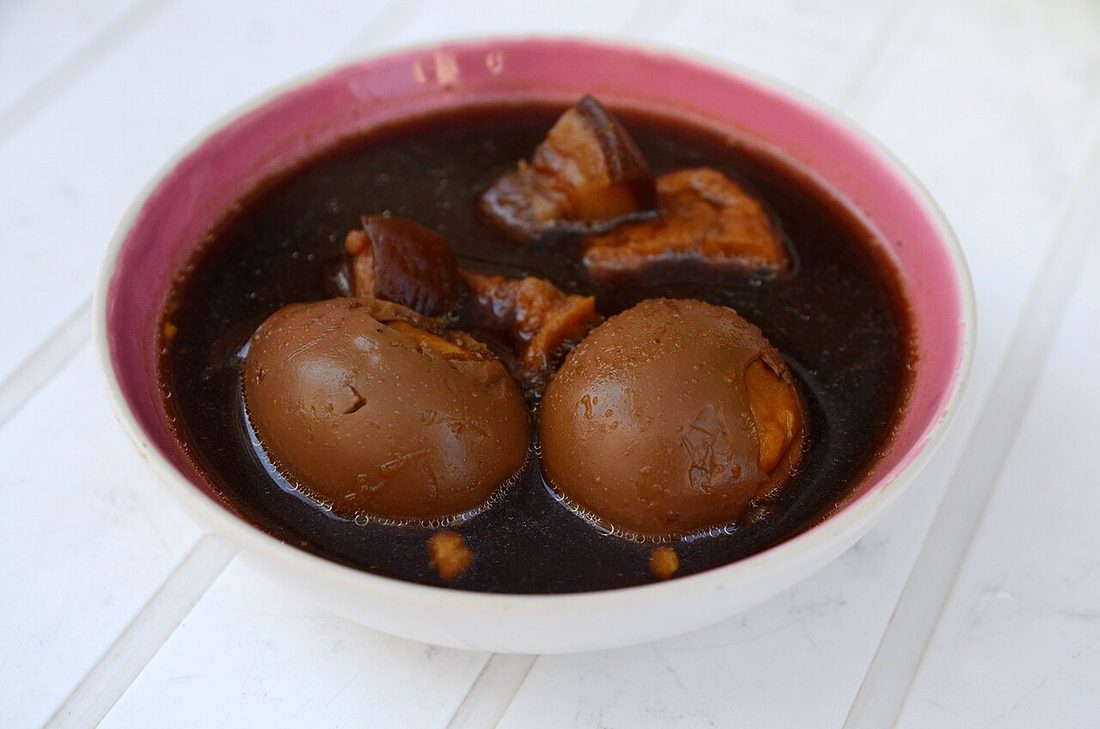
Peeled eggs braised dark in a soy stock with the pork. This one’s Thai mu phalo, a descendant of the same Chinese five-spice braise — and it makes the point: the egg goes in because it costs nothing and absorbs everything.
The master stock
Start with the thing the egg is riding in.
A master stock (滷水 lǔshuǐ, also 老滷 “old lu”) is a braising liquid that is never thrown away. Strain it, boil it, cool it, store it, use it again. Each cycle the food takes flavour from the stock and gives some back. Base: water, soy sauce, rock sugar, Shaoxing wine, plus star anise, cassia, clove, licorice, sand ginger, dried tangerine peel.
It’s Teochew/Chaoshan (潮汕) in origin, spreading into Cantonese and Fujianese cooking, and traceable to the mid-Qing. The most concrete lineage I could pin down: the celebrated 贡咕卤鹅 braised-goose house was founded by 许松茂 (Xu Songmao) during the Guangxu period (1875–1908) — so “over a hundred years.” Note that even the best-documented claim is ~120–150 years, not centuries.
滷蛋 (lu dan) — hard-boiled, peeled, steeped in the lu shui — are the humblest thing in the pot. And that’s exactly the point:
The egg is a bystander riding in a stock built for goose, duck, pork and tofu. It costs nothing to add and it absorbs everything. The egg is the cheapest possible way to buy into an expensive stock.
That’s the whole economics of braised eggs, in every culture on these pages.
The hundred-year stock: two claims, one mass balance
You’ve heard about the legendary hundred-year master stocks. So had I.
Real generational family stocks: genuinely a thing. Family-run venues do treat them as heirlooms passed down.
Specific verified ages: NOT FOUND. Every “100 years,” “300 years” claim I found is hedged by its own author — “according to hearsay,” “legend has it.” No named restaurant, no provenance, no documentation. And Chinese popular press gives away the game: “百年老卤水三百万都不卖” — a hundred-year-old lu shui, wouldn’t sell it for three million. These are marketing assets. An “old lu” is the highest praise a braise shop can claim, and there is no mechanism to audit it.
But here’s the honest framing, which I like much better:
A master stock is not a preserved object. It’s a continuously replaced one. Every cycle you lose liquid to the food and to evaporation, then add water, salt, sugar, soy, spice, and strain the solids. After a few years essentially no original molecule remains. It’s a Ship of Theseus in a stockpot.
What persists isn’t the broth. It’s the culture of maintenance and the recipe of replenishment. A hundred-year stock is a hundred-year-old practice — which is more impressive than a hundred-year-old liquid, and has the advantage of being true.
And then there’s the finding that ends the argument, which I love because it cuts both ways. Chinese food-safety testing on nitrite in lu shui:
| Stock age | Nitrite |
|---|---|
| 3 months | 0.64 mg/kg |
| 5 years | 1.87 mg/kg |
Twenty times the age. Three times the nitrite. Strongly sub-linear — it’s approaching a steady state, not accumulating. The stated principle: the legendary infinite concentration of essence “实际上是不存在的” — does not exist; the substances cycle and turn over and hold at a fixed level.
Now watch what that does:
- ✅ Reassuring: an old stock is not a toxin accumulator. It equilibrates. Those numbers are tiny.
- ❌ But it also kills the romance: if solutes reach steady state, a 100-year stock cannot taste meaningfully different from a 5-year stock.
You cannot claim infinite flavour concentration and deny infinite nitrite accumulation. It’s the same mass balance. Pick one. The evidence says: neither.
That’s the tidiest thing in this research. The same physics that makes the old stock safe makes it not-magic.
⚠ One conflict I’ll report rather than resolve: one of those same popular sources also asserts that repeatedly reheated old lu shui is very high in nitrite — flatly contradicting the plateau data it sits next to. The lore is unstable even within single articles. I’m going with the measurements.
Red braising, and 糖色
红烧肉 (hóng shāo ròu) — pork belly braised to a dark red-brown lacquer with soy, sugar, wine, aromatics. Hard-boiled peeled eggs go in alongside and act as sponges. Generally attributed to Hunan, now strongly associated with Shanghai.
The Mao association is real but needs care. He was Hunanese, the dish is inseparable from him there, and Fuchsia Dunlop — an actual authority — documents that he loved it and requested it from his Beijing chefs. 毛氏红烧肉 (“Mao-style”) is a named variant whose signature is that it takes its colour entirely from caramelised sugar (糖色), omitting dark soy sauce.
- ❌ Folklore, don’t repeat: “his mother made it for him as a child,” “he ate it every day,” “he said the fat helped his brain defeat his enemies.” Blogs only, unsourced, shaped like hagiography.
- ✅ Real and delightful: the Hunan provincial government has codified the recipe — including specifying meat from the Ningxiang pig breed. A state standard for a braise.
炒糖色 (tángsè) is the technique at the heart of it: melt sugar, take it through caramelisation, then add hot water and simmer to a dark liquid colourant. The stages, as Chinese technique guides describe them: sugar melts → large bubbles → dense small white viscous bubbles → foam thickens → foam subsides, back to large bubbles, colour goes jujube-red (枣红色) = done.
One piece of real physics worth having, and it’s a safety point: add HOT water, not cold. “热水不容易崩,凉水会崩的比较厉害” — hot water doesn’t spatter violently; cold water spatters badly. Molten caramel is ~170–190 °C. Cold water flash-boils on contact and throws molten sugar at your face. This one is legitimate.
Now: the rock sugar claims, one at a time
Here’s where I have to mark my own homework.
果壳 (Guokr) is China’s main science-popularization outlet. Writing there, citing the GB national standards, 钱程 is blunt:
“冰糖的主要成分和白砂糖完全相同,都是蔗糖” — rock sugar and white sugar are compositionally identical. Both are sucrose.
“它们的区别仅仅是物理状态不一样。一旦溶解在水里,风味上不会有区别” — the only difference is physical state. Once dissolved in water, there is no flavour difference.
“这些说白了都是忽悠和玄学,没什么道理” — these are, frankly, hype and pseudoscience, without merit.
玄学 — xuánxué — is a wonderful word to have thrown at your cooking beliefs. It means metaphysics, in the sense of “woo.”
| Claim | Verdict |
|---|---|
| Chemically different from granulated | ❌ False. Both sucrose. Difference is crystal size. |
| Less sweet than sucrose | ⚠️ It IS sucrose, so this can’t be a chemical claim. As a crystal the perception is real and trivially explained — big crystals dissolve slower on the tongue → slower sweetness release → milder impression. In a braise, where it fully dissolves, the claim is void. There’s no mechanism left. |
| Milder / purer / more 清香 | ❌ The 玄学 line above is aimed exactly here. |
| Caramelises better | ❌ Backwards, if anything. Caramelisation is thermal decomposition above ~160 °C — once melted, crystal history is erased. Molten sucrose is molten sucrose. And higher purity means FEWER reducing sugars, so less browning potential. The ranking by browning is 绵白糖 > 白砂糖 ≥ 冰糖 — the opposite of the folk claim. |
| Better gloss / lacquer | ❌ Misattributed. The shine is gelatin + reduction + fat, not the sugar. |
| Doesn’t foam or bubble over | ❌ NOT FOUND. No source, no mechanism, anywhere. |
| Healthier | ❌ ~100% sucrose. Identical calories, identical glycemic effect. |
And the purity direction is the reverse of the folklore too: rock sugar is 99.7 g sucrose/100 g; white granulated is 99.98. Rock sugar is very slightly less pure. The “prized for its purity” line in English food writing isn’t supported by composition — and it’s usually deployed to imply health benefits, which are nil.
The one that stung most: “no burnt edges” isn’t just unsourced — 搜狐 says the opposite, that rock sugar is “容易炒黑”, easily burns black, and that white sugar is more forgiving. Which has an obvious non-magical explanation: large crystals melt unevenly, so some of it is scorching while the rest is still a rock.
(That same 搜狐 article manages to claim rock sugar gives a lighter colour and a superior colour, in one breath. When the lore contradicts itself inside a single article, that’s your answer about the lore.)
So why do I still use it?
Because the tradition is real even when the explanations are folklore, and those are different claims.
Here’s what actually survives, and it’s not nothing:
1. Yellow rock sugar is genuinely different from white rock sugar — and this part of the folk knowledge is correct and well-sourced. 黄冰糖 is incompletely purified. That’s why it’s yellow. It carries a little molasses character. So the traditional instruction — yellow for braises, white where you don’t want colour — is sound, and it’s sound for a real reason.
2. It dissolves slowly. In a long braise that’s a genuine convenience, not a flaw.
3. It’s what the cuisine does. A red-braised pork belly made by someone’s grandmother in Shanghai with yellow rock sugar is the reference standard for the dish. That’s not nothing — that’s the definition. You don’t need a molecular mechanism to justify cooking a dish the way the dish is cooked.
What I’ve stopped doing is claiming reasons that aren’t true. Use yellow rock sugar for red braising. It works, it’s traditional, it’s correct. Just don’t tell yourself it’s less sweet once it’s dissolved in a litre of soy and wine, because at that point it is chemically indistinguishable from the white stuff in the bag, and everyone at the table is tasting sucrose.
The honest sentence is: I use it because that’s the dish, and because yellow rock sugar carries a trace of molasses. Not because it’s magic. That’s a smaller claim and a truer one.
There’s a full Rock Sugar page in Know Your Ingredients if you want the bingtang history.
The recipes
Lu Dan (Chinese Master-Stock Braised Eggs) — the stock and the eggs that ride in it.
Hong Shao Dan (Red-Braised Eggs) — with the 糖色 caramel step, and the hot-water rule.
The collection already has Lu Dan (Hard Boiled) - Soy Sauce (Soft Boiled) Eggs too.
And remember the science: however dark that braise goes, the colour is a rim. Cut one open. The lacquer is millimetres deep and the middle is a pale custard, and that contrast is the entire pleasure of the thing.
Next: tea eggs, where the shell stays on and everything changes.
Sources & further reading
- 果壳 (Guokr) / 钱程, 吃货研究所 — the rock sugar piece. China’s main science-popularization outlet, citing GB/T 35886-2018 and GB 13104-2014. The source for the 玄学 verdict.
- 人民网科普 on rock sugar types — jysh.people.cn.
- Master stock — Wikipedia · 潮州卤水 — 百度百科.
- Nitrite plateau data in aged lu shui — k.sina.cn. ⚠ Popular press, and the same outlet contradicts itself elsewhere; reported as a conflict.
- Red braised pork belly — Wikipedia (the Hunan state standard and the Ningxiang pig).
- 炒糖色 technique — xiachufang · 搜狐 (the “easily burns black” claim, and the self-contradiction).
- Caramelization reference — Science of Cooking.
Comments (0)