Tea Eggs
Tea eggs were the first marinated egg I ever made, and they’re still the one I’d recommend starting with. You crack the shells, you simmer them in tea and soy and spice, and you get that web of dark veins across the white that looks like crackle glaze on a pot.
They’re also the one where I found the biggest gap between what the internet says and what the documents say — including the fact that the earliest recorded tea egg has no soy sauce, no spices, and doesn’t crack the shells at all.
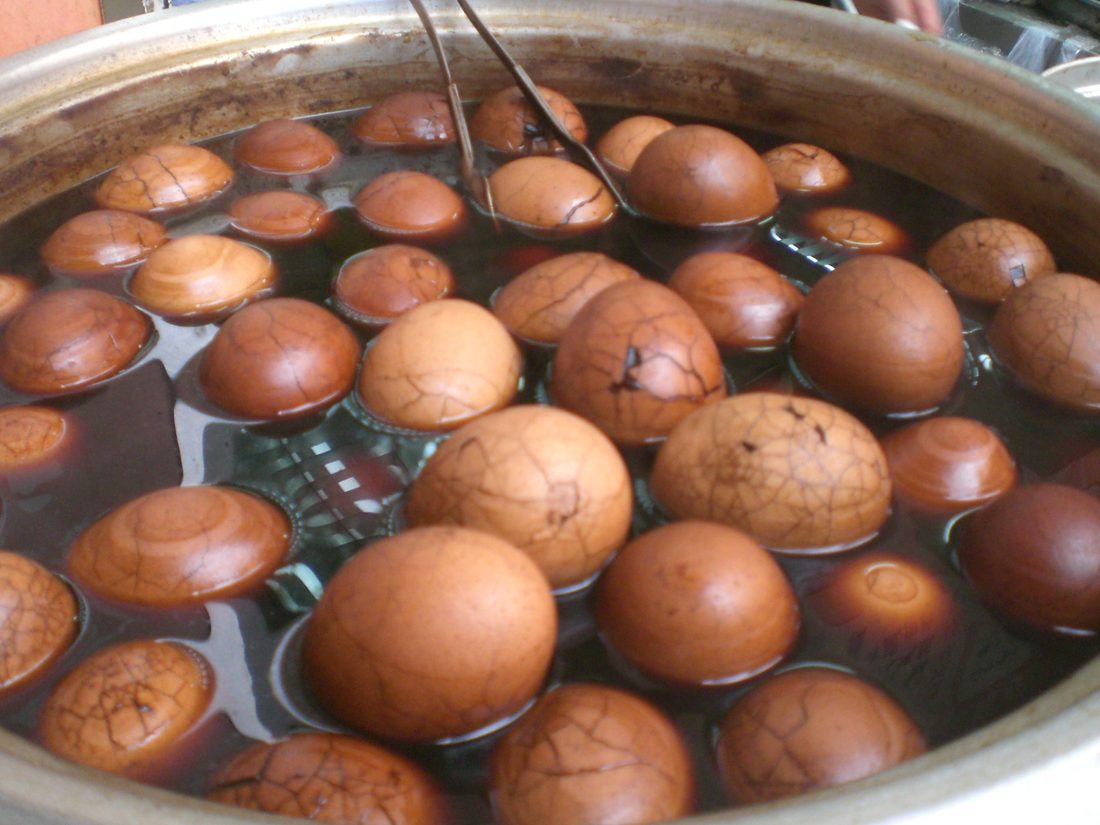
Cracked, not peeled — the shell stays on as a mould so the marinade only reaches the white through the fractures. What you get is a map of the cracks.
The 1792 text, and how badly it’s been mangled
Here’s the primary source, and it’s a good one: 袁枚 (Yuan Mei), 《隨園食單》 — Recipes from the Garden of Contentment — 1792, in the 點心單 (“snacks list”) chapter. The entry is titled 茶葉蛋, so the name itself is attested in 1792.
茶葉蛋 雞蛋百個,用鹽一兩、粗茶葉煮,兩枝線香為度。如蛋五十個,只用五錢鹽,照數加減。可作點心。
Tea eggs. One hundred eggs; use one liang of salt and coarse tea leaves, boiled for the span of two incense sticks. If fifty eggs, use only five qian of salt; increase or decrease in proportion. May be served as a snack.
Now here’s what the food-blog web says that text says: “boiling ten eggs with 50 grams of salt and coarse tea leaves for approximately four hours.”
Every element of that is wrong. Not ten eggs — a hundred. Not 50 grams — one liang. Not four hours — two incense sticks, which is a genuinely uncertain unit (more below). It’s a mistranslation that has been copied until it reads like scholarship.
Three things about the real recipe that nobody mentions:
1. No soy sauce. No spices. Just salt and coarse tea. The modern tea egg — star anise, cassia, dark soy, five-spice — is a later development. Anyone selling you the spiced tea egg as “an ancient recipe” is wrong about the ancient part.
2. It doesn’t mention cracking the shells. The marbling — the single most recognisable feature of the modern tea egg, the reason anyone photographs them — is not in the earliest documented recipe. ⚠ And I have to be straight: NOT FOUND — I could not establish when shell-cracking enters the record. That’s a real gap and I’m not papering it over. The defining visual feature of this dish has no documented birthday.
3. It’s already scaled for volume, and already called a snack (可作點心). A hundred eggs at a time, with instructions for proportional scale-down. That is not a home cook being described — it reads like catering or vending quantity. Yuan Mei was recording something that was already being made in bulk. The street-food character is arguably present at the very first attestation.
”Two incense sticks” — how long is that, honestly?
一炷香, “one stick of incense,” was a real Buddhist and night-watch timekeeping unit. It is not standard, and the sources genuinely disagree:
| Reading | One stick | Two sticks |
|---|---|---|
| Most common | ~1 hour (half a 時辰) | ~2 hours |
| Also asserted | ~30 min | ~1 hour |
| Some scholars | a full 時辰 = 2 hours | ~4 hours |
The reason is refreshingly concrete: incense was hand-made and unstandardised, and burn rate varies with wind, humidity, length, and how dry the stuff is. It’s a clock made of a thing that burns differently every time.
So Yuan Mei’s tea eggs boiled somewhere between about one and four hours, and we cannot be more precise than that. Notice what the blogs did: they picked four hours — the extreme end of that range, whose midpoint is about two — and presented it as a fact. Precision it never had.
The honest statement is: a long, slow boil, on the order of a couple of hours.
Where they come from — the honest table
| Claim | Status |
|---|---|
| Documented by 1792, named 茶葉蛋, in 隨園食單 | ✅ Solid. Primary text, three independent corroborations. |
| ”Originated in Zhejiang” | ⚠️ Unsourced. English Wikipedia says it; that article is [citation needed] throughout. |
| ”Ancient” / Tang / Song origins | ❌ NOT FOUND. No pre-Qing attestation exists that I could locate. |
| The scholars-by-the-Yangtze / eggs-dropped-in-the-teapot origin tale | ❌ Folklore. An etiological story, sourced to nothing. |
| Precise origin knowable at all | ❌ Chinese Wikipedia says it straight: “茶葉蛋的起源已難確切考證” — the origin is difficult to verify precisely. |
I’m going to follow the Chinese Wikipedia’s lead on that last one, because it’s the intellectually honest position: nobody knows where the tea egg comes from, and the people closest to the sources say so. Every English page that hands you a confident origin is manufacturing certainty that the Chinese-language scholarship explicitly declines to claim.
The category change — the thing worth understanding
This is the insight that reorganised the whole section for me, and it’s on the history page too because it matters that much.
Yuan Mei’s tea egg is a preservation food. The modern tea egg isn’t.
Salt and a long boil, no refrigeration — that’s a keeping technology. A hundred eggs at a time, because you’re putting up a batch. The modern tea egg is a flavour food: you make a dozen, you eat them in two days, the fridge does the preserving.
It didn’t just change seasoning. It changed category. Same name, same dish, opposite purpose.
That’s a much more interesting thing to know about a food than a fake dynasty.
The 7-Eleven story (the real one)
You’ll see a stat that Taiwanese 7-Elevens sell 40 million tea eggs a year. I wanted to use
it. It’s [citation needed] and circular — the sources cite each other. Dropped.
The real story is better anyway. 徐重仁 (Xu Chung-Jen) introduced tea eggs to Taiwan’s 7-Eleven in 1987 — and to get approval from the American parent, Southland, he had to agree to also stock coffee.
The coffee flopped and was pulled after a year.
Sit with that. The concession he made to get the tea eggs in — the thing the Americans presumably thought was the sure bet — died in twelve months. The tea eggs became a national institution and the smell of them is now inseparable from Taiwanese convenience stores. (Taiwan, of course, went on to become a serious coffee market eventually — just not in 1987, and not because a 7-Eleven told it to.)
The marbling
Physically it’s simple and it’s the whole point: you crack the shell without removing it, so the shell stays as a mould while the marinade seeps through the fractures onto the white beneath. The membrane and shell block it everywhere else. What you get is a map of the cracks — the liquid drew the fault lines.
Which is why tea eggs are the one place where the diffusion problem works for you instead of against you. Everywhere else, slow penetration is the limitation. Here it’s the design: if the marinade soaked in evenly, there’d be no pattern. You are deliberately using the shell to make the marinade fail unevenly.
Crack them gently — the back of a spoon, all over, until the shell is a mosaic that still holds together. Too timid and you get two veins. Too hard and the shell falls off and you’ve made a plain braised egg.
And note the order, because it’s the thing people get backwards. You hard-cook the eggs first, and only then crack them and put them back in the liquid to simmer for as long as you like. That sequence isn’t tradition being fussy — it’s the only sequence that works. The set white is what holds the egg together while the cracks let the liquid in. An egg that hasn’t been properly cooked has nothing to crack: below about 80 °C the white is a custard, not a solid, and it will simply slump out of its own shell. The temptation is to run the whole thing low and slow in one pot — cook the eggs in the braise, crack them, carry on — and it fails for exactly that reason. The temperatures, and what each one does to a white as opposed to a yolk, are laid out on Eggs, Cooking by Temperature.
The recipe
The collection already has a proper one: Chinese Tea Eggs (茶叶蛋), which carries both a warm-steep method (8 eggs, hard-boiled) and a cold-marinade method (12 eggs, with soft/medium/hard timings). That’s the one I make.
And for the historical curiosity, I’ve added Tea Eggs, Yuan Mei’s (1792) — salt and coarse tea, no soy, no spices, scaled down from a hundred eggs to a dozen. It is much plainer than what you’re expecting, and that’s the point of it. It tastes like the eighteenth century: salt, tea, egg. Make it once to understand what the modern version added.
And if you want to make them sixty at a time, the way the Taipei convenience stores do, I now own the machine: the tea egg pot — a Taiwanese commercial 茶葉蛋鍋, its manual translated, and the arithmetic for scaling the recipe above into it. The short version is that a pot at a boil marinates about seven times faster than your fridge, which changes every timing on this page.
Next: braised and soy eggs — and the rock sugar reckoning.
Sources & further reading
- 袁枚 (Yuan Mei), 《隨園食單》 (1792) — full text at Wikisource and ctext. The 茶葉蛋 entry is in the 點心單 chapter. A complete English translation exists: Sean J.S. Chen, Recipes from the Garden of Contentment (2018) — about.
- zh.wikipedia 茶葉蛋 — link. The source for “the origin is difficult to verify precisely.”
- 旺報 / China Times (2014-04-13), “茶葉蛋誰發明?清代有記載” — link.
- On 一炷香 as a time unit — 當代中國 · 香港輕新聞 · 百度百科. The sources disagree, which is the point.
Comments (0)