Pickled Eggs
I have seven pickled-egg recipes in my collection — more than any other kind of egg. Beet ones, Sriracha ones, a “dark and lovely” one, the plain classic. It’s the marinated egg I’ve made most often and thought about least.
Then the research turned up a man on a ventilator, and I read the whole thing properly. The safety page carries that story, and if you make these, go read it — it’s short and it matters.
This page is the tradition. Which, it turns out, isn’t British.
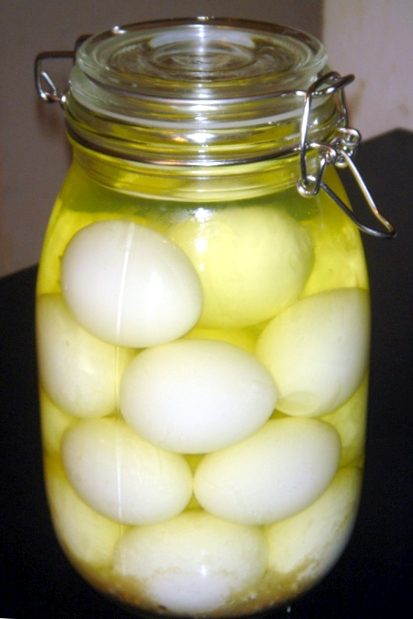
Whole eggs in brine — and whole is the operative word. Not pricked, not halved, not ‘helped along’. The safety page explains why that matters more than the vinegar does.
Three families, and everyone confuses them
Worth getting straight before anything else, because English food writing mashes these together constantly:
- Steeped / marinated — a cooked, peeled egg sits in liquid and absorbs it over hours-to-weeks. Pickled eggs, Soleier, telur pindang.
- Braised / simmered in sauce — the egg cooks in the sauce for minutes. Not marination; flavour is surface-deep. Thịt kho trứng, adobong itlog.
- Coated & fried — the egg is a vehicle for a crust. No marination at all. Kwek kwek.
That taxonomy isn’t pedantry — it’s the whole safety story. Only family (1) creates the anaerobic, low-acid, long-dwell conditions that killed a man in Illinois. A braised egg spends ten minutes in hot sauce. A pickled egg spends three weeks in a jar. Different foods, different physics, different risk.
The pub egg is German
Here’s the thing I’d have bet against. The pickled egg in a jar on the bar reads as fundamentally British — chip shops, pubs, malt vinegar, the whole iconography.
The tradition is German first. Soleier — literally “brine eggs” — is the older, salt-based ancestor, tied to the Halloren salt guild of Halle. Salt brine, not vinegar. The vinegar version is a descendant.
So the British pub egg is a branch, not a root. And the Pennsylvania Dutch red beet egg (below) is a sibling branch, not an American invention — Britain, Germany and Pennsylvania are one story, not three. That’s the structural insight worth carrying, and it lands the moment you notice the Pennsylvania Dutch are Deutsch, not Dutch.
Dating it, honestly
The one real documentary anchor is a street name: Pickled Egg Walk in Clerkenwell, London — now Crawford Passage — was in use before 1774, named after a pub called the Pickled Egg, whose landlord was Peter Crawford.
A pub named after pickled eggs, before 1774. That’s a real, checkable fact about how established the food already was.
Now the things you’ll read that I’m not going to repeat:
- ⚠ “A go-to bar snack in the late 1830s / the Pickled Egg House.” This comes from a content site and is garbled — the Clerkenwell evidence puts the pub before 1774, sixty years earlier. Don’t repeat the 1830s date. If anything it argues the tradition is older than the popular telling.
- ⚠ The royal anecdote. There’s a story about a king stopping at the Pickled Egg pub — and the tellings can’t decide whether it was Charles I or Charles II. Those are different men, different centuries, and a civil war apart. A story that can’t keep its king straight isn’t a source.
⚠ One piece of “heritage” I won’t repeat as advice
Wikipedia’s Soleier material includes the claim that they keep without needing to be kept cool — and the traditional preparation involves cracking the shells so the brine gets in.
Read that against the safety page and your blood runs a bit cold. That is exactly the fatal pattern from the Illinois case: breach the shell, hold at room temperature. On cracked shells.
I’m not calling Soleier dangerous — it’s salt brine, a genuinely different chemistry from a vinegar pickle, and people have made it for centuries. But I am not going to reproduce “they keep at room temperature” as instruction on a page that also tells you to breach the shell, because the one documented death-adjacent case in this entire subject is precisely that combination. Historical practice is not a safety endorsement. Put them in the fridge.
Red beet eggs
The Pennsylvania Dutch classic, and the best-looking thing in this whole section: hard-boiled eggs in beet juice and vinegar until the white takes a violent magenta ring and the middle stays pale gold. Cut one open and it’s genuinely beautiful.
The cultural facts are solid: the Pennsylvania Dutch are German-speaking Anabaptists and Lutherans — Mennonite, Amish, Brethren, Reformed — from the Rhineland, Switzerland, Alsace, the Palatinate, arriving in Penn’s colony from the late 17th and early 18th century. Wikipedia attributes the beet-egg variant specifically to “German-speaking Anabaptist refugees” who brought their variation of the pickled egg to Pennsylvania — and unusually for that article, that claim is actually cited.
Same people. Same technique. New colourant. The beet is the American part.
⚠ Two honesty flags:
First, sourcing. Most of the red-beet-egg history online lives on content blogs, several with an AI-slop cadence. Treat the broad strokes as sound and the specifics as unverified.
Second, and this one I want to be upfront about: there’s a real chance part of the standard story is wrong, and I couldn’t check. William Woys Weaver is the authority here — a food historian whose book is literally titled As American as Shoofly Pie: The Foodlore and Fakelore of Pennsylvania Dutch Cuisine. A book about separating PA Dutch fact from fakelore. I confirmed he exists and the book exists; I could not retrieve his treatment of red beet eggs. Given his thesis, there is a genuine possibility he has debunked something I’ve just told you. NOT FOUND — and it’s the gap I’d most like closed. If I get the book, this page changes.
And no date. NOT FOUND — no first attestation for red beet eggs specifically.
Here’s the detail that ties this page to the safety one, and it’s sobering: the Illinois victim was essentially making red beet eggs. Hard-boiled eggs, beets, hot peppers, vinegar. The difference between his jar and the ones I make wasn’t the ingredients. It was the toothpicks and the countertop.
How I actually make them
The short version, and it’s mostly a list of things not to do:
- Whole eggs. Never pricked, poked, halved, or scored. This is the rule. The brine will get there on its own schedule. See keeping them for why this is the one that matters.
- Fridge from the moment they go in. Not after opening. From the start.
- Never on the counter. Never in the sun.
- Never canned. The National Center for Home Food Preservation: “There are no home canning directions for pickled eggs.” No tested process exists, because nothing reliably acidifies a whole yolk on a predictable schedule.
- Give them a week. The physics says the acid needs 5–9 days to reach the yolk centre. That’s not patience for its own sake — that’s the actual timescale of the thing. You cannot hurry it, and the shortcut that looks like hurrying it is the dangerous one.
Do that and they’re excellent, and I make them constantly. The hazard was never the food. It was one specific shortcut.
The recipes
The collection already has a pile of these — Pickled Eggs, Easy Classic Pickled Eggs, Dark and Lovely Pickled Eggs, Sriracha Pickled Eggs, The Best Spicy Pickled Eggs, and Pickled Eggs and Cornbread.
New here: Red Beet Eggs (Pennsylvania Dutch) — built on the NCHFP’s tested recipe, refrigerator-only, whole eggs, no punctures. If you make one pickled egg from this site, make that one; it’s the prettiest and it’s the one with an authority behind it.
Next: around the world, where a Thai dish has been mistranslated by the entire English-speaking internet.
Sources & further reading
- CDC, MMWR 49(34):778–780 — Foodborne Botulism From Eating Home-Pickled Eggs — Illinois, 1997 · PubMed. The full story is on keeping them.
- National Center for Home Food Preservation — nchfp.uga.edu. The tested red-beet-egg recipe, and the “no home canning directions” ruling.
- Pickled Egg Walk / Crawford Passage, Clerkenwell — thestreetnames · Street names of Clerkenwell and Finsbury · pubshistory. The pre-1774 anchor.
- William Woys Weaver, As American as Shoofly Pie: The Foodlore and Fakelore of Pennsylvania Dutch Cuisine (Univ. of Pennsylvania Press) — Penn Press · PA Heritage profile. The gap on this page. Unretrieved, and quite possibly holding a correction to it.
Comments (0)