The Science: Why Your Marinade Never Reaches the Yolk
I’ve been making ramen eggs for years, and I believed the thing everybody says: leave them overnight and the flavour goes all the way through.
It doesn’t. It isn’t close. And once I understood why, two other things fell into place — why over-marinating wrecks an egg, and why pickled eggs have actually killed people. Those turn out to be the same fact, seen from two ends.
That fact is the most useful thing on this entire site’s egg pages, so here it is first:
A marinade moves about 3 mm into an egg overnight. The white is 5–10 mm thick. The yolk never gets the memo.
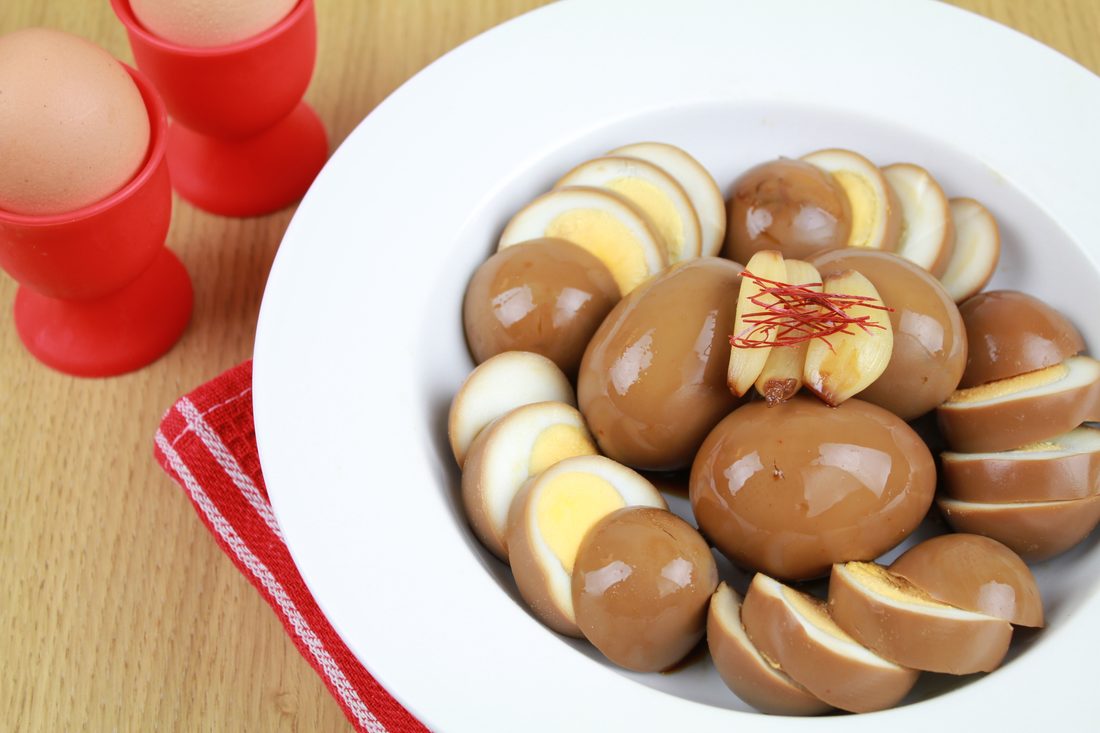
This is the whole argument in one cut. The colour stops millimetres in. The gradient is not a failure — it is the dish.
Diffusion, not osmosis — and keep them separate
A peeled boiled egg is a hydrated protein gel — roughly 90% water held in a denatured protein network. It is not a sponge. There is no bulk flow into it. Nothing gets sucked in.
Two processes run at once, in opposite directions:
- Diffusion — solutes (Na⁺, Cl⁻, acetic acid, sugars) migrate into the egg down their concentration gradient. This carries the flavour.
- Osmosis — water migrates out of the egg into the salty marinade. This shrinks and firms it.
Popular writing mashes these into one word. Keep them apart, because diffusion delivers the flavour and osmosis does the damage. Almost every marinating mistake is one of those two running too long.
The numbers
There’s exactly one clean measurement of diffusion in egg white gel specifically — not a model food, not agar, the actual thing:
| Solute | Diffusion coefficient in egg white gel |
|---|---|
| Sodium chloride | 10⁻¹⁰ – 10⁻⁸ m²/s (rising with temperature) |
| Glucose | same order, consistently lower than NaCl |
Read that second row carefully, because it’s the tell. Glucose — a small sugar, MW 180 — already diffuses measurably slower than salt. Extrapolate down that trend and the large molecules carrying most of soy sauce’s and mirin’s actual character (peptides, melanoidins, terpenes, MW in the hundreds to thousands) are slower still, and the biggest are effectively excluded from the gel network on any kitchen timescale.
⚠ My honesty flag on that: there is no direct measurement of soy-sauce aroma compounds or peptides diffusing in cooked egg white. Nobody has done it. The “big flavour molecules don’t get in” claim is a well-motivated inference from the salt-vs-glucose ordering plus general gel-permeation principles — it is reasoning, not a citation, and I’m not going to dress it up as one.
Now the arithmetic. Diffusion length is x ≈ √(2·D·t). At fridge temperature (D ≈ 1×10⁻¹⁰ m²/s):
| Marinating time | Salt penetration |
|---|---|
| 1 hour | ~0.8 mm |
| 4 hours | ~1.7 mm |
| 12 hours (overnight) | ~2.9 mm |
| 24 hours | ~4.2 mm |
| 3 days | ~7.2 mm |
| 7 days | ~11 mm |
The white is 5–10 mm thick. So an overnight marinade salts the outer third to half of the white and stops. Multi-day eventually reaches the yolk boundary; the yolk interior lags far behind that.
⚠ That’s an order-of-magnitude estimate, not a measurement — it assumes constant D, a semi-infinite slab, and ignores spherical geometry and the yolk membrane as its own barrier. It’s crude as a calculation. It’s trustworthy as a conclusion, because of what comes next.
The corroboration that settles it
Duck eggs, brined 35 days:
| Fresh | After 35 days in brine | |
|---|---|---|
| White | 0.47% salt | 8.23 – 11.61% |
| Yolk | 0.32% salt | 2.25 – 3.29% |
Thirty-five days. Five weeks of aggressive brining, and the white is at 8–12% salt while the yolk has barely crawled to 2–3%. The gradient is enormous and it persists for over a month.
If five weeks can’t equalize a duck egg, twelve hours in a bowl of soy and mirin is not reaching your yolk. It isn’t a technique failure you can fix by waiting longer or using more soy.
The gradient isn’t a bug. The gradient IS the dish. A ramen egg is a seasoned shell of white around an unseasoned custard yolk, and that contrast — salty edge, rich bland middle — is exactly what makes it good. Nobody would want a yolk brined to 10% salt. You’d spit it out.
So when a recipe tells you the flavour “penetrates right through to the centre,” it’s describing something that has never happened in anyone’s kitchen.
Why over-marinating ruins them
Here the popular explanation is shaky and I’m going to say so.
You’ll read that salt denatures and toughens the white over time. Reasonable-sounding. But the actual literature shows salt lowering egg-white gel hardness, not raising it. That’s the opposite of the folk claim.
The mechanism that actually fits is osmotic dehydration — the osmosis half from the top of this page. Water leaves the egg into the hypertonic marinade; the protein network collapses in on itself; the white gets dense, shrunken, and rubbery. It isn’t that the salt toughened the protein. It’s that the water left.
⚠ I’m flagging this as inference, not established fact. It’s the explanation that fits the evidence I could find. It is not something I can hand you a paper for.
The practical limit, honestly: sources conflict, and there’s no authority to appeal to. What the physics says is that the damage accumulates with the same clock as the flavour — the two aren’t separable, because they’re the same gradient. Somewhere around 12–24 hours you have maximum flavour for minimum damage on a soft-boiled egg. Past a couple of days you’re trading texture for salt you can’t taste anyway, because it’s going somewhere you’ll never bite.
The boiled egg itself
The white doesn’t set all at once, and that’s the whole art:
| Protein | % of white | Sets at |
|---|---|---|
| Ovotransferrin | 13% | ~61–62 °C — the most heat-labile |
| Ovalbumin | 54% | ~78–79 °C |
At ~62 °C ovotransferrin coagulates: the white turns opaque but stays soft and jelly-like. It doesn’t get firm and sliceable until ovalbumin — the majority protein — goes at ~80 °C. The window between those two numbers is the entire art of the soft-boiled egg.
The yolk:
| Stage | Temp |
|---|---|
| Begins to thicken | ~65–66 °C |
| Jammy target | ~65–70 °C |
| Fully firm | ~70 °C |
| Chalky and sad | above ~70 °C |
The jammy yolk is a ~5 °C window. And now look at what you’re being asked to do: the white needs ≥80 °C at its outer edge to be firm, while the yolk must stay ≤70 °C at its centre.
You are relying entirely on the thermal gradient. The egg never reaches equilibrium — and if it did, there would be no jammy egg at all. A jammy egg is a deliberately unfinished heat transfer. That’s why the timing is so unforgiving, and it’s a much better way to think about it than a stopwatch.
(One myth while I’m here: a widely-copied line claims “ovotransferrin is the predominant protein in egg yolks.” It’s an egg white protein. The yolk’s are livetins, phosvitin, and the LDL/HDL assemblies. And I couldn’t get individual denaturation temps for those from any accessible primary source — the review was paywalled — so don’t trust anyone who assigns a specific temperature to a specific yolk protein, including me. The 65–70 °C figures are bulk yolk behaviour, which is what a cook needs anyway.)
The 5/7/10 rule is a decent start and a bad law
Roughly 5 minutes soft, 7 jammy, 10+ hard. It isn’t a statement about eggs — it’s a statement about one specific set of conditions, and every one of these breaks it:
- Egg size. The big one, and the most underrated. Heat diffuses to the centre in time that scales with the square of the radius. A jumbo egg is not “a bit longer” than a medium — the relationship is quadratic.
- Starting temperature. Fridge (~4 °C) vs room (~20 °C) is a 16 °C head start; easily a minute.
- Altitude. Water boils cooler as you climb — ~95 °C at 5,000 ft. Add roughly 1 minute per 1,000 ft above 3,000 ft. ⚠ And note the subtlety: some sources claim eggs cook faster at altitude. That’s wrong. Cooler water means slower — and, interestingly, a gentler gradient, which slightly widens the jammy window.
- Pot size, water volume, number of eggs (each cold egg drags the temperature down), lid, rolling boil vs bare simmer.
So here’s my actual advice: a timing chart is a personal artifact. Calibrate once, in your kitchen, with your pot and your eggs, write the number down, then never change the variables. Mine is not transferable to you and yours isn’t transferable to me.
Peeling: it’s pH, and this one IS proven
Finally, a kitchen argument with a real answer.
A freshly laid egg’s albumen is about pH 7.6–8.5, buffered by dissolved CO₂. The shell is porous. CO₂ escapes over days, the bicarbonate buffer collapses, and the albumen climbs to ~9.2 and eventually 9.4–9.7.
The measured threshold: albumen above pH 8.9 yields easy-to-peel eggs. Earlier work put it at 8.7, with difficulty persisting to ~8.9.
And the reason I’ll call this proven rather than correlated: the experiment works backwards. Take old, easy-peeling eggs, put them back under CO₂ so the albumen re-acidifies — and they become hard to peel again. That’s causation, not a folk observation. You can toggle the effect with the variable.
So the fix for peeling isn’t a trick. It’s a calendar. Buy your eggs a week before you need them. That’s it. That’s the whole secret, and it’s why farm-fresh eggs — the ones everyone treats as superior — are the worst possible eggs for this job. Freshness is a liability here.
Which puts the folk remedies in their place:
| Remedy | Verdict |
|---|---|
| Older eggs | ✅ The real answer. pH, proven causally. |
| Steaming instead of boiling | ✅ Genuinely helps |
| Ice bath | ✅ Works — but it’s just cooling, not magic “shock” |
| Baking soda in the water | ⚠️ Folk remedy |
| Vinegar in the water | ⚠️ Folk remedy |
| Starting in boiling vs cold water | ⚠️ Affects timing more than peeling |
And now the dangerous part
Everything above is about flavour. But look at that first table again — slow diffusion, days to cross a few millimetres — and then consider what it means for something acidic.
A whole egg’s interior is low-acid. Normal yolk pH is 6.8. When you drop a peeled boiled egg into vinegar brine, the acid has to make the same slow crawl the soy sauce does. Studies of pickled eggs put it at 5–9 days for the yolk centre to reach pH 4.6 — the line below which Clostridium botulinum can’t grow.
For 5 to 9 days, the middle of your pickled egg is an anaerobic, low-acid, room-temperature pocket. That is a botulism incubator with a shell around it.
⚠ If you want to know where a given egg actually is, the yolk is what you measure — halved, blended, at room temperature — and not the brine around it. Measuring pH has the method and the equipment.
The same slow diffusion that makes a ramen egg taste good is what makes a pickled egg dangerous. One fact. Two consequences.
This is not hypothetical. It put a healthy 68-year-old on a ventilator in Illinois in 1997, and the CDC’s write-up contains a detail that inverts everything you’ve read about pickled-egg safety. That’s the keeping them page, and if you make pickled eggs, please read it — it’s the one page here that isn’t just interesting.
⚠ Proportionality, before anyone panics: this is a room-temperature pickling hazard, not a refrigerated marinating one. Your ramen eggs in the fridge for two days are fine. I’m not telling you to be afraid of eggs. I’m telling you which specific practice has a body count.
What this all means at the bench
- Overnight is enough. More time doesn’t reach the yolk; it just dehydrates the white.
- Season the outside, accept the gradient. It’s the dish, not a defect.
- Buy your eggs a week early. The only peeling fix that survives contact with evidence.
- Calibrate your own timing once. Then stop changing variables.
- Refrigerate everything. Always. The fridge is doing more work than your marinade — see keeping them.
- If you’d rather not calibrate, buy the temperature instead. Everything above is about a gradient you never let finish. Hold an egg at one temperature for an hour and there is no gradient left to time — the yolk simply sets to the number you chose and stops. What each number gives you, on a sous-vide stick, an induction hob, a steamer or an electric egg cooker, is on its own card: Eggs, Cooking by Temperature. The catch is the one this page has already told you: every one of those numbers describes the yolk, and the white — 54% ovalbumin, needing ~80 °C — is still nowhere near ready. That is why an egg cooked that way cannot be peeled, and why a marinated egg still wants real heat first.
Next: tea eggs, where the shell stays on and the whole calculus changes.
Sources & further reading
- Sha, Y. (2021). Distribution and diffusion coefficients of glucose and sodium chloride onto konjac and egg white gel. Food Science and Technology Research 27(3):359–367 — DOI. The only clean measurement in egg white gel.
- Ohtsuki et al. (2008). Dual mode diffusion and sorption of sodium chloride in pre-cooked egg white. LWT — ScienceDirect.
- Xu, L. et al. (2017). Effects of salting treatment on the physicochemical properties…of duck eggs. PLOS ONE 12(8):e0182912 — DOI. The 35-day white-vs-yolk table; the strongest single piece of evidence here.
- Matsudomi et al. on ovotransferrin heat coagulation — ScienceDirect.
- ThermoWorks, Boiling eggs: everything you need to know — the yolk temperatures.
- USDA FSIS, High-altitude cooking.
- CDC MMWR, Foodborne Botulism From Eating Home-Pickled Eggs — Illinois, 1997 — 49(34):778–780. Covered on keeping them.
Comments (0)