Japan: Ramen Eggs & the Inverted Egg
The ramen egg is the most famous marinated egg on earth, and I make it constantly — my own version is in the collection, built on tamari, rated five stars by the only critic who matters in my kitchen.
So I assumed it was old. Some centuries-deep Japanese technique that ramen shops inherited.
It was invented in 1992, by a man with a name and an address. And the thing he was trying to make is not the thing you think a ramen egg is.
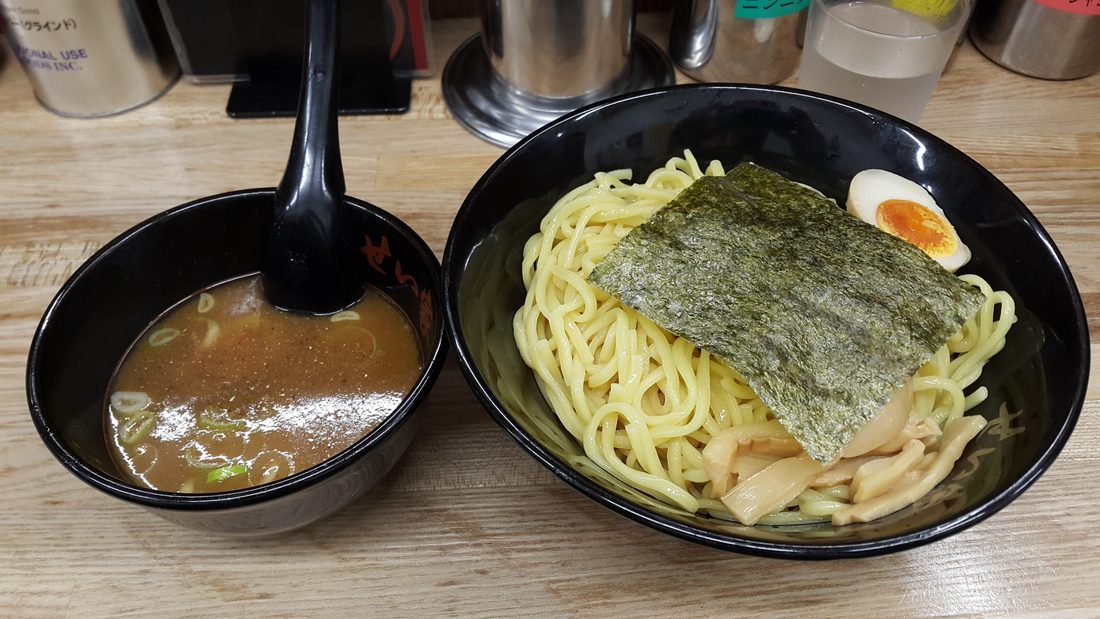
Where the ramen egg actually lives. Chiba Kenji invented this in 1992 wanting a yolk that would hold together in the soup — not the molten one the cameras later preferred.
The ramen egg has a birthday
Three independent Japanese sources converge on this, and it’s a much better story than “ancient tradition”:
千葉憲二 (Chiba Kenji) — a kaiseki chef with twenty years behind him — opened ちばき屋 (Chibakiya) in Kasai, Tokyo, in 1992, and invented the half-set ajitama. He went on to chair the Japan Ramen Association.
That’s it. 1992. Within living memory, in a specific shop, by a named person who is a matter of public record.
You may have seen a garbled version — “a restaurant owner named Kenji Chiba, a local Tokyo legend” — floating around the content farms. That vague legend is a mangling of a documented fact. The fact is better than the legend, which is usually how this goes.
And here’s the part that reframes everything
Chiba wanted a yolk that would NOT bleed into the soup.
Read that again, because it inverts the modern dish. The whole point of his invention was a gel yolk — set enough to hold itself together, so it wouldn’t leak custard into a carefully built broth. He was solving a contamination problem. He wanted the egg to behave.
The runny, molten, lava-yolk egg you see in every ramen photograph is a 1996 drift — traced to 青葉 (Aoba) in Nakano — driven by photogenic media coverage. It got runnier because it photographed better.
No English source tells this story. The ramen egg you’re chasing on Instagram is a misunderstanding of the ramen egg that was invented, and the misunderstanding won because cameras liked it.
I find this genuinely great. The original was engineered restraint; the famous one is a photograph.
⚠ One honesty note on the dating: there’s an older precedent — 漢珍亭 (Kanchintei) in Ogikubo — but its date is NOT FOUND. So the precise, defensible claim is narrow: Chiba invented the soft-set version in 1992. He did not necessarily invent the seasoned egg as such. I’m not going to overstate it, because the narrow claim is already remarkable.
Nitamago vs ajitama
You’ll find people telling you these are different things — that nitamago (煮玉子) means simmered and ajitsuke tamago means marinated, and you can read a menu accordingly.
The etymology is real (煮 = to simmer). The distinction is dead in practice. And the killer detail: Chibakiya’s own founding dish — the one that started all this — is called nitamago.
So anyone teaching you a menu-reading rule here is inventing it. They’re the same egg.
The marinade, and the thing I got wrong
Standard construction is soy, mirin, sake, sometimes dashi, usually diluted with water. That dilution is not a cost-saving measure — it’s the recipe. Undiluted soy makes a salt bomb with a rubbery shell, for reasons the science page covers: osmosis pulls water out and the white collapses.
My own recipe — Eggs, Ramen, Jeff’s (Ajitsuke Tamago) — runs 1 cup tamari to ¼ cup mirin and ¼ cup rice vinegar, with optional togarashi, ginger, garlic, cardamom, star anise. It’s adapted from The Flavor Bender and I’ve been making it for years.
And having now done the reading, I’d change one thing about my own recipe: that’s a strong marinade, and the honest reason it works is that I don’t leave the eggs in it forever. The recipe says 2 hours minimum, 8–12 for best, up to 24. That upper bound is doing real work — past a day in a marinade that concentrated, you’re not seasoning the egg, you’re dehydrating it.
⚠ And I’ll flag the weak link in my own recipe rather than defend it: it says to keep the marinade and reuse it for up to 3 weeks. I now think that’s the shakiest instruction in the file — see keeping them. It’s protein soup with egg leachate in it. I reuse a batch once or twice now, then it goes.
⚠ Sourcing note: I wanted to give you Kenji López-Alt’s ratio as a cross-check, and Serious Eats is fetch-blocked, so that ratio is UNVERIFIED here and I’ve left it out rather than half-remember it.
The timing
The classic soft-boil lands around 6:30 to 7 minutes — but see the science on why that number is a personal artifact, not a law. The jammy yolk is a ~5 °C window (65–70 °C), you’re relying on an unfinished thermal gradient, and egg size shifts it quadratically. Calibrate once in your own kitchen and then stop changing variables.
Onsen tamago: the egg that runs backwards
This is my favourite piece of egg science anywhere, and it’s a genuine inversion.
A normal soft-boiled egg has a set white and a runny yolk. Onsen tamago has the opposite — a set (custardy) yolk and a barely-set, slippery white. It looks wrong. It looks like someone ran the egg in reverse.
And the reason is beautiful:
The yolk sets at a LOWER temperature (~65–70 °C) than the white does (~80 °C).
So hold an egg at ~65–70 °C — a hot spring’s temperature — long enough to reach equilibrium, and you land in the gap: hot enough to set the yolk, too cool to fully set the white. You get the inverse egg.
Which means the normal soft-boiled egg is the weird one. A soft-boiled egg only exists because you didn’t wait — it’s a gradient artifact, caught mid-transfer. The onsen egg is what an egg actually wants to be at equilibrium, if you let it settle at the right temperature. Boiling lies to you; the hot spring tells the truth.
That’s also why onsen tamago is trivially easy with a sous-vide circulator and genuinely fiddly without one: you’re not timing anything, you’re holding a temperature. The numbers for that — and for the induction hob, the steamer and the egg cooker, which each need a completely different set of instructions — are on Eggs, Cooking by Temperature.
And this is the fact that page keeps having to repeat, so it’s worth stating here where it’s most obvious: the reason onsen tamago is served cracked into a bowl is that it physically cannot be peeled. The same inversion that makes it interesting makes the white too loose to hold a shell’s shape. Any plan to hold a ramen egg at 65 °C and then peel it is asking the onsen egg to be something it is definitionally not.
⚠ The origin story is folklore. The “300-year-old traveler discovered it in a hot spring” tale you’ll see everywhere — Japanese sources say 諸説 (various theories); the origin is not established. The only hard anchor I found is 飯坂温泉’s ~1920 “ラジウム玉子” (radium egg) — and I’m flagging that as single-sourced.
And an unresolved conflation nobody addresses: Beppu’s 地獄蒸し — “hell steaming” — is about 100 °C steam. That produces a hard-cooked egg, not a 65–70 °C onsen tamago. They get lumped together in write-ups about “eggs cooked in hot springs” as if they were one tradition. They’re two different foods made by two different physics.
Cured yolks
A real Japanese technique worth knowing: raw egg yolks cured in miso (misozuke tamago). The miso’s salt draws water out osmotically — the same mechanism that ruins an over-marinated boiled egg, deployed on purpose — and you end up with a yolk gone dense, translucent, and amber, sliceable or gratable, tasting like a savoury caramel. Over rice it’s outstanding.
Recipe: Miso-Cured Egg Yolks.
⚠ Honest deletion: I’d planned a section on umeboshi-cured yolks and cut it. NOT FOUND — no source in English or Japanese. It sounds plausible, which is exactly why I’m not writing it.
Japan vs Korea
There’s a lazy line that Japan’s marinades are dashi-and-restraint while Korea’s are garlic-and-chili. It’s tidy. It’s also flatly wrong on the facts: Korean mayak eggs are built on kelp water. Dashi, essentially. So much for that distinction.
The real difference is mechanical, not spiritual:
Japan strains the marinade. Korea serves it.
A ramen egg arrives clean, its aromatics filtered out, sitting on a bowl of something else. A mayak egg arrives in its marinade, onion and chili and sesame and all, poured over rice — the liquid is the dish.
That’s a real, observable, useful distinction, and it survives contact with the recipes. See Korea.
The recipes
- Eggs, Ramen, Jeff’s (Ajitsuke Tamago) — mine, tamari-based.
- Eggs, Ramen, Soy 味付け玉子 — the leaner quart-jar version already in the collection.
- Onsen Tamago — the inverted egg. Sous-vide and stovetop methods.
- Miso-Cured Egg Yolks — the cure.
- Onsen 鹵水 Lou Seui Egg — already in the collection; an onsen-style egg dressed with Chinese master stock, which is a lovely collision of two of these pages.
Next: Korea, where the marinade comes to the table.
Sources & further reading
- ちばき屋 / 千葉憲二 — the 1992 ajitama origin, corroborated across three Japanese sources.
Detail in
02-inputs/marinated-eggs-research/japan-and-korea.md. - 青葉 (Aoba), Nakano — the 1996 runny-yolk drift.
- 飯坂温泉 “ラジウム玉子” (~1920) — the only hard onsen-tamago anchor found. ⚠ Single-sourced.
- Just One Cookbook and RecipeTin Japan — the weighted, reliable recipe sources used for the ratios here.
- ⚠ Serious Eats / Kenji López-Alt — fetch-blocked during research; his ratio is unverified and deliberately omitted rather than half-remembered.
- On the protein temperatures behind the onsen inversion, see the science.
Comments (0)