Keeping Them: Storage, and the One That Can Kill You
Most of this section is a pleasure. This page isn’t, entirely.
I make pickled eggs. I have seven pickled-egg recipes in my collection — more than any other egg type. So when the research turned up a documented botulism case from home-pickled eggs, I read the CDC report myself rather than taking anyone’s summary for it.
I’m glad I did, because the internet has this case backwards, and the way it’s backwards is the single most useful thing on this page.
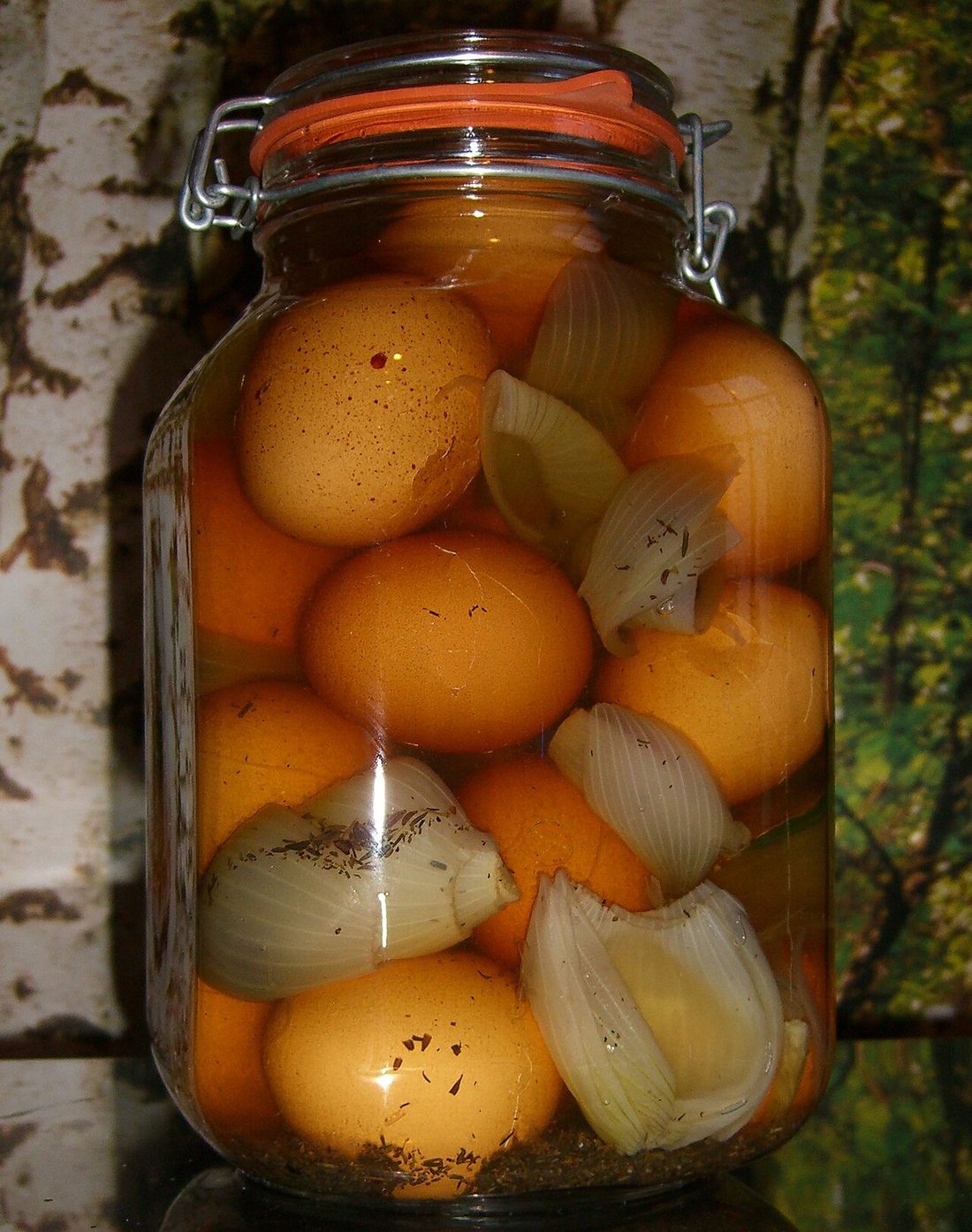
Soleier — the German brine egg the pub pickle descends from. Whole, unpunctured, and — the part that matters — kept cold. The one documented casualty did the opposite of all three.
The case
November 1997, Illinois. A previously healthy 68-year-old man ate home-pickled eggs and ended up on a ventilator with botulism. The CDC’s write-up is MMWR 49(34):778–780.
Here’s what everyone tells you went wrong: he didn’t use enough vinegar.
Here’s what the CDC actually found, verbatim:
“The pH of the pickling liquid was 3.5 (i.e., adequate to prevent C. botulinum germination and toxin formation. However, the pH of the egg yolk was not determined [normal egg yolk pH: 6.8]).”
The brine was fine. pH 3.5. The CDC says so in the same breath — adequate to prevent germination. The acid was never the problem. “Use more vinegar” would not have saved him.
So what did?
“The intact hard-boiled eggs were peeled and punctured with toothpicks then combined with the other ingredients in a glass jar… The mixture was stored at room temperature and occasionally was exposed to sunlight.”
Read that again. Punctured with toothpicks. Stored at room temperature. In sunlight.
And the smoking gun:
“The concentration of preformed type B toxin was 1000 times greater in the egg yolks than in the pickling liquid.”
A thousand times. The toxin wasn’t in the brine — it was inside the eggs. The growth happened in the yolks, in the one place the acid hadn’t reached.
The CDC’s own explanation:
“Intact eggs that have been hard-boiled should be free of bacteria or spores. Pricking cooked eggs may introduce C. botulinum spores into the yolk. Portions of the yolk that remained anaerobic and inadequately pickled (i.e., not acidified to pH < 4.6) may have allowed C. botulinum spores to germinate, grow, and form toxin. Setting the pickling jar in sunlight provided warmth that facilitated bacterial growth and toxin production.”
There was no garlic. The recipe was hard-boiled eggs, commercially prepared beets and hot peppers, and vinegar. It was, essentially, red beet eggs — the Pennsylvania Dutch classic. The ingredients weren’t exotic or wrong. The difference between that jar and a safe one was the toothpicks and the countertop.
Why the toothpicks, specifically
Go back to the science page and the diffusion table. Acid crawls into an egg at the same crawling pace as soy sauce — the yolk centre takes 5–9 days to reach pH 4.6.
So the geometry is this: a whole peeled egg in acid brine has, for the better part of a week, an interior that is anaerobic, pH 6.8, and warm if you leave it out. That is a textbook-perfect C. botulinum environment — it wants exactly no oxygen, low acid, and warmth.
⚠ And this is the clearest example on the whole site of why you measure the food and not the brine. A pickled-egg brine reading 3.5 tells you nothing about the middle of the egg sitting in it — the CDC case above is exactly that gap. Measuring pH covers the equilibrium trap and how a sample is supposed to be prepared.
Normally that doesn’t matter, because an intact hard-boiled egg’s interior is sterile. The spores can’t get in. The dangerous pocket exists, but nothing is living in it.
The toothpick carries the spores in.
That’s the whole mechanism. The failure wasn’t chemical — the chemistry was right. It was geometric. He inoculated the one part of the egg the acid couldn’t defend, and then set the jar in the sun.
And here’s what makes this genuinely worth writing about: “prick the eggs so the brine soaks in faster” is one of the most commonly repeated pickled-egg tips on the internet. It sounds helpful. It sounds like technique. It is the exact mechanism that put a man on a ventilator.
The CDC’s rule, verbatim, and it’s the one to carry away:
“Pricking, poking holes, or otherwise handling whole eggs in a manner that might allow spores or bacteria into the yolk should be avoided.”
So: never can pickled eggs
I went looking for a tested home-canning process for shelf-stable pickled eggs. There isn’t one. The National Center for Home Food Preservation — the authority on this — is unambiguous:
“There are no home canning directions for pickled eggs.”
Not “here’s how to do it carefully.” There is no process. And the reason is exactly the physics above: nothing reliably acidifies a whole yolk on a predictable schedule (egg pH runs 6.4–9.0), so no one can validate a process that guarantees the centre gets safe. Extension services say the same thing independently: Do NOT can pickled eggs.
Three authorities, one answer. Pickled eggs are a refrigerator product. Full stop.
The CDC’s guidance agrees:
“Refrigeration at 39 F (4 C) during pickling is advisable, especially in foods that may be acidified inadequately such as whole eggs.”
“Especially… such as whole eggs.” They named the food.
The rules I actually follow
- Never prick, poke, or score the eggs. Ever. The brine will get there. You have time; your nervous system doesn’t get a second chance.
- Refrigerate from the moment they go in the jar. Not “after opening.” From the start.
- Don’t put the jar on the counter, and God knows not in the sun. The sunlight in that case wasn’t incidental colour — the CDC named it as the warmth source that drove toxin production.
- Give them time. Days, not hours, for real flavour — because you’re not allowed to cheat with a toothpick.
- Whole eggs only. No halves, no slices, no “for faster infusion.”
Do those and pickled eggs are a genuinely safe, genuinely great thing that I make regularly. The hazard isn’t the food. It’s one specific shortcut.
⚠ The honest gap: soft-boiled marinated eggs
Now the part where I have to tell you nobody knows.
No authority covers soft-boiled marinated eggs. I looked hard.
- USDA’s 7-day rule is for HARD-COOKED eggs. Their actual wording specifies yolks firm. That’s not a ramen egg.
- The “1–2 days for soft-boiled” figure you’ll see everywhere traces to a blog. Not USDA. Not FDA. Not an extension service. A blog, copied.
- I am not going to invent a number to fill the hole, because a fabricated safety figure is worse than an admitted gap.
What I can tell you honestly: a runny yolk is an undercooked yolk — it hasn’t been pasteurized. Your marinade is not preserving it (see below). The fridge is doing all the work. My own practice is to eat ramen eggs within a couple of days, and I’m telling you that’s my practice based on the physics, not a validated safety limit, because no such limit exists in any source I could find.
If someone quotes you a confident number for soft-boiled marinated eggs, ask them where it came from. I’d genuinely like to know.
Your soy marinade is not preserving anything
This one surprised me.
Undiluted soy sauce is genuinely shelf-stable — high salt, low water activity, it’s a preservative in its own right.
But an egg marinade is not soy sauce. You diluted it with water and mirin and sake. Real marinades land around ~4% salt — nowhere near preservation strength. And per the science page, it can’t reach the interior anyway.
The fridge is doing 100% of the work. The marinade is doing flavour.
Anyone treating a soy marinade as a preservation step has it exactly backwards.
Reusing the marinade
Lots of recipes — including one in my own collection — say to keep the marinade and reuse it for weeks.
Think about what’s in it after a batch: protein, leached egg solids, water diluting it further each round, and whatever came off the shells. Then it sits for weeks.
I don’t have an authority to hand you here either — this is a genuine gap. But the reasoning is not complicated, and I’d rather be straight about my own recipe than protect it: reusing a marinade indefinitely is the weakest link in every ramen-egg recipe on the internet, mine included. I reuse a batch once or twice, refrigerated, and then it goes. Salt does not make protein soup safe forever.
(One recipe in the collection gets this right and says so: “For food safety, I recommend discarding the marinade and making a new batch.” That’s the correct instinct.)
Salmonella, briefly
Worth knowing and often mangled: Salmonella can be inside an intact, uncracked egg via vertical transmission from the hen — it isn’t only shell contamination you can wash off.
Which means: marinating is not a kill step. Soaking an egg in soy sauce does nothing to Salmonella. Cooking does. A hard-boiled egg is safe on that front; a jammy one is a small, knowing, generally acceptable risk that millions of people take daily — but it’s a risk, not a zero, and the people who should skip it (pregnant, immunocompromised, very young, very old) should skip it.
The proportionality, stated plainly
I don’t want this page to read as fear-mongering, because the risk here is specific and narrow:
| Practice | Risk |
|---|---|
| Marinated eggs in the fridge, eaten in days | Normal food. Go enjoy them. |
| Pickled eggs, whole, refrigerated, unpunctured | Safe. I make them. |
| Pickled eggs, PUNCTURED, at room temperature | This is the one. Don’t. |
| Home-CANNED pickled eggs | No tested process exists. Don’t. |
Botulism from marinated eggs is a room-temperature pickling hazard. It is not a refrigerated marinating hazard. In the whole US, foodborne botulism runs a median of ~23 cases a year from all foods combined.
So: make the eggs. Just don’t take the shortcut that the one documented victim took.
Back to the science, or on to pickled eggs for the tradition itself.
Sources & further reading
- CDC, MMWR 49(34):778–780 — Foodborne Botulism From Eating Home-Pickled Eggs — Illinois, 1997. Every quote on this page is verbatim from this report, which I pulled and read directly rather than trusting a summary. (Note: cdc.gov blocks automated fetching; the text was retrieved via the Internet Archive’s snapshot of that canonical URL.)
- National Center for Home Food Preservation (NCHFP) — nchfp.uga.edu — “There are no home canning directions for pickled eggs.” The authority on the question.
- USDA FSIS, Egg products and food safety — the 7-day rule, which applies to hard-cooked eggs only.
Comments (0)