How Rice Is Grown
Here’s the first thing I had to unlearn about rice, and it’s the thing most people believe: rice does not have to grow underwater to live. It isn’t a pond plant. It won’t die if you keep it dry, and it doesn’t drink through its leaves. If you planted rice in an ordinary well-watered field, the way you’d plant wheat or corn, it would come up and grow just fine. Plenty of the world’s rice is grown exactly that way.
So why the flooded fields? Why the mirror-flat paddies and the postcard terraces climbing a mountainside in staircases? The honest answer is one of my favorite facts in this whole dive, because it flips the usual story on its head. The water isn’t there for the rice. The water is there to kill everything else. Rice happens to be one of the very few crop plants that can stand having its feet in standing water for months at a time — so a farmer who floods a field hands rice a private room that almost no weed can survive in. The flood is a weapon aimed at the competition, and rice is the one crop tough enough to shrug it off.
That single idea — rice tolerates the flood, it doesn’t require it — is the key that unlocks everything else on this page. Once you’ve got it, the whole strange, beautiful machinery of a rice landscape starts making sense.
I come at rice as a Louisiana cook first. Long-grain, the backbone of a Cajun Jambalaya or a pot of Red Beans and Rice, and the rice in my pantry mostly comes off the flooded fields of the American South — Arkansas, Louisiana, Texas. So I’ve got a horse in this race. But the story of how the grain gets to the bag is a global one, and it’s worth telling right.
How rice actually handles the flood
Let me kill the “rice must grow underwater” myth properly, because the reason rice can take the flood is genuinely cool engineering.
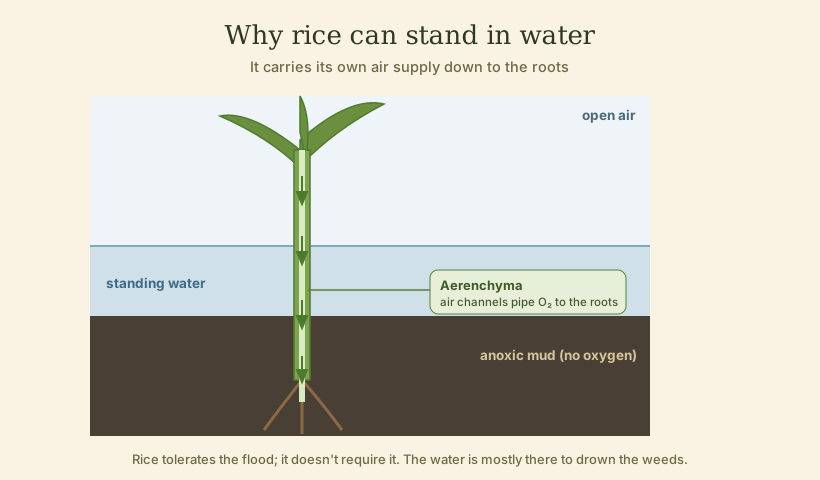
Drown most plants and they suffocate. Roots need oxygen to respire, and waterlogged soil goes anoxic — the water fills the pore spaces that normally hold air, and within a day or two the microbes have used up whatever oxygen was dissolved in it. A corn plant with its roots in a flooded field is a dead corn plant. Rice isn’t, and the reason is a piece of internal plumbing called aerenchyma: continuous air channels running down through the stem and into the roots, a network of interconnected gas spaces that pipe oxygen from the leaves and shoots — up in the open air — down to the roots sitting in the airless mud. Among the cereal grains, rice is essentially unique in building this plumbing well enough to thrive waterlogged. It breathes through a snorkel.
Rice reinforces the trick with a barrier to radial oxygen loss — a sheath around the root that keeps the precious oxygen it just piped down from leaking straight back out into the anaerobic soil. So the plant isn’t drinking water through its leaves and it isn’t magically photosynthesizing underwater. It’s a perfectly ordinary land plant that happens to carry its own air supply down to its roots. That’s the adaptation the flood exploits.
And here’s the tell that proves the flood is optional: upland rice. In the hills of West Africa, Southeast Asia, and parts of Latin America, farmers grow rice on dry, sloping, unflooded ground, rainfed like any other grain, and it comes up rice all the same. It yields less and it’s fussier about drought, but it grows. Upland rice is the living proof that submergence is a management choice, not a botanical requirement. The paddy is a strategy, not a life-support machine.
What the flood does that dry ground can’t
If the rice doesn’t need the water, why do the majority of the world’s rice farmers still flood? Because the flood earns its keep several times over:
- Weed suppression, first and always. This is the big one. A few inches of standing water drowns the seedlings of nearly every weed that would otherwise choke a young rice crop. Rice, with its snorkel, sails through; the weeds don’t. In a world before cheap herbicides — which is most of the history of rice — that was the difference between a crop and a wasteland. It still matters enormously today.
- A buffered, fertile environment. Flooded soil chemistry frees up nutrients like phosphorus and keeps soil temperature steady. The water is a thermal blanket and a slow-release pantry.
- Pest and rodent limits, and continuity. A flooded field is a harder place for a lot of soil pests, and the same fields can be cropped season after season for centuries without the fertility collapse you’d expect from other continuous monocultures — the annual flood renews them.
The catch — and it’s a big one I’ll come back to at the end — is that the same airless, waterlogged mud that suppresses weeds also brews methane and mobilizes arsenic. The flood is a bargain, not a free lunch.
The paddy as an ecosystem
One more thing the flood gives you, and it’s easy to miss from a bag of rice on a shelf: a paddy is a shallow, warm, standing-water wetland, and generations of farmers have run other food through it at the same time. The Honghe Hani terraces I mentioned above aren’t just rice — the same water raises fish, eels, and ducks, and the animals fertilize the field and eat the pests while the rice grows over them. Rice-fish and rice-duck systems are ancient across East and Southeast Asia, and they’re a big part of why a well-managed paddy can be cropped for centuries without collapsing: it’s not a monoculture so much as a managed pond that happens to grow a grain. That’s a very different picture from the dead-flat industrial fields I’ll describe at the end, and both are “rice farming.”
The paddy cycle, step by step
A lowland paddy — the classic flooded field — runs on a rhythm that’s barely changed in millennia, even where the tools have.
Puddling the field. Before anything is planted, the flooded field is churned and smeared into a soft, soupy mud — historically with a water buffalo dragging a harrow, today often with a tractor. This is called puddling, and it’s deliberate: it destroys the soil structure on purpose, sealing the pore spaces so the field holds standing water instead of letting it drain away. A puddled paddy is a bathtub. It’s also dead flat, because water finds its own level and you want it evenly shallow across the whole field — which is why the great rice landscapes are obsessed with leveling.
Transplanting versus direct seeding. Now the rice goes in, one of two ways.
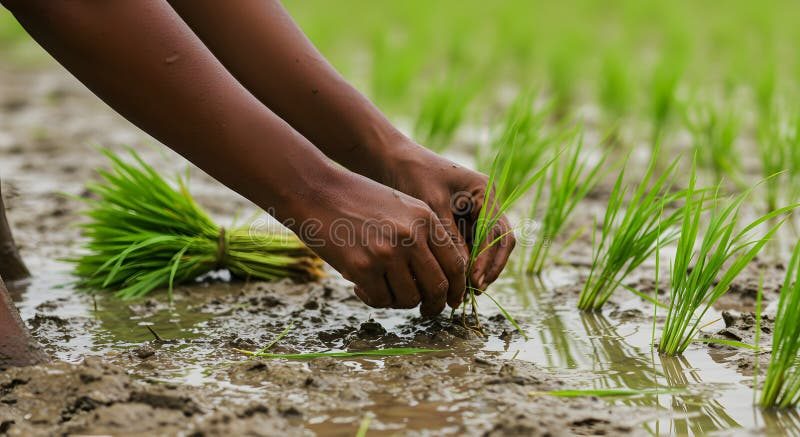
- Transplanting is the labor-heavy, high-yield traditional method: you germinate seed densely in a small nursery bed, then — by hand, bent double, in ankle-deep mud — pull the young seedlings and replant them one bunch at a time in evenly spaced rows across the flooded field. It’s brutal, backbreaking work, overwhelmingly done by women across much of Asia, and it gives the rice a head start on the weeds (the transplants are already tall when the weeds are just germinating). Those neat green rows standing in a sheet of water are transplanted rice.
- Direct seeding skips the nursery — you sow seed straight into the field, either drilled into wet mud or, at the industrial end, broadcast from an airplane over a flooded field, which is exactly how a lot of American rice goes in. It’s far cheaper on labor but leans harder on herbicides and good water control to keep the weeds down, since the rice no longer has the transplant head start.
Water management through the season. The field is kept flooded — usually a few inches — through most of the growing season, topped up and drained through a network of bunds (the low earthen walls that ring each paddy) and channels. Near the end, before harvest, the field is drained and allowed to dry out so the ground will bear the weight of harvesting and the grain can finish and firm up. Water in, water held, water out: the whole art of lowland rice is the art of moving water on a schedule.
Lowland, deepwater, and floating rice. Most paddy rice is lowland — a controlled few inches. But in the flood basins of the Ganges, the Mekong, and the Niger, farmers grow deepwater and floating rice, astonishing varieties that keep pace with a rising flood by elongating their stems as fast as several inches a day, keeping their leaves above water that may end up ten or twelve feet deep. When the flood recedes, the crop lies down and the grain is harvested off the mud. It’s rice adapted to a monsoon world where you can’t control the water, so you race it instead.
The terraces: rice as landscape architecture
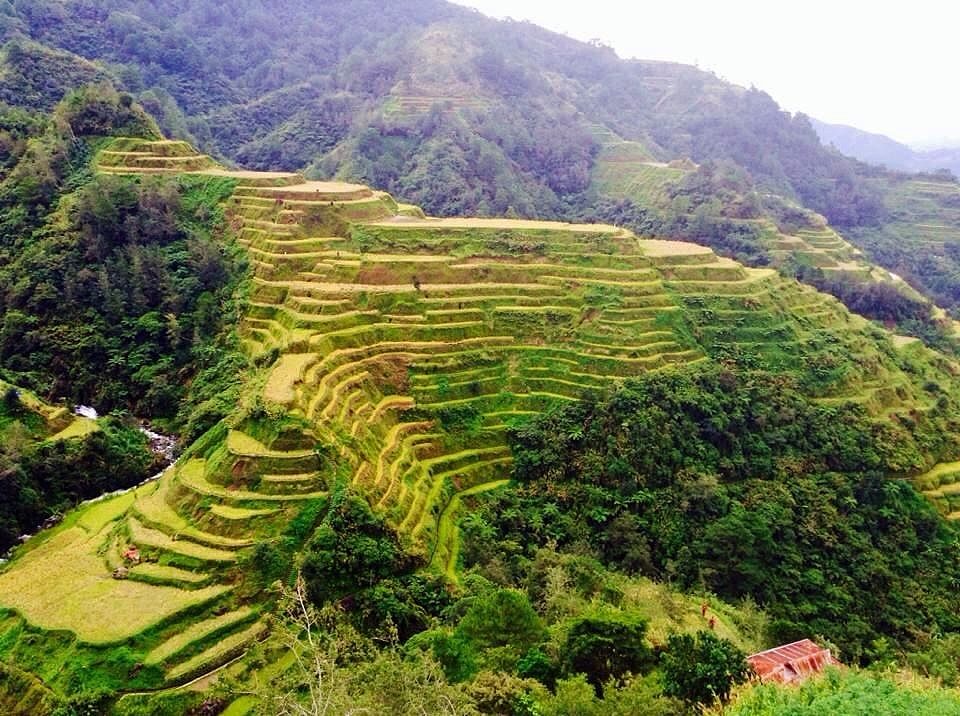
If you want to see what rice has done to the surface of the planet, look at the terraces. To hold standing water, a paddy has to be level — so to grow paddy rice on a mountain, whole mountainsides have been carved into level steps, each one a shallow flooded shelf, water fed from the top and cascading down from paddy to paddy. These aren’t gardens. They’re some of the largest hand-built structures on Earth, and people have farmed several of them continuously for more than a thousand years.
- The Banaue rice terraces in the Ifugao highlands of the Philippines climb higher and steeper than terraces anywhere else on Earth, hand-cut into the mountains and irrigated by channels routed from the forests above. The wider Ifugao terrace landscape has been on the UNESCO World Heritage list since 1995.
- The Honghe Hani terraces of Yunnan, China, are the work of the Hani people over roughly 1,300 years — some 16,600 hectares of terraces fed by an intricate system of channels carrying water down from the forested peaks, part of an integrated farm that runs buffalo, ducks, and fish through the same water that grows a local red rice. World Heritage since 2013.
- In Bali, the terraces run on the subak, a thousand-year-old cooperative water-management system tied to Hindu temples and a shared water calendar — the community, not just the engineering, is the heritage. UNESCO recognized the subak landscape in 2012.
I’ve been lucky enough to eat rice in a lot of the places where it’s grown this way, and I’ll say the thing every traveler says because it’s true: standing at the foot of a flooded terrace staircase at dawn reorganizes your sense of how much work a bowl of rice represents.
From field to bag: harvest, drying, milling
Once the field is drained and the grain is mature, the crop comes off.
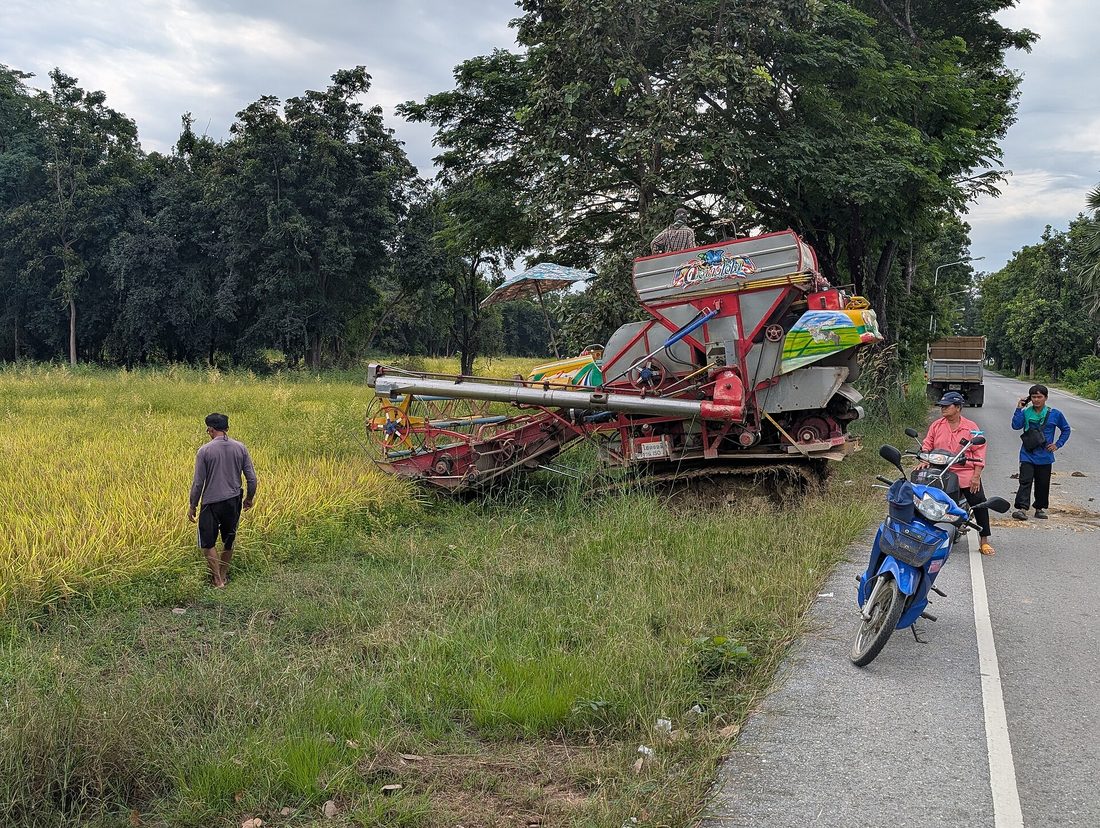
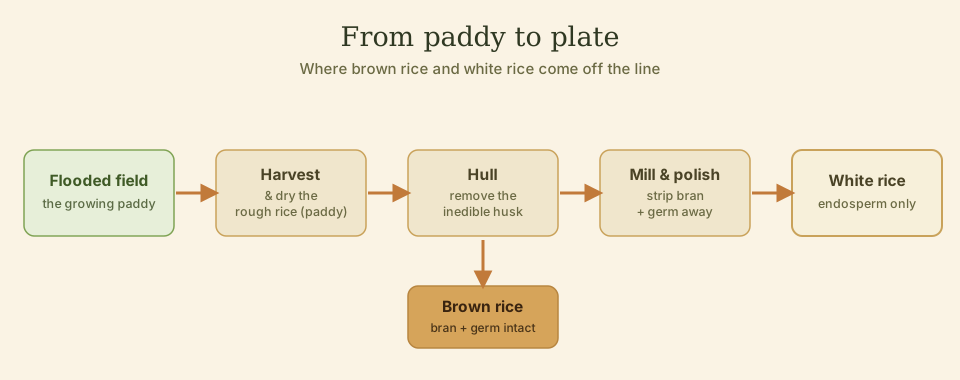
Harvest and threshing. At the small scale, rice is still cut by hand with a sickle, gathered into bundles, and threshed — beaten or trodden or run through a pedal thresher — to knock the grains loose from the straw. At the industrial scale, a combine harvester rolls through the dry field and cuts, threshes, and separates in one pass, spitting straw out the back and rough grain into a hopper. Either way, what you have at the end is paddy rice, also called rough rice: the whole grain still wearing its tough, inedible outer hull (husk).
Drying. Freshly harvested paddy is too wet to store — leave it damp and it molds or sprouts. So it’s dried down to around 13–14% moisture, traditionally by spreading it in the sun on mats or pavement (you’ll still see rice drying on roadsides across rice country), industrially in heated forced-air dryers. Dry it too fast or too hot and the grains crack, which shatters them in milling, so drying is its own careful craft.
Milling: paddy to brown to white. Now the transformation into what you actually cook. Milling is a sequence of removals:
- Husking strips off the hard outer hull. What’s left is brown rice — the whole grain, bran and germ intact. Every grain of white rice starts here.
- Milling and polishing then abrade away the bran layers and the germ, leaving the pale starchy endosperm. That’s white rice. Polishing buffs the milled grain smooth (and historically was sometimes coated with talc or glucose for shine — that’s the “wash before cooking” advice’s oldest ancestor).
The bran and germ that get stripped away are exactly where most of rice’s fiber, oil, B-vitamins, and minerals live — which is the whole nutritional argument between brown and white, and the reason white rice had to be enriched by law after it started causing deficiency diseases. That’s a big story with real history behind it, and I give it its own page: see Nutrition, Arsenic & Health. The grain’s anatomy — hull, bran, germ, endosperm, and where the starch that makes rice sticky or fluffy actually sits — gets the full treatment on the science page.
The uncomfortable part: rice and the environment
I’d be writing a brochure, not a deep dive, if I stopped at the pretty terraces. Flooded rice has a real, measurable environmental cost, and the corrections-are-the-product rule of this whole site means I have to lay it out straight.
Methane
That anaerobic paddy mud — so good at killing weeds — is a factory for methane. In waterlogged soil with no oxygen, a class of microbes called methanogens break down organic matter and belch out methane, a greenhouse gas far more potent than carbon dioxide over the short term. The plumbing that makes rice special makes it worse, too: the plant’s own aerenchyma channels act as chimneys, venting soil methane straight up through the stems into the air.
The numbers are not small. Flooded rice paddies are estimated to account for roughly 10–12% of global human-caused methane emissions — a genuinely large slice for a single crop. Rice feeds more than half the planet, so this isn’t a crop we’re going to stop growing; it’s a problem to be managed.
Alternate wetting and drying (AWD)
The most promising fix is almost embarrassingly simple: stop keeping the field flooded the whole time. Under alternate wetting and drying (AWD), the paddy is periodically drained and allowed to dry down — often until the water sits a few inches below the soil surface — before it’s re-flooded. Letting oxygen back into the soil starves the methanogens, and the methane drops sharply: field studies commonly report methane cuts on the order of 30–50%, with some meta-analyses reporting more, generally without hurting yield, while also using noticeably less water. It’s not free — it takes water control most smallholders don’t have, and you have to watch that you don’t just trade methane for a rise in nitrous oxide — but AWD is the leading lever, and it works because it directly attacks the anaerobic condition that makes the methane in the first place.
Water — and arsenic
Rice is thirsty. Continuous flooding makes it one of the most water-intensive staple crops on Earth, which is its own problem in a warming, drying world — another reason AWD and water-saving methods matter beyond climate.
And the same anaerobic, flooded chemistry that suppresses weeds and brews methane does one more thing: it mobilizes arsenic. Arsenic occurs naturally (and, in some places, from old pesticides) in soils, and in flooded, oxygen-starved paddy mud it changes to a chemical form that dissolves readily and that rice roots take up efficiently — far more than most other crops. That’s why rice, uniquely among the grains, carries a real inorganic-arsenic story, and why it deserves careful, non-alarmist handling rather than either panic or hand-waving. I give it a full, sourced treatment — including which rices are higher, the infant-cereal question, and the cooking methods that measurably reduce it — on Nutrition, Arsenic & Health. The point to plant here is just the mechanism: the flood is why the arsenic is in the grain.
SRI: a genuinely debated method
You’ll run into the System of Rice Intensification (SRI) if you read much about rice, and it deserves an honest paragraph rather than a cheerleading one.
SRI is a management package — not a variety, not a chemical — developed in Madagascar and promoted worldwide. Its core moves: transplant very young seedlings, one per hill instead of a clump, spaced widely apart; keep the soil moist but not continuously flooded; and build up organic matter and aggressively weed the aerated soil. The claim is that this produces dramatically higher yields with less seed and less water.
Here’s the honest part. Some of the yields reported from SRI plots have been so high that established rice scientists argued they exceeded the plausible biological maximum for the crop — which set off a genuine, sometimes bitter scientific fight (people really did call them the “rice wars”). Critics charged that the headline results were anecdotal, poorly documented, or not replicable under controlled trials. Defenders counter — with a growing body of peer-reviewed work — that SRI reliably delivers substantial gains in water productivity and often in yield, with lower emissions, even if the most extreme record claims don’t hold up. The fairest summary I can give: the miracle-yield claims are contested and probably overstated, but the underlying idea — that less water and better-aerated soil can grow rice well — is real, and it happens to point in the same direction as AWD. I’m not going to resolve a live agronomic argument in a food essay; I’m going to tell you it’s live.
The Green Revolution: the plant itself got rebuilt
You can’t tell the modern story of how rice is grown without the moment the plant was redesigned. For most of history, rice varieties were tall — and being tall was a liability. Feed a traditional tall rice plenty of fertilizer and it grew taller, got top-heavy with grain, and lodged: fell over in the field, where the crop rots or can’t be harvested. So there was a ceiling on how much you could push yields, because the extra grain literally toppled the plant.
The fix came out of the International Rice Research Institute (IRRI) in the Philippines, which in 1966 released IR8 — the first of the semi-dwarf “miracle rices.” By breeding in a dwarfing gene (from a Taiwanese variety), IR8 was short and stiff-stalked: it could carry a heavy head of grain and take heavy fertilizer without falling over. Under good conditions it yielded two to three times what the old landraces did, and across much of Asia average rice yields more than doubled over the following decade or so. IR8 is the plant that jump-started the Green Revolution in rice, and it’s a real reason famine forecasts for Asia in the 1960s and ’70s didn’t come true.
Like everything in this dive, it’s a story with an honest asterisk. The high-yield varieties were bred to reward heavy inputs — lots of water, fertilizer, and irrigation — which is exactly the intensive, flooded, input-hungry style of farming whose methane and water costs I’ve been describing. The Green Revolution fed a lot of people; it also locked a lot of the world into the most resource-heavy way of growing rice. AWD and SRI, further down, are in part attempts to walk some of that back without giving up the yield.
How American rice is grown
Since my rice pantry is mostly Southern long-grain, a word on how it’s actually farmed here — because it’s about as far from a hand-transplanted Ifugao terrace as farming gets.
US rice comes from a handful of states: Arkansas (far and away the biggest), California (the Sacramento Valley, where the medium-grain and short-grain sushi-style rice mostly comes from), Louisiana, Mississippi, Missouri, and Texas. The methods are heavily mechanized and precision-driven:
- Fields are laser-leveled — a laser-guided grader shaves the ground dead flat (or to a precise gentle grade) so that a shallow flood sits evenly and drains cleanly, which saves enormous amounts of water and makes the whole flood-and-drain cycle controllable.
- Seed is often sown from the air: crop-dusting planes broadcast pre-soaked seed straight onto flooded fields — the American answer to hand transplanting.
- The crop is flooded, managed, drained, and taken off with big combines, then dried and milled at industrial scale.
California’s rice in particular tends to run lower in arsenic than a lot of Southern rice, a geography quirk that matters for the nutrition page — some of the old cotton land of the mid-South carries a legacy of arsenical pesticides, while California’s rice ground doesn’t. Different dirt, different grain.
There’s a deeper and darker American rice history too — the tidal rice plantations of the Carolina and Georgia Lowcountry, and the “Carolina Gold” wealth that was built directly on the agricultural knowledge and forced labor of enslaved West Africans who came from rice-growing regions and knew tidal rice culture better than their enslavers ever did. That belongs to the history page, told properly, but it’s worth knowing that when you cook a pot of Southern rice you’re standing at the end of that long line.
Why this all matters at the stove
Everything on this page eventually shows up in your pot. The variety a farmer chose, whether the grain was milled to white or left brown, how it was dried — all of it changes how the rice behaves when you cook it. A fluffy long-grain and a sticky short-grain aren’t cooked differently by accident; they were bred and processed differently, all the way back in the field. When you’re ready to turn the grain into dinner, head to How to Cook Rice — and if you want to know why one grain fluffs and another clumps, that’s the starch chemistry on the science page.
The tree gives you sweet water and a deadline, an old maple-syrup line of mine goes; rice gives you a flooded field and a bargain. Now you know what’s in the bargain.
Comments (0)