Why Wild Rice Isn't Rice
Here’s the fact that started this whole deep dive for me, and it’s the kind of thing that sounds like a bar bet until you actually check it: wild rice isn’t rice. Not “a wild ancestor of rice,” not “a rare heirloom rice.” It’s not in the rice genus at all. The long, dark, needle-shaped grains in that fancy blend on your shelf come from a completely different plant — a tall aquatic grass named Zizania — that split off from real rice tens of millions of years before anybody was cooking either one. It got the name “rice” from Europeans who didn’t know what they were looking at, and the name stuck so hard that we’ve been calling a distant cousin by the family name ever since.
I own a Wild Rice Zojirushi recipe, I’ve been cooking the stuff for years, and I still had the botany wrong until I sat down with it. So this page is the correction, and it turns out the correction opens up a much better story than the label — one that runs through a parasitic fungus that makes a Chinese vegetable, an endangered grass that lives in exactly one Texas river, and a grain that is sacred, treaty-protected, and at the center of a live fight over who gets to grow it and call it “wild.”
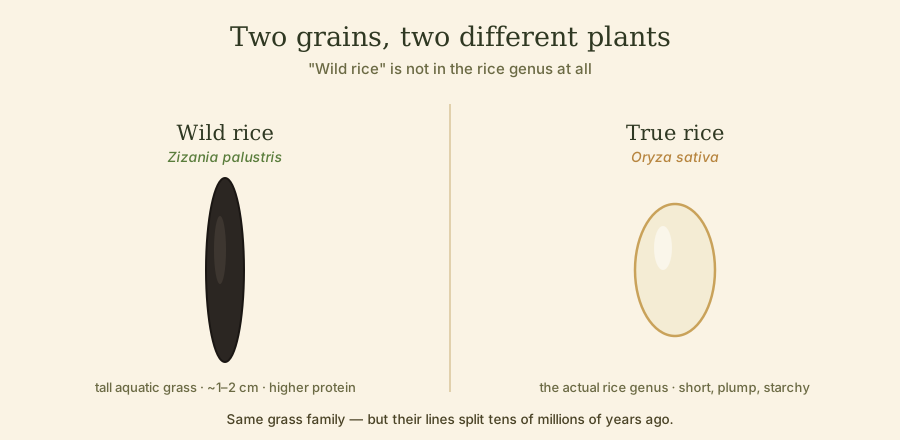
Different genus, an ocean of evolutionary time apart
Both wild rice and true rice belong to the grass family, Poaceae — but so do wheat, corn, sugarcane, and the lawn. Sharing a family is not saying much. The important line is the genus, and here they part ways completely:
- True rice is genus Oryza — Oryza sativa (Asian rice) and Oryza glaberrima (African rice), the grains I wrote about in the history of rice.
- Wild rice is genus Zizania — a separate lineage that, by the genetic clocks, diverged from Oryza something like 26 to 30 million years ago.
To put that in perspective: humans and orangutans split off from each other far more recently than that. Calling wild rice “rice” is roughly like walking into a zoo, pointing at the orangutan, and calling it a person because it has hands. Same broad family, radically different animal.
Zizania is a big, brash grass. Where a rice plant is knee-to-waist high, wild rice can shoot up eight or nine feet out of the water, waving over the surface of a shallow lake or a slow river. The grain is long, slender, nearly black or dark brown, and — this matters when you cook it — it has a tough outer bran layer that’s never polished off, because there’s no industry built to polish it the way there is for white rice. What you buy is essentially the whole grain.
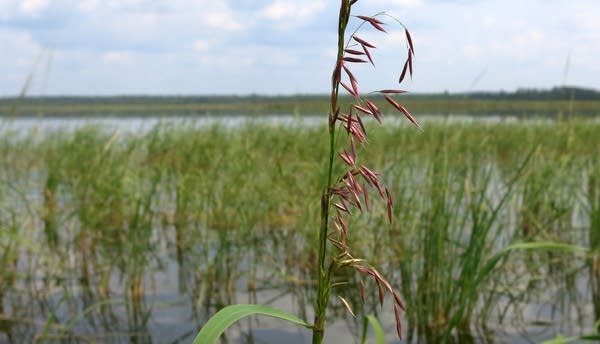
The northern kind lives on a knife-edge schedule that’s half the reason it never got fully tamed. It’s an annual: every plant grows from seed, shoots up through the water column in a single season, flowers, drops its grain, and dies, and the whole bed depends on enough seed reaching the muck to come up again next year. Those seeds are fussy — they need a cold, wet, months-long dormancy under the water before they’ll sprout, which is great for a northern lake and terrible for anyone trying to store and plant it like wheat. And the plant shatters aggressively — the ripe grain falls the moment it’s ready and it doesn’t all ripen at once, so a wild stand is never uniformly harvestable. Those exact traits, the ones that make wild rice such a pain to farm, are what kept it genuinely wild long after every other grain on the shelf had been bred into obedience. Domesticating it into a crop that holds its seed took real, recent, and (as we’ll see) controversial work.
Meet the family: four species of Zizania
There aren’t many species of wild rice, and it’s worth knowing them because the differences are real and a couple of them are surprising.
Northern wild rice — Zizania palustris. This is the big one, the one you eat. An annual grass of the northern Great Lakes region and central Canada, it’s the species with the good grain, and it’s the one at the heart of the Ojibwe harvest I’ll get to below. When a package says “wild rice,” this — or a cultivated version of it — is almost always what’s inside.
Wild rice — Zizania aquatica. Also a North American annual, but with a smaller, less substantial grain; it grows more in the East and along the Atlantic and Gulf coasts. Edible, historically gathered, but not the commercial prize palustris is.
Texas wild rice — Zizania texana. This one’s a heartbreaker. It’s a perennial that grows in exactly one place on Earth — a short stretch of the spring-fed, constant-temperature San Marcos River in central Texas — and it is critically endangered, one of the first plants ever placed on the U.S. endangered species list. It once ran for miles; pumping from the aquifer that feeds those springs, damming, pollution, and grazing knocked it down to a few surviving clumps, and it now hangs on only through active protection and replanting. It’s not a food crop and never was much of one; it’s a reminder that a “wild rice” can also be a single fragile population clinging to one river, a conservation emergency with a lovely name.
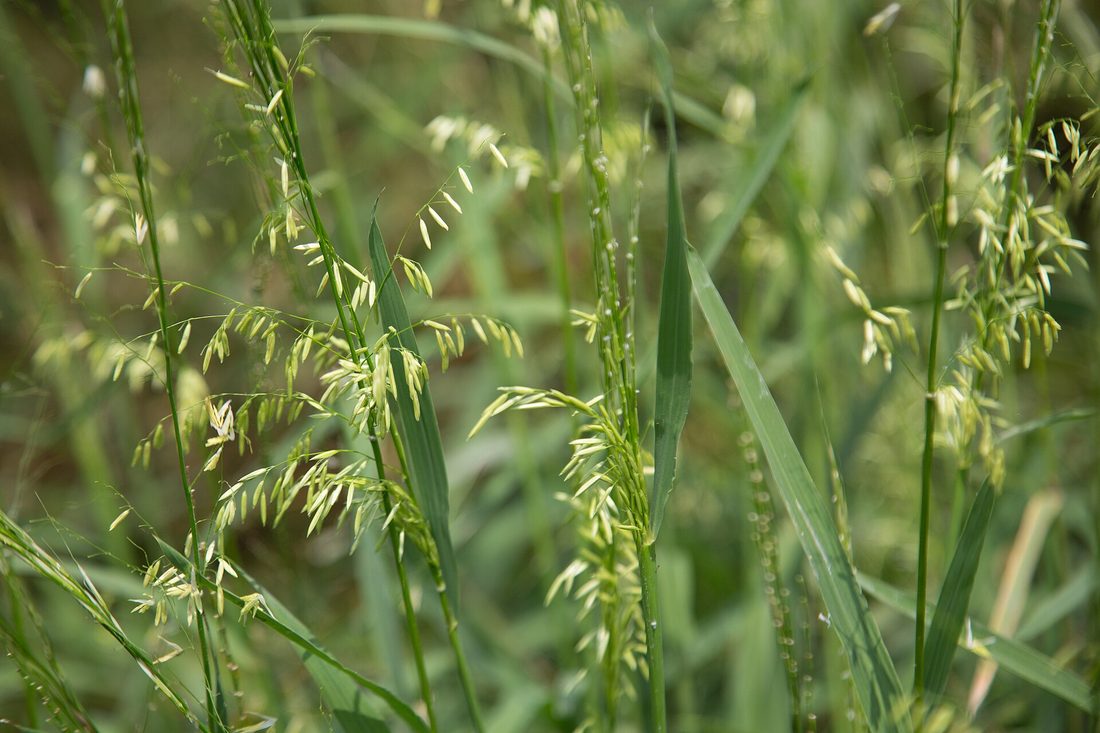
Manchurian wild rice — Zizania latifolia. The lone Eurasian species, a perennial of China and East Asia — and the setup for the strangest, truest thing on this page.
The wild rice that became a vegetable (thanks to a fungus)
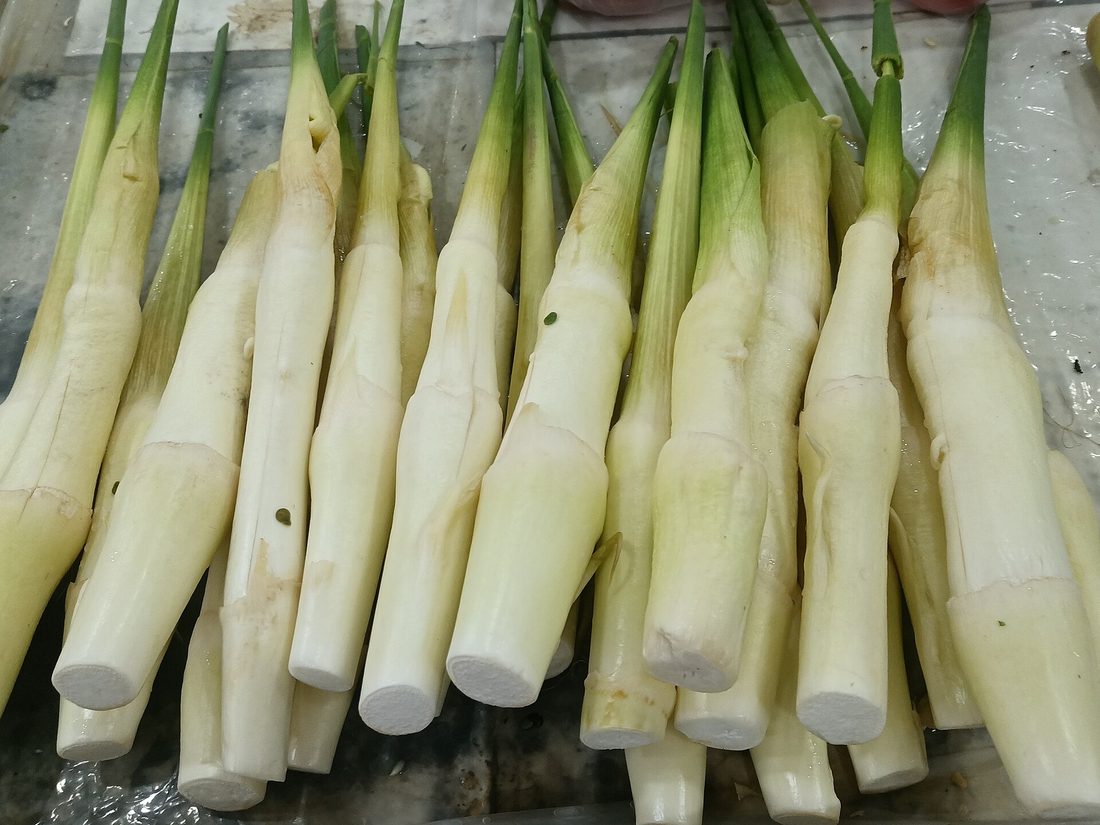
Manchurian wild rice, Zizania latifolia, was historically grown in China for its grain too. But somewhere along the line, Chinese farmers noticed something: when the plant got infected by a particular smut fungus, Ustilago esculenta, it stopped setting seed and instead the base of its stem swelled up into a fat, pale, crisp shoot. That swollen, fungus-galled stem is a prized vegetable — 茭白 (jiāobái), sometimes called water bamboo or coral shoot — mild, tender, faintly sweet, and stir-fried all over southern China and in parts of Japan and Southeast Asia.
Let me make sure that lands, because it’s genuinely one of my favorite food facts. The vegetable is the disease. The fungus infects the plant, hijacks it, prevents it from flowering, and makes its stem balloon — and that hijacked, sterile, swollen stem is the whole point. Farmers propagate the infected plants deliberately, cloning them by division so the fungus rides along, because an uninfected plant just makes grain and a “clean” one that flowers is useless for this purpose. People have been growing jiaobai this way for roughly two thousand years. A wild-rice relative, turned into a green vegetable by a parasite, on purpose, since antiquity. You could not make it up, and I’ve verified it because it sounds too good to be true.
So why is it called “rice” at all?
Because the Europeans who named it had grain on the brain and a habit of naming new plants after old ones.
When French explorers pushed into the Great Lakes and saw fields of this tall grass shedding grain over the water, they saw a resemblance to oats and called it “folle avoine” — literally “crazy oats” or “wild oats.” (The genus name Zizania, which Linnaeus assigned, comes from a Greek word, zizanion, for a weed that infests grainfields — so even the scientific name is basically calling it a nuisance grass.) English-speaking settlers, seeing a grain that grew in water and got cooked and eaten like a cereal, reached for the nearest familiar word and called it “wild rice” or “Indian rice.” That name — wrong genus, wrong plant, right general idea of “small edible aquatic grain” — is the one that won.
None of the namers were botanists sorting out lineages. They were travelers slapping a familiar label on an unfamiliar plant, and the label calcified into the grocery-store name we all use now. This happens constantly with food — it’s the same reason a “Jerusalem artichoke” is neither from Jerusalem nor an artichoke.
How it’s actually different from rice, on the plate
Being a different plant, wild rice doesn’t behave like rice, and you shouldn’t expect it to.
It’s built differently. Those long dark grains keep their tough bran, so wild rice is a whole grain in a way most white rice isn’t — it takes far longer to cook and has real chew.
The nutrition runs higher. Compared with white rice, wild rice carries notably more protein — on the order of 6 to 7 grams in a cooked cup, versus a couple of grams for white rice — plus more fiber and a better load of minerals like zinc and phosphorus. And, since people ask: no, it has no gluten — but then neither does true rice; none of these grains do. (The “glutinous” in glutinous rice is about stickiness, not gluten, a mix-up I untangle over on the science page.)
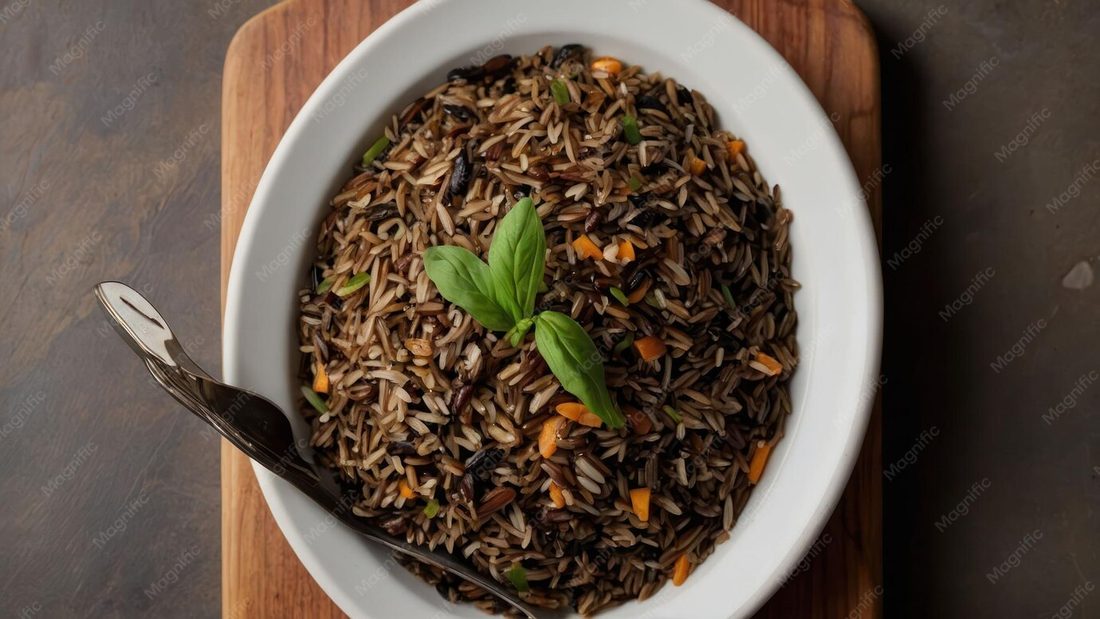
It cooks by blooming. This is the fun part in the pot. You simmer wild rice a long time — often 40 to 55 minutes, sometimes more — in plenty of water, and toward the end the grains split and curl open, butterflying so the paler inside peeks out of the dark husk. That “bloom” is how you know it’s done; a grain that’s still a tight black needle isn’t ready, and one that’s blown completely apart and gone mushy has gone too far. It drinks up a lot of water — figure roughly three to four parts liquid to one of grain — and the payoff is a nutty, almost smoky, tea-like flavor and a firm, popping texture nothing else on the shelf gives you.
And the flavor really is its own thing, worth seeking the difference. Good hand-finished wild rice tastes toasted and nutty with a genuinely smoky edge — that smoke isn’t your imagination, it’s the parching over fire that the traditional finishing puts into the grain — plus something green and almost tea-like underneath. The texture is the other half of the pleasure: a firm outer husk that gives a little pop when you bite through to the softer, blooming interior. It stands up to strong company, which is why it turns up alongside game, mushrooms, dried fruit, and toasted nuts in cold-weather cooking, and why it makes such a good cold grain salad — it holds its shape and chew days after you cook it, where soft white rice would go to paste. Treat it more like a hearty whole grain (barley, farro) than like a bowl of steamed jasmine, and it’ll tell you what it wants to be next to.
Because it’s assertive and because true wild rice is expensive, it’s very often sold and cooked as a blend with brown and white rice — which is a perfectly good idea, as long as you know that’s what’s happening. The two grains cook at wildly different rates, so a good blend either par-cooks the wild rice first or is engineered so the timing roughly meets. That’s exactly the game my Wild Rice Zojirushi is playing — letting the rice cooker manage a long, hands-off simmer so the wild grains have time to open up.
Manoomin: the good berry, the food that grows on water
Now the part that deserves the most care, because for the Ojibwe / Anishinaabe people of the western Great Lakes, this grass is not a novelty grain or a side dish. It is manoomin — often translated as “the good berry” or “the good seed” — and it sits at the spiritual and cultural center of who they are. I’m an outsider to this, so I’ve tried to relay it accurately and without dressing it up, and I’ve kept to what the Anishinaabe themselves and careful sources say.
Manoomin is woven into the Anishinaabe origin and migration story. According to the teaching of the Seven Fires, the ancestors were told to leave their homeland on the eastern seaboard and travel west until they reached “the place where the food grows on the water.” That food was manoomin, and finding it — the wild rice beds of the upper Great Lakes, in what’s now Minnesota, Wisconsin, and neighboring waters — is how they knew they had arrived home. So the plant isn’t just food; it’s the confirmation of a prophecy and the marker of a homeland. That’s a different order of relationship than I have with anything in my pantry, and it’s worth sitting with rather than skimming past.
The harvest, done by hand from a canoe
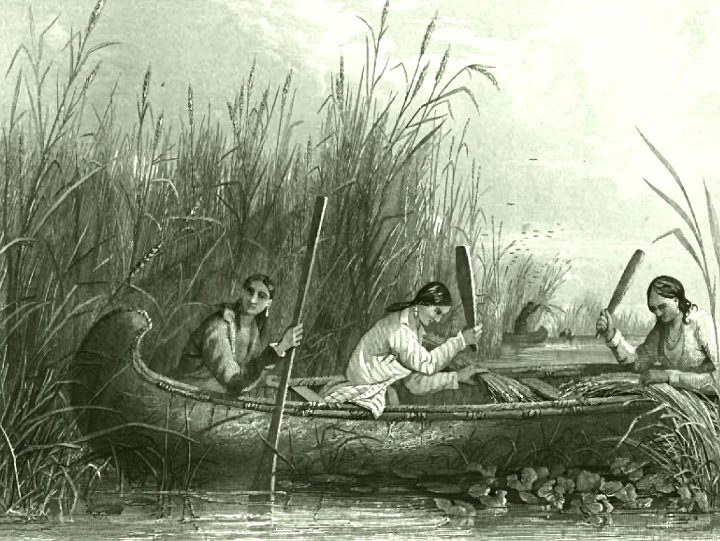
Traditional manoomin harvesting — manoominike — is still practiced, and it’s deliberately gentle. In late summer, when the grain ripens (unevenly, over a couple of weeks), two people work a canoe through the rice bed: one poles the boat slowly through the standing stalks, and the other uses a pair of smooth wooden “knocking sticks” (in Ojibwe, sometimes given as bawa’iganaakoog) to bend the seed heads over the gunwale and gently tap the ripe grains loose so they fall into the bottom of the canoe.
The genius of the method is that it’s inherently sustainable. Because the grain ripens unevenly and you only knock loose what’s ready, a lot of seed misses the canoe and falls back into the water — reseeding the bed for next year. You physically cannot strip the whole crop this way, which is the point. It’s harvesting designed to guarantee there’s a harvest again.
After the knocking comes the finishing, all traditionally done by hand: the green rice is dried or cured, then parched over a fire to loosen the hull and develop flavor, then threshed — historically by treading on it in a pit with clean moccasins, “dancing the rice” — and finally winnowed in birch-bark trays so the wind carries off the chaff. Every step is skilled work, and every step is the reason real hand-finished manoomin tastes and costs the way it does.
Treaties, and why this is a legal matter too
This isn’t only cultural — it’s law. When the Ojibwe ceded huge territories to the United States in 19th-century treaties (the Treaty of Mendota among them), they explicitly reserved the right to continue hunting, fishing, and gathering wild rice on the ceded lands. Those are what lawyers call usufructuary rights — the right to use and harvest, retained even where the land itself changed hands — and they’ve been upheld and fought over in court ever since. So when an Anishinaabe family goes out to rice a lake, they’re exercising a treaty right that predates the state around it. Manoomin has also driven some genuinely groundbreaking law: in 2018 the White Earth Band of Ojibwe passed a law recognizing the legal “rights of manoomin” itself — the right of the wild rice to exist, flourish, and regenerate — one of the first laws anywhere to grant legal rights to a plant. Whatever you think of the legal theory, it tells you exactly how central this grass is.
”Wild” on the bag usually isn’t wild
Here’s the correction that trips up almost everyone, me included. Most of the “wild rice” sold in America is not harvested from wild lakes at all — it’s farmed. It’s cultivated (paddy) wild rice: Zizania palustris bred for grain that stays on the plant, grown in flooded, diked paddies in California and Minnesota, and harvested by machine with combines, just like any other grain crop. California alone grows the large majority of the domesticated crop. It’s a real food and often a fine one — but it is a farmed commodity, not something knocked out of a canoe.
The distinction between paddy-grown cultivated wild rice and true hand-harvested lake (or “natural”) wild rice is genuine, and it’s contentious, for reasons that are equal parts economics and culture:
- Price and displacement. Cultivated paddy rice can be grown and machine-harvested cheaply and in volume, which drove the price down and undercut the hand-harvested lake rice that Anishinaabe ricers depend on. A traditional harvest can’t compete on price with a California combine.
- Labeling. Minnesota law actually requires wild rice to be labeled “cultivated” or “paddy” when it is, and to state its origin — a real attempt to keep the two honest. But that law doesn’t reach California-grown rice, so a large share of the nation’s farmed crop can still be sold simply as “wild rice” with nothing to flag that it never saw a wild lake. Read the fine print; “wild” is doing a lot of unearned work on many bags.
- The genome fight. When the University of Minnesota undertook genetic research on wild rice — mapping its genome, with the prospect of genetically modified or further-domesticated varieties down the line — many Anishinaabe people saw a real threat: the risk of genetic contamination of the sacred wild stands, and the sense of an outside institution laying claim to a being that isn’t theirs to claim. The friction was serious enough that it led, after conflict and lawsuits, to a consortium between the university and Anishinaabe representatives to work through research ethics and cultural sensitivity around wild rice. Organizations like the White Earth Land Recovery Project, co-founded by Winona LaDuke, have been central to protecting traditional manoomin and marketing genuine hand-harvested rice (under labels like Native Harvest) so ricers can actually make a living.
I’m laying all that out because “it’s just a labeling technicality” badly undersells it. For the people whose homeland was literally defined by this plant, the difference between manoomin knocked from a canoe and a machine-combined paddy grain sold as “wild” is the difference between a living relationship and a commodity wearing its name.
What to do with all this at the stove
So, practically:
Read the label. If you want the real thing — grain with the deep, smoky, tea-like flavor and the cultural weight behind it — look for hand-harvested, lake or river (“natural”) wild rice, often from Minnesota or Canada, sold by Native cooperatives or reputable sellers who say plainly where it came from. It costs more, and now you know why. Cultivated paddy rice is cheaper, milder, more uniform, cooks a touch faster, and is genuinely fine for everyday cooking — just buy it knowing what it is.
Cook it long, and watch for the bloom. Simmer in plenty of salted water (or stock) for the better part of an hour until the grains curl open; drain any excess like pasta. It reheats well and holds its texture, which makes it great in cold grain salads, folded into a pilaf, or stretched in a blend with brown or white rice so a little of the expensive grain goes a long way.
Respect where it sits. True manoomin is somebody’s sacred food and treaty right, not just an artisanal grain. Buying the real thing directly from Native harvesters and cooperatives is one small, concrete way to keep that living relationship intact rather than quietly eroding it into one more commodity — and it tends to get you the best-tasting grain in the bargain, since the hand-finished stuff really is a cut above the machine-combined paddy rice.
That’s wild rice: not rice, older than rice as a lineage, tangled up with a parasitic fungus on one continent and a migration prophecy on another, and mislabeled on half the shelves that sell it. If you want to see where it would sit if it actually were rice — and how the true grains sort into long, medium, short, sticky, and everything between — head over to the types of rice. And the whole nine-thousand-year backstory of the grain it only pretends to be is in the history of rice.
Comments (0)