The History of Rice
I cook a lot of rice. It’s the floor under my gumbo, the body of my jambalaya, the thing my Zojirushi quietly turns out while I’m doing everything else. So it took me an embarrassingly long time to stop and think about the fact that the grain in that pot has one of the longest, most contested, and in places most painful histories of anything I put on the table. Rice feeds about half the people alive right now. It was also, for a couple of centuries on the American coast, one of the crops that slavery was built to grow — and the expertise that made it grow came from the people being enslaved. You can’t tell the story of rice honestly and keep it comfortable.
So this is the long version, and I’ve tried hard to get it right where the internet usually gets it wrong. Where something is genuinely unsettled among the scientists, I say so instead of picking the tidy answer.
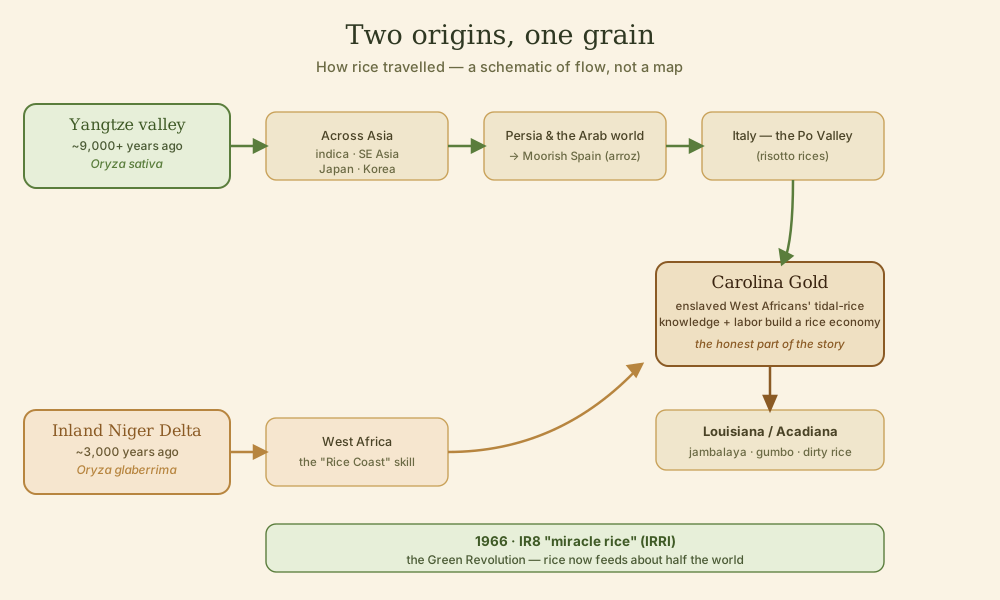
Two rices, domesticated twice, on two continents
The first thing to unlearn is that rice is one thing with one origin story. There are two separately domesticated species of rice, on two different continents, thousands of years and thousands of miles apart, and neither one gave rise to the other.
The one that feeds most of the planet is Asian rice, Oryza sativa. The other, still grown and eaten in West Africa and central to this whole story, is African rice, Oryza glaberrima. They are cousins, both in the grass family, but they were tamed by different people in different places who had never heard of each other. That fact alone reframes almost everything that follows.
Asian rice: the Yangtze, roughly nine thousand years ago and change
The homeland of Oryza sativa is the Yangtze River valley of southern China, and the timeline is genuinely deep. At Shangshan, in the lower Yangtze, archaeologists have found evidence of people gathering and exploiting rice between about 11,000 and 9,000 years ago — phytoliths (tiny silica skeletons that plants leave behind) that show rice was already being managed, if not yet fully domesticated. A little later, sites like Huxi preserve rice spikelet bases dated to roughly 9,000 to 8,400 years ago that capture domestication mid-act, and they already carry the marks of the japonica lineage — the short-grained, stickier subspecies. Downriver and later, the famous waterlogged site of Hemudu (around 7,000 years ago) turned up huge quantities of rice husks, and Diaotonghuan cave in the middle Yangtze region gives one of the longer sequences of wild-to-cultivated change.
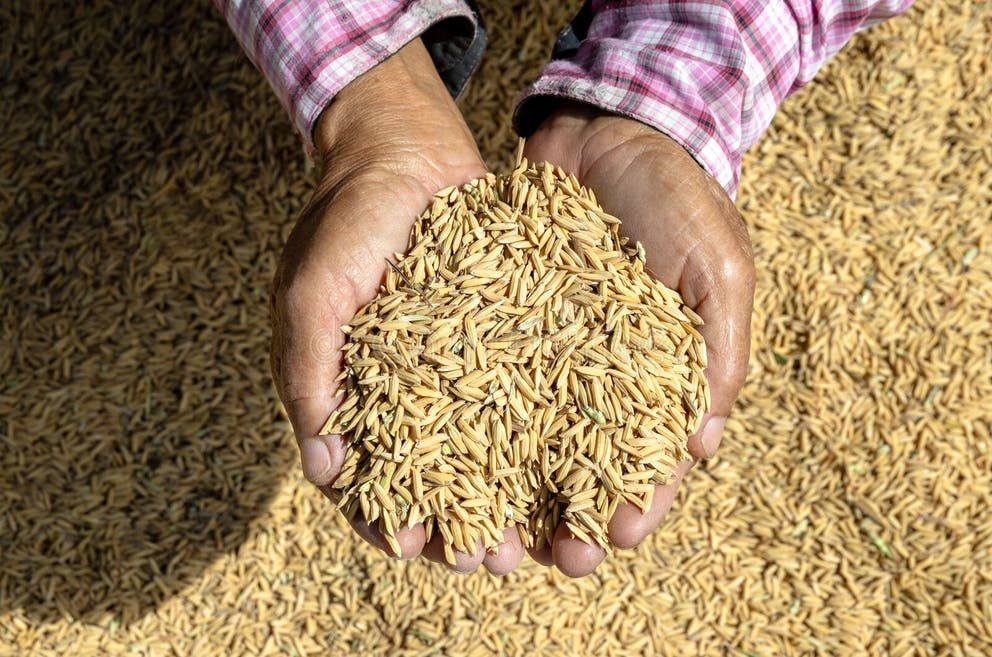
Here’s the part worth slowing down for, because it corrects the cartoon version. Domestication was not a moment; it was a slow drift measured in millennia. The single most important change is that wild rice shatters — the ripe grains fall off the stalk on their own, which is great for the plant and maddening for a harvester, because by the time you get there the seed is on the ground. Domesticated rice holds onto its grain (non-shattering), so you can actually cut it and carry it home. Studies of the archaeological grains show that the shift from mostly-shattering to mostly-non-shattering rice took thousands of years, and fully domesticated rice with a rice-based economy wasn’t really locked in until maybe 6,500 to 6,000 years ago. People were cultivating and eating rice for a very long time before it was truly a domesticated crop. It’s a process, not a eureka.
The indica question, and an honest “it’s still argued about”
If japonica came out of the Yangtze, where did indica — the long, non-sticky rice that dominates India and much of South and Southeast Asia — come from? This is where I have to be careful, because it’s an area where good scientists have publicly disagreed for years and the answer has been shifting.
The old poles of the debate were single origin (japonica and indica both domesticated once, from the wild Oryza rufipogon) versus multiple origins (they were tamed separately, in different places). What the genetics now point to is a middle answer that satisfies neither camp cleanly, and it’s genuinely elegant: the key domestication genes — the ones controlling non-shattering (sh4) and upright growth (prog1) — are nearly identical in indica and japonica, which is hard to explain if they were domesticated fully independently. The current leading model (sometimes called the “rice paradox”) is that these crucial domestication mutations arose first in japonica in China and then flowed into the wild ancestors of indica and a third group, aus (important in Bengal), through hybridization as rice farming spread west and south. So: multiple wild starting populations, but the actual “domestication toolkit” spread from one of them into the others by interbreeding. That’s the direction the field has moved, but I’d call it the best current reading, not a closed case — the data can be read more than one way, and people are still publishing arguments.
The practical upshot for a cook is simpler and not contested at all: by a few thousand years ago there were already the two great families of Asian rice you still buy today — the shorter, stickier japonica and the longer, fluffier indica — and the difference between them comes down to starch chemistry (mostly how much amylose they carry), which I get into properly on the science page.
African rice: a second domestication, entirely its own
Now the other rice, because this one usually gets erased.
African rice, Oryza glaberrima, was domesticated independently in West Africa — a completely separate event from anything in Asia. The botanist Roland Portères proposed back in 1962 that its cradle was the Inland Niger Delta, the vast seasonal floodplain of the upper Niger River in what is now Mali, and modern genome sequencing has largely confirmed him. Genetic work on hundreds of wild and cultivated African rice samples points to domestication around 3,000 years ago in that inner delta, with the crop then spreading to secondary centers along the Senegambian coast and into the Guinea highlands. The hard archaeology lines up: rice grain impressions in pottery from northeast Nigeria date back roughly 3,000 years, and actual O. glaberrima remains show up at the ancient city of Jenne-jeno in Mali about 2,000 years ago.
This is not a footnote. West Africans domesticated their own rice from their own wild grass (Oryza barthii) and built sophisticated cultivation systems around it — tidal floodplain rice along the rivers and mangrove rice on the salty coast, each requiring embankments, canals, and clever water control. Hold onto that, because it becomes the hinge of the American part of the story. O. glaberrima is a bit hardier and more pest- and stress-tolerant than Asian rice but generally lower-yielding, which is why Asian O. sativa eventually displaced it across much of West Africa for bulk production — but the knowledge system that grew up around the African rice is what mattered most when it crossed the Atlantic in chains.
Rice moves out across Asia and toward Europe
Back to Asian rice, spreading in every direction from China.
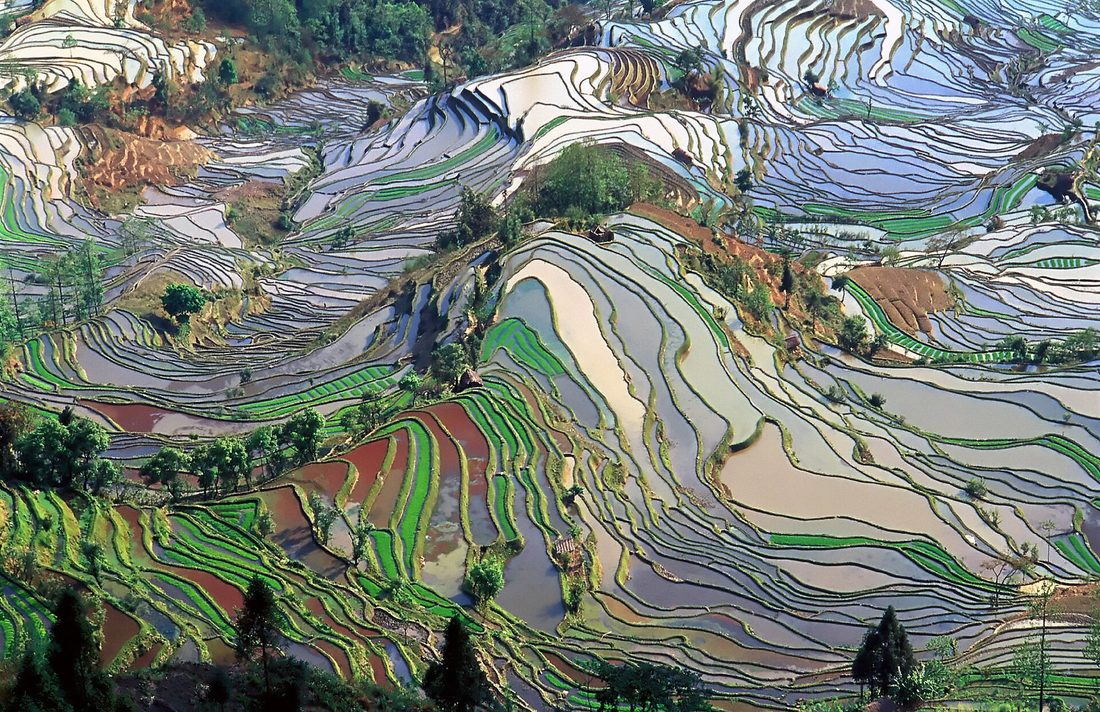
Into India, rice arrives and meets that local *aus/*indica lineage; the subcontinent becomes one of the great rice civilizations, and eventually the birthplace of dishes like layered, spiced biryani — if you want to taste that lineage, my Chicken Biryani (Dum Style) is where I go. Across Southeast Asia, rice becomes the literal center of the plate and the calendar; sticky (glutinous) rice cultures take hold in Laos and northern Thailand, where a meal is built around a woven basket of hand-rolled sticky rice, and rice paddies reshape whole landscapes into the terraced hillsides that are now postcard shorthand for the region. In much of Asia the word for “rice” and the word for “a meal” or “food” blur together — in plenty of languages, to ask “have you eaten?” is literally to ask “have you eaten rice?” That’s how deep this goes: not a staple among staples, but the definition of a meal. And the plant threw off a whole galaxy of local cooking — the coconut-scented rices of the tropics (my Restaurant Style Coconut Rice (Coconut Milk) is a nod at that whole family), the fried-rice traditions that turn yesterday’s cooked grain into today’s dinner, the rice noodles, the rice paper, the rice wine and vinegar. Into Korea and Japan, japonica rice travels (reaching Japan solidly during the Yayoi period, a few centuries BCE) and becomes so central it’s woven into religion, taxation, and eventually the entire aesthetic of a cuisine — sushi rice, onigiri, the works.
Japan is worth pausing on, because rice there stopped being merely food and became the actual operating system of the country. For centuries the economy was denominated in rice: the unit was the koku, roughly the amount of rice it takes to feed one person for a year, and a feudal lord’s wealth and rank were measured in the kokudaka — the rice yield — of his domain. Samurai were paid in rice. Taxes were paid in rice. When you read that a lord was worth “a hundred thousand koku,” that’s rice being used as currency, census, and social hierarchy all at once. And underneath the economics runs the spiritual layer: in Shinto, rice and rice wine (sake) are among the core offerings to the gods and ancestors, symbols of purity and prosperity, and the rice harvest carried its own calendar of ritual. It’s hard to overstate — the plant I toss in a rice cooker was, for much of Japanese history, the closest thing the society had to money and to the sacred at the same time.
Rice pushes west too, into Persia and Mesopotamia, where it becomes the backbone of the great rice traditions of the Middle East — the pilafs and the crackling toasted crusts. Alexander’s people reportedly ran into rice in the East and carried word of it back; the Greeks and Romans knew rice mostly as an exotic import and a medicine, not a staple crop of their own.
How rice actually reached Europe: through the Muslim world
This is a place where the popular telling is vague, so let me be specific. Rice didn’t seep into Europe from ancient Rome. It came in with the medieval Muslim agricultural expansion. When the Moors ruled Al-Andalus — Islamic Spain, from the 8th century on — they brought rice cultivation to the Iberian Peninsula, especially the wetlands around Valencia, and they rebuilt and extended the irrigation the Romans had left behind to make it work. The linguistic fingerprint is right there on the bag: Spanish arroz, Portuguese arroz, and Italian riso all descend, by way of Arabic ar-ruzz, from older roots — the Arabic article is literally still stuck to the front of the Spanish word. That’s not a coincidence; it’s a receipt. Spain’s rice country around Valencia is exactly where paella was later born.
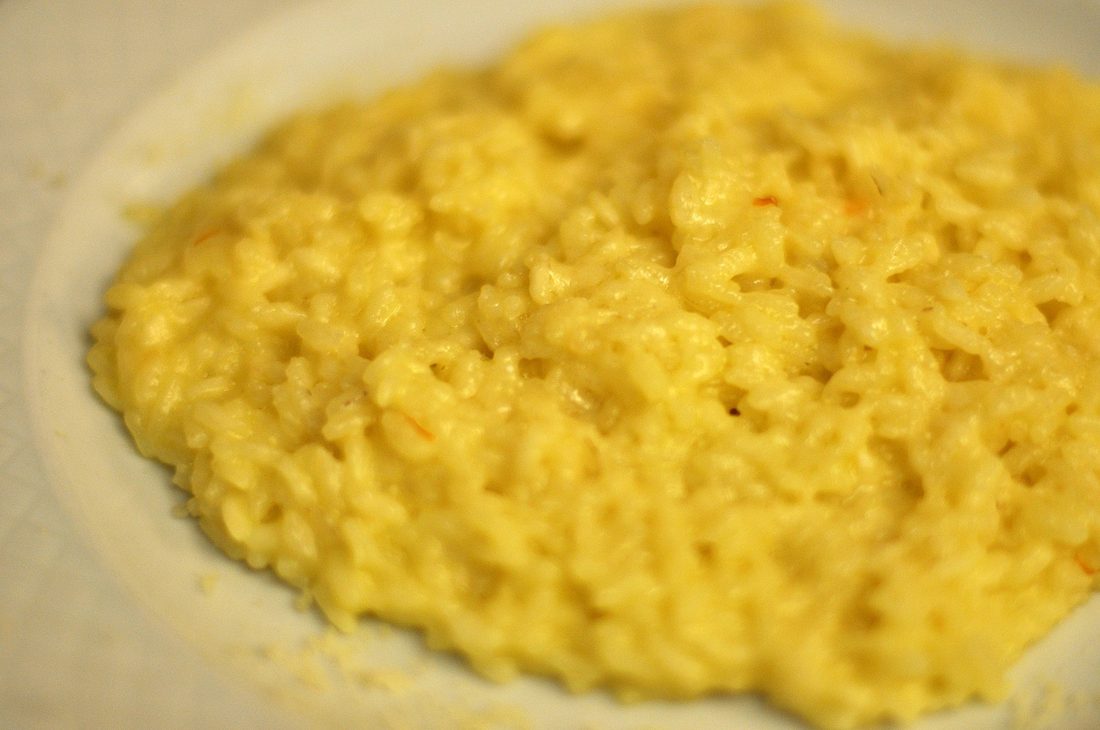
Rice took hold in Italy too, especially the well-watered Po Valley in the north, which by the late Middle Ages and Renaissance became the great European rice belt — and the reason risotto is a northern Italian dish and not a Roman one. If you want the northern-Italian expression of rice, that’s the whole point of a proper Risotto alla Milanese (Saffron Risotto) or a Mushroom Risotto — short, high-starch grains cooked to a creamy bind, a completely different philosophy from the fluffy long-grain I grew up on.
Rice crosses the Atlantic — and here the story turns
Rice came to the Americas with European colonization, but it did not succeed because Europeans knew how to grow it. They didn’t. This is the correction that the whole American rice economy has spent centuries papering over, and I’m going to state it as plainly as the scholarship does.
Carolina Gold and the knowledge that was enslaved
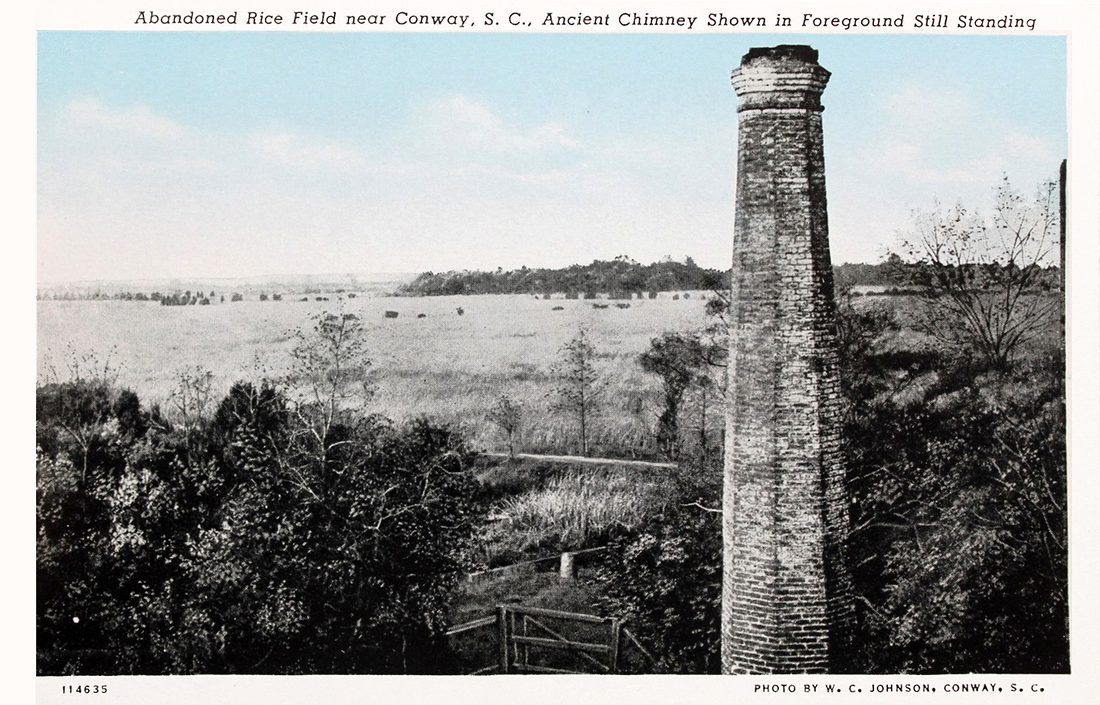
By the late 1600s, English colonists in the South Carolina Lowcountry were trying to make money and failing at most of what they tried. Rice changed that — and the rice they grew, eventually refined into the famous long-grained Carolina Gold, made the Lowcountry planters some of the wealthiest men in the colonies. But the planters were not the ones who knew how to grow rice in tidal swamps. The people they enslaved were.
The geographer Judith Carney, in Black Rice, laid out the case that’s now widely accepted: rice cultivation in South Carolina was an African knowledge system carried across the Middle Passage. Enslavers specifically sought out captives from the “Rice Coast” of West Africa — Senegambia and the surrounding region — precisely because those people came from an ancient rice-growing tradition. The techniques that made Lowcountry rice possible — building embankments and dikes, cutting canals, hanging tide-operated drainage gates (“trunks”) to flood and drain the fields with the rise and fall of the rivers — are the same principles West Africans had already perfected in their tidal-floodplain and mangrove rice systems. The African women brought the winnowing baskets and the mortar-and-pestle hulling; the African farmers brought the water engineering. The Carolina tidal rice plantation is, in its bones, a West African rice system rebuilt with enslaved hands on American rivers.
I don’t want to soften this into a heritage anecdote, because that’s exactly how it usually gets served. Growing rice in a malarial tidal swamp was brutal, deadly labor, and the wealth it produced flowed to the people who did none of it. The knowledge was taken along with the bodies. When you read that Carolina Gold “built Charleston,” understand what that sentence is actually describing.
The one living thread from that world onto plenty of American tables is red rice — the Lowcountry and Gullah Geechee tomato-and-rice dish that runs straight back to West African jollof. My Savannah Red Rice is that dish, and it’s worth cooking with this history in your head.
Collapse, and a deliberate revival
The Carolina rice kingdom didn’t fade gently; it fell apart. Emancipation ended the forced-labor system the whole enterprise depended on — the tidal plantations only “worked” because enslaved people were made to do the impossible maintenance the fields required. Then a string of catastrophic hurricanes in the 1890s and early 1900s smashed the dikes and drowned the crops, and cheaper, mechanized rice out on the prairies of Louisiana and Texas — flat land you could run machinery across — undercut what was left. By the early 20th century, commercial Carolina Gold was essentially gone, and for decades the variety survived mostly as a seed curiosity.
Its comeback is real and fairly recent. The grain was reintroduced from a small preserved seed stock, and today growers like Glenn Roberts of Anson Mills in South Carolina, and the Carolina Gold Rice Foundation, deliberately grow and mill the heirloom again — partly for the flavor, partly as an act of remembering. It’s on menus now as a delicacy. That’s a nicer ending than the middle deserved, and I try not to let the nice ending erase the middle.
The African grain that crossed with the people
Carolina is the famous chapter, but it isn’t the only place enslaved Africans planted rice in the New World, and here the story loops back to that second, separate rice from Mali. Judith Carney and others have traced how African rice, Oryza glaberrima, itself crossed the Atlantic — carried as provisions in the holds of slave ships, and then deliberately planted by the enslaved as a familiar food where they landed. It shows up in colonial Brazil, in the Caribbean, in the Guianas — grown by the same West African hands that knew what to do with it, often in the margins and provision grounds the plantation system left them. Rice-and-beans became foundational across the whole African diaspora of the Americas — Brazilian feijoada, Caribbean rice and peas, Lowcountry Hoppin’ John, Louisiana red beans and rice — variations on a single deep idea that traveled with people who had no say in the traveling. The grain and the technique were African; so, overwhelmingly, was the labor. That’s the honest shape of how rice became an American staple, and it’s worth carrying it with you to the next chapter, which is the one I actually cook out of.
Louisiana: where rice and my own cooking meet
Rice production moved west to Louisiana after the Civil War, and this is the part of the map I actually cook from. When commercial rice shifted to the prairies of southwest Louisiana — Acadiana — something different happened. Midwestern farmers moved in and brought wheat-harvesting machinery, applying binders and threshers built for oats and wheat to rice on the flat prairie. It industrialized fast. By 1890 Louisiana had become the number-one rice-producing state in the country, passing South Carolina — the same year the collapse was setting in back east. Acadia Parish became the heart of it, and towns like Crowley built their whole identity on rice.
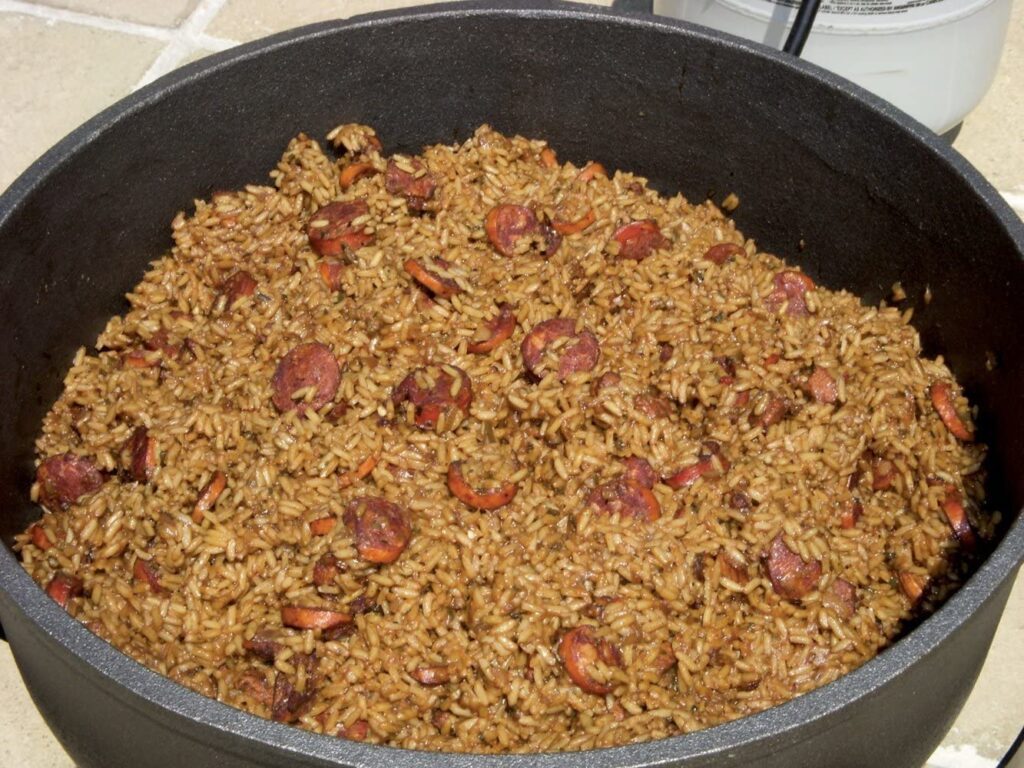
That’s why long-grain rice is welded to Cajun and Creole cooking. In a lot of Louisiana kitchens, rice isn’t a side — it’s the plate, the thing everything else is built to sit on and soak into. Gumbo is served over rice. Jambalaya cooks the rice right in the pot with everything else, so every grain carries the flavor. Red beans and rice is the Monday-night institution. Dirty rice literally takes its color and its name from the bits of liver and giblet cooked into it. Rice is the through-line of the whole cuisine, and it’s a through-line of mine.
I’ve been chasing this stuff in my own pots for a long time. My Jambalaya, Louisiana, Jeff’s ongoing recipe is exactly what the title says — a thing I keep refining. My Gumbo, New Orleans Creole, Jeff’s is built to be ladled over a scoop of long-grain, and my Fried Rice with Crawfish, Shrimp & Andouille Sausage - Jeff’s is what happens when Louisiana ingredients meet an Asian technique in my kitchen. And you can’t talk Louisiana rice without Red Beans and Rice — or, if you want the city version, New Orleans Style Red Beans and Rice — and Dirty Rice.
The West African thread never really left the American plate, either. It runs through the Lowcountry into the Gulf, and you can taste it directly in something like my West African Red-Red Beans with Coconut Rice, Avocado, & Sweet Plantain — beans-and-rice as a shared idea across an ocean.
Rice feeds half the planet — and one variety is a big reason why
Fast-forward to the 20th century and the arithmetic gets staggering: rice is the staple food for roughly half the people on Earth, and in much of Asia it supplies a huge share of everyone’s daily calories. That’s not an ancient given — it’s partly the result of a deliberate, mid-century scientific push, and it has a name.
In 1960, the International Rice Research Institute (IRRI) was founded in Los Baños, the Philippines. In 1962 its breeders crossed a tall Indonesian variety with a short, stiff-strawed Taiwanese one carrying a semi-dwarf gene (sd1, from a variety called Dee-geo-woo-gen). The result, released in 1966, was IR8 — quickly nicknamed “miracle rice.” The trick was elegant: older tall rices, when you fed them lots of fertilizer, grew leggy and fell over (“lodged”) and wasted the energy on stalk. IR8 was short and stout, so it could take heavy fertilizer and irrigation and pour all that into grain instead. Where good traditional varieties yielded around 6 tons per hectare, IR8 could hit around 10 under good management. It spread across Asia and into Latin America within a few years, and it’s usually credited with kicking off the Green Revolution in rice.
It’s worth being grown-up about this too: the Green Revolution genuinely helped stave off predicted famines and feed a booming population, and it also came with real costs — heavy dependence on fertilizer, irrigation, and pesticides, loss of thousands of local heirloom varieties, and uneven benefits between big and small farmers. IR8 itself was later found to have mediocre eating quality and pest problems, and breeders spent decades improving on it. But the headline holds: a single rice variety, bred in a lab in the Philippines in the 1960s, reshaped how half the world eats.
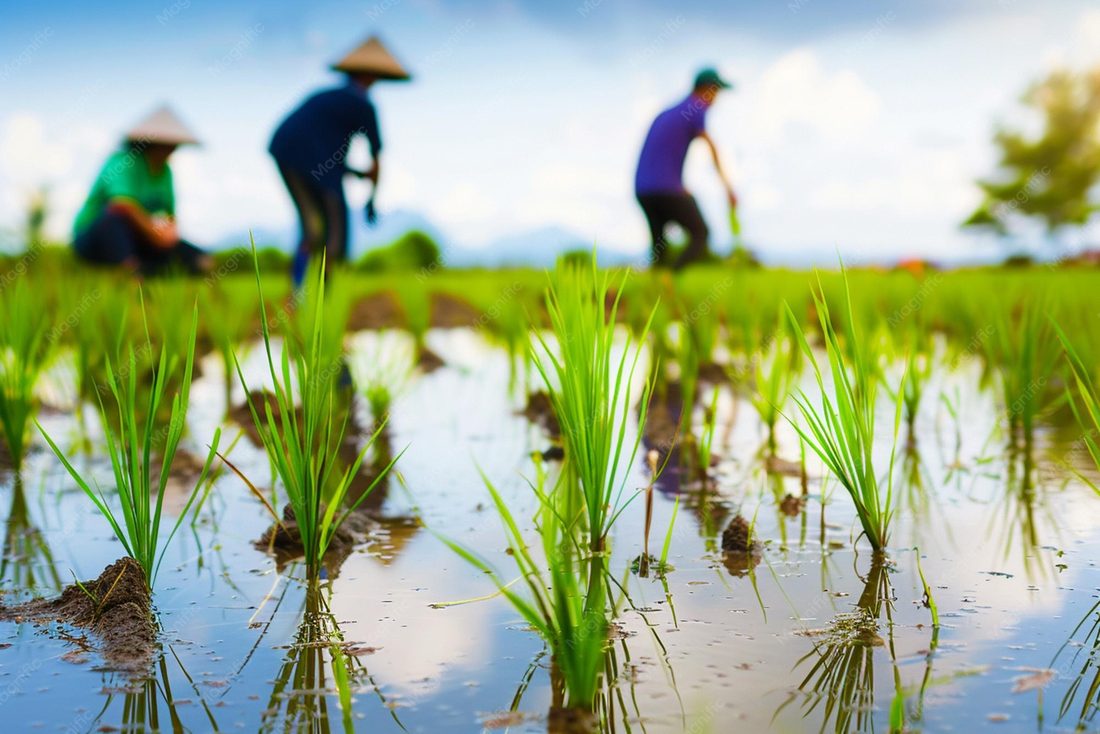
IRRI never stopped after IR8, and the work matters because rice is a moving target. Later varieties fixed IR8’s flaws — better flavor, better pest and disease resistance, shorter growing seasons that let a farmer squeeze in two or three crops a year. More recently there’s been “Golden Rice,” engineered to carry beta-carotene (vitamin A) to fight childhood blindness and one of the most fought-over crops on the planet, and a global scramble to breed rice that can handle salt, drought, flooding, and a warming climate — because if rice feeds half of humanity, then rice’s ability to cope with the next century is a food-security question for billions of people. The plant that took nine thousand years to domesticate is now being re-engineered on a decade’s deadline. Whatever you think of any particular piece of it, the stakes are exactly as large as they sound.
What I take away from all of it
A few things stick with me every time I lift the lid on the Zojirushi now.
Rice was domesticated twice, on two continents, by people working out water and grain and patience over thousands of years. The version most of us eat traces to the Yangtze, and the exact way indica and japonica came apart is still being argued by people who know far more than I do. A second, separate rice was born in Mali and carries a whole civilization’s worth of knowledge — knowledge that was enslaved and shipped across the Atlantic to build American fortunes, then largely written out of the story. And the reason I can buy a twenty-pound bag of long-grain for a few bucks to throw in a jambalaya is, in part, a semi-dwarf plant somebody bred in 1966.
There’s a lot more grain to get into from here. If you want to know why the “wild rice” in the blend on your shelf isn’t actually rice at all, that’s its own strange and worthwhile story — go read Why Wild Rice Isn’t Rice. If you want to see how the plant actually gets grown, flooded fields and all, that’s growing rice. And if you want to follow rice out across every cuisine that made it central, that’s rice around the world.
Comments (0)