The Science of Rice
Here’s the fact that reorganizes everything else you think you know about rice: the difference between fluffy, separate rice and sticky, clumping rice is not about how you cook it. Technique matters at the margins — I’ll spend a whole other page on rinsing and water ratios and lids. But the big difference, the one that makes basmati fall apart into individual grains and makes sushi rice hold together in a pinch, was decided long before the rice reached your kitchen. It was decided by the plant, in the ratio of two molecules.
Both molecules are starch. Both are built entirely out of glucose. The only difference between them is shape — one is a long straight chain, the other is a bush. And that single structural difference, playing out across billions of granules in a pot of boiling water, is the reason two grains that look almost identical behave like completely different foods.
This page is the engine room of the whole rice dive. Everything on the types page — why Arborio goes creamy and bomba stays separate, why glutinous rice isn’t really “glutinous” — comes back here. Everything on the cooking page — why you rinse, why day-old rice fries better, why cold rice is firmer — comes back here. So I want to get it right, and I want to flag the places where the popular version of the story is wrong, because there are a few, and they’re the good part.
I cook a lot of Louisiana long-grain — jambalaya, gumbo over rice, dirty rice — and I run a Zojirushi for the everyday stuff. Long-grain culture. So I came to the starch science the way most cooks do: by noticing that some rice stays separate no matter what and some rice clumps no matter what, and eventually asking why. This is the why.
What a grain of rice actually is
Before the molecules, the anatomy — because the whole story of white versus brown, of parboiled, of why brown rice goes rancid, is a story about which of these layers survives to your bowl.
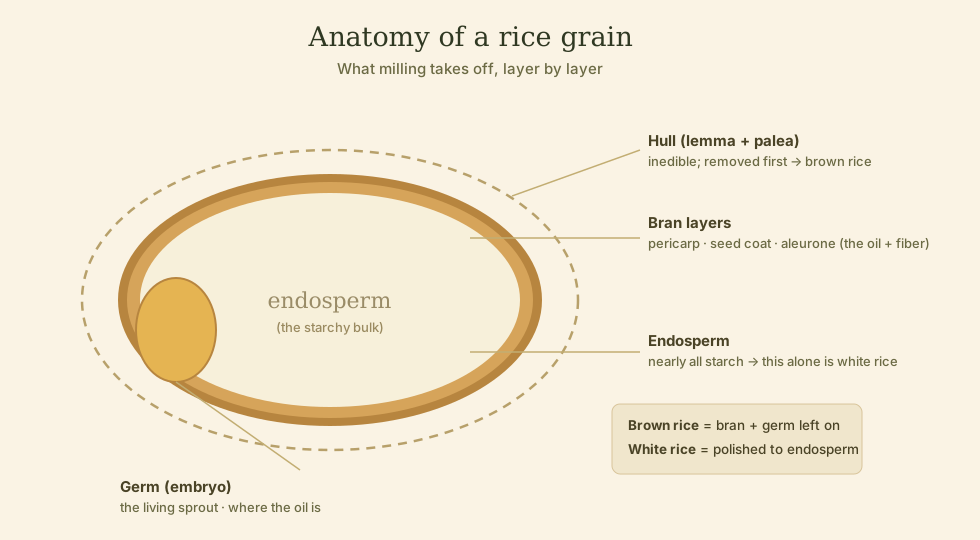
A grain of rice as it comes off the plant is a caryopsis, a single-seeded fruit, wrapped in a hard, papery, genuinely inedible hull (or husk) made of two structures called the lemma and palea. The hull is roughly 20% of the rough grain’s weight and it’s basically silica-armored cellulose — good for the plant, useless for eating. The first thing any mill does is take it off. Take the hull off and leave everything else, and you have brown rice. Brown rice is a whole grain: everything the seed needs to become a plant is still there.
Working inward from the hull, here’s what’s under it:
- The bran — not one layer but several stacked coats: the pericarp (the outermost fruit wall), the seed coat (testa), and the aleurone, a protein- and oil-rich layer that’s technically the outermost layer of the endosperm but comes off with the bran in milling. This is where the color lives in red and black rice, where most of the fiber lives, where the B vitamins and minerals concentrate, and — crucially — where the oil is. Hold that thought; the oil is the reason brown rice has a clock ticking on it.
- The germ (embryo) — the tiny structure at the base of the grain that would have become the seedling. It’s rich in oil, protein, and vitamin E. Milling knocks it off along with the bran.
- The endosperm — the big starchy bulk that fills most of the grain. This is the seed’s packed lunch, a dense store of starch (with a little protein) meant to feed the embryo until it can photosynthesize. When you eat white rice, you are eating essentially pure endosperm.
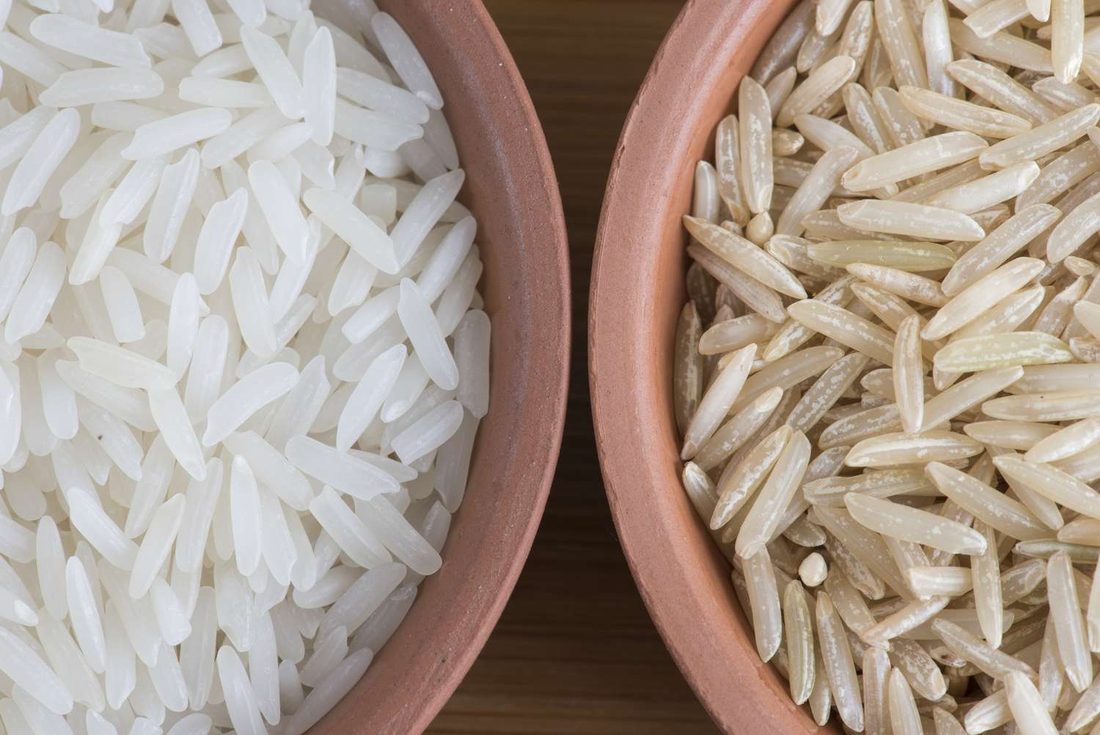
Milling is subtraction. Brown rice = hull removed, everything else intact. White rice = hull, bran, and germ all polished away, leaving only the endosperm. That’s the entire difference. White rice is not a different plant, not a different variety, not bleached — it’s brown rice with its outer coats and embryo abraded off. Everything you gain and lose going from brown to white — the fiber and oil and minerals you lose, the shelf life and quick cooking and neutral flavor you gain — follows from that one act of grinding away the outer layers. (The nutrition consequences, and why “enriched” white rice exists to patch them, live on the nutrition page.)
That’s the stage set. Now the actors: the two starch molecules that fill the endosperm.
Amylose and amylopectin: the real reason rices differ
Starch is how plants store glucose. Rather than keep a pile of loose glucose molecules — which would be osmotically disruptive and metabolically wasteful — the plant strings them together into big polymers and packs them into semi-crystalline granules. In rice, as in almost every starchy plant, those polymers come in exactly two forms, and the ratio between them is the master variable of this entire subject.
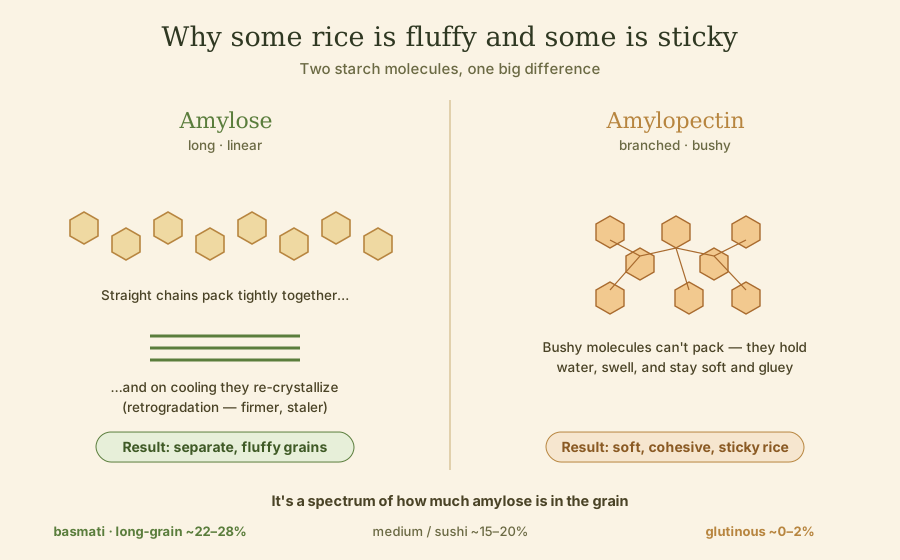
Amylose is the straight one. It’s a long, essentially linear chain of glucose units — thousands of them — with very little branching. Picture a length of uncooked spaghetti, or a piece of string. Because the chains are straight, they can lie down alongside each other, line up neatly, and lock together into tight, ordered, crystalline associations.
Amylopectin is the bushy one. It’s also a chain of glucose, but it branches — heavily, roughly every 20 to 25 units — into a huge, sprawling, tree-like molecule far larger than amylose. Picture a shrub, or a head of broccoli, or a firework frozen mid-burst. Because it’s so branched, amylopectin can’t pack neatly. The branches get in each other’s way. It stays loose, open, and floppy.
That’s the whole molecular difference. Same building block — glucose — arranged straight versus branched. And from that difference, everything follows:
- Amylose gels, firms, and separates. Because straight chains re-associate into tight networks, amylose-rich rice, once cooked and cooling, sets up firm, holds its shape, and the grains stay distinct. Fluffy, separate, dry-textured rice is high-amylose rice.
- Amylopectin swells, softens, and sticks. Because branched chains can’t lock together, amylopectin-rich rice cooks soft and sticky, the swollen granules cling to each other, and the grains fuse into a mass. Sticky, tender, glossy rice is low-amylose (high-amylopectin) rice.
Now the numbers, because this is one of those cases where the actual figures make the concept click. Rice is conventionally sorted into amylose classes (the USDA and IRRI both use versions of this scale):
| Class | Amylose (% of starch) | Typical rices | Cooked texture |
|---|---|---|---|
| Waxy / glutinous | 0–2% | Thai sticky rice, mochigome, “sweet rice” | Very sticky, translucent-cooking, chewy |
| Very low | 2–12% | some short-grains | Soft, sticky |
| Low | 12–20% | Japanese short-grain, Calrose, jasmine (~15%) | Tender, cohesive, moist |
| Intermediate | 20–25% | Arborio, many mediums, US long-grain (~22%) | Balanced |
| High | 25–33% | basmati (~22–28%), some long-grains | Fluffy, firm, dry, separate |
A few things to notice, because they carry the whole story:
Glutinous rice has essentially no amylose. Measured values run around 2% or even under — one study put a glutinous starch at 1.93% amylose, 98.57% amylopectin. That’s why it’s so extravagantly sticky: there’s almost no straight-chain molecule present to firm it up and hold the grains apart. It’s nearly pure bush. (And to kill the most common confusion right now: “glutinous” means glue-like, not gluten-containing. Rice has no gluten of any kind. The name is about texture. Sticky rice is safe for celiacs.)
Jasmine and Japanese short-grain are low amylose, not zero. Around 12–20%. That’s the sweet spot for rice you want tender and cohesive enough to pick up with chopsticks or press into onigiri but not the pure-gum stickiness of true glutinous rice. Sushi rice clings; it doesn’t glue.
Basmati and US long-grain are high or high-intermediate amylose. This is why they cook up fluffy and separate. It’s not a cooking trick — it’s that there’s a lot of straight-chain amylose present to firm each grain and keep it standoffish from its neighbors.
A correction worth making: basmati is not “waxy”
While researching this I kept hitting a specific, confidently-stated error, including in a widely-read cooking-school article: the claim that basmati is “high in amylose and low in amylopectin, like basmati, [is] considered waxy.” That’s backwards on the vocabulary and wrong on the fact. “Waxy” is the technical term for zero-amylose, all-amylopectin rice — the sticky glutinous kind. Basmati is the opposite of waxy: it’s one of the highest-amylose rices there is. Whoever wrote that sentence collapsed two contradictory sources into one. If you take nothing else from this section: high amylose = firm, fluffy, separate; waxy (zero amylose) = sticky. They are opposite ends of the same axis, and calling basmati “waxy” gets it exactly wrong.
Length correlates with starch — but doesn’t equal it
On the types page you’ll see rice sorted by grain length — long, medium, short. There’s a real correlation between length and starch behavior: long-grain rices tend to belong to the indica subspecies and skew higher-amylose and fluffier, while short-grain rices tend to be japonica and skew higher-amylopectin and stickier. One survey puts indica around 18–25% amylose and japonica up around 85–92% amylopectin (i.e., low amylose). So length is a useful shorthand.
But it’s a shorthand, not a law, and the exceptions prove it’s the starch that matters, not the shape. Arborio is a short, fat grain — yet it’s intermediate-amylose, not waxy — and its whole culinary job is to go creamy. Bomba is a short-to-medium grain that stays resolutely separate. Two short grains, opposite behaviors, because their starch ratios differ. Length is what you can see with your eyes; amylose is what actually decides the texture. When they disagree, believe the amylose.
Gelatinization: what heat and water actually do
So far the starch has been sitting inert, packed into tight, semi-crystalline granules inside the endosperm. Raw starch granules are hard, insoluble, and almost impossible to digest — try eating raw rice and your body barely gets anything out of it. Cooking transforms them, and the transformation has a name: gelatinization.
Here’s the sequence, which is the same in a pot of rice, a roux, or a cornstarch slurry:
- Cold water does nothing much. The granules absorb a little water at the surface but stay intact and crystalline. This is why you can rinse and soak rice in cold water without cooking it.
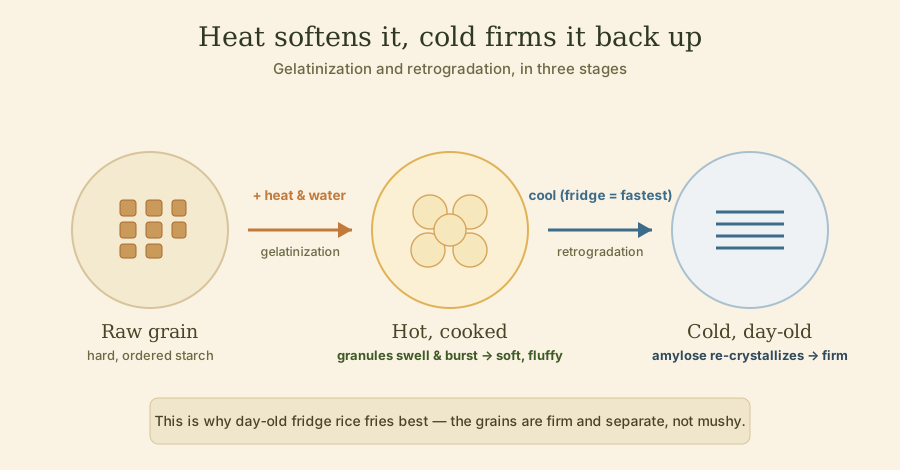
- Add heat. As the water warms past a threshold temperature, the granules begin to absorb water in earnest and swell. The orderly crystalline regions inside the granule — mostly the packed amylopectin branches — melt into disorder. This is the actual definition of gelatinization: the heat-and-water-driven disruption of the granule’s native crystalline order, an “order-to-disorder transition.”
- The granules swell, soften, and eventually burst. Amylose leaches out of the swelling granules into the surrounding water. The whole mass thickens — a slurry becomes a gel, hard rice becomes tender.
That threshold temperature has a name too — the gelatinization temperature — and it isn’t the same for all rice. Rice is sorted into low (below ~70 °C / 158 °F), intermediate (70–74 °C / 158–165 °F), and high (above ~74 °C / 165 °F) gelatinization-temperature classes, traditionally measured by an “alkali spreading” test that watches how much a grain disintegrates in dilute lye. The practical upshot: high-GT rices need more heat and more time to cook through, which is one reason different rices want different cook times and why parboiled rice (more on that below) is stubborn in the pot. Interestingly, GT class doesn’t track amylose neatly — they’re two somewhat independent quality axes — so a rice’s cooking time and its stickiness are set by different levers.
The other thing gelatinization explains is chalk and translucency. Look at raw rice and you’ll see some grains have opaque white patches — “chalk.” That chalkiness is a region where the starch granules are loosely packed with air gaps, which scatter light. Well-filled, densely-packed endosperm looks translucent. Chalky grains tend to cook unevenly and break more easily, so low chalk is a quality marker millers and breeders chase. When your cooked rice looks uniformly translucent and plump, the granules have gelatinized fully and evenly; a chalky raw grain is one that was never packed tight to begin with.
Retrogradation: why cold rice is firmer, and day-old fries better
Now cook the rice, then let it cool. Something happens on the way down that has enormous practical consequences in the kitchen, and it has a name that’s the mirror image of gelatinization: retrogradation.
When starch gelatinizes, its molecules go from ordered to disordered — the neat crystalline packing melts into a loose, hydrated tangle. Retrogradation is that process running backward as the rice cools. The disordered amylose and amylopectin chains “gradually re-associate or rearrange into a different ordered structure.” The straight amylose chains, especially — free-floating in the cooked grain — find each other, line up, and lock back into tight crystalline bundles, re-forming “tightly packed double helices.”
This is not the same as the rice drying out. Retrogradation is the molecules re-crystallizing, and it happens even in a sealed container where no water is lost. And it explains a whole cluster of kitchen observations that otherwise seem unrelated:
Why cold rice is firmer than hot rice. As amylose retrogrades, it firms the grain from the inside. Fridge-cold rice has a distinct, almost al-dente firmness that fresh-cooked rice doesn’t — that’s retrogradation, not just the chill. Amylose is far more prone to retrograde than amylopectin, which is why high-amylose long-grain firms up hard in the fridge while sticky waxy rice stays comparatively soft. (It’s also why waxy rice is the traditional choice for things you want to stay tender when cold, like mochi.)
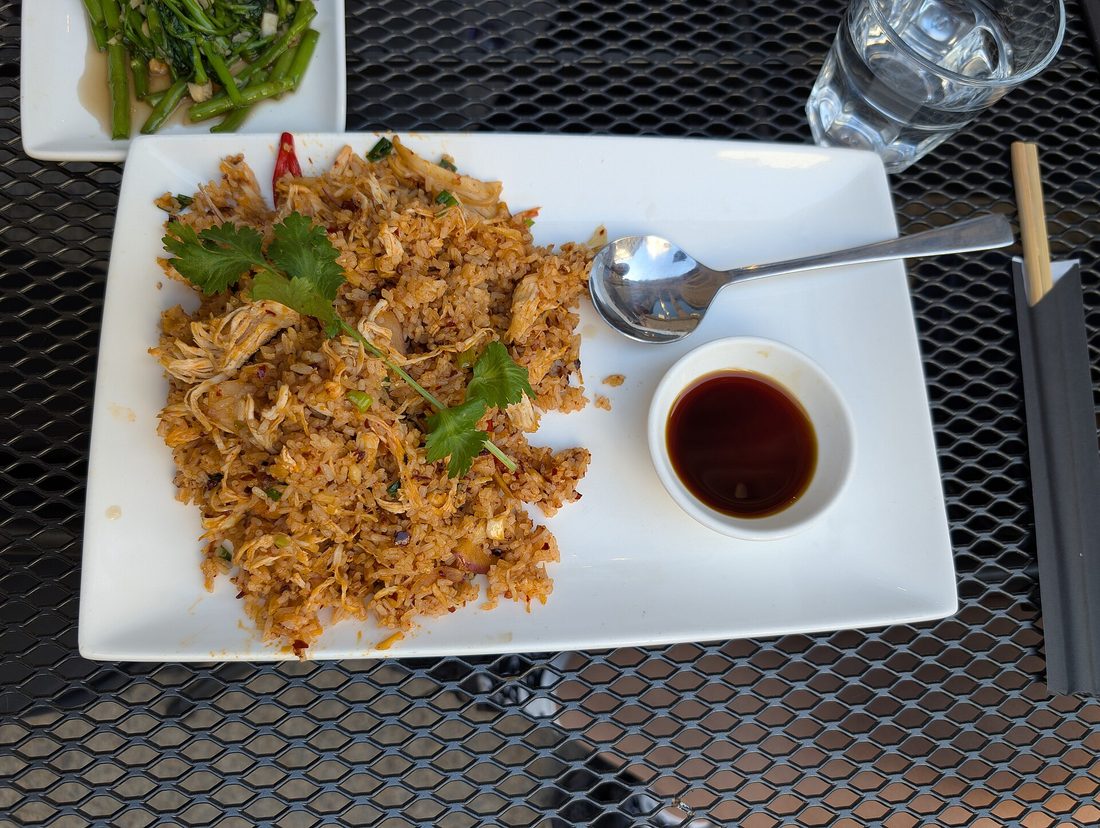
Why day-old rice fries better. This is the single most useful piece of rice science for a home cook, and it’s pure retrogradation. Fresh-cooked rice is soft, moist, and its granules are fully swollen — throw it in a hot wok and it steams, clumps, and turns to mush. Rice that’s been cooked and refrigerated overnight has retrograded: the grains are firmer, drier at the surface, and hold their integrity against heat and a spatula. That’s why every serious fried rice recipe, and every cook who’s made kimchi fried rice or my own crawfish-and-andouille fried rice, tells you to start with cold, day-old rice. The overnight in the fridge isn’t laziness or leftovers — it’s a deliberate texture-setting step. Retrogradation is fastest at refrigerator temperatures (around 4 °C), which is exactly why the fridge, not the counter, is where day-old rice gets its fry-ready firmness.
The resistant-starch angle. Retrograded amylose doesn’t just get firmer — the tightly re-crystallized chains also become resistant to digestion. The re-associated double helices “resist enzymatic hydrolysis”, meaning some of the starch now passes through the small intestine undigested and behaves more like fiber, feeding gut bacteria in the colon instead of spiking blood sugar. Cooked-then-cooled rice measurably increases its resistant starch content, and re-heating it doesn’t fully reverse the effect. This is a real, measured phenomenon — I get into what it means for blood sugar and health on the nutrition page — but the mechanism is the same retrogradation that firms your fried rice. The firmness and the resistant starch are two faces of the same re-crystallization.
One caution that belongs here and gets its own full treatment on the buying-and-storing page: cooling rice for later is good for texture and resistant starch, but cooked rice left warm — sitting at room temperature for hours — is a genuine food-safety hazard, because rice can carry heat-surviving Bacillus cereus spores that produce toxin as the rice sits. Cool it fast and cold, not slowly on the counter. The molecule you want (retrograded amylose) and the microbe you don’t (B. cereus toxin) both develop as rice cools — the difference is entirely in how fast it gets through the danger zone.
The aroma molecule: 2-acetyl-1-pyrroline
Open a bag of good basmati or jasmine and there’s a smell — popcorn, warm bread, something floral and toasty that plain rice doesn’t have. That’s not marketing and it’s not a blend of a dozen things. It’s overwhelmingly one compound: 2-acetyl-1-pyrroline, usually shortened to 2-AP.
2-AP is a remarkable molecule. It’s the same compound that gives popcorn its smell, that gives the crust of white bread its aroma, and that’s the signature scent of pandan leaves (which is why Southeast Asian cooks throw a pandan leaf into ordinary rice to fake the fragrance of the good stuff). Our noses are extraordinarily sensitive to it — the detection threshold is measured in parts per billion — so even the small amounts a fragrant rice variety produces read loud and clear.
Here’s the genetics, and it’s a genuinely elegant story that I verified against the primary literature because it’s the kind of thing that gets garbled. Fragrant rice makes lots of 2-AP because of a broken gene. Normal, non-fragrant rice carries a working copy of a gene called BADH2, which codes for an enzyme (betaine aldehyde dehydrogenase). That enzyme’s normal job includes mopping up a precursor compound before it can accumulate. In fragrant varieties — basmati, jasmine, and other scented rices — the BADH2 gene carries a loss-of-function mutation: it’s effectively switched off. With the enzyme disabled, the precursor (a compound called GAB-ald) piles up instead of being cleared, and the excess gets diverted, by a non-enzymatic reaction, into 2-AP. In short: the aroma is “a phenotypical expression of spontaneous recessive mutations of the BADH2 gene.”
Read that again, because it’s counterintuitive and it’s the whole point: fragrant rice is fragrant because something is missing, not because something extra was added. A working gene makes rice un-scented by clearing the precursor away; break that gene and the scent accumulates. The prized aroma of the world’s most expensive rices is, at bottom, a functional defect that humans happened to love and selected for. It’s a recessive trait, which is why breeders have to be careful keeping fragrant lines pure — cross a fragrant rice with a non-fragrant one and the working gene comes back and the scent vanishes.
Aging amplifies the effect for a related-but-separate reason. Basmati is traditionally aged one to two years before sale, and aging measurably improves its cooking behavior: the starch dehydrates and re-crystallizes (yes — a slow retrogradation, again), the grain gets harder and hydrates more slowly and evenly, and the payoff is elongation — well-aged basmati cooks up to nearly twice its raw length (elongation ratios around 1.8–2.2×), stretching into those dramatic slender grains prized in biryani. Aging is a starch phenomenon; the fragrance is a genetic one; premium basmati happens to deliver both.
What parboiling does, molecularly
Parboiled rice — sold as “converted” rice, the classic supermarket example being the Uncle Ben’s style — is one of the most misunderstood products on the shelf. People assume “parboiled” means precooked-for-convenience, like instant rice. It’s almost the opposite: parboiled rice usually takes longer to cook than regular white rice, and the process was invented not for speed but for nutrition and durability. And it all happens before milling, while the grain is still inside its hull.
The process is: soak the rough (unhulled) rice, then steam or heat it under pressure, then dry it, then mill it. Three molecular things happen during that hydrothermal treatment:
The starch gelatinizes inside the husk. The heat and moisture gelatinize the endosperm starch right there in the intact grain — the crystalline amylopectin regions melt and the granules swell, exactly as they would in a pot, but with limited water and inside the hull. Then, on drying and cooling, that gelatinized starch retrogrades and re-crystallizes into a denser, harder mass. The grain comes out of the process physically harder and more translucent than it went in.
Nutrients migrate inward. This is the clever part and the original point of the whole exercise. The bran and aleurone are packed with water-soluble B vitamins and minerals — normally, milling scrapes all of that off and throws it away, which is why plain white rice is nutritionally stripped. But during parboiling, the steam drives a portion of those water-soluble nutrients out of the bran and into the endosperm. So when the grain is later milled to white rice, the nutrients that would have been lost with the bran are already safely inside the part you keep. Parboiled white rice is meaningfully more nutritious than ordinary white rice — it retains more thiamine, niacin, and minerals — precisely because parboiling front-loads the goodness into the endosperm before the bran is removed. It’s an old-world nutrition hack, developed in South Asia centuries ago, that “enriched” rice tries to replicate by spraying vitamins back on.
The grains harden and cook up separate. Because the endosperm is now a dense, retrograded, re-crystallized block, parboiled rice cooks up firm, and the grains stay resolutely separate — they don’t clump or go mushy. The gelatinized surface layer limits water migration and reduces stickiness. This is why parboiled rice is beloved for things like Louisiana-style rice under a saucy stew, or big-batch food service — it’s forgiving, it holds, and it won’t turn to paste if it sits. The trade-off is a slightly firmer, “bouncier” texture and a faint yellow-amber tint the process leaves behind (that color is why it’s called “converted”). It cooks slower for the same reason it holds better: that hardened, re-crystallized endosperm resists water.
So the parboiled shelf-stable rice your grandmother trusted isn’t a shortcut product at all. It’s a grain that’s been gelatinized and retrograded on purpose, before you ever see it, to be tougher, more separate, and more nutritious than plain white rice. Same two starch molecules, rearranged deliberately.
Why rinsing matters
I’ll argue the rinse question in full on the cooking page — whether to rinse, how many times, and the cases where you shouldn’t — but the reason rinsing does anything is pure surface science, so it belongs here.
When rice is milled, the polishing that removes the bran also abrades the surface of the endosperm, leaving each grain dusted with loose surface starch — free amylose and fine starch particles clinging to the outside, plus starch dust from grains grinding against each other in the bag. When you drop unrinsed rice into water and heat it, that surface starch gelatinizes first and outside the grain, forming a sticky, gluey coating that makes the grains clump and can boil up into a starchy foam. Rinse the rice until the water runs clear and you’ve physically washed that loose surface starch away, so the grains cook up cleaner and more separate.
That’s why rinsing is near-mandatory for fluffy, separate long-grain rice, biryani, and pilaf — you’re removing the glue before it can form. And it’s also why you don’t rinse the risotto and paella rices: for risotto, that surface starch releasing into the pan is the entire mechanism by which the dish goes creamy, so washing it off would defeat the purpose. The rinse debate isn’t really a debate once you see it as a starch-management decision: rinse when you want the grains apart, keep the surface starch when you want them bound. It’s the same molecule (amylose on the grain’s surface) doing the same thing (gelatinizing into a sticky coat) — you just decide whether you want that coat or not.
Brown rice: the oil, the fiber, and the clock
The last piece of grain science is the one that most directly affects how you buy and keep rice, so I’ll set it up here and hand it off to the buying-and-storing page to finish.
Remember that the bran and germ — the layers brown rice keeps and white rice loses — are where the oil lives. That oil is nutritionally valuable (it carries vitamin E and healthy unsaturated fats), but oil is chemically unstable, and this is the fundamental trade-off of whole-grain rice: the same layer that makes brown rice nutritious is the layer that makes it spoil.
Milling brown rice — taking off the hull but leaving the bran — physically ruptures and exposes those oil-rich layers, and it does two things at once: it exposes the oil to oxygen, and it brings the oil into contact with an enzyme in the bran called lipase. Lipase attacks the fat, splitting it into free fatty acids — that’s hydrolytic rancidity, the first stage. Then oxygen (helped by another enzyme, lipoxygenase) attacks those free fatty acids and turns them into the smelly, off-flavor breakdown products of oxidative rancidity. The result is that stale, painty, “old” smell that brown rice develops — and it develops fast. Brown rice keeps only about three to six months before going rancid, where white rice, with its oil-bearing layers milled clean away, keeps for years.
White rice sidesteps the whole problem by amputating the oil. That’s the unromantic reason white rice conquered the world’s granaries long before anyone understood vitamins: it keeps, and in a hot climate before refrigeration, a grain that keeps beats a grain that’s more nutritious but spoils by summer. (The tragic downside — the thiamine deficiency disease beriberi that swept through populations who switched to polished white rice — is a story for the nutrition page.)
The bran carries one more thing worth naming: phytic acid (phytate), a compound that binds minerals like iron and zinc and reduces their absorption. It’s why the mineral content of brown rice, though higher than white, isn’t as available to your body as the raw numbers suggest, and why soaking or fermenting whole grains — which lets enzymes break down some of the phytate — is a genuinely useful traditional practice, not just folklore. It also carries the majority of the grain’s fiber, which is the real nutritional argument for brown rice and the reason it digests slower and blunts the blood-sugar spike compared to white.
So the brown-versus-white choice, stripped to its science, is a three-way trade among nutrition (brown wins — more fiber, oil, vitamins, minerals), shelf life (white wins, decisively — no oil to go rancid), and convenience (white wins — cooks faster and softer, no tough bran to soften). There’s no universally “better” rice; there’s the grain that fits what you’re doing. And every bit of that trade-off traces straight back to the anatomy at the top of this page: it’s all about whether the oily, nutritious, perishable outer layers made it to your bowl, or got polished away on the way there.
Next: put this to work. See the whole family on The Types of Rice; apply the starch science at the stove on Cooking Rice; understand what stays in the grain on Nutrition and Arsenic; and keep it from going rancid on Buying and Storing.
Comments (0)