The Upper Peninsula: A World Apart
In about two weeks, my son and I are going to drive north until the road runs out of Lower Michigan, climb the long green rise of the Mackinac Bridge, and cross into a place that is technically my home state and yet has always felt like a country of its own. That’s how it works up here. You can be a lifelong Michigander and still feel, every single time, that crossing “the Mighty Mac” is a border crossing. Five miles of suspended roadway over the Straits of Mackinac, Lake Michigan on your left and Lake Huron on your right, and on the far side: the Upper Peninsula. The U.P. Yooperland. A world apart.
We’ve got a route mapped out that’s really a list of meals with driving in between. St. Ignace first, the moment we’re off the bridge, for pasties at Lehto’s. Then west and north to hug the Lake Superior shore — Munising for Muldoon’s, over to Marquette for whitefish at Thill’s, up to Negaunee and Ishpeming for cudighi and a pasty at Lawry’s, a swing through Trenary for toast that’s more properly called a rusk. We’re basing out of a bed-and-breakfast in Ishpeming and giving ourselves several days, because the eating is only half of it. The other half is hiking, fishing, and just looking at the biggest freshwater lake on earth.
This dive is the long version of everything I’ll be chewing on during that drive: why this peninsula ended up so different from the rest of Michigan, so different from anywhere, and why a region with barely three percent of the state’s people cooks food you cannot get anywhere else in America. Before we get to the pasties and the sausage and the fried whitefish — each of which has its own page — I want to lay out the shape of the place. Geography, weather, history, and a stubborn streak of independence that runs through all of it. Because up here, the food is downstream of the geography. Every last bit of it.
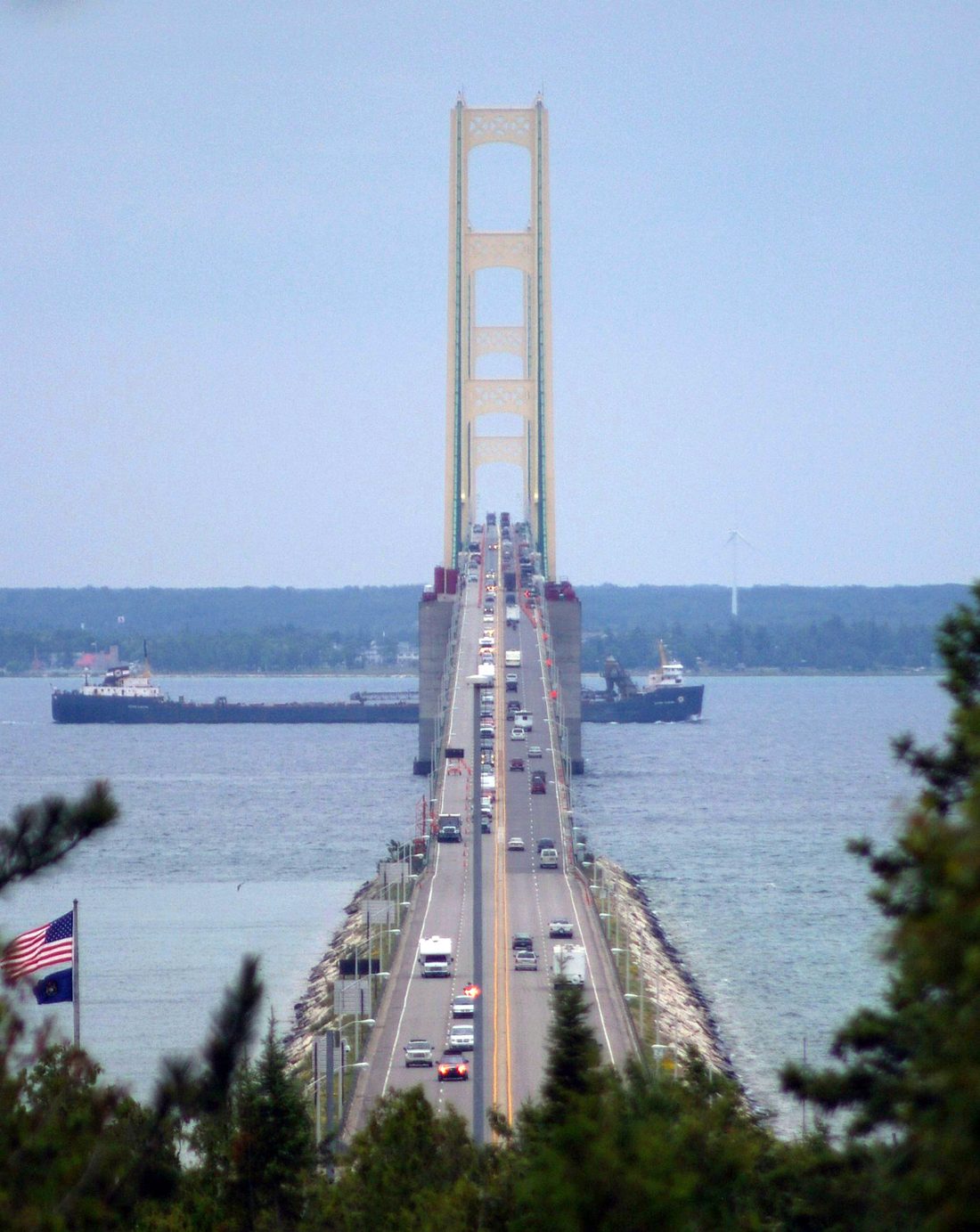 The five-mile span of the Mackinac Bridge is the only road link between the Upper and Lower Peninsulas. Before it opened in 1957, the only way across was a ferry.
A Peninsula That Belongs to the Wrong State
Here’s the first strange thing about the U.P., and it’s the thing that explains a lot of the rest: geographically, it does not belong to Michigan. Look at a map without the state lines drawn in. The Upper Peninsula shares a long land border with Wisconsin. It shares no land border at all with the Lower Peninsula — the two halves of Michigan are separated by open water, the Straits of Mackinac, where Lake Michigan and Lake Huron meet. If you wanted to draw the boundary the sensible way, following the land, the U.P. would be the northern third of Wisconsin.
So how did it end up as Michigan’s? Through a border fight and a consolation prize. In the 1830s, Michigan Territory and Ohio both claimed a strip of land around the mouth of the Maumee River — the “Toledo Strip,” with the growing port city of Toledo at its heart. The dispute got heated enough that both sides mustered militias, in what’s remembered, a little tongue-in-cheek, as the “Toledo War.” Congress brokered the deal that ended it: Michigan gave up its claim to Toledo, and in exchange got the western Upper Peninsula, which almost nobody in Michigan wanted at the time. It looked like a swindle — trading a real city for a frozen wilderness. Michigan accepted, grudgingly, and became a state in 1837.
Within a decade that “frozen wilderness” turned out to be sitting on top of one of the richest copper and iron deposits on the continent, and the joke was suddenly on Ohio. But the accidental, backhanded way the U.P. joined Michigan left a mark that never faded. This is a place that was handed to a state it isn’t attached to, as a leftover from a fight over somewhere else. No wonder Yoopers have spent a century and a half feeling like an afterthought.
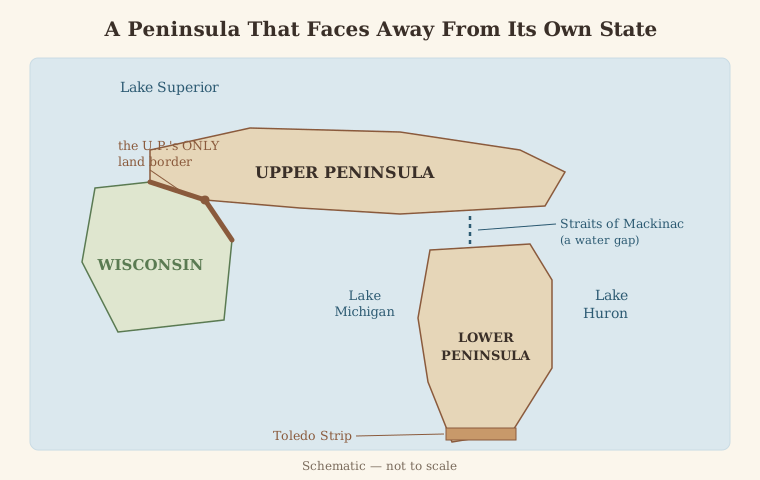
The Upper Peninsula touches Wisconsin by land, and its own state only across the water of the Straits of Mackinac.
Cut Off Until 1957
For most of its history, the U.P. wasn’t just psychologically separate from the rest of Michigan — it was physically cut off. There was no bridge. If you lived in the Upper Peninsula and wanted to reach Detroit or Lansing, you either drove the long way around through Wisconsin and Chicago, or you took a boat across the Straits.
The state ran a ferry service across the Straits of Mackinac starting in 1923, and as cars multiplied it became a genuine bottleneck. By the 1950s a fleet of nine state ferries was hauling as many as 9,000 vehicles a day across the gap, and on the worst weekends — deer season, the Fourth of July — the line of idling cars waiting to board on the Lower Peninsula side could stretch sixteen miles back down the highway. People planned entire trips around the ferry wait. Over the thirty-four years the state ferries ran, they carried something like twelve million vehicles and thirty million passengers across a few miles of water.
The Mackinac Bridge changed that overnight. It opened to traffic on November 1, 1957, after years of construction over some genuinely brutal water — the Straits are notorious for wind and current. The day the bridge opened, the ferries stopped. A five-mile drive replaced a wait that could eat half a day.
It’s worth sitting with what that means for the food. The distinct food culture of the U.P. — pasties, cudighi, Finnish rye and rusk, fried lake fish — was fully formed before the bridge existed. It grew up in the decades when the Upper Peninsula was, for practical purposes, an island: reachable from downstate only by boat, connected far more easily to Wisconsin and to the Great Lakes shipping lanes than to the rest of its own state. A cuisine that develops in isolation stays weird, in the best sense. It doesn’t get sanded down by the national average. By the time the bridge finally stitched the two peninsulas together, the U.P. had already become itself.
Surrounded by Inland Seas
Three of the five Great Lakes wrap around the Upper Peninsula, and they are not lakes in any sense a person from most of the country would recognize. They’re inland freshwater seas. Lake Superior runs along the entire northern shore — the largest freshwater lake in the world by surface area, cold and deep and big enough to make its own weather and swallow whole ore freighters, which it has done. Lake Michigan laps the southern shore. Lake Huron touches the eastern end near the Straits. Almost the whole peninsula is coastline.
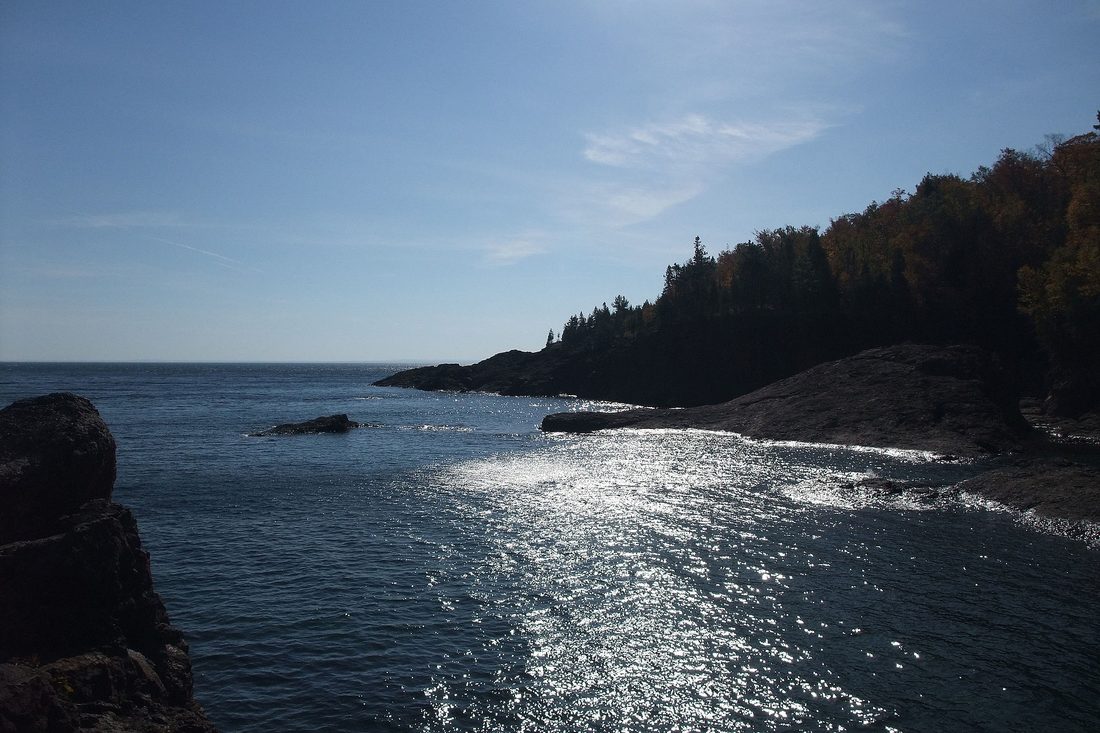 Lake Superior wraps the entire northern edge of the U.P. It is the largest freshwater lake on earth by surface area, and it shapes everything from the snowfall to the fishing.
Being ringed by that much cold water does a few things. It gave the U.P. its fishing industry — whitefish, lake trout, herring, all pulled from the big lakes and central to the local table to this day (there’s a whole page here on the whitefish dinner and the family fisheries behind it). It made the peninsula a hub of Great Lakes shipping, which is how the copper and iron got out and how goods and people came in, reinforcing the connection to Chicago and Duluth over any connection to downstate Michigan. And it made the winters something close to legendary.
The Snow
I want to be precise about the snow, because the U.P.’s reputation for it is one of those cases where the reality actually lives up to the legend. The Keweenaw Peninsula — the finger of land that juts north into Lake Superior, the old copper country — is the snowiest place in the United States east of the Mississippi River. Not “one of.” The snowiest.
The mechanism is lake-effect snow. Lake Superior is so large and so deep that it never fully freezes over. All winter long there’s open water, and when cold Arctic air sweeps south across that relatively warmer, unfrozen lake, it picks up moisture, and then it dumps that moisture as snow the moment it hits the colder land on the far shore. The Keweenaw sits right in the firing line. Communities up there — Calumet, Painesdale, Delaware — routinely take two hundred to three hundred inches of snow in a season. The long-term average at the old Delaware mining station, going back to 1910, is around 240 inches a year. The record winter, 1978–79, buried Delaware under about 390 inches — that’s over thirty feet of snow in a single season. And these aren’t dusty historical numbers: the Keweenaw cleared three hundred inches again in a recent winter.
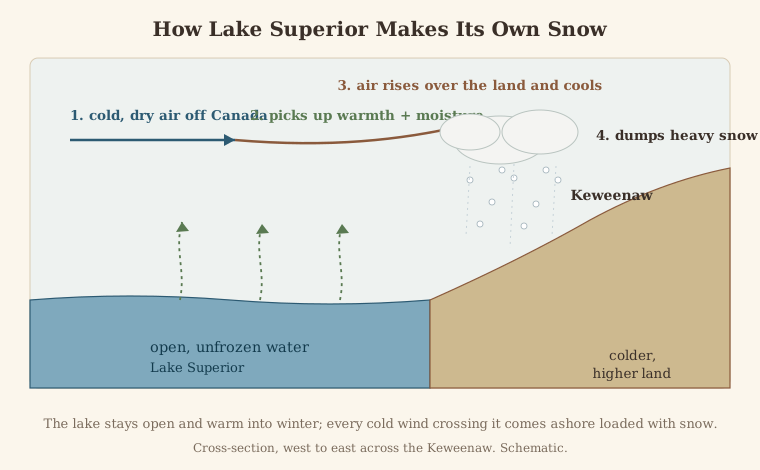
Cold air crossing the open lake picks up moisture, then drops it as heavy snow when it rises over the colder Keweenaw.
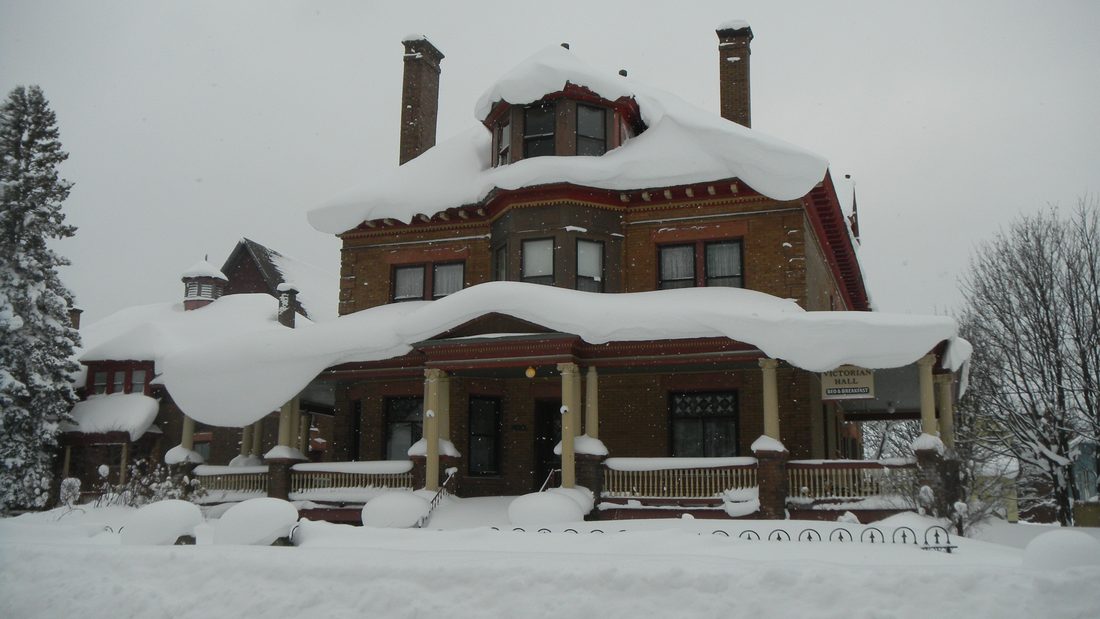 A Keweenaw winter. The peninsula is the snowiest place in the United States east of the Mississippi, and a season of two to three hundred inches is normal, not exceptional.
Thirty feet of snow is not a novelty; it’s a way of life. It’s why so many U.P. houses have entrances on the second floor, and why you’ll see snowbanks in April taller than a pickup truck. It’s why the snowmobile is closer to a necessity than a toy, and why the region measures its winters in feet, not inches. And it matters enormously for the food. When winter shuts you in for five or six months, you need a pantry that keeps — root vegetables that store in a cold cellar, salted and smoked fish, hard dry rusk bread that lasts for weeks, hearty stews, dense sweet breads. Cuisines built in cold climates are cuisines built around keeping. That’s not a coincidence you’ll find only in the U.P.; it’s true of Finland and Cornwall and northern Italy too, which is exactly why the immigrants who came here felt at home in the kitchen even when nothing else was familiar.
Empty on Purpose, and by Nature
The Upper Peninsula is enormous and almost empty. It makes up about 29 percent of Michigan’s land area — nearly a third of the whole state — and holds only around 3 percent of Michigan’s people. Roughly three hundred thousand souls scattered across an area larger than several entire states. Marquette, the biggest city, has around twenty thousand people. Vast stretches are forest, lake, bog, and rock, with a small town every so often and long empty highways in between.
That emptiness is partly nature — it’s hard country to farm, with thin acidic soil, a short growing season, and that punishing winter — and partly history. The population actually peaked in the early twentieth century, when the mines were running full-bore and needed every hand they could get. When the mines wound down, the people left. Whole towns shrank; some vanished entirely into the woods. So the U.P. isn’t empty because nobody ever came. It’s empty because they came, and then most of them had to go.
For food culture, low population and long distances cut two ways. On one hand, isolation preserves things — recipes and traditions survive up here that got homogenized away in busier places. On the other hand, it strains them. A pasty shop or a fish house or a family bakery in a town of a few thousand, a long drive from the next town, survives on a thin margin and a loyal local crowd. Some of the places on our trip list have been feeding the same families for three and four generations. Every one of them is a small miracle of persistence.
Yoopers and Trolls
People from the Upper Peninsula call themselves Yoopers. The word comes straight from the abbreviation — “U.P.-er” — and somewhere along the way it stopped being a joke and became a genuine identity, worn with pride. There’s a Yooper accent, heavy with the flat vowels of Finnish and Scandinavian and Canadian influence, the one that turns up in the old comedy songs and the “Da Yoopers” band out of Ishpeming. There’s Yooper food, Yooper humor, Yooper stubbornness.
And there’s the affectionate name Yoopers have for everyone who lives on the other side of the bridge, down in the Lower Peninsula: trolls. Because they live under the bridge, get it. (The summer tourists who clog Mackinac Island buying up the famous local candy get a different nickname — “fudgies.”) It’s mostly a joke, but like all the best jokes it carries something real. There’s a genuine sense up here that downstate Michigan — Detroit, Lansing, the auto money, the political power, the majority of the votes — doesn’t understand the U.P., doesn’t prioritize it, and never really has. Being a Yooper means, in part, being not a troll. Being from the part of Michigan that got handed over as a consolation prize and made something of itself anyway.
I say all this as someone who is, by strict geography, a troll. I’m a Michigander, the U.P. is my home state, but I’m not a Yooper by birth. I’ve just spent years crossing that bridge and eating my way across the peninsula — pasties at Lehto’s in St. Ignace and Muldoon’s in Munising and Lawry’s out in West Ishpeming, cudighi in Negaunee at Tino’s, whitefish at Thill’s in Marquette, rusk in Trenary — enough to love the place and to know I’ll always be a visitor in it. That’s the honest position I’m writing from, and it’s the same list of places my son and I are about to go revisit.
That identity isn’t only defensive, either. There’s a whole self-deprecating, wickedly funny Yooper culture that leans into the stereotype on purpose — the flannel, the pickup, the deer camp, the accent thick enough to cut, the “yah, you betcha.” Ishpeming even gave the world a comedy band, Da Yoopers, whose songs about snowplows and shooting your own outhouse are local scripture. It’s the humor of people who know the rest of the state thinks they’re backwoods and have decided to enjoy the joke rather than resent it. And under the jokes is real pride: pride in surviving the winter, in doing without, in a place that’s genuinely theirs.
The 51st State That Never Was
The sense of separateness runs deep enough that, more than once, serious people have tried to make it official and turn the U.P. into its own state — usually called Superior, after the lake.
This is not a fringe modern gag; it’s an old idea with real history behind it. As far back as 1858, there was a convention proposing to knit the Upper Peninsula together with a chunk of northern Wisconsin and a few counties of Minnesota into a new state of Superior. The notion kept resurfacing for a century. In 1962 a group called the Upper Peninsula Independence Association gathered around twenty thousand signatures on a petition for separation — impressive, but well short of the roughly fifty-six thousand they’d have needed to force a referendum. The last serious push came in the mid-1970s, driven partly by a fear that new state and federal environmental regulations would strangle the U.P.’s mining and timber economy. Legislators, including the long-serving Yooper representative Dominic Jacobetti, floated it. When the question actually went to voters in Marquette and Iron Mountain in November 1975, they turned it down, and that was more or less the end of the road for Superior as a real proposal.
It never happened, and it almost certainly never will. But the fact that it keeps coming up — that “State of Superior” bumper stickers still sell, that people still half-mean it — tells you everything about how apart this place feels from the rest of Michigan. You don’t spend a century trying to secede from somewhere you feel like you belong to.
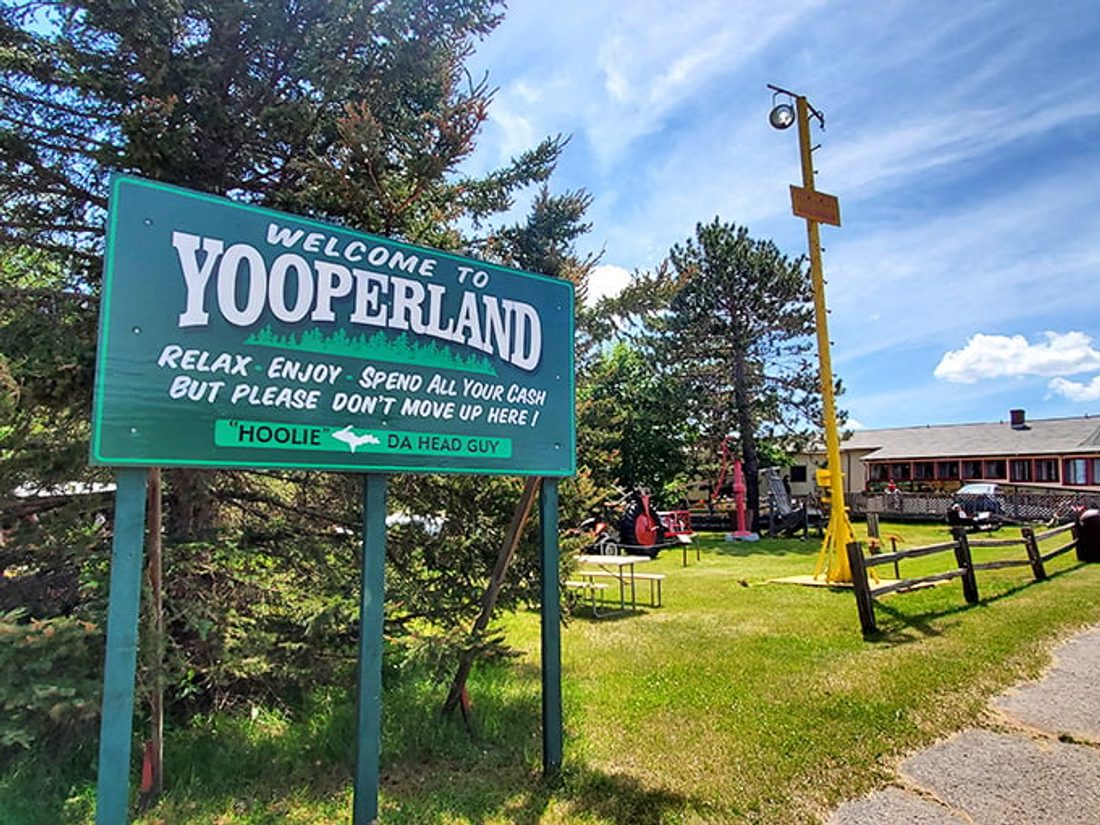 The dream of a separate “State of Superior” goes back to 1858 and last came to a vote in 1975. It failed, but the sentiment behind it never did.
Why the Food Came Out Weird
So take everything above and stack it together. A peninsula geographically joined to Wisconsin but politically owned by a state it can’t reach by land. Cut off from the rest of that state by open water until 1957. Ringed by three of the largest lakes on earth. Buried under some of the heaviest snowfall in the country. Nearly empty, and emptier every decade since the mines closed. Proud, remote, and half-convinced it ought to be its own country.
Now drop into that landscape, in the second half of the 1800s, a wave of immigrants — Cornish and Finnish and Italian and Swedish and French-Canadian and Slovenian and more — pulled in from across the ocean by copper and iron and timber. Hard men and women doing dangerous, freezing, backbreaking work, far from home, in a place where the winter locks you down and the growing season is a rumor. Each group brought its own foodways, tuned to their own cold northern homelands. And then those foodways collided, mingled, and adapted to what the U.P. actually offered: root vegetables, wild game, lake fish, rye and barley, whatever kept through a Superior winter.
That’s the recipe for a genuinely distinct regional cuisine, and it’s exactly what the U.P. produced. The pasty — a whole meal of meat and root vegetables folded into a sturdy pastry crust you could carry down a mine and eat cold — came from Cornwall and became the food of everyone. Cudighi, a sweetly spiced Italian sausage that survives almost nowhere else on earth, took root in the iron towns of Negaunee and Ishpeming. The Finnish table brought cardamom bread and pancake-custard and fermented milk and the dry rusk that Trenary, Michigan, still makes and ships under its own name. And the big cold lakes gave up the whitefish that anchors a Friday fish fry across the whole peninsula.
Every one of those has its own page in this dive, because every one deserves the space. What I wanted to do here first was explain why — why this particular corner of America ended up with a food culture you can’t find anywhere else. The answer is that the U.P. was isolated enough, cold enough, and strange enough, for long enough, that the food it worked out never got homogenized into the national blur. It stayed itself. Just like the people.
Where to Go From Here
If you want the human side of the story — who actually came to this cold, remote peninsula, why they left home, and what they carried in their kitchens — start with Who Came, and What They Cooked. If you want the industrial engine that pulled them here and demanded a food like the pasty in the first place, read Copper, Iron, Timber and Fish. And then the food pages themselves: the pasty, the cudighi, the whitefish dinner, the Finnish table, Trenary toast, the wild thimbleberry, and a look at the U.P. table today.
But if you only remember one thing from this page, remember the bridge, and what it was like before it existed. For most of the U.P.’s history, getting there meant a boat and a wait, and the rest of Michigan was a rumor across the water. My son and I will drive across the Mackinac Bridge in a couple of weeks in about eight minutes, air conditioning on, radio playing, and it will still feel like crossing into another country. Because it is one — or near enough. Let’s go see what’s cooking there.
Comments (0)