The Pasty: The U.P.'s Definitive Food
If you drive north out of the Lower Peninsula, over the Mackinac Bridge and into the Upper Peninsula, you will start seeing the word within about a mile. PASTIES. It’s on hand-painted plywood, on gas-station marquees, on the sides of A-frame shops that sell nothing else. You cross the water and the pasty is simply there, the way sweet tea is there when you cross into the South. It is the one food the U.P. will tell you is its own, and it is the one food I make sure to eat every single time I go up.
I want to get the history of this thing right, because the pasty is buried under more affectionate nonsense than almost any food I can think of. Some of the beloved stories are true. Some are half true. At least one of the most-repeated “facts” is very likely made up, and the people who repeat it mean no harm — it’s just a good story, and good stories travel faster than boring truths. So let me try to separate the two, and then let me tell you how a genuinely good one is made, and why.
A quick housekeeping note before we go further, because it matters more than you’d think: up here, “pasty” rhymes with “nasty,” not “hasty.” Short A. PASS-tee. It has nothing to do with the burlesque item spelled the same way, and if you say it with a long A in a shop in Calumet you will get a patient look from someone who has heard it a thousand times. The word comes from the Old French paste, meaning a pastry or a pie — same root as our “paste” and “pastry.” Say it wrong and you’re a tourist; say it right and you’re merely a troll, which is what Yoopers call the rest of us who live below the bridge. You can’t win, but you can at least pronounce it.
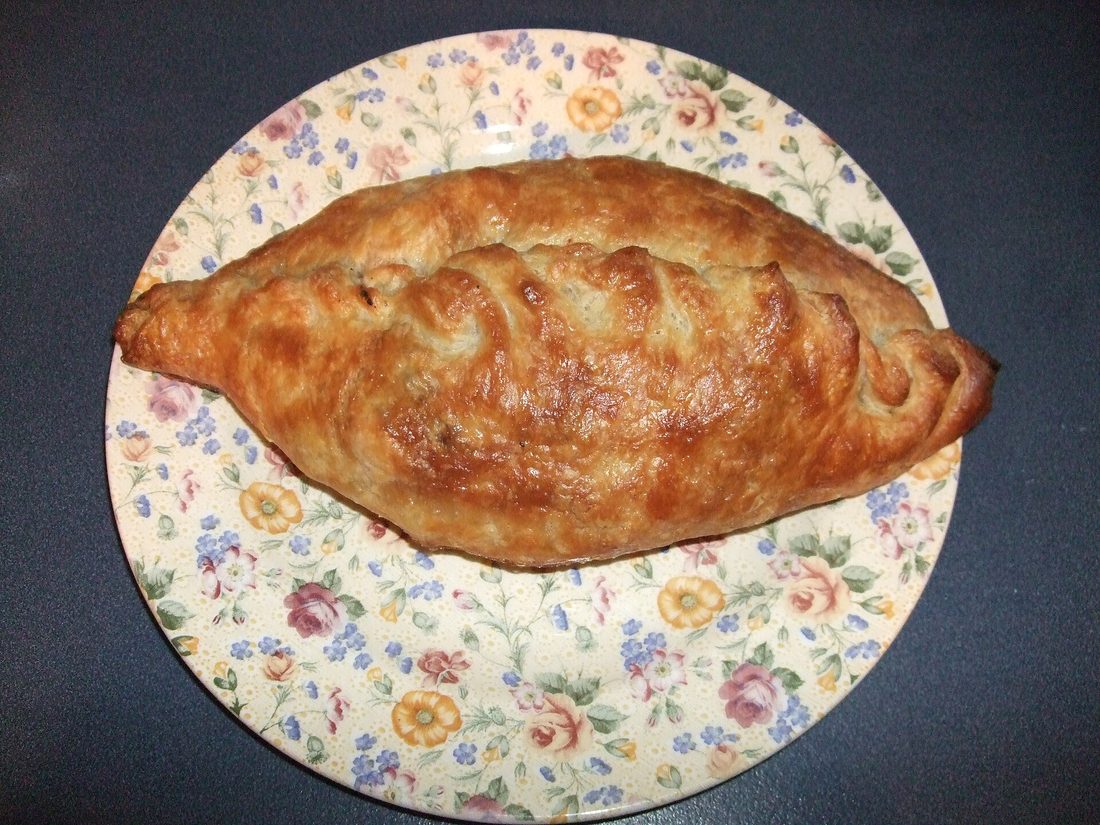 A U.P. pasty as you actually meet it: a half-moon of shortcrust, the crimp running along one edge like a rope, steam coming off the vent. This is lunch in the hand.
Where it really comes from: Cornwall
The pasty is Cornish. Not Finnish, not Michigander — Cornish, from that granite thumb of southwest England that spent centuries pulling tin and copper out of the ground. The pasty was the miner’s lunch, and it was the miner’s lunch because it solved a specific set of problems better than anything else. It was a whole meal — meat, potato, root vegetable, onion — sealed inside a sturdy pastry you could carry in a pocket, eat cold or warm, and hold in one hand without a plate, a fork, or a table. Underground, that’s the whole ballgame.
Cornish women made them by the dozen. The folklore around them is genuinely charming, and some of it I’ll happily pass along as folklore. The best one: the Devil, they said, would never cross the River Tamar into Cornwall, because he knew perfectly well that Cornish women would put anything into a pasty — and he had no intention of ending up as a filling. That’s not history. It’s a joke Cornish people told about their own cooking, and it’s a good one. It also happens to be accurate about the cooking: a pasty is defined by its form, not its filling, and over the centuries Cornish pasties held beef, but also pork, rabbit, fish, and on the sweet end, apple or jam crimped into one corner of the same pasty as the savory dinner filled the other. Two courses, one crust.
Another piece of folklore that’s probably true: miners are said to have had their initials crimped into one end, so that in a dark, crowded changing-house a man could find his own lunch, and — the story goes — eat it from the un-initialed end first, then set the marked end aside to come back to. Whether every miner really did this, or whether it’s a tidy story built on top of the plain fact that a crimped corner is an obvious place to scratch a mark, I can’t tell you for certain. It has the ring of something that happened sometimes and got told as though it happened always.
The arsenic story, and why I don’t believe it
Here’s the big one, the story you’ll hear at half the pasty shops in Michigan, printed on placemats and told with total confidence: that the thick, ropey crimp on the edge was a disposable handle. Tin miners’ hands, the story goes, were coated in arsenic — a real byproduct of tin and copper ore — so a miner held his pasty by the crust, ate the middle, and threw the poisoned handle away without ever touching his food with his fingers.
It’s a wonderful story. I think it’s mostly wrong, and it’s worth explaining why, because the reasons are more interesting than the myth.
First, the physical evidence points the other way. The old photographs and accounts of miners at their lunch show them eating pasties whole, often out of a cloth or muslin wrapper or a paper bag — not gripping a bare crust and pitching the end. Second, and this is the part that really sinks it: these were poor, hungry men doing brutal labor, and a pasty crimp is a substantial wedge of pastry. The idea that a nineteenth-century Cornish miner would routinely throw away a third of his only hot meal is, frankly, absurd. Food was not wasted. It was too dear and the days were too long.
There is a scrap of truth folded into the myth, and it points somewhere stranger. Some miners did sometimes leave a bit of crust behind — but the traditional reason wasn’t hygiene, it was the knockers: the little spirits or ghosts said to live in the mines, whose knocking either warned you of danger or led you to ore, depending on their mood. Leaving them a corner of your pasty kept them friendly. That’s a folk belief, not a fact about anybody’s health, but it’s a much older and more honest explanation for a left-behind crust than arsenic.
So what is the crimp actually for? The boring, correct answer: it’s a seam. When you fold a circle of pastry over a pile of filling, you have to seal the open edge or the whole thing leaks and falls apart in the oven. Crimping — folding the edge over on itself in a rope pattern — is simply the strongest way to close that seam by hand. It also happens to make a good grip, and a good structural spine that lets you hold a heavy pasty without it sagging in half. Function first; the handle is a nice side effect, not the design goal. I lead with this because it’s a small case study in how food history works: the true explanation is usually structural and dull, and the myth is usually vivid and moral, and the myth wins every time it’s told.
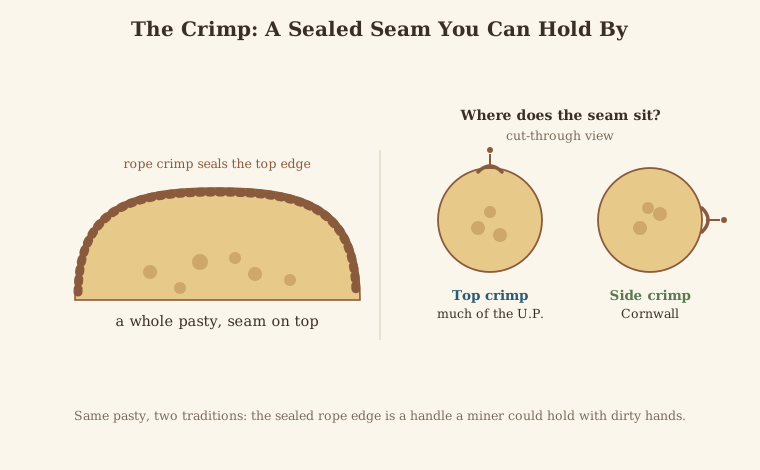
The sealed rope crimp is the pasty’s built-in handle — riding the side in Cornwall, the top across much of the U.P.
The 2011 rules: what “Cornish pasty” legally means now
For most of its life the pasty had no official definition — it was whatever a Cornish cook made. That changed in 2011. On February 22 of that year, the European Union granted the “Cornish pasty” Protected Geographical Indication (PGI) status, the same legal shield that guards Champagne, Parma ham, and Melton Mowbray pork pies. From then on, a thing sold as a “Cornish pasty” in the EU had to meet a written spec, and had to have been assembled within the historic county of Cornwall.
The spec is worth reading closely, because it settles — for Cornwall, anyway — several arguments Americans are still having:
- Shape: a “D,” a clean half-moon.
- The crimp goes on the side, not the top. This is the big one. Real Cornish pasties are sealed along one curved edge, so the seam runs down the side of the D. A crimp along the top spine is, by Cornish law, not a Cornish pasty — it’s a “wrong ‘un,” or arguably a Devon pasty, which is fighting words in Cornwall.
- Filling: beef, swede, potato, and onion, with a light seasoning of salt and pepper — and nothing else diced in. Chunky, not minced to paste.
- Raw, not pre-cooked: the vegetables and meat go in uncooked and cook together inside the sealed pastry. This is why a proper pasty tastes the way it does; more on that below.
- Pastry: savory shortcrust (or a puff/rough-puff), sturdy enough to survive baking and a coat pocket without cracking.
One translation note that trips up every American: “swede” is rutabaga. In Cornwall, confusingly, they often call the rutabaga a “turnip,” but the vegetable the rules mean — and the one that actually belongs in a pasty — is the big, yellow-fleshed, purple-shouldered rutabaga. Hold onto that, because in the U.P. the rutabaga is the whole fight.
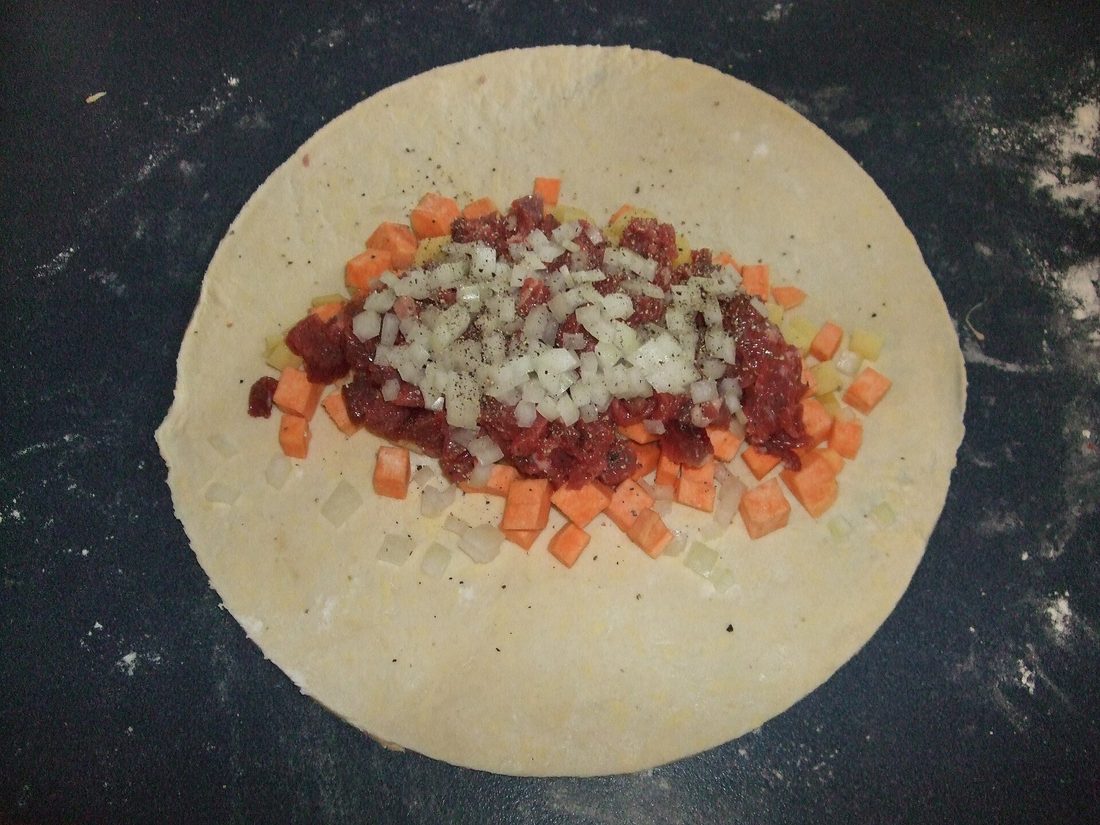 The filling goes on raw and diced small. The canonical core is beef, potato, onion and — the vegetable people go to war over — rutabaga; the cook here has thrown in carrot too, which a purist will tell you is heresy.
How it crossed the ocean: Cousin Jacks, then everybody
The pasty came to Michigan the way it came to mining districts all over the world — Wisconsin, Montana, Colorado, Mexico, Australia — in the pockets of Cornish miners. When Cornwall’s own mines began to fail in the middle of the 1800s, Cornish miners scattered across the globe chasing the only work they knew, and they were very good at it. Hard-rock mining was a Cornish specialty, and mine captains prized them.
In Michigan they landed first in the Copper Country — the Keweenaw Peninsula, that far-north spike of land jutting into Lake Superior — where some of the purest native copper on Earth had been found. Later they came in numbers to the iron ranges around Marquette, Ishpeming, and Negaunee. The Cornish miners got a nickname that stuck: “Cousin Jacks,” with their wives and sisters the “Cousin Jennies.” The usual explanation is that whenever a foreman had an opening, the Cornishman would say he had a cousin back home who could do the job — and the cousin, more often than not, was named Jack. Whether that’s the literal origin or a story grown up around the name, the term was everywhere in the Lake Superior mining towns, and the Cousin Jacks brought their pasties with them.
Here’s the part I find genuinely lovely, and I want to be honest about it rather than smoothing it over. The pasty is Cornish, but in the U.P. it became Finnish — or at least it became so thoroughly adopted by Finnish immigrants that today a great many Yoopers, including people whose families have made pasties for a century, will tell you it’s a Finnish food. It isn’t, in origin. But the Finns, who arrived in huge numbers to work the same mines a generation after the Cornish, took to the pasty completely — it fit their own tradition of hearty, root-vegetable, cold-climate cooking like a key in a lock — and they made it so much their own that the handoff is now nearly invisible. You’ll find pasties at Finnish churches, Finnish festivals, Finnish family reunions, sold as heritage food. The Cornish brought it; the Finns kept it and spread it; and after that came Italians, Croatians, French Canadians, Cornish-Finnish grandchildren who are both at once. The pasty is a genuine melting-pot object, and the fact that half the U.P. thinks it’s Finnish isn’t an error to correct so much as a story to appreciate. A food can belong to the people who love it hardest.
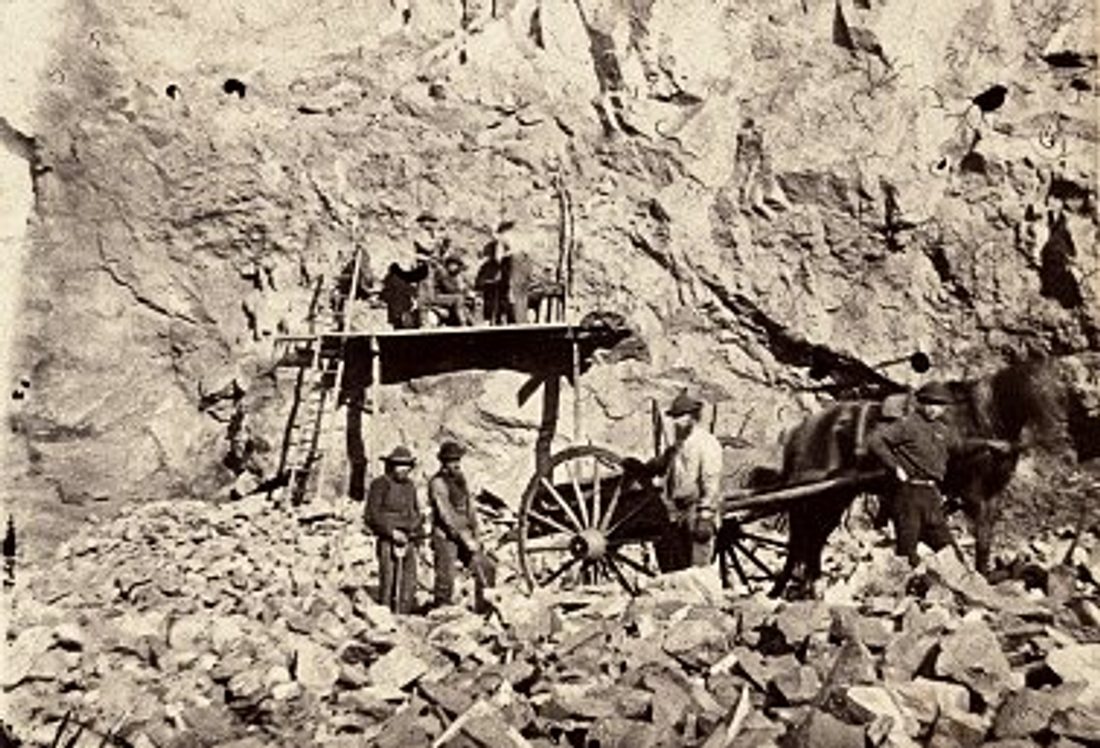 Iron-range mining country around Ishpeming and Negaunee, where the pasty went underground every day. The Cornish brought it; the Finns made it the U.P.’s own.
The anatomy, and every argument in it
Now the fun part. Because there’s no PGI board in Michigan, a U.P. pasty is a bundle of choices, and every one of those choices is somebody’s hill to die on. Let me walk the whole thing the way a cook does, and lay the fights out honestly, because there is rarely one right answer — just camps, and both camps are real.
The crust
Traditional pasty pastry is a sturdy shortcrust made with lard, suet, or a mix, sometimes with butter or shortening cut in for flavor and flake. The goal is not the tender, shatter-at-a-touch crust you’d want on a dessert pie. It’s the opposite: you want a crust with backbone, one that holds a half-pound of wet filling, survives an hour in the oven and a ride in a lunch bucket, and doesn’t split at the seam. Lard and suet give you that structure and a savory richness butter alone can’t. All-butter crusts have crept in as tastes changed, and they’re delicious, but they’re a little more fragile — a modern preference more than a traditional one.
The rutabaga question
This is the defining vegetable and the defining fight. A traditional pasty is built on rutabaga, potato, and onion, and to a purist the rutabaga is non-negotiable — it’s what gives a pasty that faint sweet-earthy, slightly peppery flavor that a potato-only pasty just doesn’t have. Leave it out and, to a certain kind of Yooper, you haven’t made a pasty at all; you’ve made a meat-and-potato hand pie wearing a pasty’s clothes.
And yet plenty of people can’t stand rutabaga and build theirs without it. And here’s where the Finnish influence gets interesting: the Finnish-leaning style tends to be rutabaga-forward — heavier on that yellow root than the Cornish original — while some cooks, Finnish ones included, swap in or add carrot, which turns a certain kind of traditionalist purple in the face. Carrot in a pasty is, in some kitchens, a genuine flashpoint; it adds sweetness and color, and to its detractors it’s a corruption. I land on the side of rutabaga-yes, carrot-optional, but I’ll eat a good pasty made either way and be grateful.
The meat
Beef is standard — traditionally skirt steak, which is what Cornwall specifies, though up here round is common and honest. Some cooks add pork to the beef for richness; a beef-and-pork pasty is a legitimate regional style, not a mistake. The bigger technical argument is diced versus ground. A traditional pasty uses meat cut into small cubes, so you get distinct bites of beef against the vegetables. Ground beef is easier, cheaper, and makes a more uniform, meatloaf-ish filling — and a huge number of U.P. shops and home cooks use it, so it’s not “wrong,” but if you want the old texture, dice it. I dice.
Raw fill versus pre-cook
The most important technical choice, and the one that separates a great pasty from a merely fine one. In the traditional method, everything goes in raw — raw diced beef, raw sliced potato, raw rutabaga, raw onion — and it all cooks together, slowly, sealed inside the pastry. As it bakes, the vegetables release moisture, the beef releases fat and juice, and the whole interior essentially steams itself into a single savory system, the crust catching every drop. Pre-cooking the filling first (browning the meat, softening the vegetables) is faster and more foolproof, but you lose that: the flavors don’t marry the same way, and a pre-cooked filling can go dry or muddy. The raw method demands you slice things thin enough to cook through in the time the crust needs, and it demands patience, but it’s the reason a real pasty tastes like more than the sum of its parts.
The crimp: top or side
Remember that Cornwall’s law puts the crimp on the side. Much of the U.P. crimps on the top — the seam runs along the spine of the D like the ridge of a little pastry dinosaur. Is this “wrong”? By Cornish rules, yes. In the U.P., it’s just how a lot of grandmothers did it, and nobody up there is going to apologize to Cornwall. It’s a real, visible regional divergence, and you can often tell where a pasty was made by where its seam sits. I mention it not to pick a side but because it’s one of those small details that, once you notice it, you can’t stop noticing.
The condiment war
And now the one that ends friendships: what do you put on it? This is a genuine U.P. dividing line, and I’m not exaggerating for effect. The camps:
- Ketchup. Wildly common in the U.P., especially among the Finnish-descended crowd and pretty much anyone under seventy. To a large share of Yoopers, a pasty without ketchup is unfinished. This is the majority position in a lot of the western U.P.
- Gravy. The other big camp, more common toward the eastern U.P. and among people who consider ketchup a barbarism. A brown or beef gravy ladled over the top. There’s a running joke that ordering gravy marks you as a tourist — but that joke runs in exactly the opposite direction in gravy country, where ketchup is the tell. Both sides are convinced the other is the tourist.
- Butter. An older, quieter tradition — a pat of butter melted into the hot interior. Less common now but genuinely traditional, and very good.
- Nothing. The purist position: a properly made pasty is seasoned and juicy enough that it needs no sauce at all, and drowning it insults the cook. Cornwall would mostly agree.
I’m not going to tell you who’s right, because I’ve seen this argument turn a friendly table tense, and because both camps are completely real — this isn’t one true way with some deviants. It’s a live regional split. I’ll confess my own hand: I grew up on ketchup and I still reach for it, and I know that admission costs me some credibility with the gravy people. So be it.
How a good one is actually made
Let me put the choices above into an actual method, the way I’d explain it to someone standing in my kitchen. This isn’t the full recipe — for measured quantities, see my pasty recipe — but it’s the why behind the steps, which is the part that makes yours good instead of just edible.
Start with the crust and let it rest cold. A sturdy lard-or-suet shortcrust, mixed just until it comes together, then chilled hard. Cold fat and a rested dough mean a crust that rolls out without tearing and bakes up strong. Roll it thicker than you would a dessert pie — this crust has a job to do.
Cut everything to cook in the same time. This is the secret the raw method hides. Your rutabaga is the densest, slowest thing in the pasty, so it gets the smallest dice. Potato, sliced thin. Onion, thin. Beef, cubed small. If your rutabaga is in big chunks it’ll still be crunchy when the crust is done, and a crunchy rutabaga is the mark of a rushed pasty. Match the cuts to the cooking.
Season honestly and layer, don’t premix into mush. Salt and a lot of black pepper — pasties want more pepper than you think. Layer the vegetables and meat onto one half of your rolled circle so every bite has a bit of everything, and dot the top with a little butter or a nub of suet, which becomes self-basting fat as it melts. Keep it chunky.
Seal it like you mean it. Fold the pastry over, press the seam, and crimp — side or top, your conscience is your own — firmly enough that no steam escapes early. Cut one small vent in the top so it doesn’t burst, and give it an egg wash if you want that mahogany shine.
Bake long and moderate, not hot and fast. A pasty is not a thing you blast. It wants a moderate oven and a long bake — think in the range of an hour — so the raw filling has time to cook through and marry while the crust sets and browns without scorching. Rushing the heat gives you a dark crust around a half-raw, watery middle. Low and patient is the whole game.
Do that, and you get the thing itself: a heavy, golden half-moon that steams when you break it, with distinct bites of peppery beef and sweet rutabaga and soft potato bound in their own juices, inside a crust strong enough to hold in your hand. Sauce optional and contentious.
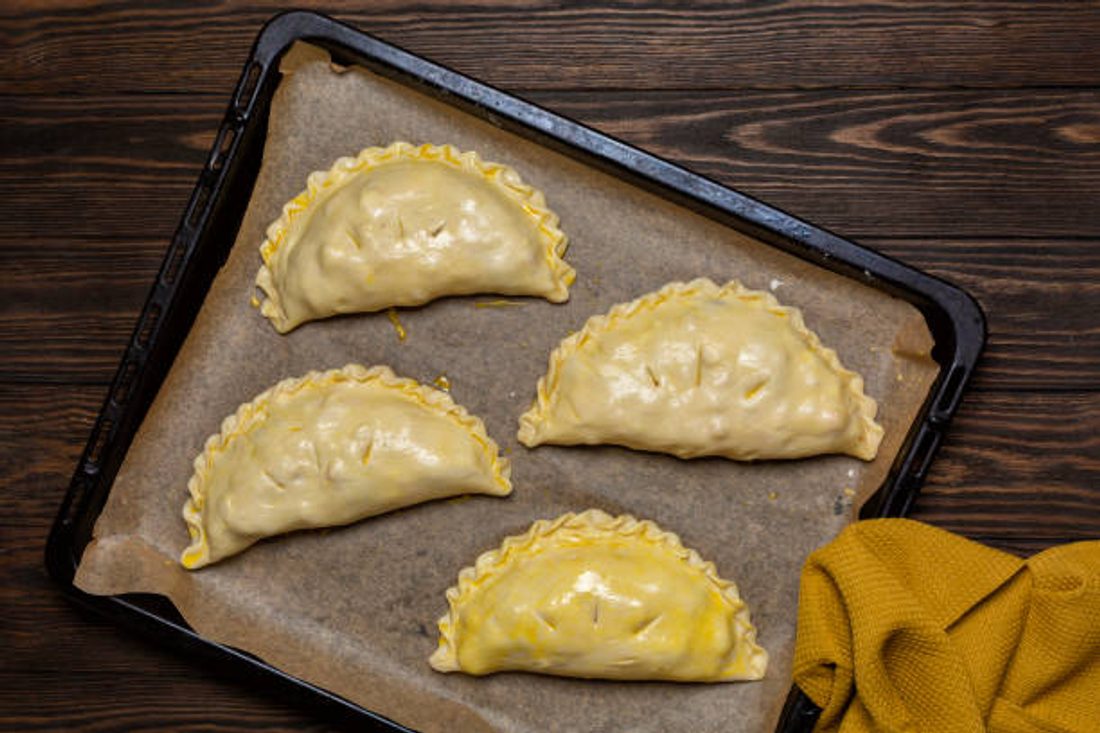 Raw-filled and crimped, vents cut, egg-washed, headed for a long moderate bake. The filling goes in uncooked and cooks itself into one thing inside the crust.
Pasty culture: it’s bigger than lunch
The pasty in the U.P. isn’t a menu item, it’s a piece of civic infrastructure. A few pieces of it worth knowing:
Pasty shops are everywhere, and many of them sell nothing else — no fries, no burgers, just pasties and maybe a slice of pie and a can of pop. Standalone pasty shops are as normal up there as taco stands in Texas.
The church-and-fundraiser pasty is its own institution. Fire departments, Finnish Lutheran churches, school booster clubs, and civic groups run pasty sales as fundraisers — big volunteer assembly lines cranking out hundreds of them, sold frozen by the dozen to fund a new roof or a ball team. If you buy a pasty off a card table in a church basement in October, you’re buying a very old tradition.
Pasty Fest happens every August in Calumet, up in the Copper Country, and it is exactly as gloriously strange as a food festival should be: thousands of pasties sold — well over seven thousand in a good year — plus a car show, a pasty-eating competition, and, for reasons that make sense only in Calumet, staged medieval sword duels in the street. It’s a whole town celebrating a hand pie, and it’s wonderful.
And the frozen mail-order business is real and large. Expat Yoopers get so homesick for pasties that the shops ship them frozen all over the country. A cardboard box of frozen pasties arriving in Arizona or Florida from the U.P. is a genuine expression of homesickness, and the shops have built serious businesses on it.
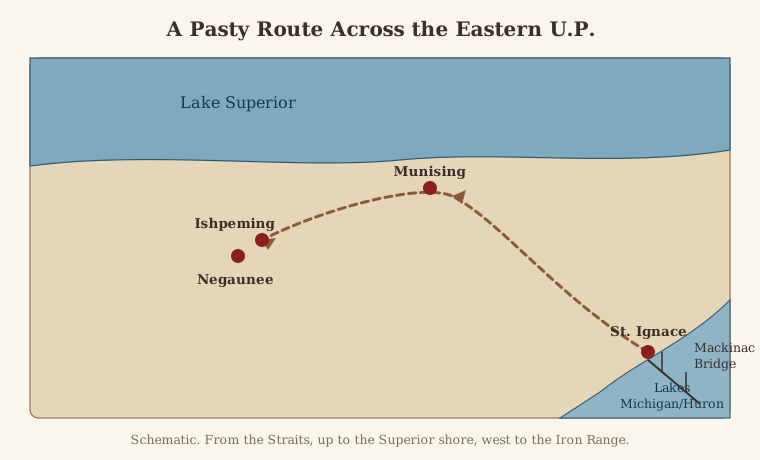
From the Straits at St. Ignace, up to the Lake Superior shore at Munising, and west to Ishpeming and Negaunee.
Two shops on our route
In a couple of weeks my son and I are driving the whole U.P. to revisit the places I’ve eaten over the years, and the route practically draws itself along the pasty trail. Two of the stops are pasty shrines, and they bookend the front half of the trip.
Lehto’s — St. Ignace
The moment you come down off the Mackinac Bridge into St. Ignace, you’re in the U.P., and one of the very first things you can eat is a Lehto’s pasty. Lehto’s (626 N. State Street) has been at it since 1947, when a young World War II veteran came home from the Army and started selling pasties — which makes it one of the oldest continuously running pasty shops in Michigan, now run by the third generation of the family. It’s small, it’s plain, and it does one thing. The pasties are hand-made the same way they’ve been made for three-quarters of a century, and there’s a reason people time their bridge crossing to hit it. Bring cash — it’s the kind of old-school place where that’s the expectation, not a modern quirk — and don’t expect a big menu. It’s a pasty. That’s the point. For a lot of us, Lehto’s is the taste of crossing into the U.P., the first-stop ritual that tells your stomach you’ve arrived. I’ve eaten there over the years, and it’s the first stop on this trip for exactly that reason.
Muldoon’s — Munising
From St. Ignace we follow the Lake Superior shore west, and the natural pasty waypoint on the way toward Ishpeming is Muldoon’s Pasties (1246 M-28) in Munising, right on the big lake near Pictured Rocks. Muldoon’s is younger than Lehto’s — a couple named Dale and Sally Beckwith opened it in 1989 to sell their own family recipe — but it earned its stripes fast, taking a U.P. People’s Choice award in a tourism-conference taste test in 2001, and it’s carried on under new family owners since the Beckwiths retired. It’s the kind of shop that draws both the Pictured Rocks tourists and the locals who know, which is usually a good sign. Munising is a natural lunch stop when you’re pointed west, and Muldoon’s is why.
Where the pasty sits
The pasty is the U.P.’s definitive food not because it was invented there — it wasn’t — but because the U.P. took a Cornish miner’s lunch, ran it through Finnish and a dozen other kitchens, and made it into something a whole region agrees is theirs. It carries the mining history in its shape, the immigration history in its seasoning arguments, and the local character in its condiment wars. It’s honest food: cheap, filling, portable, made to fuel hard work in a hard climate. And it’s still, right now, the thing you eat first when you come over the bridge.
If you want to go deeper into the country that made it, the history of the U.P. and the mining industries that drew the miners set the stage, and the immigrant kitchens — Cornish, Finnish, Italian, and more — explain why the food up there tastes the way it does. And once you’ve had your pasty, the natural next stop on the iron range is the sandwich the range kept almost entirely to itself: cudighi. But we’ll get to that. First, eat your pasty. Ketchup optional. I won’t judge. Much.
Comments (0)