Copper, Iron, Timber and Fish: The Industries That Built the Table
The pasty is a mining food. That single fact is the key to the whole U.P. table, and you can’t really understand it — or the cudighi, or the fish fry, or the Finnish rusk — without understanding the industries that pulled a hundred thousand hungry immigrants onto a cold, remote peninsula in the space of a couple of generations. People don’t move to a place like this for the weather. They came for what was under the ground and in the water, and the brutal, dangerous, freezing work of getting it out is exactly what shaped what they ate.
There were four big industries, and they arrived roughly in this order: copper, iron, timber, and fish. Three of the four have largely gone quiet now, and in their place has come a fifth thing — tourism — which is really the reason a road trip like the one my son and I are about to take exists at all. This page is the story of all five, and the thread running through it: hard work demands hard food, and when the hard work leaves, the food is one of the things that stays.
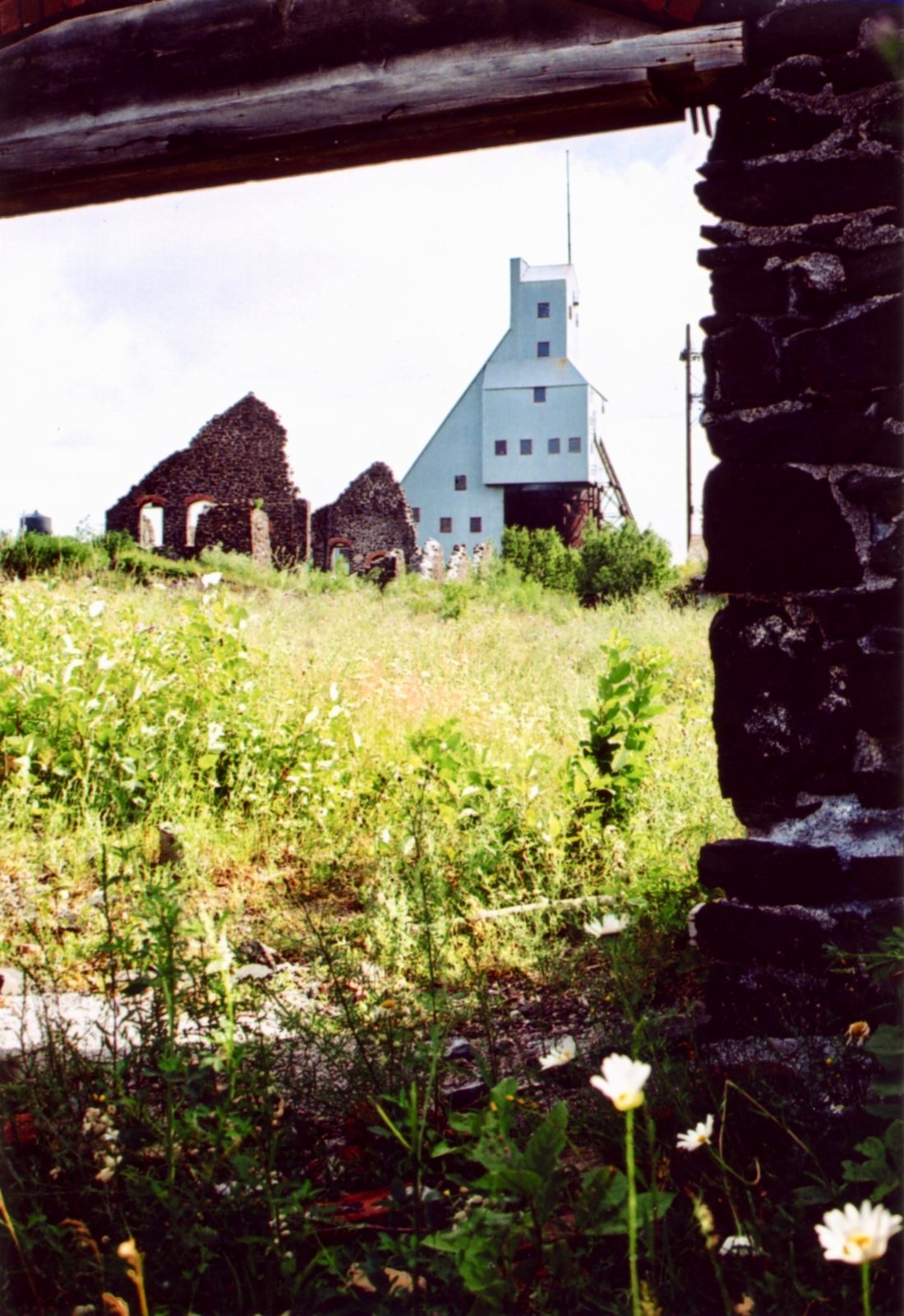 A surviving mine headframe in the Keweenaw. For a century, structures like this crowned the shafts that pulled copper and iron out of the U.P. and pulled immigrants in.
The Copper That Was Already Metal
Start with copper, because copper came first — by about eight thousand years.
Almost everywhere on earth, copper comes out of the ground as ore: locked up in a chemical compound that has to be crushed and roasted and smelted to release the metal. The Keweenaw Peninsula is the great exception. Here, uniquely among major deposits, the copper occurs as native copper — pure, metallic copper, sitting in the rock as nuggets, sheets, and sometimes massive multi-ton slabs, needing no smelting at all. You could, in principle, cut a piece off and hammer it into a tool. And people did, for thousands of years before any European arrived.
The Keweenaw is, as far as anyone knows, the only place in what’s now the United States where prehistoric people mined copper. Indigenous peoples were digging shallow pits here and working the metal at least eight thousand years ago — hammering it cold, and with heat, into knives, awls, fishhooks, beads, and ornaments that got traded across an astonishing distance, down into the mound-building cultures of the Ohio and Mississippi valleys. It’s one of the oldest known metalworking traditions anywhere in the Americas, and it was going on right here, on this snowbound finger of land, millennia before the copper boom the history books usually start with.
That later boom began in the 1840s. A Michigan state geologist named Douglass Houghton published a report in 1841 documenting the region’s copper, and it set off one of America’s first true mining rushes — earlier than the California Gold Rush of 1849. In 1842 the federal government pressured the Ojibwe into a treaty ceding their mineral rights across the peninsula, in exchange for payments worth a small fraction of what would come out of the ground. Then the prospectors and the capital poured in.
Calumet, Hecla, and the Company That Ran a World
Out of that rush grew some of the most productive mines on the planet. The giant was the Calumet and Hecla Mining Company — “C&H” — which by the second half of the nineteenth century dominated American copper and, for a stretch, led the world in production and mining technology. Around it grew Calumet, a company town of tens of thousands with an opera house, a library, streetcars, and immigrants speaking a dozen languages. For a while the Copper Country was one of the richest, most cosmopolitan corners of the whole Great Lakes.
The numbers are staggering in hindsight: from the mid-1840s until the mines finally wound down, the Keweenaw yielded on the order of ten and a half billion pounds of copper. This one narrow peninsula wired a good part of industrializing America.
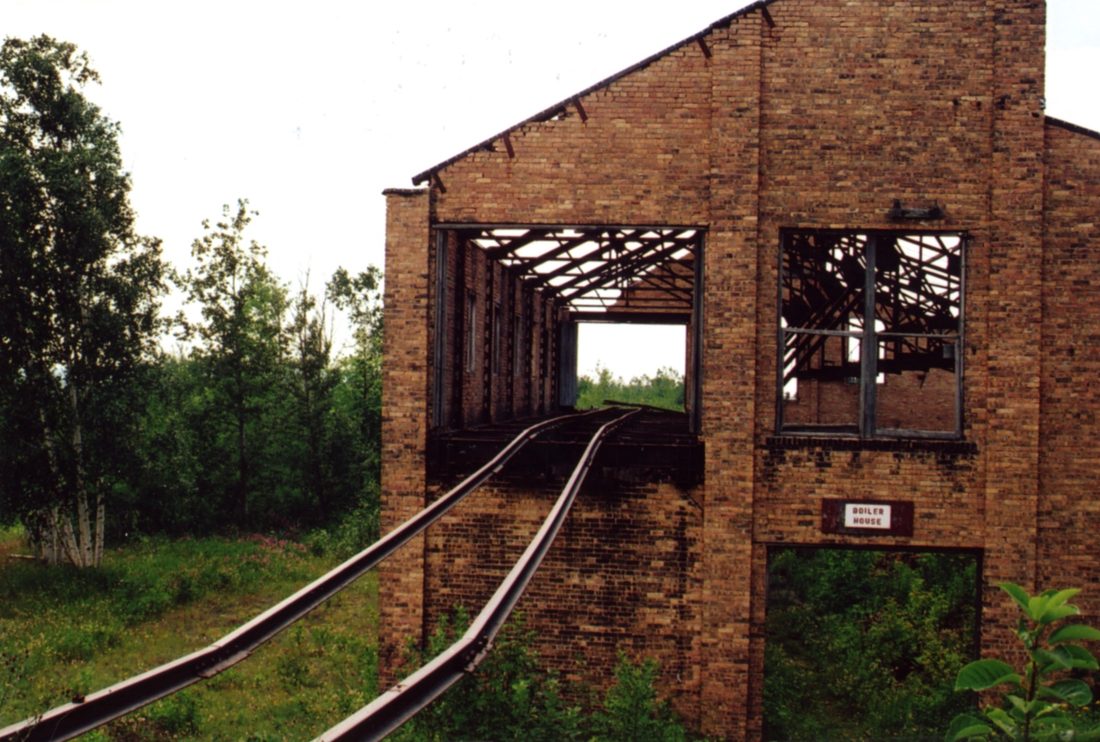 The stone shells of Copper Country mines and mills still stand in the woods around Calumet. Calumet and Hecla mined here for over a century before closing in 1968.
But mining copper a mile underground, in the 1800s, was murderous work — and the wealth flowed overwhelmingly to the companies and their distant shareholders, not the men doing the dying. That tension broke open in the Copper Country Strike of 1913–14, and it produced one of the darkest days in Michigan history.
The Italian Hall Disaster
The strike began on July 23, 1913. Thousands of miners, organized by the Western Federation of Miners, walked out demanding higher pay, an eight-hour day, and above all an end to the one-man pneumatic drill — a machine that let the companies cut crews in half and that the miners called the “widow maker,” both for the men it put out of work and for the rock dust it drove into their lungs. The companies refused to even recognize the union. The strike dragged on for months, bitter and violent, straight into the winter.
On Christmas Eve, 1913, the striking families gathered for a holiday party for the children on the second floor of the Italian Hall in Calumet. During the party, someone — never identified, then or since — shouted “Fire!” There was no fire. But the crowd stampeded for the stairs, and in the crush on that narrow stairwell, seventy-three people were trampled and suffocated to death. Most of the dead were children. It remains one of the worst disasters of its kind in American history, and it happened at a children’s Christmas party.
The event scarred the Copper Country permanently, and it entered the wider American memory partly through Woody Guthrie’s song “1913 Massacre,” which tells the story with the accusation — never proven, but widely believed by the strikers — that the false alarm was raised deliberately by company men, who then held the doors shut. The coroner’s inquest and a congressional hearing never pinned down who yelled fire. The strike itself collapsed a few months later, in April 1914, a defeat for the union. And the disaster is still remembered every year in Calumet, where the arch of the demolished hall’s doorway now stands as a memorial.
I mention all this on a food page for a reason. The immigrant families who cooked the food this dive celebrates were not living some picturesque folk idyll. They were doing lethal work for outside owners, striking and starving and burying their children. The food was cheap and filling and portable because it had to be. Keep that in mind when we get to the pasty.
Iron: The Range That’s Still Running
Copper made the Keweenaw. Iron made the central and western U.P., and unlike copper, iron mining up here never entirely stopped.
There are three iron ranges in Michigan’s U.P. The Marquette Range is the oldest and most important — a belt of iron formation running roughly forty miles inland from the city of Marquette, through Negaunee and Ishpeming, toward L’Anse on Keweenaw Bay. West and south of it lie the Menominee Range, around Iron Mountain and Norway, and the Gogebic Range, stretching from Ironwood at the Wisconsin line eastward. Iron was discovered on the Marquette Range in the 1840s, at almost the same moment as the copper rush, and mining towns sprang up fast.
The classic image of the U.P. iron trade is the ore dock — the enormous elevated timber-and-steel structures along the Lake Superior and Lake Michigan shores at places like Marquette and Escanaba, where railcars full of ore or pellets ran out over the water and dumped their loads down chutes into the holds of waiting freighters. Marquette’s ore docks are still a defining feature of the city’s harbor, and the great lake freighters still call there. The iron went out by water, down the lakes to the steel mills of the lower Great Lakes — Cleveland, Gary, Detroit — and it built a large share of American industry.
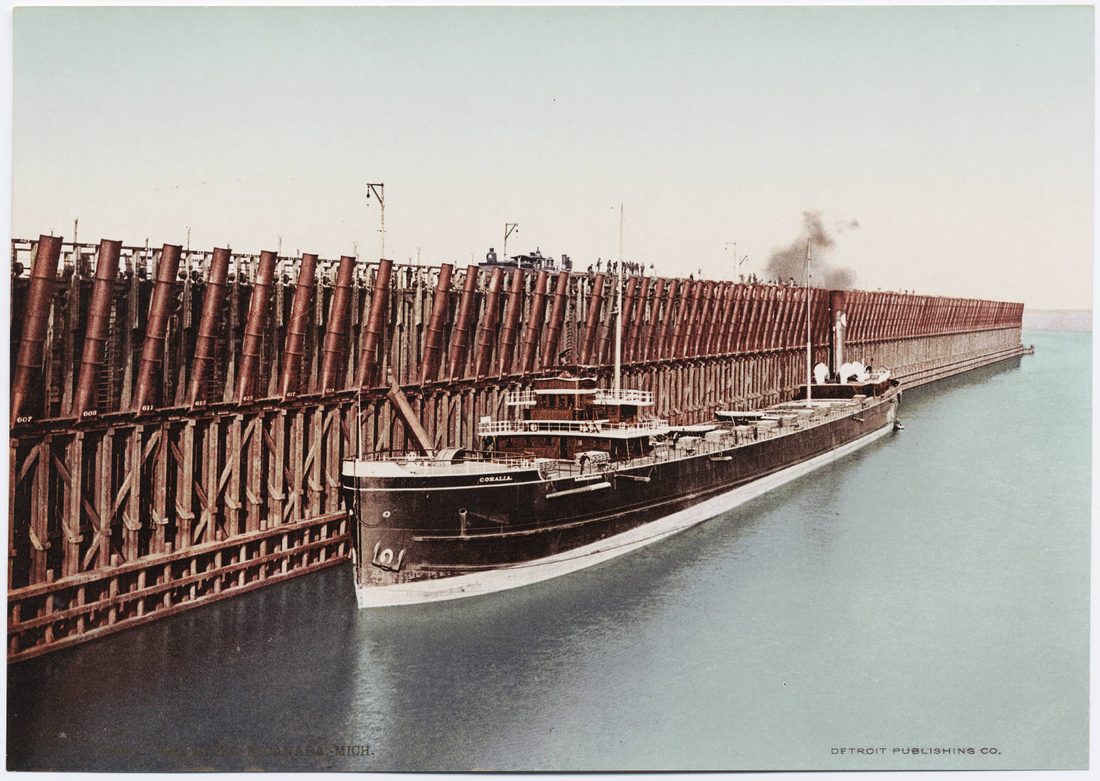 An ore dock at Marquette. Railcars ran out over the water to load iron into lake freighters bound for the steel mills of the lower Great Lakes.
Here’s the part people get wrong, so I want to be exact about it: iron mining in the U.P. is not a purely historical thing. Right outside Ishpeming — the town where my son and I will be staying — the Tilden Mine is still an active, working open-pit iron operation. It’s run by Cleveland-Cliffs, it’s one of the larger iron-ore pellet producers in the world, capable of turning out something on the order of eight million tons of pellets a year, and it is running today. Its neighbor, the Empire Mine, right alongside it, was a twin operation until 2016, when it was idled indefinitely. So the accurate picture near Ishpeming is: one big mine idled, one big mine still going. When you drive that stretch, you are not looking at a dead industry. You’re looking at a shrunken but living one — the last working piece of the great mineral boom that built the whole peninsula.
Timber: The White Pine and the Log Drives
Between and around the mines came the loggers, and for a few decades the U.P. — like the rest of the northern Great Lakes — was one enormous lumber camp.
The prize was white pine: tall, straight, light, and — crucially — buoyant. From roughly the 1840s to the turn of the twentieth century, loggers cut the U.P.’s pine at a ferocious pace to build the growing cities of the Midwest, to timber the mines, and to plank the boardwalks and barns of a settling frontier. The work was seasonal and it was organized around water. Crews cut through the winter, when it was easiest to skid the huge logs over frozen ground and snow to the banks of a river. Then in spring, when the snow melted and the rivers ran high, they drove the logs downstream — millions of tons of timber floating down to the sawmills on the lakeshore. The log drive, with river-men riding and steering the floating logs and breaking up the deadly jams, is the iconic image of the era.
It didn’t last, because it couldn’t. The great pineries were treated as inexhaustible and cut as if they’d never end, and by around 1905 the big white pine of the Upper Peninsula was essentially logged off — the Lower Peninsula’s had gone a decade earlier. The loggers left behind, in the phrase of the time, “an ocean of stumps.” The forest that covers the U.P. today is largely second- and third-growth that came back over the following century, along with the maple and birch and aspen that fill the hardwood country. But the logging era left its own mark on the population — many of the Scandinavians and French-Canadians came for the timber as much as the ore — and on the appetite. A logging camp ran on volume: enormous quantities of plain, heavy, sustaining food, cooked by a camp cook who was one of the most important men in the outfit. Pasties, stews, beans, dense bread, pie. The pattern is the same as the mines: cold, exhausting work demands cheap, filling fuel.
Fish: The Harvest From the Lakes
The fourth industry didn’t come from the ground at all — it came from the water, and it’s the one most directly tied to the table. Commercial fishing on the Great Lakes has been part of U.P. life from the earliest days: whitefish, lake trout, herring, and more, netted from Superior, Michigan, and Huron by small family operations working out of harbor towns all around the peninsula.
I’m going to keep this brief here, because the whitefish and the fishery it comes from get a full page of their own in this dive — including the family fish houses like Thill’s in Marquette, where we’re planning to eat, that still bring the catch in fresh and sell it over the counter. But it belongs in the list of industries that built the table for one obvious reason: the fish fry, the smoked whitefish, the fish spread on a cracker, the whole Friday-night ritual of fried lake fish across the U.P., exists because the lakes were a working food source, not a scenic backdrop. The lakes fed the miners and the loggers too. For the full story of that, see the whitefish dinner page — and my own Michigan whitefish dinner recipe.
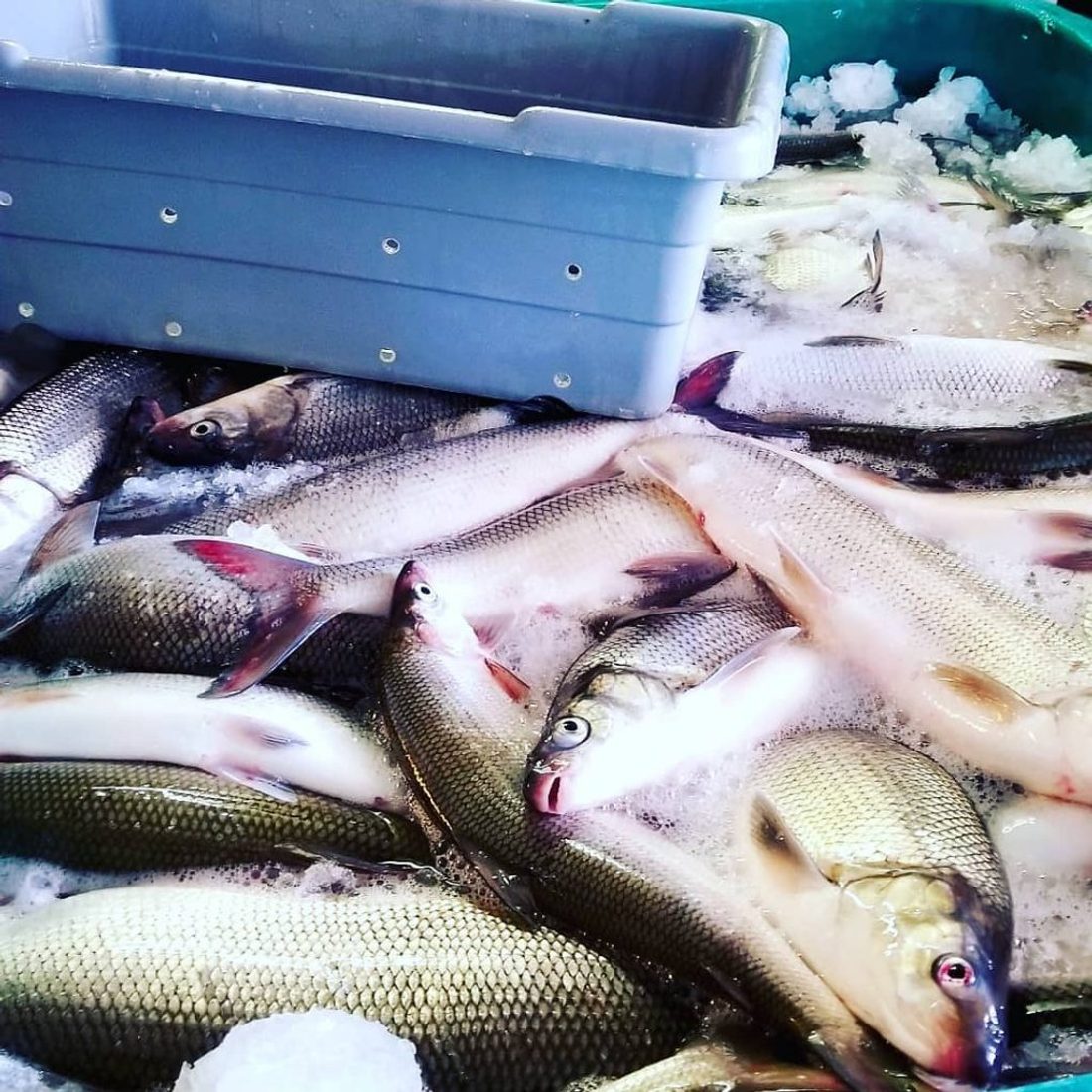 Whitefish on ice. Commercial fishing on the big lakes has fed the U.P. since before the mines, and the family fish houses that sell it fresh are still going.
Why All of This Made the Pasty
Now pull the four together, because they share a shape, and that shape is the whole reason the U.P. eats the way it does.
Copper mining, iron mining, and logging were all hard, cold, dangerous, and remote. A miner went down a shaft at dawn and didn’t come up until his shift ended, hours later, a mile underground where it was dark and often hot and always dangerous. A logger was out in the frozen woods all day. There was no going home for lunch, no café on the corner, no way to keep a hot meal hot. What these men needed was food that was cheap (because they were poor and the companies paid little), filling (because the work burned enormous energy), portable (because it had to be carried to the workface), eaten with one hand and no utensils (because you ate where you worked, on a rock, in the dark), and ideally still good cold, or easy to reheat (a miner could warm one on a shovel held over a candle, or on the heat of the mine itself).
Describe those requirements to anyone and you have essentially defined the pasty: a self-contained meal of beef, potato, onion, and rutabaga sealed inside a thick, sturdy pastry crust, with a crimped edge you could hold like a handle and throw away. It was invented in the tin mines of Cornwall for exactly these conditions, and when Cornish miners — the most experienced hard-rock miners in the world — came to the Keweenaw and the iron ranges, the pasty came with them and fit the U.P. mines like it had been designed for them. From there it spread to every other group underground. The industries didn’t just bring the people who made the food. The nature of the work selected for the food itself. Cheap, portable, filling, reheatable: that’s a mine lunch, and it’s the pasty in one breath.
For how the pasty then jumped from the Cornish to the Finns and the Italians and everyone else, and became the food of a whole region, see Who Came, and What They Cooked and the pasty page itself.
The Bust, and the Pivot to Tourism
Booms end. The copper mines closed one after another through the twentieth century — Calumet and Hecla, the giant, finally shut down in 1968. The iron trade shrank hard, leaving that one working mine near Ishpeming and a lot of idle ones. The pine was gone by 1905 and the industry that replaced it, pulp and paper, is a shadow of the old lumber boom. And when the work went, the people went. The U.P.’s population peaked in the mining heyday and has drifted down or held flat ever since. Towns that once bustled with thousands became quiet or emptied out entirely into the woods.
What has come up in place of copper, iron, and timber is tourism, and it’s now one of the pillars the U.P. economy leans on. And it turns out the very things that made the peninsula such a hard place to work — the remoteness, the cold, the wild empty forest, the enormous lakes, the buried mining ruins — are exactly the things that make it a spectacular place to visit.
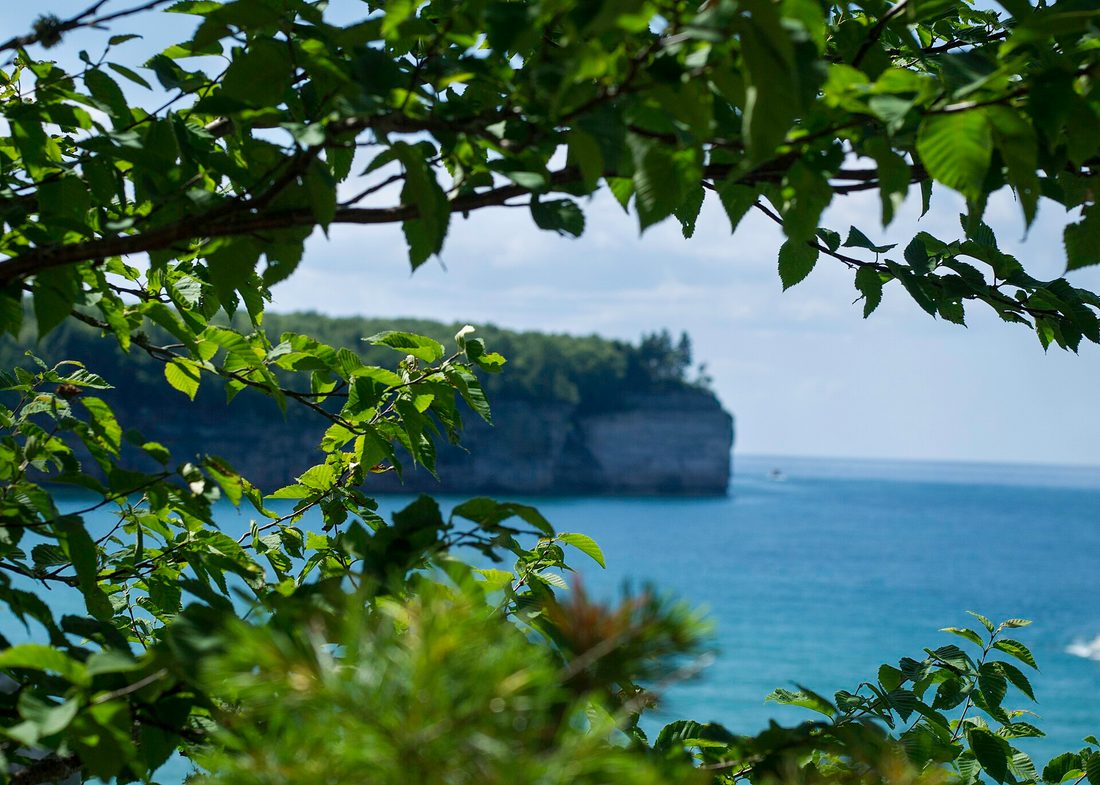 The sandstone cliffs of Pictured Rocks National Lakeshore run 42 miles along Lake Superior near Munising. Landscapes like this are the backbone of the modern U.P. economy.
The list of draws is long and genuinely world-class. Pictured Rocks National Lakeshore runs some forty-two miles of multicolored sandstone cliffs along Lake Superior between Munising and Grand Marais — Munising being right where we’ll stop for pasties at Muldoon’s. Tahquamenon Falls, in the eastern U.P., pours over a two-hundred-foot-wide drop stained a deep amber-copper color by tannins leached out of the cedar swamps upstream — one of the largest waterfalls east of the Mississippi. In winter, the U.P.’s enormous snowfall becomes an asset, drawing snowmobilers to hundreds of miles of groomed trails and skiers to the hills. In autumn, the hardwood forests turn, and “leaf-peeping” season now rivals summer in some towns. And year-round there’s the fishing, the hiking, the paddling, the hunting, and the sheer pleasure of a place with almost nobody in it.
That’s the frame for our whole trip. My son and I aren’t going to the U.P. to mine copper or drive logs down a river. We’re going because the descendants of the people who did are still there, still cooking, and because the wild country the mines couldn’t tame is some of the most beautiful in America. We’ll cross the bridge, eat a pasty in St. Ignace, drive the Lake Superior shore past Pictured Rocks, and base ourselves in Ishpeming — an iron town, right next to a mine that’s still running — and spend our days hiking and fishing and eating. The tourism economy that makes that possible is the U.P.’s fifth industry, and in a sense it’s the one that keeps all the others alive as memory and flavor.
What Endures
Three of the four old industries have gone quiet. The copper is done. The pine is a century regrown. Iron holds on at a single big mine. Only the fishery still runs at anything like its old scale, and even that is much diminished. But the food those industries demanded and shaped did not go quiet at all. The pasty shops are still there. The cudighi is still griddled in Ishpeming and Negaunee. The fish house still sells whitefish over the counter in Marquette. The Finnish bakeries still turn out cardamom bread and rusk.
That’s the thing I keep coming back to. Industries are fragile — they boom and bust and abandon a place in a generation. But a food that a whole community learned to love in hard times can outlast the very thing that created it by a hundred years and counting. The copper made Calumet and then left it. The pasty it demanded is still on the menu across the whole peninsula. When you eat one up here, you’re eating the last living piece of the mining boom — the part that refused to close down.
Next: Who Came, and What They Cooked — the peoples who did all this work, why they crossed an ocean for it, and the kitchens they brought with them.
Comments (0)