Thimbleberries and the Wild Larder
There’s a berry up north that you can’t buy in a grocery store, can’t order online in fresh form, and can’t grow on a commercial farm no matter how much money you throw at it. It grows thick along the roadsides and forest edges of the Keweenaw Peninsula and up the Lake Superior shore, ripens for a few short weeks in the back half of summer, and then it’s gone. If you want it, you pick it yourself, or you pay a startling price for a small jar of jam that somebody else picked by hand.
That berry is the thimbleberry, and once you understand why it can’t be tamed, you understand something important about the whole Upper Peninsula table. So much of what makes U.P. food special is that it comes out of the woods and the water and the long memory of the people who settled there, not off a truck. The thimbleberry is the purest example I know. It refuses to be a commodity. You either go to it, on its terms, in its season, or you don’t get it at all.
I’ve been eating my way around the U.P. for a long time, and in a couple of weeks I’m taking my son up over the Mackinac Bridge to do the whole loop again. This page is about the wild part of that larder — the berries, the mushrooms, the syrup, the deer camp, the fish — because you can’t really tell the story of Yooper food without it. But it starts with one small, soft, impossibly good berry.
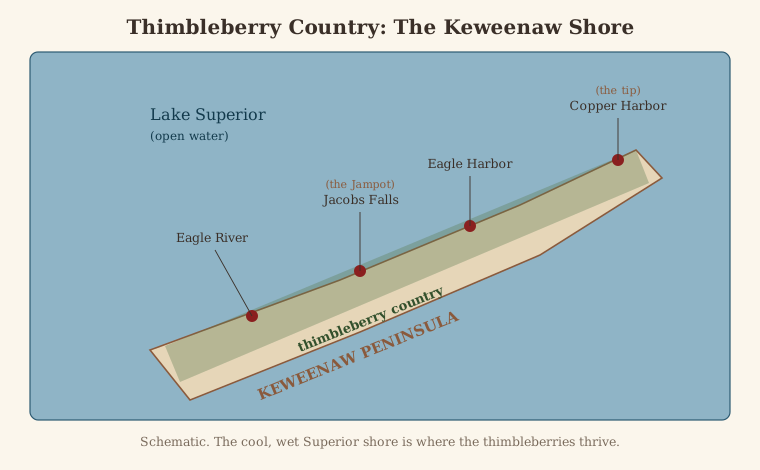
The cool, wet Lake Superior shore of the Keweenaw — Eagle River to Copper Harbor — is where the thimbleberries grow.
What a thimbleberry actually is
Let me get the botany right, because there’s some confusion out there. The thimbleberry that grows in the Keweenaw and along Lake Superior — the one people make jam from — is Rubus parviflorus, sometimes called the western thimbleberry. It’s a member of the genus Rubus, which makes it a cousin to raspberries and blackberries. There’s another plant sometimes called thimbleberry, Rubus odoratus, the purple-flowering raspberry, which grows in the eastern U.S. and has showy pink-purple flowers, but that’s not the U.P. jam berry. The Keweenaw plant has broad, soft, maple-shaped leaves and simple white flowers, and it’s R. parviflorus you want to know about.
Here’s what the fruit is like. A thimbleberry looks a bit like a shallow, wide raspberry, but flatter and softer — more like a little red cap or, yes, a thimble. When you pick a raspberry it comes off the plant leaving a hollow core, and the berry holds its shape. A thimbleberry is far more delicate. It’s essentially a fragile dome of tiny seed-filled druplets with almost no structure to hold it together. Pick it a hair too firmly and it collapses into a smear of juice and seeds in your fingers. That fragility is the whole story.
The flavor is intense. People who’ve only had grocery-store raspberries are often surprised — it’s tart and floral and deep, less sugary than a cultivated raspberry and more wild tasting, with a lot of seed for the amount of pulp. That high seed-to-pulp ratio matters when you go to make jam, and it’s part of why a little goes a long way.
The plant itself is easy to learn once you’ve seen it. The canes are thornless — a real mercy compared to fighting a raspberry or blackberry bramble — and can grow chest-high or taller in a good stand. The leaves are the tell: big, soft, and shaped like a maple leaf, palm-sized or bigger, a light matte green. In early summer the plants throw simple five-petaled white flowers, and by mid-to-late summer the fruit comes on, ripening from firm and pale to a soft, deep, glowing red. When it’s ready, a ripe berry practically falls off the plant into your hand — which is both how you know it’s ready and why it’s such a nuisance to gather without crushing.
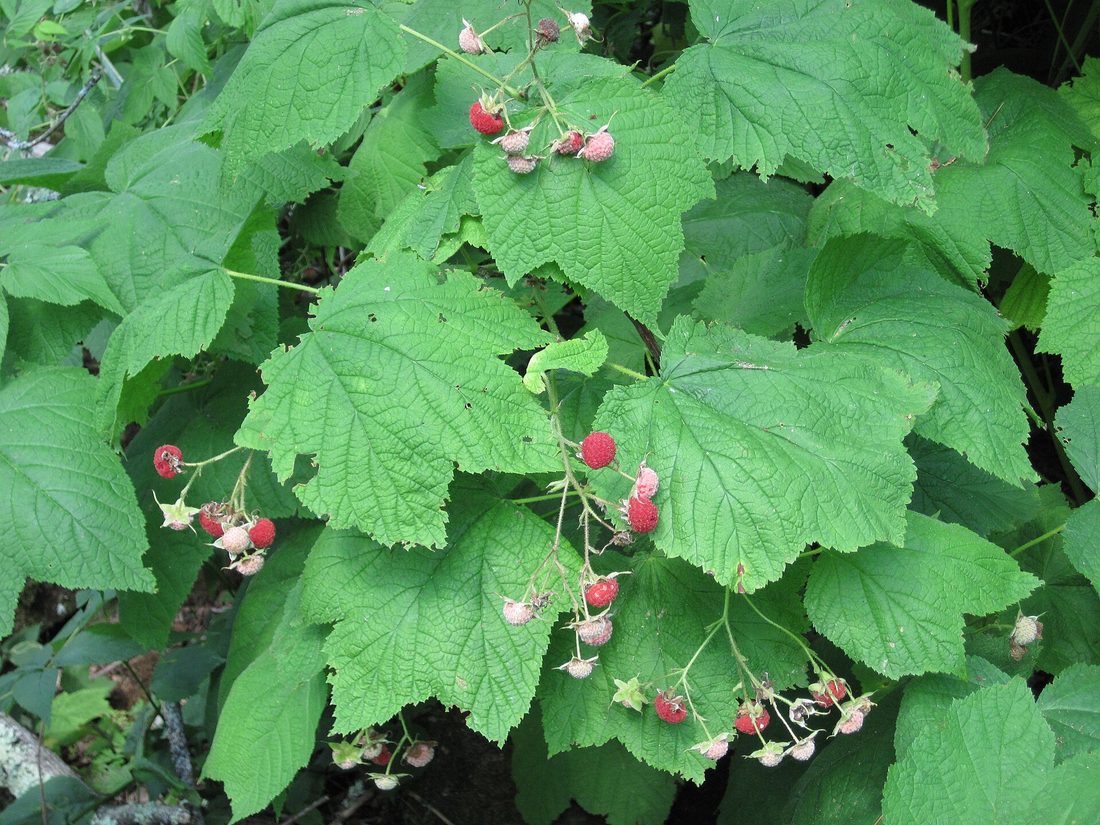 Ripe thimbleberries on the plant. The broad, soft, maple-like leaves are the easiest way to spot the patches from a slow-moving car — the berries themselves hide underneath.
Why it can’t be farmed or shipped
This is the part I find genuinely fascinating, and it’s worth being precise because it’s easy to repeat the legend without the facts. Several real things combine to keep the thimbleberry wild.
It’s too soft to ship. The berry has thin, delicate skin and essentially no shelf life once picked. A raspberry is already a fragile fruit that bruises in the clamshell; a thimbleberry is far more fragile than that. It won’t survive being boxed, trucked, and stocked. By the time it reached a distant store it would be juice. That alone rules out the fresh-market supply chain that makes every other berry a year-round commodity.
There are no cultivated varieties bred for production. Blueberries, raspberries, strawberries, blackberries — all of them have been selectively bred over generations into farm cultivars chosen for yield, firmness, uniform ripening, and durability. Nobody has done that for the thimbleberry. It remains essentially a wild plant. And it’s what the growers call an underproducer: a mature plant sets only a handful of berries, and they don’t all ripen at once, so even where the canes grow thick you’re getting a modest harvest spread over the season.
The season is short and the picking is all by hand. In the Keweenaw the thimbleberry season runs roughly from mid-July into late August — a window of a few weeks. Because the berries ripen unevenly and fall apart at a firm touch, there’s no mechanical harvest, no way to run a machine down a row. Every single berry that ends up in a jar was picked, gently, one at a time, by a human hand, and then used quickly before it spoiled.
Put those together and you have a fruit that is structurally impossible to industrialize. It’s not that nobody’s tried hard enough. It’s that the thing that makes it delicious — that soft, seed-heavy, just-barely-holding-together fruit — is exactly the thing that makes it un-shippable and un-farmable. Scarcity isn’t marketing here. It’s biology.
And the picking itself is a whole social thing in the Copper Country, not just a chore. When the berries come on in the back half of summer, families and neighbors head out to the patches they know — a roadside stretch, an old logging edge, a spot Grandma always went to — and spend the afternoon bent over the canes, buckets or ice-cream pails in hand, working slowly because you have to. It’s the kind of communal, low-stakes, hands-in-the-bushes outing that binds a place together, and there’s now even a Keweenaw Thimbleberry Festival celebrating exactly that. The berry’s stubbornness is precisely what keeps it a shared local ritual instead of a product on a shelf. You can’t outsource picking a thimbleberry, so the whole community does it together.
Thimbleberry jam, and why the price is honest
So the way you preserve a berry that can’t travel is you cook it, right where it grows, into jam. Thimbleberry jam-making started as a home tradition in the Copper Country, passed down in families, a way to hold onto the taste of a few August afternoons. Eventually enough outsiders wanted it that some families started selling their jars, and it became one of the U.P.’s signature souvenirs.
The classic preparation is almost aggressively simple: thimbleberries and sugar, and not much else. No pectin needed, because the berries carry enough of their own, and honestly a good thimbleberry jam is often a little loose and runny anyway — that’s normal, not a defect. Some makers use close to equal parts berries and sugar by weight, cook it down briefly to keep the flavor bright, and jar it. That’s it. The whole point is to taste the berry, so you don’t bury it under a lot of other ingredients. It works beautifully on toast, on a biscuit, spooned over ice cream, or — my favorite — on a piece of Trenary toast (more on that on the Trenary Toast page).
Now, the price. A small jar of real thimbleberry jam costs many times what you’d pay for a jar of raspberry preserves, and every time somebody sees the shelf tag they do a double take. But think about what you just read. That jar holds berries that a person walked out to a roadside patch and picked one at a time, bending over the canes, filling a container slowly because the plants are underproducers and the fruit dissolves if you rush. There’s no farm, no machine, no economy of scale to bring the cost down. The high seed-to-pulp ratio means it takes even more berries to get a given amount of usable pulp. When you buy that jar you are paying, fairly, for human hands and a short season. I’ve never begrudged the price once I understood it. It might be the most honestly-priced food I know.
There’s a wrinkle worth knowing if you ever try to buy it: because the supply is so limited and the demand outstrips it, some jams sold as “thimbleberry” are actually blends, cut with other berries to stretch the precious ones, or thimbleberry-flavored rather than pure. That’s not always a scam — a blend can be perfectly good and honest if it’s labeled as one — but if you want the real, pure, single-fruit article, read the label and expect to pay for it. Pure thimbleberry jam is a short list of ingredients and a long price, and that’s how you know.
Where do you get it? Roadside stands and small shops all over the Keweenaw and the Copper Country, gift shops and general stores up the peninsula, and — the famous one — the Jampot.
My thimbleberry jam recipe is right here — the simple berries-and-sugar method, with honest notes about how loose it sets and how much fruit it takes.
The Jampot
If there’s one destination that has fused thimbleberry jam with a genuine sense of place, it’s the Jampot, and the story behind it is one of my favorites in all of U.P. food.
Along scenic M-26 on the Lake Superior side of the Keweenaw, between Eagle River and Eagle Harbor, right at Jacobs Falls, there’s a monastery. It belongs to a small community of Byzantine Catholic monks — the Society of St. John, at the Holy Transfiguration Skete. A skete is a small monastic settlement, and these monks support themselves almost entirely by what they make and sell out of a little shop by the road called the Jampot.
They sold their first jar of preserves in 1986, made from local wild berries, and they’ve been at it ever since. The jams and jellies go out under the label Poorrock Abbey, and the lineup leans hard into what the Keweenaw actually offers — wild thimbleberry, of course, plus golden raspberry, chokecherry, and a rotating cast of local fruit. But the monks aren’t only jam-makers. The Jampot is also a bakery, and they’re famous for their fruitcakes (genuinely good, not the punchline kind), their muffins, cookies, chocolates, and other baked goods. They outgrew their old building and put up a larger one closer to the falls in 2015 to keep up with demand.
What I love about it is that everything about the place is real. It’s not a themed roadside attraction. It’s monks, in a working monastery, making preserves and cakes as their livelihood, in one of the most beautiful stretches of shoreline in the country, from berries that grow in the ditches out front. You pull over, you walk in, you buy jam and a muffin from a monk, and you eat it looking at Lake Superior. That’s the U.P. in one stop.
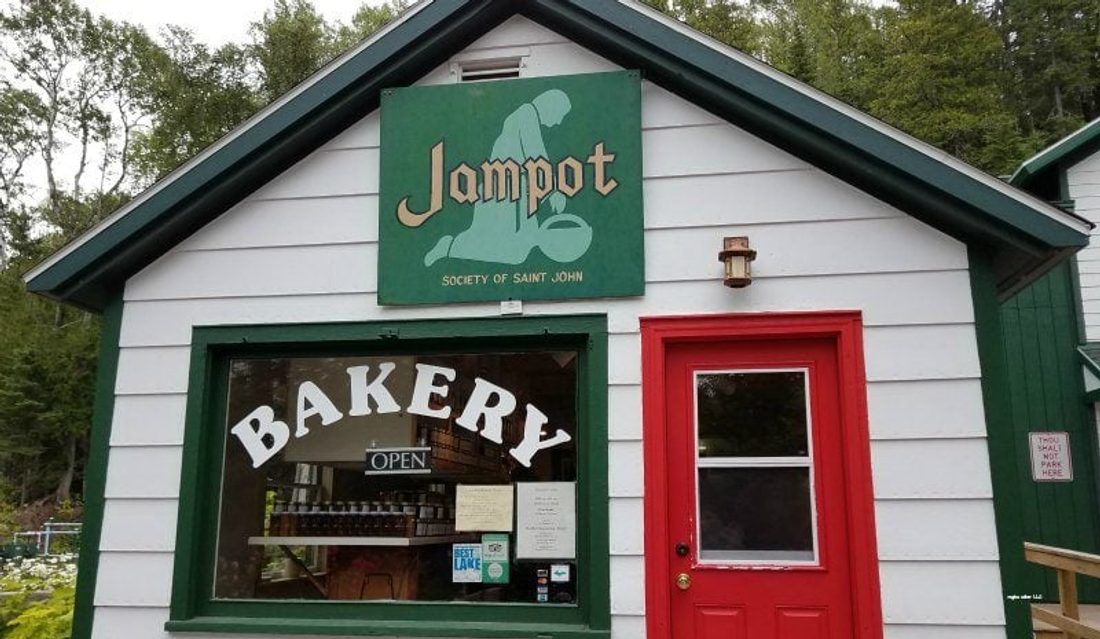 The Jampot, on M-26 near Jacobs Falls between Eagle River and Eagle Harbor. The monks of the Society of St. John have been selling wild-berry preserves here since 1986.
A note on that: the Keweenaw is up at the far tip, past Houghton and Hancock, well north of the Ishpeming-Marquette base my son and I are working from on this trip. Whether we make the full run up to Eagle Harbor depends on the days. But the Jampot is the kind of place I want him to see at least once, so if we can steal a day for it, we will.
The wider wild larder
The thimbleberry is the headliner, but it’s one act in a much bigger show. The U.P. woods and waters put a whole pantry on the table if you know where and when to look. Here’s the honest inventory — what actually grows and gets hunted up there, not a padded list.
Wild berries beyond the thimbleberry
Wild blueberries. The U.P. is lowbush blueberry country, and picking them is a genuine summer institution. These aren’t the big cultivated highbush berries you get in a clamshell down south — they’re small, low to the ground, and intensely flavored, and they ripen from mid-to-late summer. People forage them in places like the Hiawatha National Forest and the old burned-over and cut-over ground where they thrive. Half the fun is the picking itself; families go out with buckets and stained fingers and come home with pies in mind.
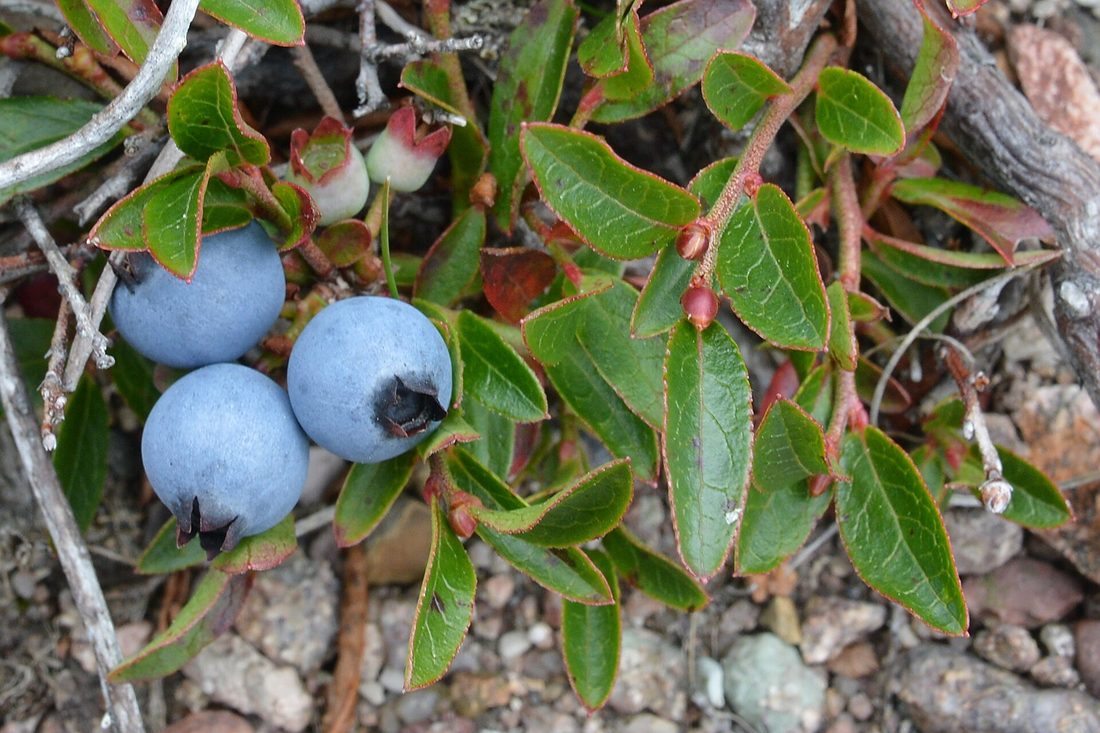 Wild lowbush blueberries — small, low to the ground, and far more intense than any cultivated berry. Picking them is a summer institution across the U.P.
Wild strawberries, raspberries, and blackberries. All three grow wild across the peninsula. Wild strawberries are tiny — a fraction of the size of the cultivated ones — and worth the stooping for a flavor that’s concentrated to an almost unfair degree. Wild raspberries and blackberries fill in the mid-to-late summer bramble season along the same edges and clearings where you find everything else.
Chokecherries. Small, astringent, dark stone fruit that you would never eat by the handful raw — they’ll pucker your whole face — but that cook down into a wonderful tart jelly and syrup. This is one of the flavors the Jampot’s Poorrock Abbey line leans on, and it’s a classic U.P. and northwoods preserve.
Juneberries (serviceberries). Also called saskatoons in some places, these ripen in early summer (hence “June”) and taste something like a mellow, almond-tinged blueberry. They grow on small trees and shrubs across the north and make excellent pies and preserves.
Highbush cranberries. Not a true cranberry at all — they’re a viburnum — but tart, red, and cranberry-like, ripening in fall and hanging on into winter. They make a sharp, bright jelly and sauce, another one for the fall preserving shelf.
Morels and the spring mushroom hunt
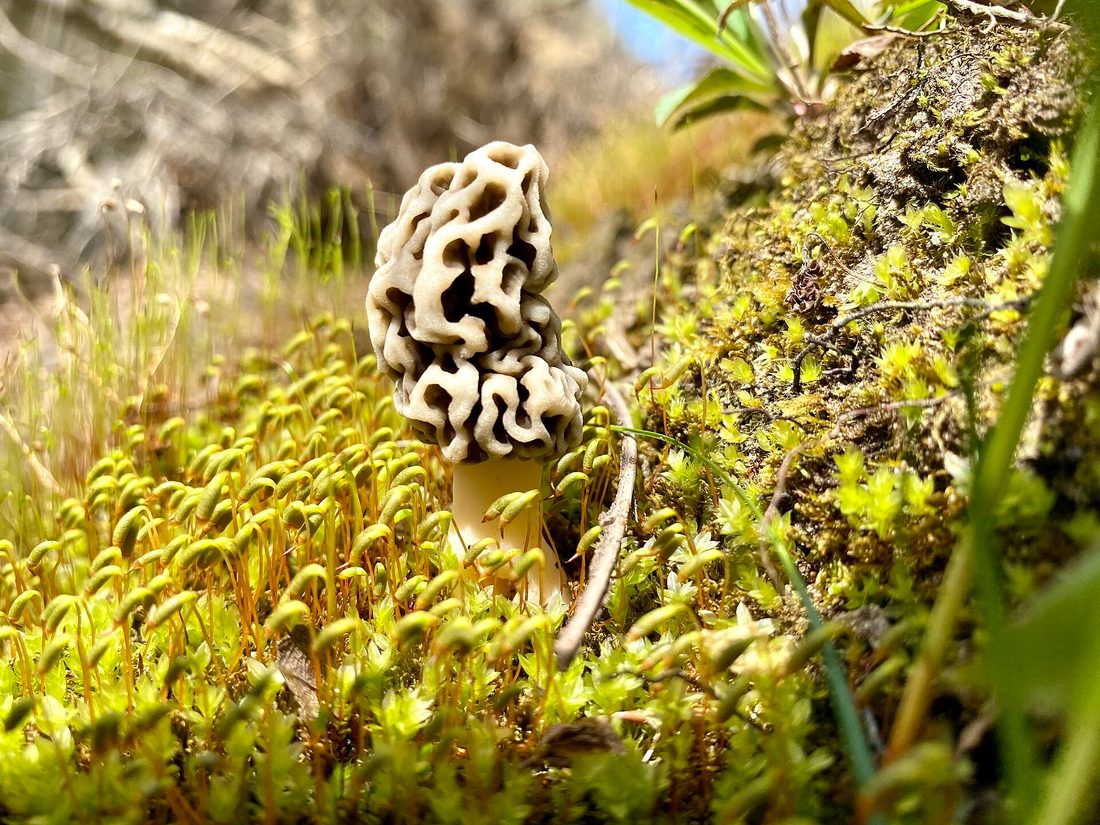 Morels, with their unmistakable honeycombed caps. In the U.P. they come on later than downstate, and their patches are guarded like family heirlooms.
Spring in the U.P. means morels. Morel season generally runs from around mid-April through mid-June, and because the Upper Peninsula is colder and later than downstate, the U.P. hunters see them toward the back end of that window. Morels want warmth and damp — daytime temperatures up around 50 and above, nights above 40, and a few days after a warm spring rain is prime. People are famously tight-lipped about their spots; a good morel patch is a family secret you take to the grave. If you find them, you clean them, and you cook them simply in butter, and you understand immediately what all the fuss is about.
Maple syrup — the sweet water
The U.P.’s hardwood ridges run to sugar maple, and late-winter-into-spring is sugaring time, when the sap runs and gets boiled down into syrup. It’s the same tradition I go deep on elsewhere, so rather than repeat myself I’ll point you there: my whole Tree Syrups dive covers how sap becomes syrup, why it takes roughly forty parts sap to one part syrup, and the difference between the trees. In U.P. terms, just know that maple syrup is part of the wild larder here too — a woods product, tapped from the same forests the berries and morels come out of.
Wild leeks (ramps)
In spring, before the trees fully leaf out, the forest floor greens up with wild leeks — ramps — the pungent, garlicky-oniony wild allium that foragers go a little crazy for. You dig the bulbs and use the leaves, and they turn up in everything from eggs to potatoes to, of course, sausage. A word on conscience: ramps are slow to regrow and easy to over-harvest, so the responsible pickers take a few from a patch and leave the rest. The good patches, like the morel spots, are kept quiet.
Venison and deer camp
You cannot talk about the U.P. wild larder without deer camp. The November firearm deer season is close to a regional holiday up there — kids have historically gotten time off, camps open up, families and friends gather at cabins, and a real amount of the year’s meat comes home over those couple of weeks. Venison is a serious food source, not a novelty, and it gets used all the way down: roasts and steaks, ground venison, and above all venison sausage and jerky and snack sticks, because that’s how you preserve and stretch a deer and make it taste like more than one meal.
That’s where the wild larder hands off to two of my other dives. The smoking and curing side — jerky, smoked sausage, snack sticks — lives in the Smoking dive, and the grind-and-stuff craft of making venison into links is the whole Sausage dive. Deer camp is the U.P.’s version of a harvest, and the smokehouse is where it gets kept.
Smelt, brook trout, and the fishing
The water gives as much as the woods. In spring, the smelt run brings people down to the streams and shorelines at night with nets and buckets to dip these small silver fish by the thousands, then fry them whole — a raucous, cold, wonderful tradition. In the rivers and inland lakes, brook trout are the prize, a beautiful native fish that belongs to clean cold water. Our trip includes fishing, and that’s the kind of fishing I mean — small streams, cold mornings, a pan waiting at the end of it.
The big lake fishing — whitefish, lake trout, the commercial nets — I treat separately, because Lake Superior whitefish is its own enormous subject and gets its own page. If you came here for the fish, head over to the Whitefish page, the sibling to this one. Between the two, berries-and-woods on this page and fish-and-water on that one, you’ve got the wild half of the whole U.P. table.
The through-line
Here’s what ties all of it together, and it’s the same thing the thimbleberry taught us at the top. The best of U.P. food is not manufactured — it’s gathered, hunted, tapped, netted, and picked, in its own short season, by the people who live there. The thimbleberry can’t be farmed. The morel can’t be bought fresh in a store worth trusting. The blueberries are on your knees in a burn. The venison is a November at deer camp. The syrup is a March of boiling sap. The smelt is one cold night with a net.
That’s not a limitation. It’s the whole appeal. It means that to really eat the U.P., you have to go there, and you have to go when the woods and the water are ready to give it to you. Which is exactly what my son and I are about to do. The plan, the route, and every good place on the list are laid out on the last page of this dive — The Whole U.P. Table, and a Trip Back to It. Bring an appetite and an empty jar.
Comments (0)