The Finnish Table: Nisu, Pannukakku and the Sauna
There are places in America where an immigrant heritage is a museum — a festival once a year, a name on a church, a word or two nobody uses anymore. The western Upper Peninsula is not that. Up in the Keweenaw and the copper country, Finnish isn’t a memory; it’s a living thing you can still eat, drink coffee with, and sweat out in a sauna on a Saturday night.
I want to walk through the Finnish table honestly, with the real names, because the food is genuinely wonderful and it’s also genuinely misremembered — even by people who love it. Half the fun is getting the words right.
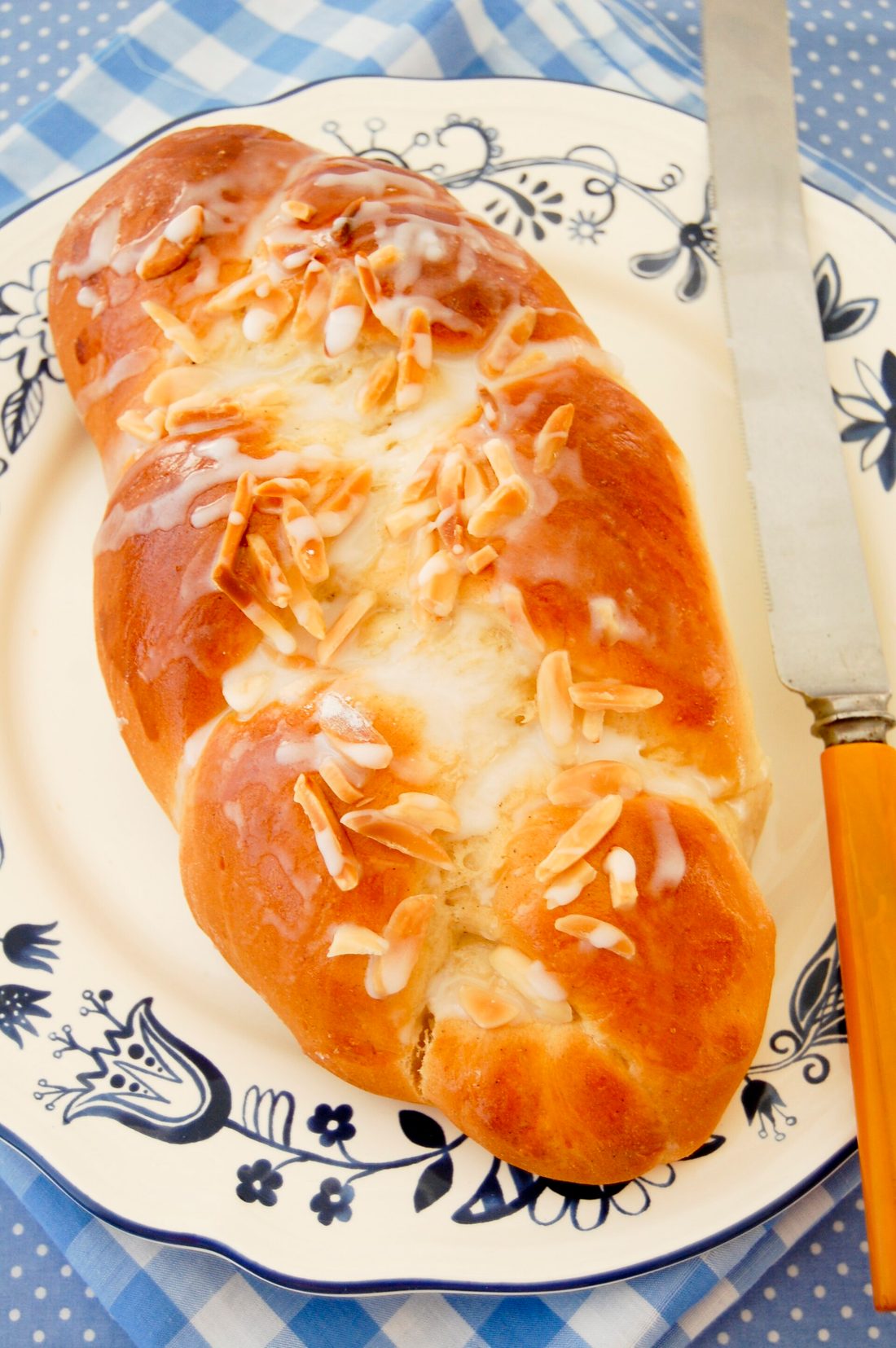
Nisu — the braided, cardamom-scented sweet bread that is the signature Finnish-American bake of the U.P. If a Yooper grandmother baked one thing, it was this.
Just how Finnish is the U.P.?
Let me put a real number on it, because it’s more extreme than people assume. The five northwestern-most counties of the Upper Peninsula — Houghton, Keweenaw, Baraga, Ontonagon, and Gogebic — are the only counties in the entire United States where people of Finnish ancestry are the single largest ethnic group. Not “a lot of Finns.” The largest group. Nowhere else in the country.
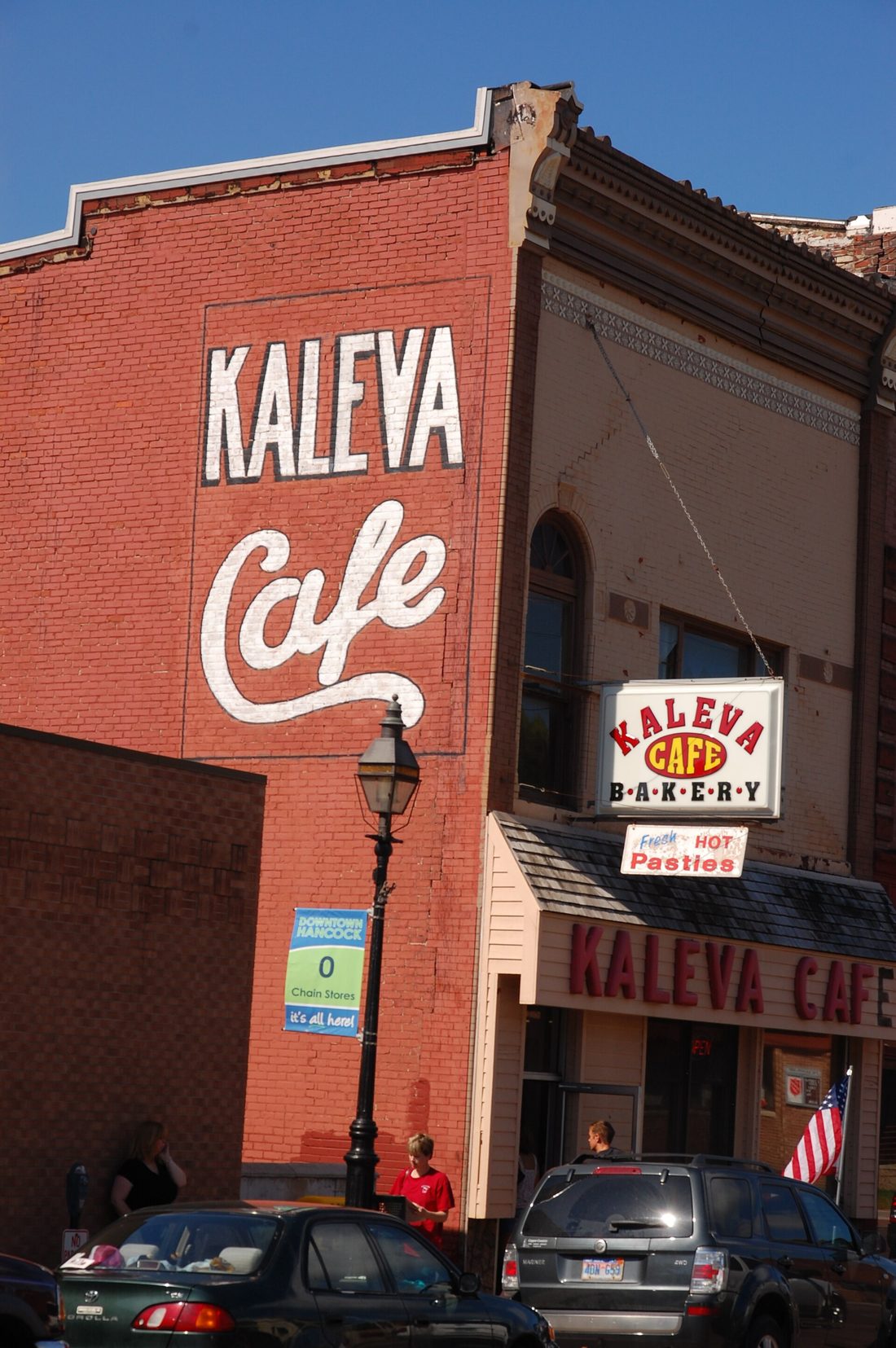
Hancock, in the Keweenaw — more people of Finnish descent live here than anywhere else in America. Finnish isn’t a memory in the copper country; it’s a working part of the town.
The hub is Hancock, across the canal from Houghton, a town of about 4,500 that’s often called the capital of Finnish-American culture — more people of Finnish descent live in the Keweenaw than anywhere else in the U.S. Hancock was even named the 2026 Finno-Ugric Capital of Culture, the first city in North America ever to hold the title. It’s home to the Finnish American Heritage Center, a Finnish-language newspaper (The Finnish American Reporter), and the campus of what was Suomi College, later Finlandia University — “Suomi” being simply the Finnish word for Finland.
The Finns came for the same reason most people came to the U.P.: the mines. Copper and iron companies recruited them heavily in the late 1800s and early 1900s — they had a reputation as tough, reliable underground workers, some recruited straight out of mines in northern Norway. They arrived by the tens of thousands, and they stayed, and they cooked. This page is what they cooked.
One more piece of context makes the food make sense: the Finnish U.P. was built on cooperation, sometimes literally. Finnish immigrants were famous organizers — of labor, of temperance halls, of the cooperative stores that dotted the copper and iron country, where members pooled money to buy flour, coffee, and staples together and share the profit. A lot of the baking below is co-op baking and church-basement baking — food made in quantity, for a crowd, to be shared. That’s not incidental to the cuisine; it’s the shape of it. The Finnish table up here is a communal table. When you understand that “come for coffee” is a social obligation and a pleasure both, the enormous braided loaves and the pans of oven pancake and the endless pots of coffee all click into place.
Nisu (pulla): the signature bake
Start with the bread, because if the Finnish U.P. has a national loaf, this is it.
It’s an enriched, lightly sweet yeast bread scented with cardamom — braided into a plaited loaf, brushed with egg, and finished with pearl sugar and sliced almonds. Torn warm, it’s soft and slightly springy, fragrant with that piney-citrus cardamom perfume, made for coffee. It’s the thing that comes out for guests, for holidays, for funerals, for absolutely no reason on a Tuesday.
Here’s the naming wrinkle, and it’s a good one. Modern Finns call this bread pulla. But in the U.P. — and in western Finland, where a lot of the emigrants came from — it’s nisu. The short version of the story: nisu was the older, everyday word (it’s related to a word for wheat), and at some point Finland’s language reformers pushed to shed terms that felt too Swedish and standardized on pulla. That shift happened back in Finland after the big wave of emigration — so the immigrants who left in the early 1900s carried nisu with them, and it froze in place here. The result is a small linguistic time capsule: the U.P. still says the word Finland mostly stopped saying. Ask for pulla and you’ll be understood; ask for nisu and you’ll sound like you’re from Calumet.
My nisu (pulla) recipe is here on the site — it’s the cornerstone Finnish-American bake and the gateway to half of what’s below.
Korvapuusti — nisu’s cinnamon-roll cousin
Take that same cardamom pulla dough, roll it out, spread it with butter, cinnamon, and sugar, and you get korvapuusti — the Finnish cinnamon roll, cut and pinched so it splays into a shape the name jokingly describes as a “slapped ear.” Topped with pearl sugar, they’re all over Finland (it has an unofficial national cinnamon-bun day in October) and they turn up at every Finnish bakery in the copper country too. If an American cinnamon roll is a sugar bomb, korvapuusti is more restrained and far more fragrant — the cardamom in the dough is what makes it.
Pannukakku: the pancake that’s really a custard
Now the dish that most confuses newcomers, because the name says “pancake” and the thing is nothing like one.
Pannukakku is a baked pancake — you melt butter in a pan, pour in a loose, eggy, milk-heavy batter (think closer to a Dutch baby or a Yorkshire pudding than to a stack of flapjacks), and bake it in a hot oven. It puffs at the edges, the middle stays soft and custardy, and it comes out golden with a set, eggy center. You cut it into squares and eat it warm with berries, jam, or a dusting of powdered sugar — often thimbleberry or blueberry jam up here, which ties it straight to the U.P.’s own berries.
The distinction that matters: this is not the thin Finnish lettu/ohukainen or the Swedish crêpe-style pancake. Those are lacy and rolled. Pannukakku is thick, baked in a pan, and sliced — a homey oven dish, as much dessert or evening snack (iltapala) as breakfast. In the U.P. it’s a Sunday-morning and church-supper standard, and it’s the Finnish dish most likely to have quietly become “just how Grandma made pancakes” in a family that forgot it was Finnish at all.
My pannukakku recipe is here, right beside the nisu.
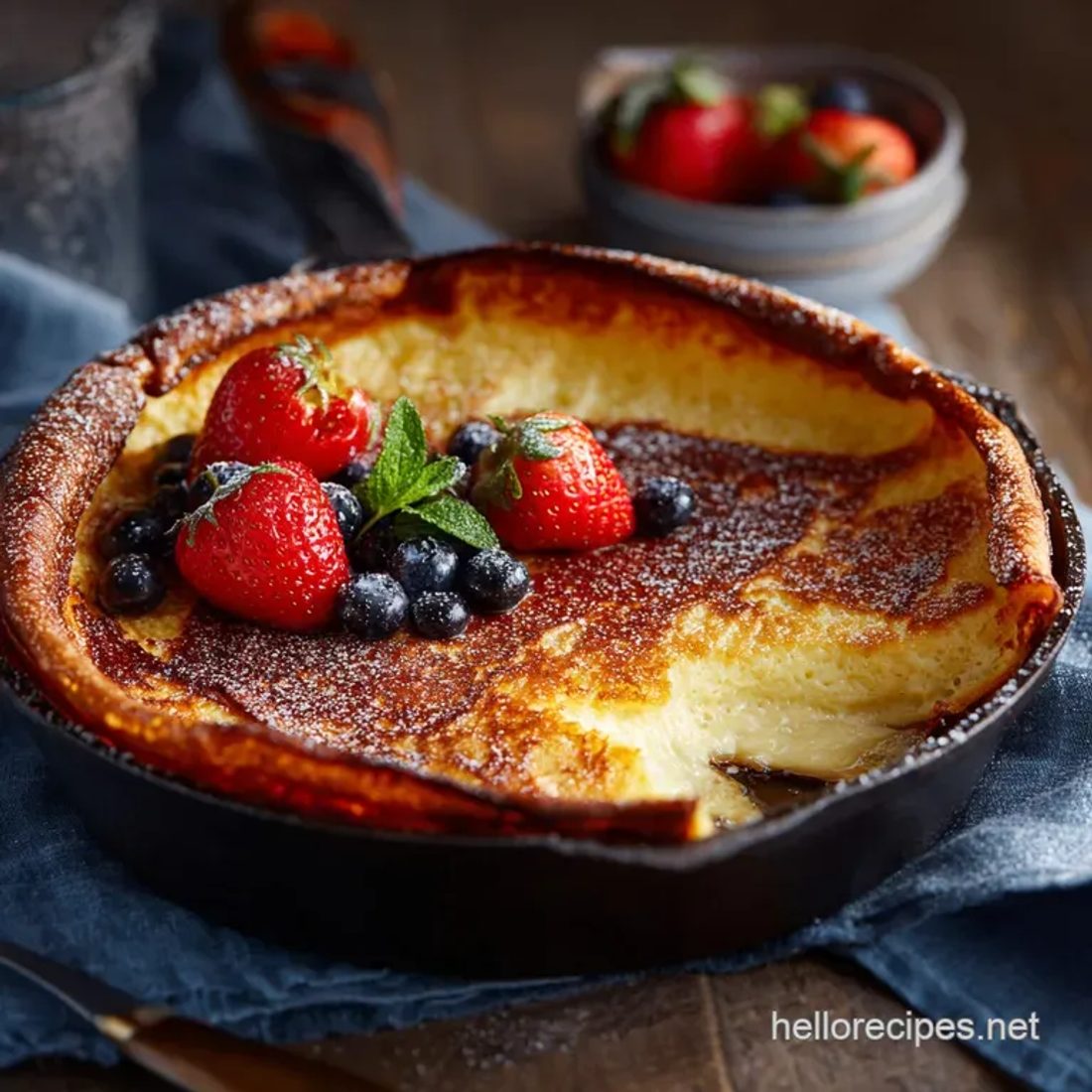
Pannukakku — baked, not griddled; cut in squares, custardy in the middle, and served with berries. Call it a pancake if you want, but it’s really a baked custard.
Korppu — and the road to Trenary Toast
There’s a member of the pulla family that earned its own page on this site, and it’s worth introducing here in context: korppu.
Korppu is a rusk — a slice of sweet cardamom bread that’s baked a second time, low and slow, until every bit of moisture is driven out and it turns hard, dry, and shelf-stable. In Finland it was thrift food: a way to use up wheat bread from the harvest so nothing went to waste, and to have something that kept. Dusted with cinnamon and sugar, it becomes a crunchy thing you dunk in coffee until it softens enough to bite.
That is the direct ancestor of the U.P.’s most famous export in this family, Trenary Toast — korppu, industrialized just enough to fill a brown paper bag and ship, still made in a tiny U.P. town, still meant for the coffee cup. It’s a big enough story that I gave it its own page: Trenary Toast.
Viili, piimä, and the squeaky cheese
The Finnish dairy corner is where things get genuinely strange and wonderful, and where the heirloom-heritage thing is most literal.
Viili — the ropy milk
Viili is a mesophilic (room-temperature) cultured milk — think of it as a distant cousin of yogurt, but with a signature that stops newcomers cold: it’s ropy and stretchy. Lift a spoonful and it strings; the texture is faintly slimy in a way that is completely intentional and, once you’re used to it, oddly great with a little sugar or jam and a spoon. The remarkable part is how it’s kept: viili is propagated by backslopping — you save a spoon of the last batch to start the next, indefinitely — so a family’s viili culture can be a genuine heirloom, carried across the Atlantic and passed down for generations. There are U.P. families whose viili “mother” is, in a real sense, older than any of them. That’s not a metaphor; that’s a living microbial inheritance sitting in a jar on the counter.
What makes viili’s culture unusual, and so durable, is that it’s mesophilic — it sets at room temperature, no incubator, no thermometer, no fuss. You stir a spoonful of the old batch into fresh milk, leave it on the counter overnight, and by morning it’s set into that ropy, custardy mat. That simplicity is exactly why it survived immigration and a century of farm and mining-town life: you didn’t need equipment, only diligence and a willingness to never quite finish the jar. There’s a specific yeast-and-bacteria partnership behind the ropiness (and a faint bloom that can grow on top), and each family’s strain drifts a little over the decades, so one household’s viili is subtly its own. Losing the culture means losing something you can’t just buy back — which is why people guard theirs, and why a spoonful passed to a neighbor is a real gift. It’s the most literal heirloom on this whole page.
Piimä — the buttermilk
Piimä is the Finnish cultured buttermilk — tangier, drinkable, the everyday soured milk of the Finnish kitchen. It shows up as a drink, in baking, in pancakes, poured over porridge. If viili is the exotic one, piimä is the workhorse.
Leipäjuusto — bread cheese, “squeaky cheese”
And then there’s the cheese, which has two Finnish names — leipäjuusto or juustoleipä — and one English one that tells you exactly what it does: squeaky cheese. (You’ll also hear “bread cheese,” a literal translation, and “Finnish squeaky cheese” on U.S. labels.)
It’s a fresh cow’s-milk cheese — traditionally made from the very rich first milk after a cow calves — curdled, pressed into a flat disk, and then baked or grilled until it’s flecked with brown, almost charred, freckles. The texture is springy and mild, and when you bite it, it squeaks against your teeth — that’s the whole personality. It originally comes from Ostrobothnia and the north of Finland, exactly the regions the U.P.’s Finns came from.
How you eat it is the best part: warm, with coffee. You can literally dip a piece in your coffee cup — the Swedish name for the cheese, kaffeost, means “coffee cheese” — and eat it with a spoonful of cloudberry jam, that amber, tart-sweet Nordic berry preserve. Bread cheese with cloudberry jam and strong coffee is one of the most quietly perfect things the Finnish table does, and you can find it, warm, in the copper country.
That cloudberry jam is worth a pause, because the berries are their own thread through the Finnish U.P. Finns were and are serious foragers, and the north woods gave them a landscape that rewarded it: wild blueberries by the bucket, and — the U.P.’s own treasure — the thimbleberry, whose seedy, intense jam is a regional obsession I’ve given its own page (thimbleberries). Cloudberry, the true old-country berry, is harder to come by here, but the habit of putting a wild-berry preserve next to the cheese, the pancake, and the coffee bread came straight over from Finland. Berries and cardamom, more than anything, are the two flavors that make the Finnish table taste like itself.
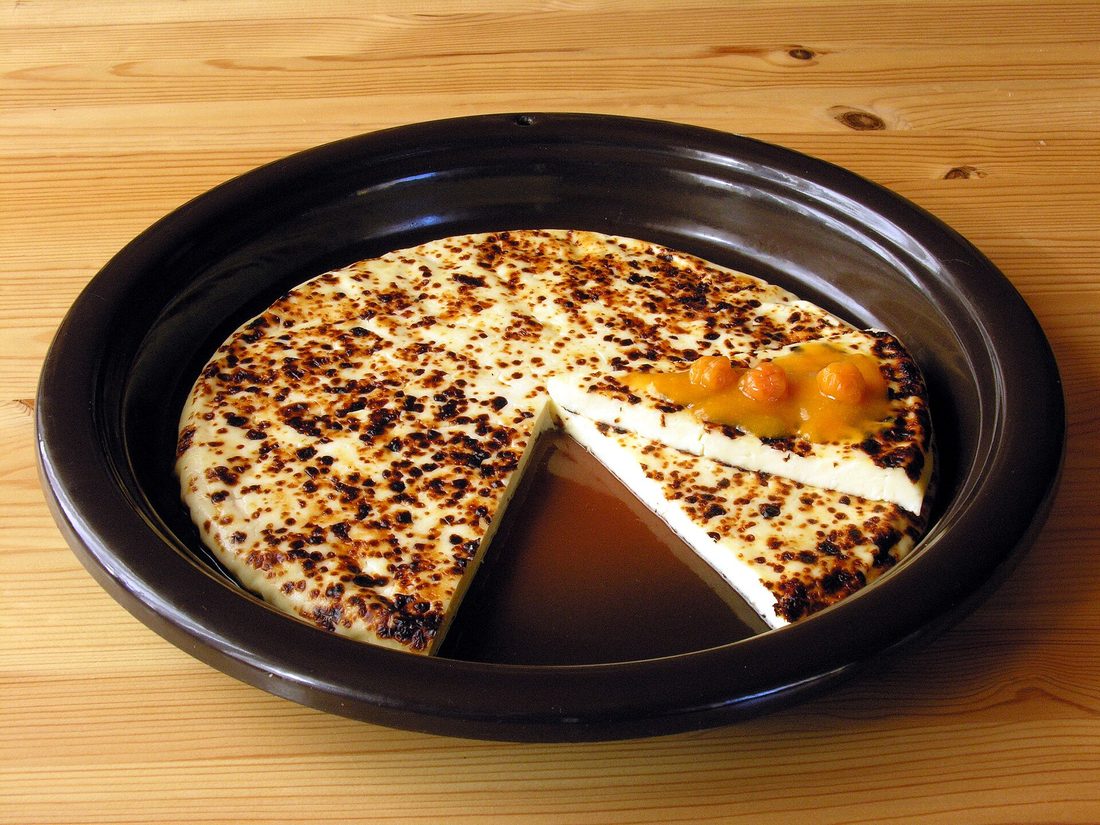
Leipäjuusto — “squeaky cheese,” baked until freckled, mild and springy. Warm it, dunk it in coffee, add cloudberry jam. The Swedish name literally means “coffee cheese.”
Mojakka: the Finnish-American stew
Here’s a word you’ll only really hear in the Finnish belt of the Upper Midwest — the U.P., northern Minnesota, northern Wisconsin, and western Ontario — and its meaning shifted on the way across the ocean.
Mojakka is a stew or soup. In Finland the original was a fish dish (it traces to the Kalajoki region on the Gulf of Bothnia) — whitefish or herring simmered with potatoes, onion, butter, and a flour-and-water thickening. In America, Finnish immigrants started making a beef (or venison) version too, and the name split to keep them straight:
- kalamojakka — kala is fish — the fish stew, often made with, yes, whitefish, tying it back to the whitefish page: clear-ish broth, potatoes, sometimes milk or cream, allspice, dill.
- lihamojakka — liha is meat — the beef version, a clean-broth beef-and-potato-and-carrot stew, often with a whisper of allspice as the giveaway Finnish note. In the U.P. and the Minnesota Iron Range it became a genuine staple, filed in a thousand church-basement cookbooks.
Mojakka can run from a thin brothy soup to a thick stew depending on the family, and the argument over which is “right” is exactly the kind of thing that gets settled — never — at a St. Urho’s Day cook-off in March. (St. Urho, for the record, is a gloriously fake Finnish-American saint invented in Minnesota. He’s part of the joke, and part of the culture.)
The everyday and savory table
The sweets and the cheese get the attention, but the Finnish home kitchen up here ran on plainer food, most of it built for cold and for physical work.
- Pasty. Yes — the pasty. It’s Cornish in origin, but the Finns adopted it wholesale in the U.P. mines, and in a lot of Finnish families it became as much “our food” as anything on this page. It gets its own page: pasties.
- Kropsua is essentially pannukakku’s plainer sibling — another baked pancake, sometimes thicker and more bread-like, a cousin dish with a lot of regional overlap. Different families use the two names almost interchangeably, which is very U.P.: the exact boundary between kropsua and pannukakku is the kind of thing people will argue about happily and never resolve.
- Riisipuuro — rice porridge — slow-cooked rice in milk, served with cinnamon and sugar or a berry “soup,” a Christmas-morning fixture (traditionally with a single almond hidden in the pot for luck: whoever finds the almond gets good fortune, or has to sing, depending on the family).
- Hernekeitto — pea soup — thick yellow split-pea soup with ham or pork, the classic Thursday dinner in Finland (often followed by pannukakku for dessert), and a natural fit for a U.P. winter.
- Rieska — a flatbread, traditionally quick and unleavened or barely leavened, made from barley or, in a version many U.P. families make, mashed potato worked into the dough. Baked flat, cut in wedges, eaten fresh and warm with butter. It’s plainer than anything else here and all the better for it — the everyday bread behind the special-occasion nisu.
- Coffee — endless coffee. Finnish-American coffee culture is real and it is serious. Finns are among the heaviest coffee drinkers on earth, and the U.P. inherited it: coffee with nisu, coffee with korppu, coffee with squeaky cheese, coffee at every gathering. “Come for coffee” means come for coffee and a spread of the baking above. If you want the deeper story of the bean itself, that’s my coffee deep dive — but the U.P.’s contribution is the ritual: coffee as the social solvent that dissolves everything else on this page. Cardamom turns up in the coffee bread and the rolls, so the whole coffee table smells of it.
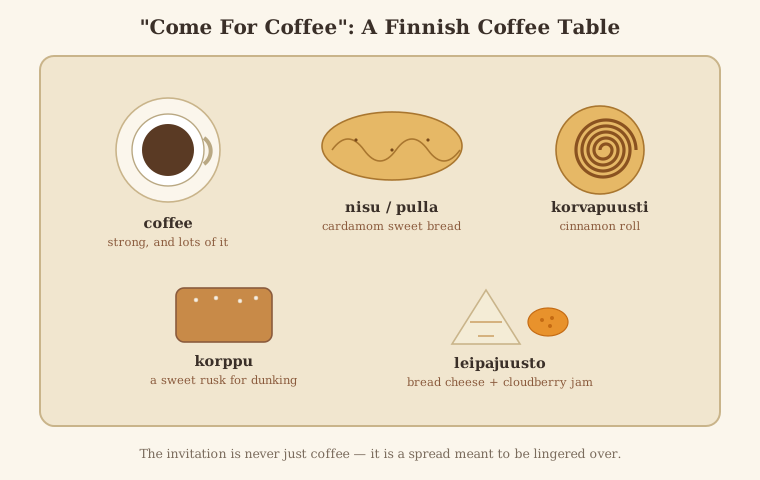
“Come for coffee” means a whole table: strong coffee with pulla, korvapuusti, korppu, and bread cheese with cloudberry jam.
The sauna and its food
You can’t separate the Finnish U.P. table from the sauna, because for a Finn the sauna isn’t a spa amenity — it’s a room in the house (or its own little building out back) and a social institution. The U.P. is dotted with old family saunas; “let’s take a sauna” is an invitation to an evening, not a workout. It was where you got clean, where babies were once born, where you sat in the heat and then, if you were brave, rolled in the snow or jumped in the lake.
And it has its own food, because of course it does. The classic is sauna makkara — sausage grilled or warmed on the sauna stove while you sweat, eaten with mustard right there in the heat. Then out to cool down with coffee and pulla, or a cold piimä. The sauna meal is simple on purpose: heat, sausage, coffee, sweet bread, company. It’s the Finnish table stripped to its essentials, and it might be the truest version of it.
There’s a rhythm to a proper sauna night that food is woven all the way through. You heat the sauna — a real wood-fired one takes hours, so it’s a commitment, not a whim. You take your turns in the heat, throwing water on the stones (löyly, the burst of steam, is the whole art), then cool off outside — in the snow, in the lake, on the porch with a cold drink — and go back in. The sausage warms on the stove between rounds. And when everyone’s done, wrung out and clean and loose, you sit down to coffee and nisu and whatever else is on the table and you talk. The sauna does the same social work as the coffee table: it’s an excuse to spend hours together. Food isn’t a break from the sauna; it’s part of the same long, unhurried evening. A lot of U.P. deals, grudges, marriages, and friendships got worked out in exactly that sequence of heat and coffee.
Where to find it
The living center of all this is the Keweenaw — Hancock and Houghton, the old “Finn town” of the copper country — where you can still buy nisu and korppu and squeaky cheese, get real Finnish coffee, visit the Finnish American Heritage Center, and find a sauna without trying hard. Bakeries and small shops across the western U.P. keep the baking alive; some of it, honestly, has quietly melted into the general U.P. diet, so a “Yooper” bakery two counties over is often selling Finnish food without flagging it as such.
I’ll be honest about the trajectory, because I try to be everywhere on this site: the deep fluency is thinning as the generations turn over, and some of these foods — viili especially, with its heirloom culture — survive on the effort of specific families and shops rather than on sheer demand. But it is genuinely still here, still eaten, still baked weekly. That’s rarer than it sounds, and worth showing up for.
If you’re planning a visit, time it if you can to one of the Finnish festivals — Heikinpäivä, the mid-winter St. Henry’s Day celebration in Hancock, is the big one, a whole midwinter carnival built around Finnish culture, food included. But you don’t need a festival. A weekday stop at a Keweenaw bakery for nisu and a coffee, a warm wedge of squeaky cheese, a bag of korppu to take home — that’s the living version, and it’s available most days if you go looking.
Cook your way in
If you want a way into the Finnish table from your own kitchen, start with the bread. My breads deep dive is the place to build the yeast-and-enriched-dough skills that nisu (pulla) and korvapuusti are made of, and the pannukakku above is genuinely one of the easiest impressive things you can bake — no kneading, one bowl, an oven. From there, the coffee deep dive gives you the other half of the table, and the Trenary Toast page closes the loop back to korppu and the coffee cup.
Get the words right, put the coffee on, and it all makes sense.
More of the U.P. table: pasties · cudighi · whitefish · Trenary toast · thimbleberries · the table today
Comments (0)