The Whole U.P. Table — and a Trip Back to It
This is the last page of the dive, and it does two jobs. First it fills in the rest of the Upper Peninsula table — all the good things that didn’t fit under pasties or cudighi or whitefish or the wild larder, and there are plenty. Then it does the thing I’ve really been writing toward this whole time: it walks the road trip my son and I are about to take, in a couple of weeks, up over the bridge and around the Lake Superior shore, to eat our way through a list of places I’ve loved for years.
So the first half is a map of the table. The second half is a map of the trip. They’re the same map, really.
The rest of the U.P. table
Pasties and cudighi — the two anchors
I’ve given each of these its own page, so I’ll keep this short and just place them. The pasty is the U.P.’s definitive food — the hand-held meat-and-rutabaga pie the Cornish copper miners brought over in the 1800s, that the Finns and everyone else adopted, that you now find at a shop in every town. The full story is on the Pasties page. And cudighi is the U.P.’s great regional secret — a spiced Italian sausage, patty or link, piled on a bun with sauce and cheese, that basically nobody outside the central U.P. has heard of. That’s the Cudighi page, and I’ve got recipes for it too: my cudighi sausage and the cudighi sandwich built on it. These two — one Cornish, one Italian — are the poles the rest of the table hangs between, and they tell you right away that this is immigrant food, mining food, working food.
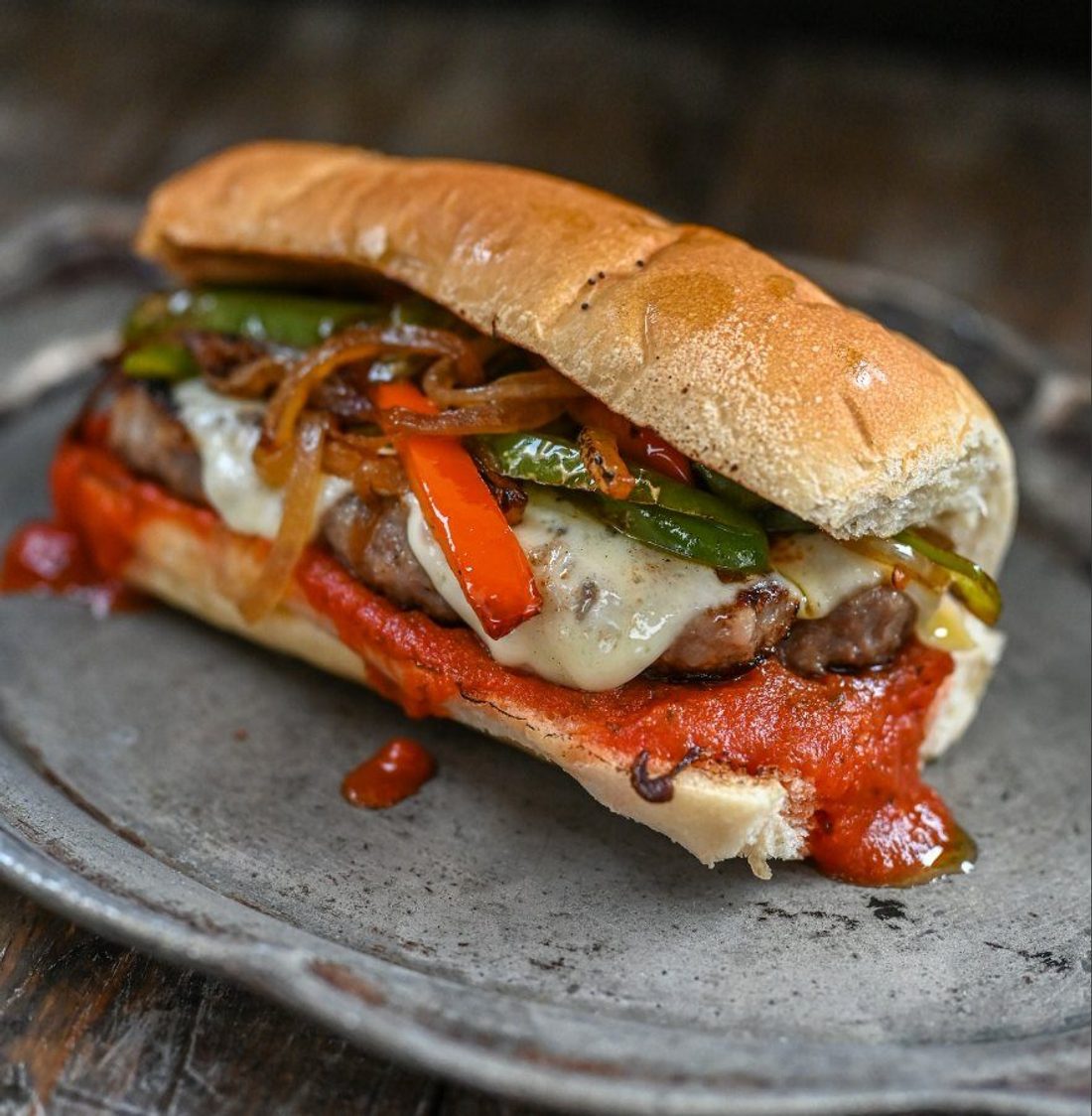 Cudighi — the central U.P.’s spiced-sausage sandwich, almost unknown outside the region. Along with the pasty, it’s one of the two poles the whole U.P. table hangs between.
Saffron and cardamom — the immigrant breads
The mining rushes brought a lot of Cornish families, and the Cornish brought saffron. Cornish-Americans up north keep the tradition of the saffron bun — a rich, yeasted, saffron-gold sweet bun studded with currants and raisins, the same “revel bun” or “tea treat” they baked in Cornwall. It shows up around St. Piran’s Day (March 5th, the Cornish saint’s day) and it’s a lovely, unexpected thing to find in a U.P. bakery: real saffron, that expensive red thread, in a copper-country kitchen.
Alongside it, from the other big immigrant wave, comes cardamom — the warm, citrusy spice that defines Finnish and Scandinavian sweet bread. Finnish nisu / pulla, the braided cardamom bread, is a fixture of the Finnish-U.P. table, and I go into that whole world on the Finnish Table page. What I love is the crossover: two immigrant groups, two prized aromatic spices, saffron and cardamom, both landing in the same small mining towns and both surviving to today on the same bakery shelves. For the broader craft of these enriched breads, my Breads dive has the technique.
Porketta — the Iron Range roast
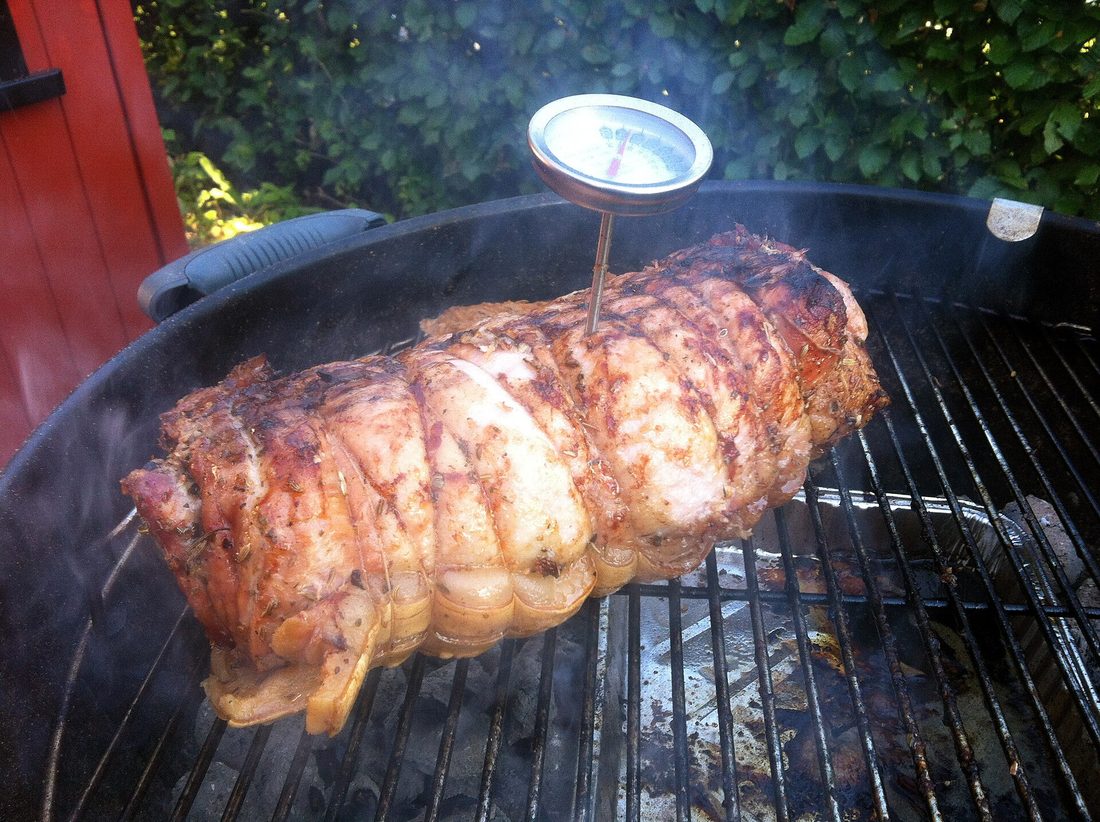 Porketta — the iron-range Italian roast, pork shoulder rolled around a heavy rub of fennel, garlic, and herbs and cooked low until it pulls apart.
Here’s one worth being careful about, because the easy version gets it wrong. Porketta is a seasoned, rolled pork roast heavy with fennel, garlic, and herbs — an Americanized descendant of Italian porchetta, invented by Italian immigrants who came to work the iron mines. It’s a genuine iron-range Italian dish. The honest caveat: it’s most strongly identified with Minnesota’s Iron Range (the Mesabi), and you’ll see it called “Iron Range porketta” in a Minnesota context most often. But the Italian mining migration ran across the whole Lake Superior iron and copper country, Michigan’s ranges included, so the fennel-and-garlic pork tradition is at home in the U.P. too. Unlike crisp-skinned Italian porchetta, the range version typically uses pork shoulder, rubbed inside and out and rolled, then cooked low and slow until it pulls apart. If you see porketta on a U.P. menu or deli case, that’s the lineage.
”U.P. pizza” and cudighi pizza
Cudighi is so beloved in the central U.P. that it jumped from the bun to the pizza. Cudighi pizza — that same spiced Italian sausage as a pizza topping — is a real local thing, and more broadly the Italian mining heritage gave the U.P. a solid, unpretentious, red-sauce pizza culture in towns like Negaunee and Ishpeming. This isn’t Neapolitan cosplay; it’s tavern pizza made by families who’ve been feeding miners for a century. One of the stops on our trip, Tino’s in Negaunee, is exactly that kind of bar-and-pizza place, and I’ll get to it below.
Jilbert’s, and U.P. dairy and ice cream
The U.P. has its own dairy, and it’s a point of pride. Jilbert Dairy in Marquette dates to 1937 — it started on the Jilbert farm in Lake Linden, moved to Calumet, and landed in Marquette in 1983 — and it’s the U.P.’s own milk-and-ice-cream plant, distributing across the peninsula and beyond. There’s a fun claim attached to it: Moose Tracks ice cream — that vanilla-with-fudge-and-peanut-butter-cups flavor you now see everywhere — traces its origin to Marquette and Jilbert’s. The company’s changed hands over the years, but it still runs as a local dairy and ice cream shop, and getting a cone there is a Marquette thing to do.
Sayklly’s and U.P. chocolates
Down in Escanaba there’s Sayklly’s, a confectionery with real roots — founded by a young Lebanese immigrant, Joseph Sayklly, in the early 1900s (the candy business goes back to around 1900, the formal shop to 1906), and still family-connected today through descendants of the founders. Handmade chocolates, fudge, brittle, and candy from recipes passed down for generations, plus their own U.P.-branded candy bars. It’s another immigrant-family story — Lebanese this time, adding to the Cornish and Finnish and Italian — and another reminder of how many different people built this table.
Vernors — a Michigan thing, not really a U.P. thing
I want to be straight about this one because people lump it in. Vernors ginger ale is beloved in the U.P. — Yoopers drink it, grandmothers swear it settles a stomach, it’s in every store. But it is not U.P.-specific in the slightest. It’s a Detroit creation, invented by pharmacist James Vernor and served to the public starting in 1866, aged in oak, and it belongs to the whole state of Michigan and honestly the whole Midwest. If you want a genuinely Michigan soda story it’s a great one, but don’t let anyone sell you Vernors as a secret of the north. It’s a Michigan thing top to bottom, Lower Peninsula born.
Supper clubs and the Friday fish fry
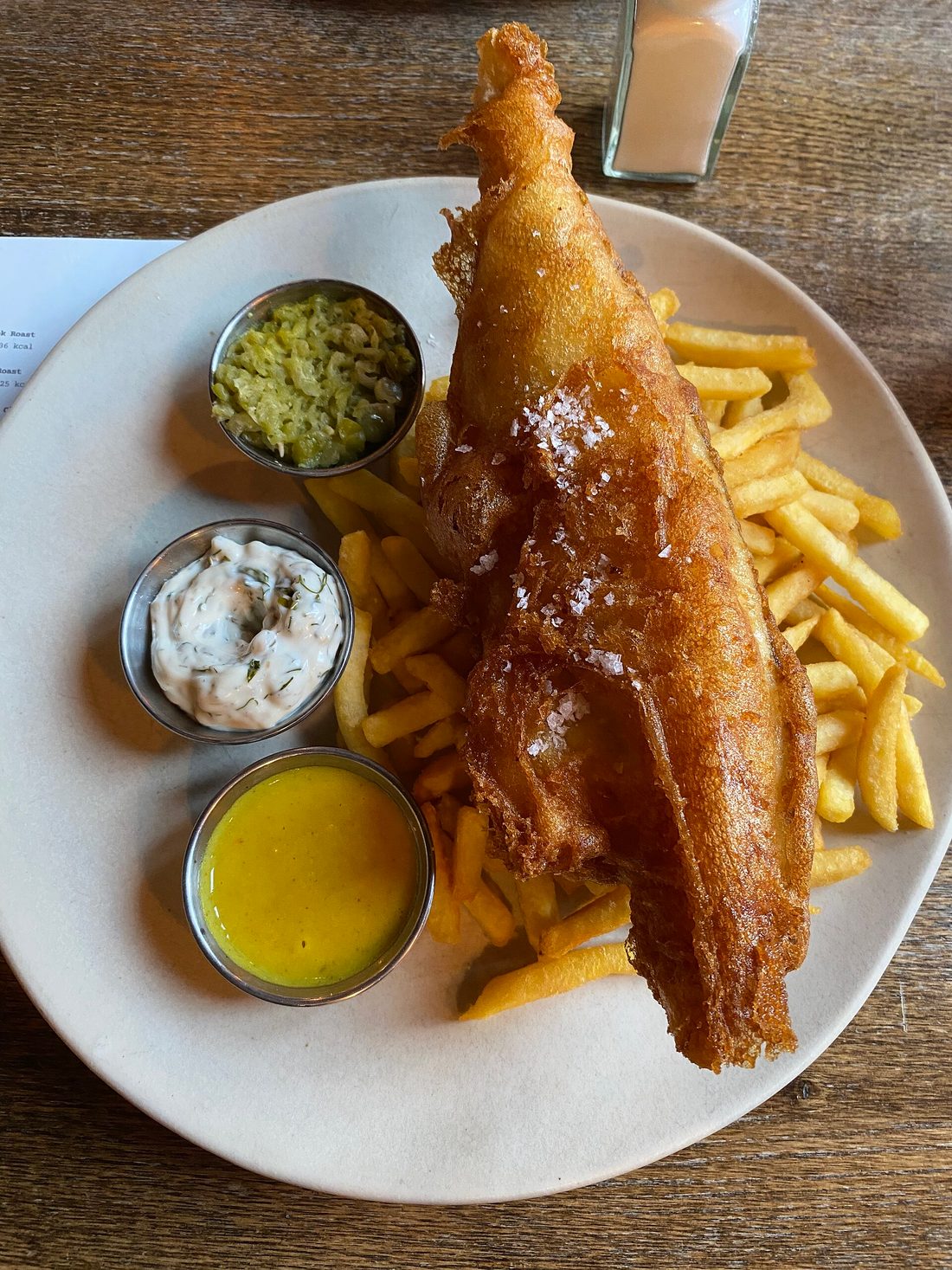 The Friday fish fry — less a meal than a standing weekly appointment with your neighbors, held at bars, supper clubs, and VFW halls all over the U.P.
Now we’re at the heart of how the U.P. actually eats out. The supper club and the Friday fish fry are Upper Midwest institutions, and they’re woven deep into U.P. life. Friday night, especially through Lent but really year-round, you go out for a fish fry — battered or beer-battered fish, often locally caught, with the usual sides — at a bar, a roadside supper club, a VFW or Elks hall, a lakeside fish house. It’s so ingrained that Yoopers who’ve moved away will tell you the first thing they want when they get back home is a Friday fish fry. It’s less a meal than a standing appointment with your neighbors. Pair that with the everyday “Yooper” diner — the weathered small-town counter-and-booth place where you get pasties, a patty melt, pie, and bottomless coffee — and you’ve got the two rooms where most U.P. eating-out actually happens.
Poutine — the Québec import the U.P. made its own
Poutine is French-Canadian, not Yooper, and I’ll say that up front — but it is genuinely everywhere in the U.P. now, on bar and diner and roadside menus all over the peninsula, and it got here the honest way: across the border, carried by the same French-Canadian thread that runs all through the U.P.’s immigrant story. So it earns a place on this table.
The dish is simple — hot fries, fresh cheese curds, and brown gravy poured over so the curds go soft and squeaky-warm without fully melting — and its origin is contested in the best small-town way, because nobody wrote it down. It came together as a lunch-counter improvisation in rural Québec in the 1950s, and two towns still argue over it. Warwick claims it: the story goes that in 1957 a regular named Eddy Lainesse asked Fernand Lachance, at Le Lutin Qui Rit, to just throw the cheese curds in the bag with his fries — and that first version had no gravy at all, only fries and curds. Drummondville claims the dish as we actually know it: Jean-Paul Roy, at Le Roy Jucep, was already selling fries-and-curds, and he’s generally credited with adding the gravy in the early-to-mid 1960s to make the three-part poutine everybody eats today. Both claims are real, both are a little self-serving, and the honest version is that poutine assembled itself across Centre-du-Québec over about a decade rather than getting invented in one moment by one person. It reached Québec City by the end of the ’60s, Montréal by the ’80s, and from there, inevitably, across the river and into the northern U.S. — the U.P. included.
Half the fun is the variations. In Québec you’ll find poutine italienne (a meat/bolognese sauce instead of brown gravy), galvaude (chicken and peas), steak and smoked-meat versions, and every roadside stand’s own house build. The U.P. runs its own riffs — and here I have to tell you about mine.
My move is crumbled cudighi in the poutine, added right before the gravy. Cudighi — that sweet-spiced Iron-Range sausage — broken up loose over the curds, and then the hot gravy poured over the top so the heat blooms the cinnamon and clove up through the curds and fries. It is the two best things on the range in one paper boat, and it is, with no exaggeration, my single favorite thing to eat in the Upper Peninsula. And I’m not the only one who does it: the Crossroads Restaurant & Lounge in Marquette builds a proper poutine — fries, Jilbert’s cheese curds (yes, the same Jilbert’s from up the page — the U.P. feeds itself), mozzarella, brown gravy, and green onions — right next to a great cudighi on the same menu, so putting the one into the other is the most natural thing in the world. I’ve written mine up: Cudighi Poutine. It’s a required stop on our trip, and I come back to it below.
Smoked fish, jerky, and snack sticks
The preservation trades run all through the U.P., because you have to keep what the water and the woods give you. Smoked whitefish and lake trout are everywhere — I go deep on the whitefish side on its own page — and on the meat side, jerky and snack sticks, especially from venison, are a way of life, tied to deer camp and covered in my Smoking and Sausage dives. A roadside smokehouse or fish house with its own smoker out back is one of the most reliably good food stops in the whole peninsula.
Beer and brewing
The U.P. has a real craft-beer scene now, and two names anchor it. Keweenaw Brewing Company, founded in 2004 up in Houghton (with production in South Range), grew into the largest brewer in the U.P., known for its Widow Maker Black Ale. And Blackrocks Brewery in Marquette, opened in 2010 by two former pharmaceutical salesmen, took its name from a local landmark and became one of the biggest craft breweries in the U.P., known for its 51K IPA. Between them and a long list of smaller places, the U.P. has grown a beer culture that fits the region — unfussy, local, and warm against a long winter.
Wild rice — manoomin
I’ll be honest about relevance here rather than force it. Wild rice — manoomin, “the good berry” in Ojibwe — is a genuinely sacred and central food for the Anishinaabe (Ojibwe, Odawa, Potawatomi), tied to the migration story that brought them to “the place where the food grows on water” in the Great Lakes. Is it a U.P. thing? Partly, yes. It grows in shallow lakes and slow water across the northern Great Lakes, and there’s active restoration work in the U.P. — the Michigan DNR and the Keweenaw Bay Indian Community have partnered for years reseeding wild rice in Baraga and Houghton counties. It’s more abundant in Minnesota and Wisconsin than in Michigan, so I won’t overstate it, but it’s real and it’s rooted in the U.P.’s Indigenous foodways, which predate every immigrant on this whole page. If you want the botany and the difference between true wild rice and cultivated paddy rice, that’s in my Rice dive; here I just want to name manoomin with the respect it’s due and put it first in time even though it comes last in this list.
Local sodas and the rest
Beyond Vernors, the U.P. and northern Michigan have a scattering of local pops and small bottlers, and you’ll find house root beers and the like at diners and drive-ins. I won’t pad the list with things I can’t stand behind — but keep an eye out at the small places; the U.P. rewards curiosity about the little regional brands more than almost anywhere.
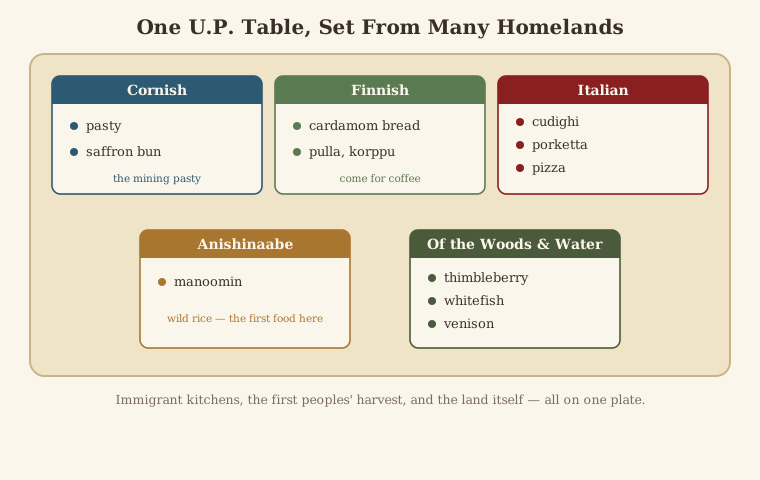
One table set from many sources: Cornish, Finnish, and Italian immigrant kitchens, the Anishinaabe harvest, and the woods and water.
The trip
Alright. Here’s the part I’ve been driving toward.
In about two weeks, my son and I are getting in the truck and heading north. Not on a whim — this is a route I’ve built over years of eating around the U.P., a string of specific places I love, and now I get to take him to every one of them. He’s old enough to remember it, and I’m at the age where taking your kid to the places that made you is starting to feel like the whole point of anything. It’s a food trip, but it’s really a father-and-son trip with food as the excuse, which is the best kind.
Let me walk the route, because the route is the story, and every stop connects back to a page in this dive.
Over the bridge — Lehto’s, St. Ignace
You don’t ease into the U.P. You cross the Mackinac Bridge, five miles of suspension span over the straits where Lake Michigan and Lake Huron meet, and on the far side everything is different — the light, the trees, the pace, the accent. Crossing that bridge is the moment the trip actually starts. I want my son standing at the rail on the other side feeling that.
And right there, as you come off the bridge into St. Ignace, is the first stop: Lehto’s Pasties. It’s one of the oldest pasty shops in the U.P., a little roadside place, and it has become my ritual first bite of every U.P. trip — you cross the bridge, you pull in, you get a pasty, and now you’re really up north. It’s the perfect opening because it’s the pasty, the U.P.’s defining food, eaten at the literal threshold of the U.P. My son’s first act as a visitor to the Upper Peninsula is going to be eating a Lehto’s pasty in the car with the windows down, and I couldn’t script it better.
Up the Lake Superior shore — Muldoon’s, Munising
From St. Ignace we turn and run the north shore, the Lake Superior side, which is one of the great drives anywhere. The lake is enormous and cold and impossibly blue, the shore is cliffs and beaches and waterfalls, and the road threads through it all. Our first real stop along it is Munising, gateway to Pictured Rocks, and there we hit Muldoon’s Pasties & Gifts. Another pasty, yes, and unapologetically so — comparing pasties from town to town is half the fun of the U.P., and Muldoon’s is a good one. Munising is also right in the middle of the country I described on the wild larder page — Superior-shore woods and water, berries and fish — so it’s a natural place to slow down.
Marquette — Thill’s and Trenary
Then on to Marquette, the biggest city in the U.P. and the hinge of the whole trip. Two stops here, and they’re both about as U.P. as it gets.
First, Thill’s Fish House, down on the Marquette waterfront — a genuine commercial fishery and fish market, the real thing, where Lake Superior whitefish comes off the boats. This is the beating heart of the whitefish story I told earlier: fresh and smoked whitefish, straight from the lake it lives in. If you want to understand why whitefish is the U.P.’s fish, you stand in a place like Thill’s and watch it come in. I want my son to see fish sold the way it’s been sold here for generations.
Second, Trenary, and this needs a small clarification of geography for the trip. The Trenary Home Bakery is in the little town of Trenary, south of Marquette, and it’s the source of Trenary Toast — that hard, cinnamon-sugar, twice-baked Finnish korppu rusk you dunk in coffee, which I gave a whole page. There’s also the Trenary Toast Cafe presence in Marquette, so you can get the toast and a proper cup of coffee without the side trip if the days are tight. Either way, Trenary Toast is on the list, because a bag of it is one of the most portable, characteristic tastes of the U.P. — and it happens to be the exact thing to spread that thimbleberry jam on. My Coffee dive explains why the dunk works so well.
Marquette, one more — the Crossroads
There’s a third Marquette stop I saved for last on purpose, because it’s the one I look forward to most on the whole trip. The Crossroads Restaurant & Lounge, out on County Road 480, is a proper U.P. bar and supper club — the kind of place that gets voted best fish fry in the county — and it’s where I get the thing I told you about up top: poutine with crumbled cudighi in it. They build a real poutine (fries, Jilbert’s curds, mozzarella, brown gravy, green onions) and they do a good cudighi, and together they make my single favorite thing to eat in the Upper Peninsula. That’s not a casual favorite; it’s a drive-the-whole-way-north-for-it favorite. My son is getting one whether he asks for it or not, and I already know the look he’s going to make on the first bite — the same one everybody makes when the sweet spice hits under the gravy. If there’s one plate on this entire trip I’d bet the farm on, it’s this one.
The base — Ishpeming
From Marquette it’s a short hop inland to Ishpeming, and that’s where we land. We’ve booked a bed-and-breakfast in Ishpeming as our base for the back half of the trip. Ishpeming and its twin Negaunee are old iron-mining towns, deeply Italian and Finnish and Cornish all at once, and they’re the ancestral home of the cudighi — so it’s the perfect headquarters for what’s left on the list. After a couple of days on the road, having a room to come back to, a real breakfast in the morning, and a base to explore from is exactly what you want.
The rest — Lawry’s, Tino’s, and the days between
With Ishpeming as home base, the last two food stops are right here in the neighborhood, and we spread them across the following days along with everything else the U.P. is good for.
Lawry’s Pasty Shop, in West Ishpeming, is one more pasty — and yes, that makes four pasty shops on one trip, and I regret nothing, because the whole joy of it is arguing about whose is best. Lawry’s is an institution and it earns its place. Between Lehto’s at the bridge, Muldoon’s in Munising, and Lawry’s here, my son is going to get a genuine cross-section of the pasty and form his own strong, probably wrong, opinion.
Tino’s Bar & Pizza, in neighboring Negaunee, is the cudighi and U.P.-pizza stop — a real bar-and-pizza place in the town where this food lives. This is where I get to watch my son take his first bite of a cudighi, the sandwich almost nobody outside the central U.P. knows exists, in the exact kind of place it comes from. If there’s a single “let me show you a secret” moment on the whole trip, this is it. (And if he loves it, I can make it for him at home — cudighi sausage and the sandwich.)
And the days aren’t only about eating. Based out of Ishpeming, we’ll spend the rest of the time doing the other things the U.P. is for — hiking the trails and the Superior shore, fishing the cold streams and inland lakes for brook trout (the exact wild-larder fishing I wrote about on the thimbleberry page), and just exploring the old mining towns, the waterfalls, the woods. If we can steal a longer day, I’d love to push north toward the Keweenaw and the Jampot, but that’s a stretch goal, not a promise. The food is the spine of the trip, but the woods and the water are the body of it.
What it all adds up to
When I lay the trip out like that — bridge, Lehto’s, the shore, Muldoon’s, Thill’s, Trenary, the Crossroads, the B&B, Lawry’s, Tino’s, and the woods in between — it looks like a food itinerary, and it is one. Every stop maps to a page in this dive: the pasties, the cudighi, the whitefish, the Trenary Toast and the Finnish table behind it, the thimbleberries and the wild larder. If you followed the whole dive, you now know the story behind every bite on the list. That’s on purpose. The pages were always the map; the trip is the territory.
But of course it’s not really about the food. It’s about a home state I keep going back to, a bridge that still feels like a doorway every single time, a short list of good and true places I’ve loved for years, and my son riding shotgun while I get to show him all of it. The U.P. is its own world — a whole other country across five miles of water, with its own food and its own words and its own weather and its own way of being — and the best thing I know to do with a place like that is take somebody you love to eat their way through it.
In two weeks we cross the bridge. I’ll come back and fill these pages with our own photos and the stories that only happen when you’re actually there. Until then, this is the map. If you ever get the chance, go north, cross the water, and order the pasty.
Comments (0)