Equipment
I boil on a turkey fryer. Buckets on spiles, sugar and red maple, Michigan cold, a propane burner roaring under a pot in the driveway. It works — I sell that syrup at a store and at a farmers market, so I know it makes real product that real people pay for. But I’ve stood next to that burner at eleven at night watching sap refuse to become syrup, and I’ve done the propane math on the way inside.
So this page is me shopping, not reporting. I don’t own an evaporator. I’ve never fired a Corsair or a CDL and I’m not going to pretend otherwise. What I can do is read every price list and extension bulletin until the shape of the decision comes clear, and tell you where the traps are. There are two, and here’s the second one first, because it’s the one that saves money:
🔴 Buy the ~$1,200 reverse-osmosis unit before you buy the bigger arch. Upgrading a Smoky Lake Corsair from its flat pan to a raised-flue pan set costs about $4,000 — and Smoky Lake, on their own buying guide, says plainly that “Reverse Osmosis will increase the number of taps your evaporator can handle.” The vendor selling the expensive arch is telling you the cheap box does the same job. Believe them.
The turkey fryer isn’t slow. It’s thermally hopeless.
That distinction matters, because “slow” implies patience fixes it.
A turkey fryer burner throws most of its heat around the pot and into the sky. No firebox, nothing forcing hot gas to stay against metal. Vermont Evaporator ran a propane grill setup and reported $75 of propane producing three-quarters of a gallon of syrup — call it $100 a gallon in fuel alone. Cornell’s Beginner’s Notebook says it more gently: a propane batch setup “can produce a fine syrup,” but “the main drawback of this method is the cost of the propane” — heat loss to air is so severe “the cost can approach the value of the finished syrup.”
That sentence ended it for me. When fuel approaches sale price, you don’t have a hobby with a cost problem, you have an arithmetic problem.
And the fix isn’t more BTUs — it’s containment. The cheapest real upgrade in maple is a firebox around your pan. Everything above is a variation on that.
One honest caveat: MapleTrader producers report one 20-lb propane tank per gallon of syrup at $12 a tank — about $12/gal, not $100. Both are probably true of their own rig. Vermont Evaporator was burning on a grill; a gas-fired arch with jet burners at 70,000+ BTU each is a different machine. Propane’s cost is dominated by how bad your burner is. Mine is bad.
The ladder, with real prices
As of mid-2026, as-listed. Maple pricing moves season to season.
Tier 0 — the barrel, ~$110 to $799. A 55-gallon drum on its side: barrel stove kit ($46), drum ($10), stovepipe ($14), two steam table pans ($40) ≈ $110. Vermont Evaporator sells the same concept finished — the Seedling kit with barrel, purpose-built pan, stove kit, stack, paint and a cutting template: $799.00. The spread is scrounged pans versus a real pan and a template that puts the hole in the right place. Neither has a published evaporation rate or tap rating, and I won’t invent one.
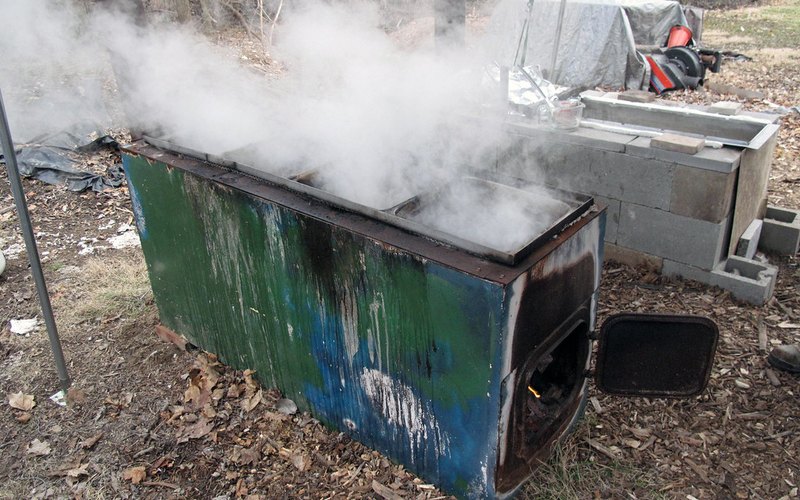
Someone welded a firebox out of a filing cabinet, and it is doing exactly what a $3,500 arch does: holding fire under metal and keeping hot gas where it belongs. That’s the tier, and it’s real.
Tier 1 — entry hobby, $1,370–$2,150. Where you stop building and start buying.
- Smoky Lake StarCat — from $1,370.00, arch + pan, 3–30 taps, 5–8+ GPH.
- Leader Half Pint — $1,370.00 at Schweigart’s, and here’s what you’re paying for: a three-section divided stainless pan. 15–50 taps, 4 GPH. Stack not included, firebrick not included.
- VEC Sapling — $1,527.00, includes a 30”×20”×6” baffled pan. 5–50 taps, 4–8 GPH.
- Smoky Lake Dauntless, flat pan — from $1,965.00, 20”×48” mirror-finish stainless, 9–11+ GPH.
- Leader 1/2 Pint “Complete” — $2,150.00 at Bascom: adds a cast iron door, steel legs, a preheater pan, grates, arch. Stack still separate.
⚠ About that Half Pint price: three dealers, three numbers for nominally the same unit — $1,370 (Schweigart’s), $2,050 (an unverified supply-store listing), $2,150 (Bascom’s “Complete,” a genuinely different bundle). They don’t reconcile from the web pages. Get a quote from a named dealer. I’m not publishing a single Half Pint price.
Tier 2 — the murky middle, and I have to be straight with you. W.F. Mason builds TIG-welded 304 stainless wood-fired rigs; the prices floating around are $1,400 small (7–9 GPH, 1–50 taps) and $1,600 larger (9–12 GPH, 1–100 taps), plus a $325 blower. Those are search snippets only — both of Mason’s hostnames failed DNS resolution when I went to check. Not a 404; no resolution at all. Temporary glitch, or the company is gone. I can’t tell you, and I’m not recommending them until someone reaches a human being there. Roth Sugar Bush is the same story from the other side: their pages 403 every automated fetch, so I have no Roth prices beyond one RO listing. They sell a 2’×6’ reversible wood-burner for small sugarbushes — and note Roth’s base price excludes the pan. Which brings me to the thing you came for.
Tier 3 — small commercial.
- Smoky Lake Corsair, flat pan — from $3,973.00 (disc. $3,528.75)
- Smoky Lake Dauntless Hybrid — $3,700.70, 30–95 taps, 15–20+ GPH
- Corsair + raised flue pan set — from $7,568.75
- CDL 2’×6’ Complete (Bascom) — $8,682.00. 2’×4’ pan with 7” raised flues + sap level regulator, cross-flow syrup pan, arch, grates, stainless stack. 50–250 taps. Needs 70 full firebricks, not included.
- Smoky Lake Liberator — from $9,318.00 · Silverplate — from $10,851.00
🔴 The pan trap — bigger than you think
| Corsair configuration | Price |
|---|---|
| Arch alone, no pan | from $1,870.00 |
| Arch + flat pan (the bundled “Full Evaporator”) | from $3,528.75 |
| Arch + raised flue pan set | from $7,568.75 |
The headline “Corsair from $3,528.75” is the flat-pan bundle. Read that number, picture a serious flued rig, start saving — and you are short about $3,600. The flue Corsair is 2.1× the advertised entry price.
Here’s what reframed the market for me: the pan costs more than the arch. Smoky Lake’s standalone flue pan sets run $4,100 (High Output Drop Flue, standard), $4,550 (Raised Flue, standard), and $5,100 / $5,550 for the SSR configs. The arch is $1,870. You are not buying an evaporator with a pan on it. You are buying a pan with a firebox under it — and the industry’s pricing knows it even if its marketing doesn’t. Those sets are 22-gauge mirror-finish stainless with float boxes and drain mechanisms.
The rule that defuses it. Smoky Lake is straight about the mechanism: “Full Evaporators are discounted because you are bundling a Pan and Arch together” — 5% off the arch. So a “Full Evaporator” listing does include a pan. The FROM price just won’t tell you which pan. Always read which pan the headline price assumes. That habit is worth four thousand dollars.
The trap isn’t only pans. Leader Half Pint: no stack, no firebrick. Leader 1/2 Pint Complete: firebrick (32 full, 63 half), cement, stack, elbow, valve — all separate. CDL 2’×6’ Complete: 70 firebricks. “Complete” is a marketing word, not a specification.
One correction, because I nearly repeated it: a snippet told me Leader Half Pint “arch pans are sold separately, not included.” False — the pan is included; the stack and firebrick are what’s excluded. The snippet garbled it. I flag it because it’s exactly the trap I was hunting. Just not there.
The 50–200 tap gap is real, and I’m standing in it
| Rig | Tap rating | Price |
|---|---|---|
| Leader Half Pint | 15–50 | ~$1,370 |
| VEC Sapling | 5–50 | $1,527 |
| Dauntless (flat/divided) | 10–55 | ~$1,890 |
| Dauntless Hybrid | 30–95 | $3,700.70 |
| CDL 2’×6’ Complete | 50–250 | $8,682.00 |
Every entry rig dies at about 50 taps. That’s where the hobby market thinks the hobby ends. The next real rung is the Hybrid at $3,700, then $7,568 (flued Corsair) or $8,682 (CDL). There’s a wide hole in the ladder and it’s exactly where a person selling at a farmers market lives. Which is why the RO argument lands so hard.
And trust GPH, not tap ratings. Mason rates 1–50 taps at 7–9 GPH; Leader rates 15–50 taps at 4 GPH. Same ceiling, double the boil. They can’t both be right about what 50 taps needs — and I never found a vendor-published sap-per-tap figure to derive taps→GPH from first principles. GPH is a physical claim. Tap count is a sales claim. Smoky Lake even disagrees with itself: their guide rates the Dauntless 10–55, their product page 10–75, same GPH. I plan on 10–55.
Sizing — Cornell’s method, which is the sound one
Cornell’s Beginner’s Notebook reframes this in a way I found genuinely clarifying: “This is a more complex question than most beginners realize. A real question to be answered is, how much time will you have for boiling?” Your evaporator is sized by your patience, not your trees.
taps × gal sap per tap per day        = gallons per run
gallons ÷ hours you'll actually boil  = required gal/hr
required gal/hr ÷ gal/hr/sq ft        = square feet of pan
Inputs: sap per tap per day — Cornell 0.5–2.5 gal, UNH ~1 gal. Per season the sources fight (UMaine 5–15, OSU 6–10, New York 10–20), but the usual ~10 gal/tap midpoint cross-checks — UMaine says a tap yields about a quart of syrup, and 0.25 × 43 = 10.75. On buckets in Michigan woods I plan 8–12. Storage: 2 gallons per tap — Cornell says it twice.
⚠ The evaporation rate is the most consequential disagreement in the whole subject. OSU says flat-pan rates “are highly variable… they may range from as little as ¾ to more than 1½ gallons of water for each square foot,” and refuses a point estimate — which I respect. Their band checks against Bascom’s small-pan table (24”×48” → 8–10 GPH). But Cornell and UNH both publish “a 2’×4’ removes about 15 gal/hr” — 1.88/sq ft, nearly double — without saying whether they mean flat or flued. Cornell notes in the same passage that a flue pan “can significantly increase the rate of boiling,” which strongly suggests their table is flued; UNH matches Cornell at every size, which smells like shared lineage, not confirmation. A beginner sizing a flat pan off Cornell’s table undersizes by roughly half. My working split: flat ≈ 1.0–1.25 gal/hr/sq ft; flued ≈ 1.9–2.1. (“10–15 gallons per hour per square foot,” which you will see, is off by ~10× — a garbling of “a 2×4 does 10–15 GPH total.” Reject it.) Rates disagree by up to 90% on the same pan size. Don’t average them into a confident fiction.
Run mine: 100 taps × 1 gal = 100 gallons a run. 2’×4’ flat at 8–10 GPH → 10 to 12½ hours. 2’×4’ flued at 15 → under seven. 2’×6’ flued at 25 → four. A MapleTrader post reads like prophecy: “I ran a 2x3 pan with 100 trees for years — but there were many late nights and the occasional time when sap was dumped.” The math and the man who lived it agree.
Undersizing doesn’t cost sleep — it costs product. Cornell: “Sap spoils very quickly, so if you get a run overnight, you will need to stay to boil, or else forfeit the run.” Long boils darken syrup, so undersizing costs grade too. MapleTrader names the asymmetry: “Oversized is better than undersized.” Waiting versus dumping. (In fairness: Bascom notes that if you boil as you go instead of accumulating, smaller is fine. The rule is conditional on batching.)
Pan design — baffles don’t add area, they add gradient
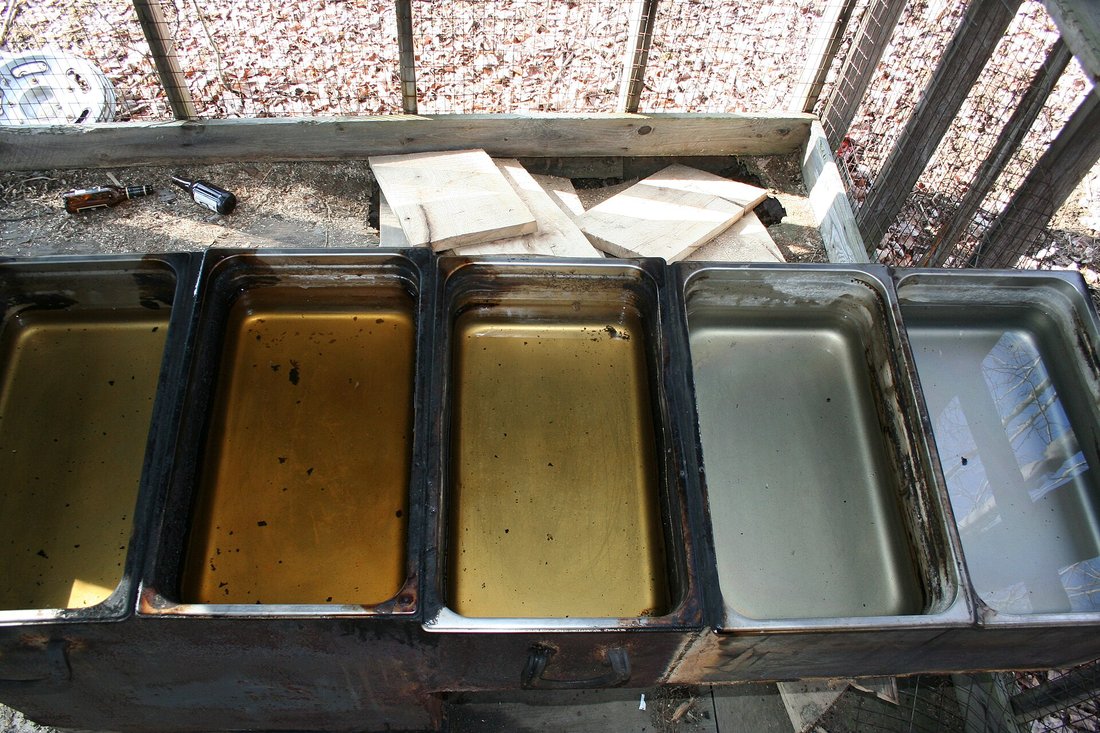
That photo is the whole idea in one frame. Same pan, same fire — but the sap is at a different concentration in every compartment, and the syrup comes off the amber end.
This is the concept that made pan pricing make sense to me.
A flat pan is a batch. Vermont Evaporator’s Andy Boutin names the failure: “Flat pans require constant stopping and starting — each sap addition kills the boil until the entire pan reaches uniform density.” Every scoop of fresh sap is a thermal setback across the whole volume.
A divided pan is connected channels. Sap enters at one back corner and walks forward; per Smoky Lake, “the sap that is closest to the draw-off valve will be darkest and the highest sugar density.” You draw off a little at a time and add continuously, never emptying the pan. The design rule follows: sap enters at the corner opposite the draw-off, because “the longer the distance between ‘sap in’ and ‘syrup out’, the stronger the density gradient will be.”
Then Boutin’s line, the crux of everything:
In a flat pan “the gradient is only as long as the pan is deep.” With baffles, “the gradient is as long as the different channels all stretched out.”
A flat pan’s gradient is two inches — vertical, destroyed by every stir. A baffled pan’s is feet long, horizontal, self-sustaining. A 20”×30” baffled pan “operates as if it is a 10”×60” pan, squashed over the firebox.” Baffles don’t add area. They add gradient length. That’s what you’re actually buying in the Half Pint’s three-section pan at $1,370, and it’s the biggest quality-of-life jump over my turkey fryer.
Flues are next, and Smoky Lake states the mechanism on their own page: “More flues means more surface area of your pan will be in contact with the heat from your firebox… drastically increasing the evaporation rate.”
⚠ The number everybody quotes is unsourced. You’ll see “drop flue pans achieve 2× the evaporation rate (25 gal/hr) vs. the same size flat pan (11 gal/hr max)” attributed to Smoky Lake. I went to that page. Those numbers are not on it — it makes only the qualitative surface-area argument, no numerical comparison. MapleTrader folklore says “2 or 3 times.” The UNH/Bascom comparison at the same footprint implies ~1.5–1.9×, and that’s inference, not measurement. The direction is well supported. The multiplier is not. Don’t budget on it.
Drop vs raised, since the delta is $450: drop flue uses one float box for the whole machine at 1.5–2” throughout — cheaper, simpler, flues hang into the arch. Raised flue uses two floats for independent depth (back pan ~1”, front 1.5–2”) — higher efficiency, faster boil-off, better front-pan recovery after a draw-off via head pressure. Its origin was purely ergonomic: “The raised flue came about so that one would not hit the flues while putting in wood.” Above 2’×6’ manufacturers push raised flue; below, drop flue is defensible. At my scale it barely arises.
Depth: 1.5–2 inches, and four independent extension sources agree. UMaine: “Keep the sap at least 1½ inches deep in the pan, or it may burn.” Shallower boils harder and strengthens the gradient — but stack temperatures run 600–1000°F, and “the only thing that keeps that metal from melting is the thin layer of sap on top.” The sap is the pan’s coolant. Lose it and you lose the pan, not the batch. “The most common reason for burning a pan is human error, usually caused by a distraction.” 1.5–2” is a risk-managed compromise, not an optimum, and uneven depth is the real hazard — OSU warns of “2 inches in one part of the pan and only a half-inch in another.” Level your rig. That’s what float boxes are for: constant depth is what makes a stable gradient possible. And one non-obvious discipline from OSU — “Any change you make to the float at the back of the evaporator will be transferred forward to the draw-off point. Thus, all changes should be minimal and incremental.” Transit runs ~45 minutes. The gradient has latency and punishes overcorrection.
Steel and the used-pan hazard. Nearly every new pan is 304 stainless. 316 costs more and buys you nothing — its extra resistance is for chlorides, which sap doesn’t present. Modern pans are TIG welded with back-purging, retiring solder questions entirely; Smoky Lake specs 22-ga mirror finish (mirror is about cleanability, not looks) and warrants the Dauntless weld for life. VEC calls the Sapling pan “stainless steel” but doesn’t state the grade — the DIY-tier gap, since steam-table pans are typically 201 or 430.
🔴 Buying used — and a hobbyist is — old maple pans may contain lead solder. The industry moved to lead-free (Silvabright) after the scare; vintage gear predates it. Cornell is soft on pans (“Stainless steel pans fabricated with lead-free solder or welded seams are strongly suggested” — note they accept lead-free solder as legitimate) and hard on tanks (“Tanks with lead solder are not acceptable”). 304 + TIG is the spec to ask for.
Fuel — where the sources fight
The physics anchor, from Ohio State: 400,000 BTU to turn 2% sap into 66-Brix syrup, and a standard evaporator makes 22 gallons of syrup from a cord of dry wood. Efficiency: traditional wood 40–60%, modern wood with forced air + insulation 85–90%, fuel oil ~80%, gas mirrors oil. Read those first two together: a modern wood arch with forced air is as efficient as an oil burner. Fossil fuel’s edge is burner control, not efficiency. And Cornell names forced air the cheapest capacity upgrade available — “boiling will happen much faster so that a smaller system can accomplish more production.”
⚠ OSU and MapleTrader disagree about fuel oil by 8×. OSU: under 4 gallons of oil per gallon of syrup. MapleTrader producers: about half a gallon. They can’t both be right. My read: No. 2 fuel oil is ~138,000 BTU/gal, so 400,000 BTU needs ~2.9 gal at 100% efficiency and ~3.6 at OSU’s 80% — inside OSU’s “under 4,” and the half-gallon claim doesn’t survive that arithmetic. But I checked OSU using OSU’s own BTU figure — that’s internal consistency, not independent proof. I’m siding with OSU and telling you why, not telling you it’s settled.
The wood number you can use: forget the “$0.50 per gallon” figure in circulation — it assumes $5/cord, a trucking cost for a man who owns the woodlot, not a market price for dry hardwood. I found no current published cord price and won’t invent one. So: wood cost per gallon of syrup = (your cord price) ÷ 22. And the cost nobody prices, per both OSU and MapleTrader: “you need to figure in your time to cut it, stack it, and then to move it and load it into the arch.” No source assigns a dollar figure to the sugarmaker’s labor. A real gap, not an oversight.
🔴 Reverse osmosis — the highest-leverage dollar here
Cornell Small Farms on little ROs at hobby scale: yes, with a caveat — “if you are not at all mechanically inclined making your own RO is probably not the best idea.”
At 25–70 taps: 4.5–5 GPH permeate removed, sap 2% → 4–5% sugar, boil 8 hours → 4, wood down ~50%.
| Unit | Price |
|---|---|
| DIY entry — GE Merlin + pre-filter | ~$360 (2017 Cornell, stale) |
| DIY mid — 8”×40” membrane + Procon pump + vessel | ~$1,150 (2017, stale) |
| CDL Nano RO, 3-membrane w/ recirculation | $1,170.40 (Roth listing) |
| CDL Nano RO | $1,287.44 (The Maple Guys) |
CDL publishes no price on their own page. Their Nano RO specs: 30 GPH filtrate, 4–5 Brix in batch, three 3”×12” membranes, rated 50–250 taps — which brackets my entire range in one box.
⚠ The throughput numbers don’t agree. CDL’s page says 30 GPH at 4–5 Brix. A dealer snippet for the recirculation variant says 13 GPH filtrate / 26 GPH sap treated, up to 6 Brix. Probably different SKUs and/or batch vs. single-pass — but nobody says so, and 30 vs 13 is a 2.3× spread on a headline spec. Ask CDL which rating is which.
Now the comparison that started this page:
- Nano RO: ~$1,200. 50–250 taps. Halves the wood. Halves the boil.
- Corsair flat → raised flue pan set: +$4,039.75 ($3,528.75 → $7,568.75).
A third the price, and Smoky Lake themselves say it raises your tap ceiling. Cornell’s list of things that change the sizing answer leads with it: RO → “a much smaller boiler can be used.” You’re not buying speed. You’re buying less water to boil in the first place — the only move here that attacks the problem instead of brute-forcing it.
Cornell’s cautions, not optional: avoid chlorinated water entirely. Remove carbon filters — they “will remove sugar and many other things you normally want.” Store membranes submerged in pure permeate off-season. Change pre-filters often. Pump must be at least 50% above the membrane rating or you get sugar buildup. And one counterintuitive thing: RO concentrate spoils faster than raw sap — spoilage is time, temperature and sugar concentration, and higher sugar below 66 Brix means faster microbial growth. You didn’t buy shelf life. You bought fewer gallons.
What I’m actually going to buy
I don’t own any of this yet. But the list writes itself now:
- The RO first. ~$1,200, rated 50–250 taps, half the wood and half the boil. A third the cost of the pan upgrade — and it makes every other decision here smaller.
- Then a divided pan with a firebox under it. At the entry tier, the divided pan is the product.
- A blower before a bigger arch. Cornell calls forced air the cheapest capacity upgrade there is.
- A hydrometer and a refractometer. Both. That’s the finishing page’s argument, not this one’s, but it’s the cheapest line on this list and it decides whether everything above it produced a legal, sellable product.
- Filters I boil before I use them, and a hot-fill-rated pail I don’t cheap out on.
Notice how the list inverts the price ladder. The expensive decisions on this page — arch, pan, flues — buy speed. The cheap ones at the bottom buy the product itself. Which is why I’d rather send you to finishing and filtering before I send you to a dealer: the last hundred dollars of this list can ruin everything the first nine thousand bought, and none of it works the other way around.
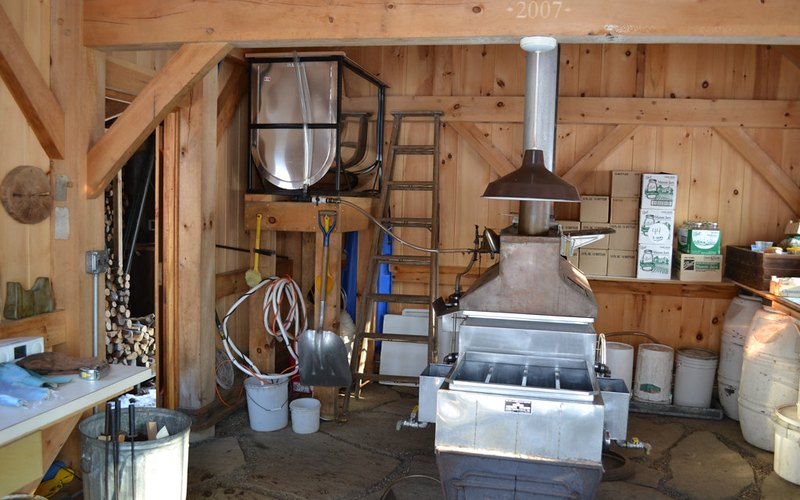
And somewhere to put all of it — the hood, the stack, the steam, and the fact that a rig this size does not belong in a driveway. That’s the sugar shack.
The turkey fryer stays, though. It’s a perfectly good finishing pot, and it’s the honest reminder of where this started: a burner, a bucket, a driveway, and enough syrup that strangers handed me money for it.
Comments (0)