Tapping
Everything else in sugaring is chemistry and patience. Tapping is the one part that’s a decision. You walk up to a living tree with a drill and pick a spot, a depth, and a day — and you’ll be right or wrong about all three, and the tree will tell you which over the next twenty years, slowly, in wood.
I tap sugar and red maples here in Michigan. Buckets on spiles, lids on, and a turkey fryer in the yard to boil what I carry back. Small enough that I know most of the trees by sight, big enough that I sell what I make at a store and at a farmers market — a hobby with a receipt attached. And it means the walk matters. At this scale you don’t feel your setup in a spreadsheet. You feel it in your shoulders, in February, hauling.
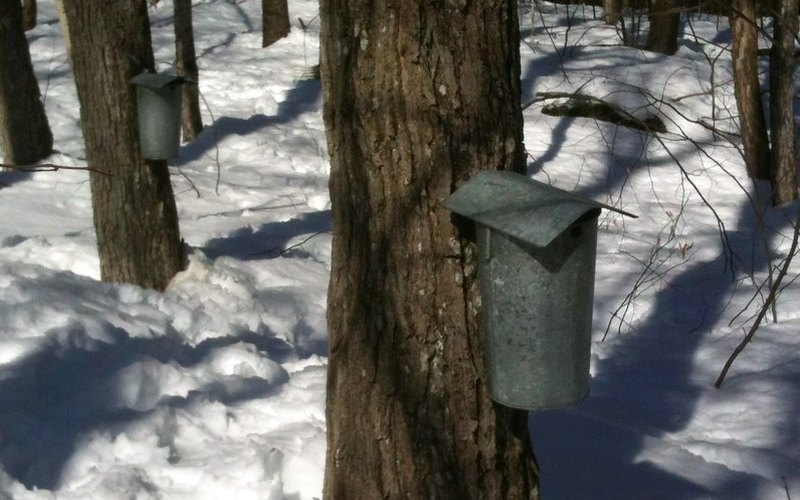
This page is the practical half: when to drill in Michigan, how deep, how big a hole, how many taps a tree can carry, and what you hang on the spout afterward. The why of sap running at all — the freeze-thaw mechanism, which is not the story you’ve probably been told — lives on how sap becomes syrup. I’ll lean on it rather than re-run it.
The Michigan window — and why a Vermont schedule will fail you
Here’s the single most important correction I can offer anyone starting here, and it’s the one almost every book, blog, and video gets wrong for us: nearly all the good maple writing in English comes from Vermont, New York, or Maine, and Michigan’s season is not their season.
Michigan runs from about 41.7°N at the Ohio line to about 47.5°N at the Keweenaw — roughly six degrees of latitude inside one state’s borders. The season doesn’t start statewide on a date. It moves north. MSU Extension puts it plainly: it starts in the southern Lower Peninsula in mid- to late February and proceeds northward until it reaches the Upper Peninsula eight to ten weeks later.
So, roughly:
- Southern Lower Peninsula — mid- to late February. MSU’s own hedge is “for much of Michigan, it’s during that last week of February,” which is really an LP statement.
- Northern Lower Peninsula — March. MSU treats the NLP loosely as “March” rather than bracketing it, and I’d rather say so than invent a tighter window than the sources support.
- Upper Peninsula — mid- to late March, running into April. An April run in the UP is normal, not the freak late season it would read as in Vermont.
The best independent check isn’t prose at all — it’s the Michigan Maple Syrup Association’s Maple Weekends, staggered by region. Producer-set open-house dates mark when each region is reliably in season, chosen by people with money on it: Southern Lower March 21–22, Northern Lower March 28–29, Upper Michigan April 11–12. A three-week spread inside one state. When a Vermont guide says to tap “the first week of March,” it’s wrong at both ends of Michigan — late for me, absurdly early for Marquette.
Watch the forecast, not the calendar. Sap runs on the freeze-thaw cycle: nights below freezing and days above. Not a temperature — a cycle. MSU is explicit that the start is unpredictable, because sap moves when daily temperatures begin consistently rising above freezing. One producer’s practical numbers — nights in the 20s–30s°F, days in the 40s to low 50s°F — match what I watch for. I tap when I see a stretch of that in the ten-day.
And here’s the number that reorganized how I think about the operation: the calendar window is four to six weeks, but a Michigan season may only deliver 10–20 genuinely good sap-flow days inside it. (Producer’s operational read, not a research finding — hold it loosely, though it squares with MSU’s framing of the season as a handful of small “sap runs.”) Size your boiling capacity to the runs, not the calendar. Four weeks sounds leisurely. Ten days of hard running does not.
One thing I’d love to tell you and can’t: whether the Great Lakes moderate our freeze-thaw cycle in a way that matters for sap. Everyone assumes it, and I could not find a single Michigan source that puts numbers on it for sap specifically. The lakes moderate our climate generally; whether that helps or hurts the cycle we live on, nobody I could find has measured. That’s a hole, and I’d rather flag it than fill it with a nice-sounding guess.
Which trees, and how many
Sugar maple (Acer saccharum) is the target, and Michigan is exceptional country for it — the USDA Forest Service’s Silvics of North America lists Michigan first among the states with the greatest commercial volumes, ahead of New York and Maine. Red maple is the other one I tap: native, common, often on swampier sites but happy on dry uplands too. It runs, it makes syrup, and at my scale I’m not walking past one.
Black maple (A. nigrum) is the Michigan note a Vermont-sourced guide underplays: MSU’s Michigan Fresh says syrup “is typically harvested from sugar maple and black maple trees.” It’s often treated as a subspecies of sugar maple and occurs mainly in southern Michigan.
On tapping non-maples, I have to be straight with you. The research turned up no MSU Extension or Michigan DNR source that endorses or documents tapping birch, black walnut, sycamore, or hophornbeam in Michigan. The MI extension literature is maple, full stop. Everything you’ll read about tapping walnut or sycamore is generic eastern-US guidance, and dressing that up as Michigan practice is exactly the failure I’m avoiding here. And hophornbeam, which turns up on internet lists of tappable trees: I found no source anywhere documenting it as a syrup tree.
The diameter tables — and the argument that undercuts them
Every extension service publishes a table, and they don’t agree with each other, which should tell you how precise the underlying science is.
MSU’s Michigan Fresh says a tree needs to be about 40 years old and at least 32 inches in circumference at 4.5 feet before tapping — about 10.2 inches diameter. The DNR’s guidance (see the caveat below) is the conservative, familiar schedule:
- 10” diameter minimum before you tap at all
- 1 tap at 12–18”
- 2 taps at 19–25”
- 3 taps above 25”
That’s consistent with what UMaine, UNH, and Vermont publish, give or take an inch — UMaine’s minimum is 10”, UNH’s is 12” with a hard cap of 2 taps ever, Vermont’s standards start around 9–10”.
But there’s a paper that reframes the whole question, and it’s the most under-reported thing I read. Brad Chabot’s “New Tapping Guidelines” (Cornell, 2005) argues that the real constraint isn’t “tree health” in some vague sense — it’s whether the tree can grow new wood over your old tapholes before you come back to that spot. Wood compartmentalized around an old hole is permanently out of sap production, and its chemistry contributes off-colors and off-flavors. So the question isn’t “can the tree survive this,” it’s “am I retiring wood faster than the tree is making it.”
Then he does the arithmetic, and it’s sobering. At Cornell’s Arnot Forest, average radial growth runs about 0.04 inches a year — at which rate a 10-inch tree adds only 1.3 inches of radius in thirty-one and a half years, too little to tap at the normal 2-inch depth. By his math you want a 15.9” DBH tree to support one 2-inch hole a year, and a 33-inch tree for two. Compare the tables above, which happily put two taps in a 19-incher.
Chabot’s four rules: one tap unless the tree is fast-growing or very large; depth closer to 1 inch and never more than 2; expand the tapping area vertically 12–15” above or below old holes; and use a pattern you can track back twenty years. He also says measure circumference, not diameter — circumference is what actually measures your available tapping real estate.
Now — those growth numbers are Arnot Forest numbers, and Michigan sugar maple in a well-thinned stand grows faster. Federal silvics data for UP stands puts maximum diameter growth near 3 inches per decade for an 18-inch tree. So the tables and Chabot are arguing from different woods, and the honest read is that the tables are simplifications and the mechanism underneath them is new-wood-over-old-tapholes. If your trees grow well, the tables are probably fine. If they’re crowded and slow, Chabot is telling you the tables will quietly eat your sugarbush. I go one tap per tree except on the genuinely big ones. I’d rather leave sap in a tree I’ll still have in 2050.
For scale: Michigan averaged about 0.3 gallons of syrup per tap in 2025 (USDA NASS), so a hundred taps is roughly thirty gallons in an average year. That’s the arithmetic that tells you how many trees you need.
Finding trees you’re allowed to tap
This is where Michigan bites, and it’s genuinely useful to know before you go looking.
Michigan does not permit tapping on state land. The DNR’s position, as best I can establish it, is that sap collection is not permitted on public lands and that the DNR does not issue permits for it. The legal hook appears to be that tapping counts as damaging vegetation — state land rules prohibit cutting, peeling, damaging, destroying, or removing a tree or other vegetation without written permission from the director. The DNR’s own suggested alternative is: tap your backyard.
Verify this yourself before you act on it, and I mean that. Every michigan.gov and DNR page returned a 403 when I went looking — this rests on search-engine extracts of those pages, not the pages themselves. Every source points the same way and I’ve no reason to doubt it, but none of it was read first-hand, and there’s a loose thread: someone reportedly once held a Wildlife Division permit to tap a State Game Area in Huron County, which sits awkwardly beside “the DNR does not issue permits.” Open the DNR foraging page in a browser, or call your local DNR office. That’s their recommendation and it’s mine.
Separately: tribal treaty-reserved gathering rights apply on certain ceded lands under the 1836 Treaty of Washington and others — that’s tribal members, not the general public.
So if you’re short on trees, the realistic routes are private landowner agreements with neighbors who have mature maples (this is how most small Michigan operations scale, and how you should plan to), municipal programs where they exist — the City of Birmingham runs a maple tapping program, and each has its own rules — and asking the DNR directly about your specific situation.
And join the Michigan Maple Syrup Association — 150+ members, 150,000+ taps, and a directory of 150+ Michigan sugarbushes. It’s sized like serious hobbyists and small commercial producers rather than industrial operations, which makes it the right room at 50–200 taps.
The hole
Now the actual drilling, which takes about fifteen seconds and outlives you by decades.
Depth: 1.5 inches, measured. That’s the standard UVM Proctor tests to, described as “the correct tapping depth for today’s operations” for a 5/16” spout. UMaine says 1.5–2”. Chabot pushes shallower still. Notice the direction of travel — older sources say 2–3 inches, current practice has drifted to 1.5, and Chabot argues for closer to 1. That drift is the compartmentalized-wood argument expressed as a number. For a hobbyist, 1.5 inches with a depth stop on the bit is the defensible answer. A wrap of tape works. Eyeballing it is how you end up at 2.5”.
Bit: match your spout exactly — 5/16” spout, 5/16” bit — and use a sharp one. A dull bit tears and burnishes the hole instead of cutting it, and you want clean walls.
Angle: level, or very slightly upward. UMaine says level/horizontal; other sources want a slight upward angle so sap doesn’t pool. That’s a genuine minor disagreement in the literature, the trend runs level-to-slightly-upward, and honestly I don’t think it’s the lever that decides your season.
Spacing from old holes: at least 6 inches horizontally and 2 feet vertically (UMaine) — though Smith & Walters found in 1972 that you can tap within an inch of an old taphole without hurting yield, which suggests the rule is about staying out of dead wood rather than some exclusion zone. Chabot’s version — move the whole band 12–15 inches vertically — is the one I follow, because it’s trackable. Use a pattern you can reconstruct twenty years from now.
Why the spout got smaller
If you’ve got old spiles in a coffee can in the garage, they’re probably 7/16”. That was the standard for a century. It’s obsolete for tubing now, though it remains “acceptable and common” on buckets, which is why plenty of us are still hanging them.
The modern “health spouts” are 5/16” or 19/64” — the research treats those two as equivalent — available since the mid-to-late 1990s. The name tells you the argument: a smaller hole removes far less wood, which is Chabot’s concern in physical form.
But here’s the part that gets sanded off in most write-ups, and it matters specifically to me because I’m on gravity. The comparison work from Cornell, Proctor, and Centre ACER found that 5/16” yields as much as 7/16” under vacuum — and slightly less on gravity. Cornell’s tubing notebook says it directly: using the 5/16” health spout without vacuum often cuts the yield, while under vacuum the difference is minimal.
So the clean marketing line — “smaller spout, same sap, happier tree” — is only true if you’re pulling vacuum. On a bucket, on gravity, the small spout costs you a little. It’s still probably the right trade — a little less sap now against decades more tappable wood — but it is a trade, and anyone who tells you it’s free is quoting the vacuum study at a gravity operation. I plan to move to 5/16” anyway, partly for the tree and partly because if I convert to tubing I want the spout size already consistent.
Sanitation is the free yield
This is the biggest free lever on a gravity setup, and it follows straight from the freeze-thaw physics: when the tree drops below freezing it develops internal vacuum and sucks sap back in from the spout and the drop. Contaminated spout, contaminated taphole, early dry-out.
Cornell’s gravity numbers are not subtle. Old spout on an old drop: 3.4 gallons per tap. New spout and new drop: 6.0 — 76% more sap for a new plastic part, and across a season on an aging system they measured 88% more. Contaminated tapholes dry out earlier, so sanitation directly buys you season length. Not yield-per-day. Days.
New spouts every year. Whatever else you skip.
Two different things end your season
This gets conflated constantly, and they’re not the same thing.
The run stopping is not the season ending. The freeze-thaw cycle quits for a week, the buckets go quiet, everyone announces it’s over — then it freezes Thursday night, Friday’s warm, and the trees run again. A flat week is weather, not a verdict.
What actually ends it is one of two mechanisms, and they’re different chemistry. The first is microbial: warm weather means the taphole colonizes fast — below ~50°F growth is slow, above it microbes multiply rapidly — and the hole dries out early while the sap that does come turns off-flavored (end-of-season pH drops sharply; light color, bad taste). Ohio State’s argument is worth repeating: producers blame the buds when the real culprit is a microbial colony shutting the taphole down. That’s why sanitation buys you days.
The second is genuinely “buddy” syrup, and it’s caused by dormancy release — the buds actually breaking. The chemistry is unrelated to sour sap: it shows up as organic sulfur compounds in the sap and dimethyl disulfide in the syrup, and dormancy release is necessary for the defect. Michigan’s calendar window is four to six weeks precisely because it closes when the buds swell.
So: a dead week is weather. Off-flavor is microbes, and you can fight it. Bud break is the tree, and you can’t.
Buckets — what I actually do
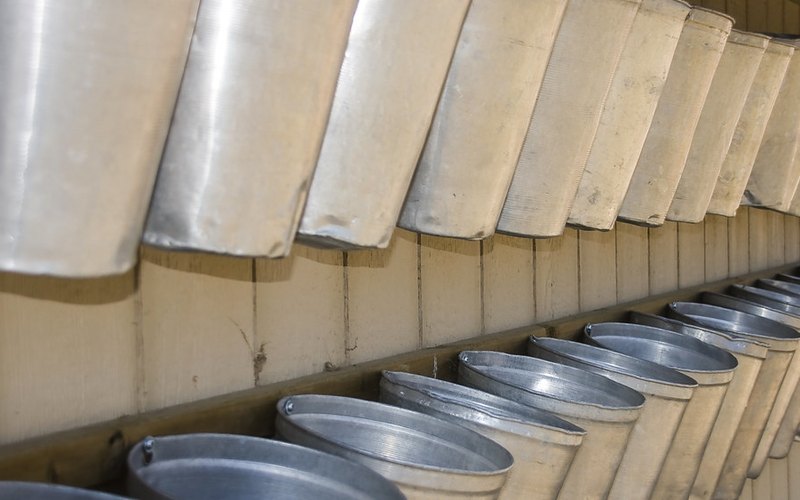
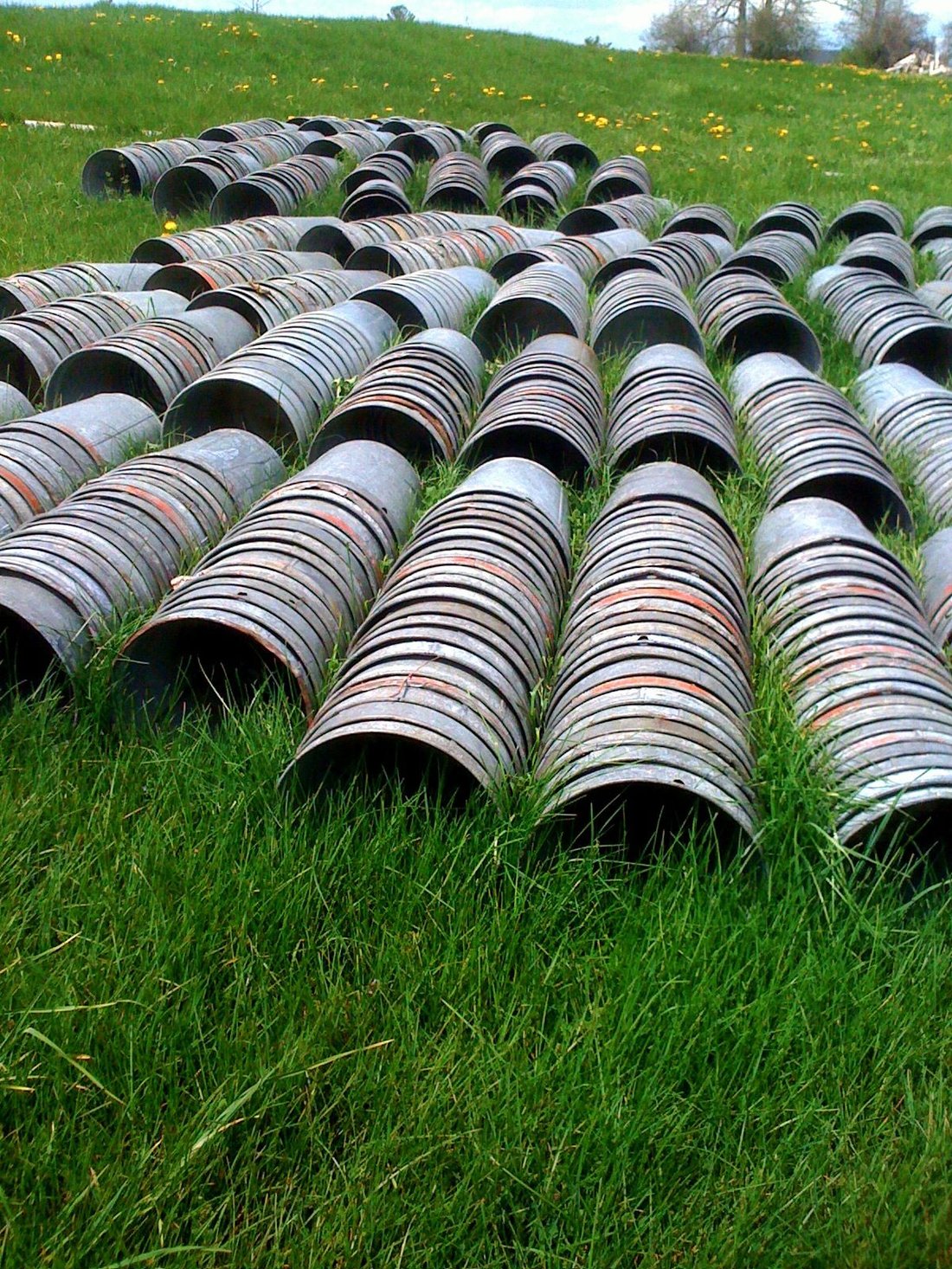
I hang buckets on spiles, and I want to defend that honestly rather than treat it as the thing you graduate from.
What’s genuinely good about buckets: zero layout planning — they work on flat ground, on trees scattered across a property line, on the one enormous maple 300 feet from anything else. They’re trivially inspectable: lift a lid and you know. No leak hunting, no wire, no fittings. And one that’s badly underrated — Chabot notes bucket users have far more flexibility to move the tapping band vertically year to year. A fixed drop wants to return to the same place; a bucket goes wherever you drill. That’s a real tree-health advantage, and the argument the tubing catalogs don’t make.
What’s not:
- The labor. Hang, empty, wash, store. That’s most of what I do in February.
- The sap sits warm and exposed. UMaine’s line is the one to keep in your head: “Sap is like milk. It will sour if left in the sun.” Below 40°F bacterial growth is slow; above 50°F it’s rapid, and the guidance is blunt — anytime sap hits 50°F and you can’t cool it, boil immediately. At room temperature, off-flavors in 6 to 12 hours.
- Yields are the baseline — 3.4 to 6 gallons a tap in Cornell’s gravity woods, depending entirely on how new your spouts are.
- The cost is worse than you’d think. Buckets run about $8–9 per tap; 3/16” tubing about $5 at a 25–50 tap comparison. (Vendor figures, dated — order-of-magnitude, not a quote.) The bucket is cheap and the system isn’t.
The tubing upgrade I’m planning
I have not run tubing. Next season is the plan, and I’ve spent more time reading about it than is strictly reasonable, so here’s what I’ve concluded before I’ve spent a dollar.
Gravity, not vacuum. At 50–200 taps a vacuum pump is the wrong shape of money and the wrong shape of hassle — it wants electricity out at the collection point, sizing at 1 to 1.5 CFM per 100 taps, and a maintenance relationship. The yield case is real (Cornell measures vacuum raising production 50% to over 200%; roughly doubling from 0 to 15” Hg is the defensible headline, then 5–8% per additional inch, with clear diminishing returns past 20”). But the honest hobby answer is that 3/16” tubing makes its own vacuum out of gravity, and that’s the door I want to walk through.
The physics, briefly. A sap column in 3/16” tubing won’t let air bubbles past — it pushes them out ahead of itself, and the result is real vacuum at the tap. The vacuum is proportional to the elevation drop of sap-filled tubing below that tap. Proctor’s practical rule is vacuum ≈ 50–75% of the vertical drop in feet: 24 feet gets you 12–18” Hg, 40 feet gets 20–27”. (Other conversions get quoted; they disagree. Use Proctor’s.) And here’s the consequence nobody mentions in the sales copy: taps near the top get excellent vacuum, taps near the bottom may get none. Cornell measured 24” Hg at the top tap on a line with 34 feet of drop, and 0” Hg at the bottom tap. The fix is extending the tubing further downhill so even the lowest tap has drop beneath it — at the price of more hiking and more of your system exposed to wildlife.
The gate, and it’s a real gate. Cornell’s Steve Childs recommends 3/16” where you have a fall of 15 feet or more and at least a 6–10% slope — and below that he explicitly declines to recommend it without more research. That “he declines” is worth more than most recommendations. The trade’s rule of thumb wants 40–50 feet of fall for genuinely good vacuum, and how much line that takes depends entirely on slope: a 50-foot fall is 150 feet of line at 30%, 500 feet at 10%, and 1,500 feet at 3%.
Taps per line — the number that inverts your intuition. You do not need many taps to make vacuum: Cornell found 8 taps per line generated excellent vacuum, and notes elsewhere that 3 or 4 produce enough sap to create it. Capacity is the upper bound and it’s generous — Childs summarizes that 30 to 40 taps fit on a line above 10% slope before sap flow exceeds the tubing. But his own recommendation isn’t capacity-driven at all, and I love him for saying it out loud:
“Installing a system that is easily maintainable is more important than if the tubing can handle the sap load. I would rather find where a leak is on a ten or twelve tap line vs. a 40 tap line.”
So: 8–12 taps per 3/16” line. Enough for full vacuum, short enough to leak-hunt. The 30–40 figure is headroom, not a target. And note that “taps per lateral” has no single answer across the craft — it’s 5–6 for 5/16” on vacuum, 10–15 for 5/16” on gravity, 8–12 practical for 3/16”. Any page that gives you one number is wrong.
Slope and layout rules I’ve written down for next year:
- Laterals suspended 2–5 feet off the ground, tight, always downhill to the mainline — no loops, no traps, no sags, including in the drops. Sap sitting in a sag ferments and inoculates the next run. Too low and the line gets buried in snow, stays frozen, and blocks every tree uphill of it on the early runs.
- Mainline slope: a fairly even grade between 2% and 6%. It’s the evenness that matters — changing slope creates slugs of sap that block airflow. Better to have laterals steep and mainlines gradual. ¾” is large enough for gravity.
- Wire: #9 or #12.5 high-tensile for the mainline, #12 or #14 for side ties — the gauge difference is deliberate. If a tree falls on the line, the lighter side-tie wire breaks first and spares the mainline.
- End trees and saddles: the common “double tee” loop around the end tree is, per Cornell, “probably the least effective” — sap sits in it and ferments; an end ring is cheap and lets you re-tension by sliding it. Saddles go on last, after the laterals, so they land in the right spot.
On flat ground, none of this works. Natural vacuum needs three things: a leak-free line, elevation drop, and enough sap in the line. Flat ground fails the middle one, and that’s fatal, not marginal. The industry answer is a wet/dry line — two conductors, the bottom carrying sap, the top carrying air, secondaries entering at a booster or whip, the dry line sometimes sized slightly larger. It’s the cost-effective answer for minimal slope, but it implies mechanical vacuum, which puts me back at a pump. So on a flat yard at my scale the trade’s honest answer sounds like a cop-out and isn’t: 3/16” is “less practical for flat yards or widely scattered trees where individual buckets make more sense.” A few dozen taps on genuinely flat ground — buckets may simply remain correct.
The disagreement I can’t resolve for you
Here’s where I stop being helpful and start being accurate, because Cornell and UVM Proctor materially disagree about 3/16” tubing, and every enthusiastic write-up you’ll find quotes one of them and ignores the other.
Cornell’s numbers are spectacular. Their 2015 trial — six laterals, 8–11 taps each, ~220 feet, 23 feet of drop, 10–19” trees, new black 5/16” spouts on both — measured 5/16” at 11.25 gallons per tap and 3/16” at 18.2. That’s +62%, about an extra pint of syrup per tap, and install time was identical.
Proctor’s numbers say the honeymoon ends. Perkins and Bosley report that 3/16” clogs with microbial masses, especially at the fittings, where the internal diameter necks down sharply — producing “progressively lower yields over a 2–3 year period, eventually reaching the point where sap yields can be lower than 5/16” tubing without vacuum.” Their own multi-year data: +12% in 2015, decaying to roughly −10% versus 5/16” by 2017 — despite annual spout replacement. Bleach sanitation restored +53% in 3/16” versus only +21% in 5/16”, which they read as strong evidence that fitting plugging is the primary factor.
Both are right. The difference is the time horizon. Cornell’s numbers are years one and two on new tubing; Proctor’s are what happens by year three if you don’t fight it. The honest framing, and the one I’m going in with: 3/16” is a high-yield system with a maintenance bill, not a free lunch. Proctor’s prescription is annual hypochlorite cleaning (fall preferred) or replacing all your 3/16” tees and connectors every 2–3 years. (Check current state and organic-certification rules on sanitizers — that guidance is dated and legality varies.)
Two more things from that dispute that are widely mis-sold:
- Check-valve spouts backfire in 3/16”. Same product, opposite signs: +10.4% in 5/16”, −14% in 3/16”. Do not put check valves on 3/16” tubing.
- Leaks are the entire ballgame. Cornell drilled 1/16” holes — the size of a real-world tubing leak — at various points and found they both reduced flow and significantly cut vacuum at the top. A leak destroys vacuum for everything below it. Which loops right back to Childs: short lines, because you have to be able to find the leak.
So the decision rule I’ve landed on: 3/16” gravity makes sense with 15+ feet of fall (ideally 30–50), 6–10% slope, clustered trees, and an owner willing to keep it leak-free and replace fittings on a 2–3 year cycle — roughly double the bucket yield, no pump, no electricity, about $5/tap. It doesn’t on flat ground, with scattered trees, or for an install-it-and-forget-it owner, because a neglected 3/16” system converges to worse than 5/16” gravity within three years.
One design note for the conversion: size the tank for the new yield, not the bucket-era yield, and shade it. In Cornell’s trial the 3/16” tanks overflowed when the 5/16” tanks didn’t. If the system works, it will embarrass your tank.
Where I’ve landed
Buckets, one tap per tree, 1.5 inches deep, new spouts every year, and an eye on the ten-day forecast starting in February. It’s more walking than it needs to be. It’s also completely legible — I can see every tap, and nothing about it can fail in a way I won’t notice.
Next season I want to find out whether the ground I’ve been walking with buckets can do that work instead. 15 feet of fall and 6% slope is the gate, and I’ll measure before I buy — because the difference between a 3/16” system that doubles my yield and one that quietly degrades to worse than nothing is a couple of numbers I can check with a level in an afternoon.
That’s tapping. The tree only ever gives you sweet water and a deadline; the boil is where the syrup actually gets made. That story is over on how sap becomes syrup.
Comments (0)