The History
Most of what you’ve heard about maple syrup is wrong, and the wrong version isn’t even the good one. The story usually goes: a Native chief threw a tomahawk into a tree, his wife accidentally boiled meat in the sap, and ever since then plucky New England farmers have been carrying buckets through the snow. That’s the postcard. Nearly every load-bearing piece of it falls apart the moment you look, and what’s underneath — a pre-contact Indigenous industry that made sugar, not syrup; an abolitionist boycott that burned out in three years; a Quebec cartel with a strategic reserve; and a heist worth CAD $18.7 million — is a far better story than the postcard.
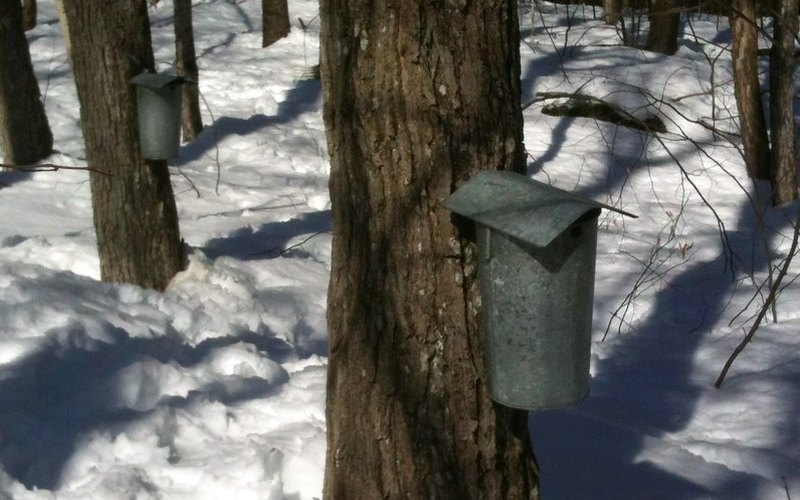
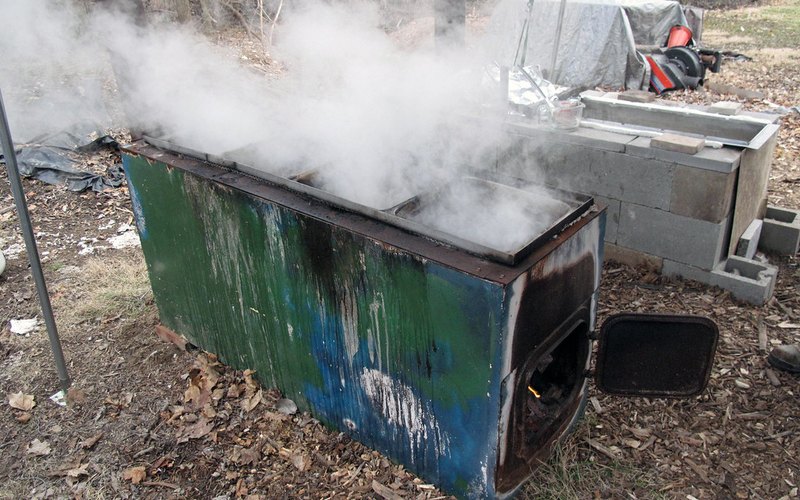
I tap sugar and red maples here in Michigan with buckets on spiles and boil on a turkey fryer, which puts me a couple of technological centuries behind the industry and, honestly, in decent historical company. But on this page I’m a reader, not a witness. Everything below happened to other people, and I’ve tried to be careful about who those people actually were.
The foundation: this is an Indigenous technology
Start here, because everything else is a footnote to it. Indigenous nations of the Great Lakes and the Northeast invented maple sugaring. Not “were also doing it.” Not “showed the settlers a trick.” They developed the knowledge, the seasonal round, the tools, and the product. The Minnesota Historical Society puts it plainly: Native people have produced maple sugar “since time immemorial throughout the Great Lakes and New England,” and for Ojibwe people maple sugar has been “a traditional dietary staple… for centuries.” The European contribution was to change the equipment and the scale. Not the practice.
And here’s the correction that reframes everything else on this page: the product was sugar, not syrup.
That sounds like a small thing. It isn’t. Liquid syrup in a jug is a market form — it exists because it’s what a store can sell you and what a bottling line can fill. The Indigenous product was granulated maple sugar, hard and dry and portable, and it was the primary seasoning of the kitchen. Granulated sugar, per MNopedia, “will not spoil for months, providing Ojibwe people with a food source throughout the year.” That’s the whole point of it. You are not making a pancake topping. You are making a preserved staple that carries a season’s calories forward through the year and travels in a pack.
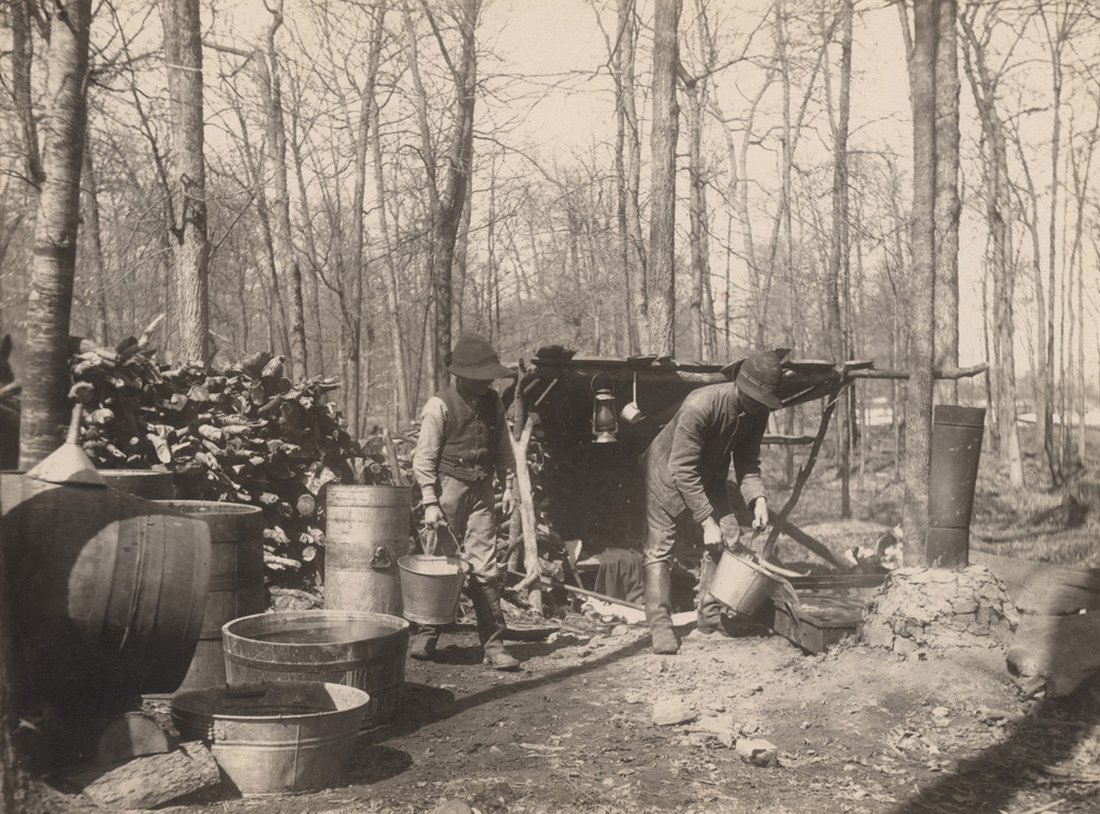
Alongside the granulated sugar came sugar cakes — the syrup boiled and worked down and pressed into molds, sometimes shaped like maple leaves. And it was stored in makuk (also spelled makak) — birchbark containers built as truncated pyramids, the same vessel form used for wild rice and for gathering berries. Frances Densmore, whose ethnographic fieldwork with Ojibwe communities in Minnesota, Wisconsin, and northern Ontario ran from 1908 to 1920, described “bark dishes, makuks, and buckets, white outside and warm yellow within,” kept in weatherproofed lodges, holding cakes of maple sugar and granulated sugar both.
Every time I read that description I think about my own jars. Glass, gasketed, filled with a liquid that I have to tell people to refrigerate after opening. The older technology is arguably the better-engineered one.
The sugar camp, and who did the work
Sugaring wasn’t a chore bolted onto the calendar. It was the calendar. The sugar camp marked the opening of spring — the moment Ojibwe communities, dispersed into small groups through the winter, came back together into larger ones. Larry “Amik” Smallwood, a Mille Lacs elder, described it this way: “Families would help each other and everybody would have a role.”
Those roles were gendered, and the sources are specific about which way. Women performed most of the labor of maple sugar production, with men in supporting roles — cutting firewood, hunting. That pattern held until the twentieth century, when entire families worked the camps together. If you’ve absorbed a mental image of sugaring as men’s work in flannel, it’s worth knowing that image is late, and it’s borrowed.
The tools evolved. Historically trees were gashed with axes. Later the method shifted to drilling a hole about an inch deep and inserting a tap cut from a sumac branch — sumac because the pith centers out easily, leaving you a natural tube. Metal taps show up from the late 1700s. Cast iron kettles arrived through French traders in the 1600s.
One more thing that belongs here and gets left out of the folksy version: sugaring is tied to treaty-guaranteed harvest rights. The 1837 Treaty of St. Peters guaranteed them. This is not only heritage. It is law, and it was negotiated, and it was paid for.
The honest version of “who boiled first”
There’s a real historical dispute here and I’d rather hand you the dispute than a tidy answer.
Position A: Indigenous people didn’t reduce sap to sugar until iron pots arrived with Europeans. Position B: sugar-making predates contact — perhaps by centuries — using birchbark pails and clay pots, with Abenaki practice cited. The sources genuinely conflict, and anyone telling you the question is settled is selling something.
What isn’t in dispute is the anchor point: European explorers’ accounts from as early as the sixteenth century describe Indigenous people carving V-shaped incisions and tap holes into sugar maples. That’s the Europeans’ own writing, at the earliest moment of contact, describing a practice already in place. So tapping is established. The narrower argument is only about the boiling and concentrating method.
It’s also worth saying why the argument can’t be resolved by digging. MNopedia — a state historical society — states production “since time immemorial” without an archaeological citation, and that gap is genuine: organic residue doesn’t preserve well. Absence of evidence, in this particular case, is very weak evidence of absence. A birchbark vessel and a fire do not leave much behind for anybody to find in the year 2026.
So the defensible line is this: that Indigenous nations tapped maples before Europeans arrived is documented by the earliest European accounts themselves. Whether pre-contact sugaring used stone-boiling and clay vessels, or was transformed by the iron kettle, is debated. What is not debated: the practice, the knowledge, and the seasonal round were Indigenous, and Europeans learned them.
Woksis: the most important correction on this page
Here’s the one I want to nail down, because it is repeated everywhere — on syrup bottles, in museum placards, in children’s books, in nearly every maple article ever written.
The legend goes: Woksis, a chief, hurls his tomahawk into a maple and leaves for the hunt. Sap runs from the gash and collects in a vessel below. His wife Moqua finds it, assumes it’s water, and boils the evening’s meat in it. The water cooks away, the sugar concentrates, and the family discovers maple. It’s a lovely little story — accidental discovery, domestic ingenuity, a neat mechanism.
It is not a Native legend. It is not documented as one anywhere. It first appeared in print in April 1896, in a six-page article called “Old-Time Sugar-Making,” written by Rowland E. Robinson — a Vermont farmer and novelist — in The Atlantic. A magazine piece. By a Euro-American fiction writer. In the 1890s.
And there’s a tell built right into its retellings: Woksis is described as an Iroquois chief in some versions and an Algonquin chief in others. Those are not interchangeable. That’s not how oral tradition behaves — a tradition belongs to a people, and the people are not a detail the teller shuffles. It behaves exactly like a piece of literary invention loose in the public domain, getting a plausible-sounding attribution stapled on by whoever’s retelling it this decade.
So the honest description: a nineteenth-century Euro-American literary invention that has been laundered into “Native legend” status through a century of repetition. I won’t attach it to any named nation, and neither should anyone else.
What gets me about this is the swap. A real, documented, centuries-deep Indigenous industry — women running sugar camps, birchbark makuks, granulated sugar as a year-round staple, treaty rights — gets replaced in the popular imagination by a cute accident invented by a novelist. The myth makes the discovery luck. The truth is that it was knowledge, and it was somebody’s, and it was work. The fake version is a demotion dressed up as a tribute.
(There are genuine Anishinaabe narratives involving Nanabozho and Nokomis. But those are teachings, not chronicles, and they should be framed that way and sourced to a community-controlled source — not to a syrup marketer, and not to me. I haven’t verified them well enough to retell them here, so I won’t.)
The free sugar movement: maple as a moral argument
Now the part of the history I find genuinely surprising, and which the industry mostly doesn’t advertise, maybe because it doesn’t end well.
In the 1790s, maple sugar became an abolitionist product.
The background you have to keep in view, because sanitizing it empties the story: cane sugar in this period was produced in the West Indies by enslaved people, under conditions that killed them. Sugar was not a neutral commodity. It was the output of one of the most brutal labor systems ever built, and everyone drinking sweetened tea in Philadelphia knew it. Maple’s pitch was straightforward — this sweetener is made by trees in the North, and nobody is enslaved to make it.
In 1789, Benjamin Rush founded the Society for Promoting the Manufacture of Sugar from the sugar maple, together with Philadelphia Quakers. In 1791 he published a pamphlet, An Account of the Sugar Maple-Tree of the United States, arguing maple as the ethical alternative. The stated aim was blunt: “to lessen or destroy the consumption of West Indian sugar, and thus indirectly to destroy negro slavery.” Maple sat inside the broader free produce movement — an organized boycott of slave-made goods, which is to say a consumer ethics campaign running in the 1790s.
Rush also staged what may be the first maple marketing event in history. He threw a tea party. Guests — including Alexander Hamilton, the Quaker merchant Henry Drinker, and, per the account, “several Ladies” — drank hyson tea sweetened with equal amounts of cane sugar and maple sugar. Everyone agreed the maple was just as sweet. Which, if you’ve cooked with maple sugar, is not a surprising verdict, but I love that somebody thought to run the demonstration.
Jefferson was in on it too, and this is where it gets uncomfortable. In 1790 he wrote that maple sugar required only “the labour of children,” setting that against slavery’s toll. He tried a maple planting at Monticello. By 1794, eight saplings had survived.
I’m not going to launder that line into an anti-slavery credential. Jefferson enslaved people while writing it, and the argument he’s making is at least as much an economic pitch as a moral one. The honest version of this whole chapter: maple was marketed as a moral sweetener; the moral claim was real and sincerely held by the Quakers; it failed commercially within about three years; and it did nothing measurable to slavery. The maple sugar bubble ran roughly 1791 to 1794. Abolitionists were left disappointed that maple hadn’t displaced the sugar islands or the system attached to them.
The trees weren’t the problem. The economics were. You cannot out-produce an industry running on stolen labor by asking Vermonters to boil harder, and the people who tried found that out in about thirty-six months. But I think it’s worth knowing that for three years in the 1790s, this stuff was a political statement, and that people meant it.
Industrialization: the long war against carrying water
Everything after this is one problem being attacked over and over: sap is mostly water, and water is heavy, and boiling it off costs fuel.
Here’s the number that makes the whole history make sense. Sap is 2 to 3 percent sugar. Syrup is about 66 percent. It takes roughly 40 litres of sap to make 1 litre of syrup. Everything else is water, and every drop of it has to leave. Every innovation below is somebody trying to move less water, or boil less water, or spend less fuel doing it.
The sequence:
- 1790 — drilling a hole and inserting a spile was already the recommended practice over slashing the tree. The earliest spiles were hollow-centered softwood twigs — sumac again.
- Late 1700s — metal taps come into use.
- 1916 — W.C. Brower of Mayfield, New York invents metal sap-gathering tubing. Great idea. It failed completely in the field: it froze at night, it leaked, and deer chewed it up.
- 1959 — Nelson Griggs of Montpelier, Vermont patents a plastic sap pipeline. This is the one that works. This is the breakthrough that makes tubing viable, and it’s why a modern sugarbush looks like a web of blue lines through the trees rather than a man with two buckets on a yoke.
- Vacuum pumps get added to the tubing, actively pulling sap rather than waiting on the tree’s own pressure. (I couldn’t pin down a reliable date for first commercial vacuum adoption, so I’m not going to invent one.)
- Late 1970s — reverse osmosis arrives. RO pushes sap through a membrane and removes water without boiling it. You feed the evaporator sap that’s already concentrated, and the fuel bill collapses. You’ll see savings percentages quoted around the web; I couldn’t find an authoritative source for a number, so take the direction and leave the figure.
- Pre-heaters get developed to recycle the heat otherwise lost up the stack as steam.
Look at that list next to my turkey fryer and it’s pretty funny. But it also clarifies something: the industry didn’t get more clever about flavor. It got more clever about not carrying and not boiling water. The flavor chemistry is the same fire it always was.
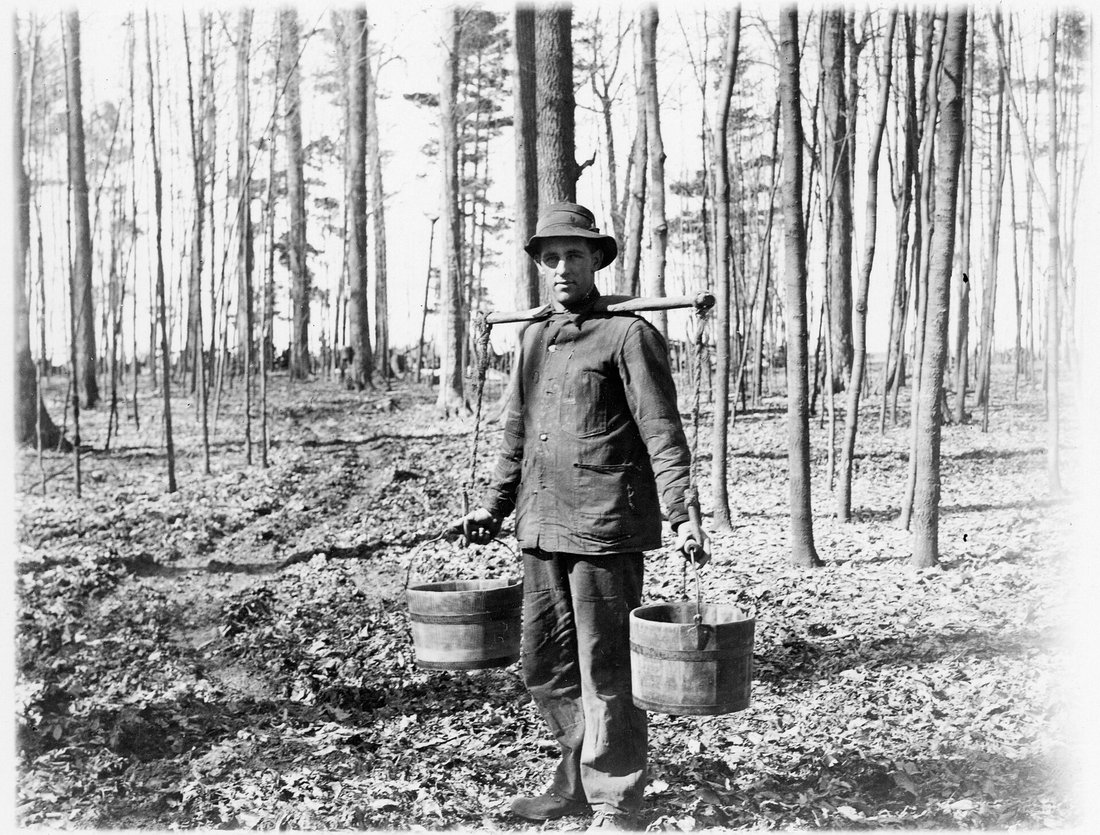
Bring the two pictures together in your head — this man, and a mile of blue line running downhill to a tank — and you have the whole industrial story in one frame.
Michigan
I’m in Michigan, which is a top-five maple state, and I’d love to tell you a rich Michigan chapter here. But the research I’m working from is Great Lakes-wide rather than Michigan-specific, and I’d rather leave a gap than fill it with a confident guess.
What I can say honestly is that the Indigenous history above is Great Lakes history — the Ojibwe sugar camps, the makuks, the seasonal round, the treaty-guaranteed harvest rights are the history of this region, not a New England import that drifted west. The maples I tap are in the same forest system, on the same schedule, doing the same thing they were doing for the people who worked out how to use them. Vermont has better marketing. It does not have an older claim.
Quebec: quotas, a strategic reserve, and the heist
Which brings us to the strangest institution in the food world, and then to the crime.
Quebec produces most of the maple syrup on Earth. As of 2011 the province accounted for 94 percent of Canadian production and 77 percent of the world’s supply. That kind of dominance tends to produce institutions, and it did.
The Quebec Maple Syrup Producers (QMSP, known in French as PPAQ) was established in 1966, building on a 1958 regional initiative in the Beauce. It represents around 13,500 producers — though I’ll flag that another source counts about 8,000 during the quota fights around 2010, likely a different year or a different way of counting, and I can’t reconcile them. Since 1989, all QMSP producers work under a collective marketing agreement. Supply management covers roughly 85 percent of bulk output through production quotas and centralized sales.
In 2000, they created the International Strategic Reserve — a literal strategic reserve of maple syrup, held in warehouses at Saint-Antoine-de-Tilly (6,300 tonnes), Saint-Louis-de- Blandford (4,500 tonnes), and Plessisville (1,400 tonnes).
The mechanism is genuinely elegant. Before each season QMSP reads global demand, existing inventory, and market trends, sets a province-wide quota, and divides it among producers. Have a big year and exceed your quota? The surplus goes into the reserve. Have a bad year — a warm March, a short run — and you buy from the reserve to fill your contracts. The reserve absorbs the weather. Maple is an agricultural product controlled entirely by a few weeks of freeze-thaw, and this is a system engineered to make an unpredictable crop behave like a predictable one. The Economist called it “the OPEC of the maple syrup world,” and the name stuck.
The cartel framing is contested, but it isn’t baseless, and the criticisms deserve real space:
- Producers may exceed quota — but they’re only paid once the Federation’s entire inventory is exhausted, and they pay storage fees while they wait.
- Since the quota system took effect, Quebec production rose 89 percent — the smallest gain of any syrup-producing region — while Vermont rose 264 percent. Quebec’s global share slid from roughly 80 percent to about 70 percent. (The source doesn’t give base years, so treat those as directional.)
- Around 2010 it turned ugly. Protests broke out; the federation posted guards on rebel producers’ land and confiscated entire crops. Fines for repeat quota violators reached CAD $500,000 and up.
- 2017 — the federation added five million taps in response to foreign competition.
- 2021 — QMSP released 22.7 million kg (50 million lb) from the reserves to meet demand, attributed to pandemic-era home cooking.
One honest caveat: PPAQ’s own website wouldn’t load for the research behind this page, so the organization’s account of its own intent isn’t represented above. The criticisms are sourced; their rebuttal isn’t. Weigh accordingly.
The Great Canadian Maple Syrup Heist — the real numbers
And then somebody robbed the reserve.
Over several months across 2011 and 2012, thieves took the contents of 9,571 barrels — nearly 3,000 tonnes of maple syrup — worth CAD $18.7 million (about CAD $25.2 million in 2025 dollars).
Stop there, because this is where every retelling goes wrong. You will read that the heist was $30 million. It wasn’t. $30 million was the approximate value of all the syrup stored at the Saint-Louis-de-Blandford facility — the entire warehouse’s inventory, not what was taken. Early reports also floated ~$30M before the confirmed figure landed, and that number simply never died. The theft was CAD $18.7 million.
And say Canadian. American retellings print “$18 million” or “$30 million” with a bare dollar sign, implying USD. Both the syrup value and every fine below are in Canadian dollars.
The method was patient and, in its way, beautiful. The syrup was in a temporary warehouse at Saint-Louis-de-Blandford with “minimal” security — no cameras, no alarm system. Barrels were trucked to a remote sugar shack, siphoned, refilled with water, and returned to the rack. Full shelves. Right weight, near enough. Nothing missing to look at.
It came apart in July 2012 during the annual inventory inspection. An inspector climbed the racks and opened a barrel and it was empty. Others that looked full were water.
Seventeen men were arrested between December 18 and 20, 2012. Hundreds of barrels were recovered from an exporter in Kedgwick, New Brunswick.
The convictions:
- Richard Vallières, the ringleader — 8 years and a CAD $9.4 million fine (2017). The Quebec Court of Appeal cut the fine to CAD $1 million in 2020. The Supreme Court of Canada reinstated the full CAD $9.4 million in 2022.
- Raymond Vallières, his father — 2 years less a day, plus 3 years probation.
- Avik Caron, the inside man — 5 years and a CAD $1.2 million fine.
- Étienne St-Pierre, the reseller — 2 years less a day, 3 years probation, and a fine north of CAD $850,000.
- Sébastien Jutras, the trucker — 8 months.
That’s my favorite ending in all of food history: the Supreme Court of Canada convened, heard argument, and ruled on stolen maple syrup. Wikipedia notes that adjusted for inflation it’s been described as the most valuable heist in Canadian history — treat that as a claim of that source rather than a fact-checked ranking, but let it sit with you. The most valuable theft in the country’s history was pancake topping, because pancake topping is a strategic commodity, because a province built a reserve for it, because the trees only run for a few weeks and somebody had to engineer around the weather.
What’s actually old here
So: strip out the tomahawk, and what’s left?
An Indigenous technology of real depth — sugar camps as the hinge of the spring calendar, women running the work, birchbark makuks full of granulated sugar built to last the year, tapping methods the earliest European visitors wrote down because they’d never seen anything like it, all of it still carrying treaty-guaranteed harvest rights. A three-year abolitionist bubble that meant what it said and accomplished nothing. Two centuries of engineering aimed at a single stubborn fact: forty parts water to one part syrup. A Quebec cartel with a warehouse full of strategic sweetener. And a heist that went to the Supreme Court.
I’m out in a Michigan woodlot with buckets on spiles and a turkey fryer, which is roughly the technology of 1800 with a propane upgrade. That’s not romanticism, it’s scale — I’m small, and small operations don’t amortize an RO membrane. But it does mean the part I do is the part that hasn’t changed: you find the tree, you make the hole, you wait on the weather, and you boil off thirty-nine parts of water to keep one. Everybody in this story did that. The only argument has ever been about how much fuel it takes.
The sugar shack goes up next season. I’ll still be boiling water.
Comments (0)