How Sap Becomes Syrup
Here’s the thing nobody tells you before your first season: sap doesn’t taste like maple. Not a little bit. Not faintly. You pull the lid off a bucket in March, dip a finger in, and what you get is cold water with a whisper of sweetness — about as flavorful as the last inch of a melted popsicle. Two percent sugar. That’s it. If you handed a stranger a glass of it they would not be able to name the tree it came from.
The maple flavor isn’t in the tree at all. You make it. It gets built, molecule by molecule, in the pot, over hours, out of heat and chemistry. That’s the single best fact in this whole craft, and it reframes everything else on this page: the tree gives you sweet water and a deadline, and the boil gives you syrup.
So this page is really two stories bolted together. First, why sap runs out of a hole you drilled — which is not the reason you’ve read everywhere else, and I’ll explain why the popular version is wrong. Second, what happens in the boil that turns barely-sweet water into the thing on your pancakes.
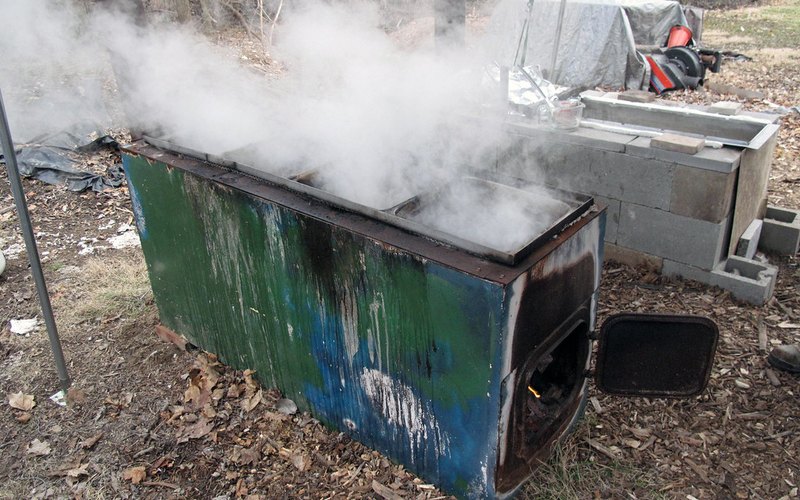
I tap sugar and red maples here in Michigan, buckets on spiles, and boil on a turkey fryer in the yard. Small-time. But you learn the physics fast when you’re the one carrying the buckets.
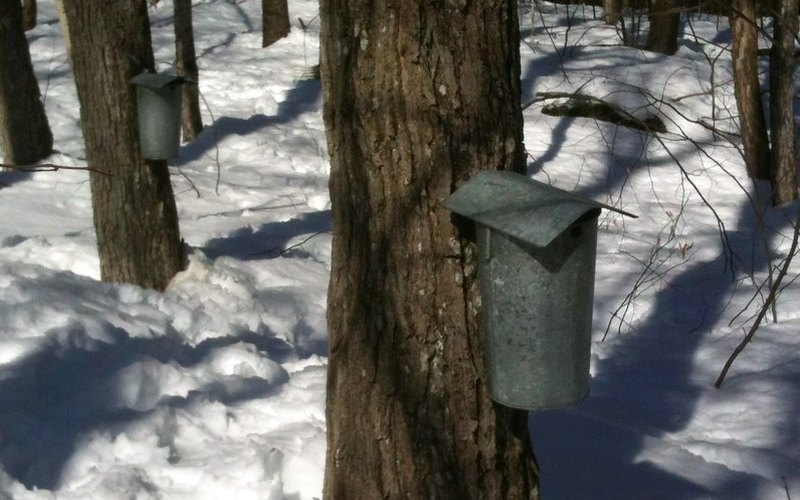
The part everyone gets wrong: why sap runs
Ask around, or search it, and you’ll get some version of this: in spring the tree pumps sap up from the roots to feed the buds, and root pressure pushes it out of your taphole. Or the slightly fancier one: osmotic pressure drives sap up the trunk.
Both are wrong, or at least so incomplete that they’re misleading. They’ve been repeated so long they’ve become the standard explanation, and they’re worth killing off carefully, because the real mechanism is stranger and it explains things the folk version can’t.
Start with the obvious hole in the story. If sap ran because the tree was pushing water up to the buds, it would run whenever the tree was awake — steadily, warm week after warm week, right into leaf-out. It doesn’t. It runs in fits, on specific days, and then quits for a week when the weather goes flat. Root pressure also can’t explain why sap comes out of a hole drilled at chest height in a dormant tree that hasn’t got a leaf on it and isn’t transpiring anything.
Some trees genuinely do run on root pressure — birch is the classic example, which is part of why birch runs later and behaves differently. Maple doesn’t. Maple runs on something else.
The freeze-thaw stem-pressure mechanism
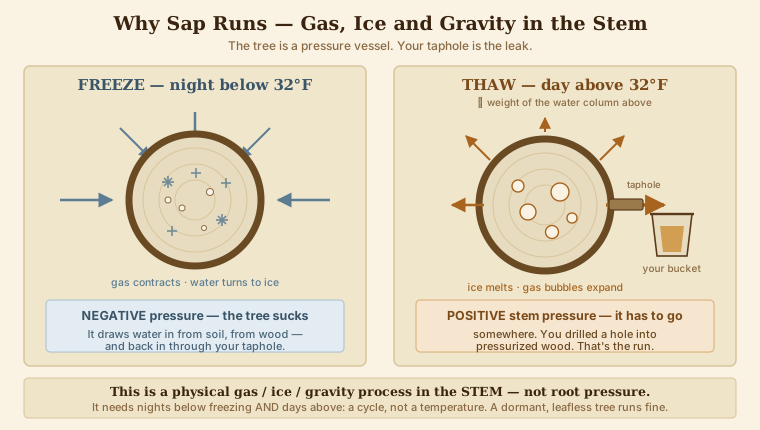
The validated modern model — this is the one in the tree-physiology literature and the one UVM’s Proctor Maple Research Center works from — is a physical process happening in the wood of the trunk itself. Not the roots. The stem. And it’s driven by gas, ice, and gravity.
Roughly, here’s the cycle:
On the freeze. Temperatures drop below freezing at night and water in the wood starts turning to ice. As it does, the gases dissolved and trapped in the wood contract — cold gas takes up less room, and freezing water pulls things around as it changes phase. The net effect inside the trunk is negative pressure. The tree is, in effect, sucking. It draws water in — from the soil, from the surrounding wood, and, worth noting, from anything attached to your taphole.
On the thaw. The day warms, the ice melts, and those gas bubbles in the wood fibers expand again. Add the weight of the water column above — gravity is genuinely part of this — and the inside of the trunk goes to positive pressure. It has to go somewhere. If you have drilled a hole through the bark into that pressurized wood, the somewhere is your bucket.
That’s it. That’s the run. Sap flows because the inside of the trunk is at higher pressure than the outside, and your taphole is the leak.
Why the tree does this in the first place
Here’s the part I find genuinely lovely, and it’s the reason the mechanism is so counterintuitive: the tree isn’t trying to give you sap. Stem pressure isn’t a feature for feeding buds. It’s understood as an adaptation for dealing with embolisms — air bubbles.
When a tree freezes in winter, dissolved gases come out of solution and form bubbles inside the water-conducting vessels. A bubble in a vessel is a blockage; enough of them and the tree can’t move water at all come spring. That’s a serious problem for something that has to be plumbed and running by the time it leafs out. The freeze-thaw pressure cycle is, in the current reading, the tree squeezing those bubbles back into solution and clearing its own plumbing.
So the run is a byproduct. We are exploiting the tree’s annual de-airlocking routine. The sap you collect is not sap the tree was sending anywhere; it’s sap that leaked out of a system doing maintenance. That doesn’t make it a free lunch — you’re still taking sugar the tree stored last summer — but it does mean the whole industry rests on a side effect.
Sugar maple and red maple, incidentally, have both been studied under this framework — measured and modeled — which is convenient for me, because I tap both.
It’s a cycle, not a temperature
The practical consequence of all that physics is the single most useful thing on this page:
Sap needs nights below freezing AND days above. It is a cycle, not a temperature.
Not “warm weather.” Not “when spring comes.” You need the freeze half and the thaw half, back to back, over and over. A week of 45°F days and 40°F nights — which sounds like beautiful sugaring weather to anyone who hasn’t done it — produces essentially nothing, because there’s no freeze to reset the pressure. Same for a week that never gets above freezing: the tree is charged up and locked.
You want the tree to breathe in and breathe out. In Michigan, in practice, that means nights in the 20s and days in the 40s (that’s producer experience rather than research, so take the exact numbers as a rough guide). What matters is that the line at 32°F gets crossed twice a day.
This is why the season is so much shorter than the calendar suggests. Michigan’s window runs roughly four to six weeks — mid-to-late February in the southern Lower Peninsula, marching north over eight to ten weeks until the UP finally goes in late March and into April. But inside that window, producers here talk about only ten to twenty genuinely good sap-flow days. The rest of the time the weather just isn’t doing the thing. You don’t plan for the window. You plan for the runs, and you sit around a lot in between.
I know the forecast now the way some people know a stock ticker. A hard freeze followed by a sunny 40°F afternoon is a workday. Everything else is waiting.
There’s one more wrinkle from the freeze side that matters practically. Remember that on the freeze, the tree pulls inward — including back through your spout. Whatever is sitting in that spout gets drawn into the taphole. That’s the reason sanitation matters so much: a dirty spout inoculates the wound, the hole heals and clogs early, and your season gets shorter. The physics that gives you sap also gives you the mechanism by which you can ruin it.
Two percent sugar, and where the 40:1 comes from
Sap out of a sugar maple averages about 2% sugar — roughly 2.0 Brix, with a normal range of about 1.5 to 3.5%. It arcs over the season: around 1.5–2.0 at the start, peaks mid-season near 2.5 or better, and falls back toward 1.5–2.0 at the end. Finished syrup is about 66–67% sugar.
That gap is the whole job. You’re not cooking anything. You’re removing water — pounds and pounds and pounds of it — and everything else is a consequence.
Which brings us to 40:1, the number everybody quotes. It isn’t a law of nature. It’s arithmetic, and it falls out of a rule of thumb from 1946: C.H. Jones at UVM published what became the Jones Rule of 86:
86 ÷ sap Brix = gallons of sap per gallon of syrup
At 2% sap you get 43 gallons. At 2.5% you get about 34. At 1.5% — a thin early run — you’re looking at 57. So “40 to 1” is just the Rule of 86 evaluated at the sugar content of an average sugar maple, rounded to a friendly number. If your trees run sweet, your ratio is better and you did nothing to earn it. If they run thin, you boil longer for the same jug.
Two honest caveats. The rule is calibrated to 1946 density standards, and modern minimums sit at 66.0 Brix (some states use 66.9), so the answer it gives is a ballpark and always has been. And sap sweetness is primarily genetic — some trees are just sweeter than their neighbors — with crown exposure to sunlight as a secondary factor. There’s no Michigan-specific sap sugar figure I’d stand behind, and no study I’ve seen comparing Michigan sap to Vermont’s; anyone who tells you our sap is sweeter or thinner is guessing.
For scale on the Michigan end: the state averages about 0.3 gallons of syrup per tap in a normal year. A hundred taps, thirty gallons, in an average season. That’s real work.
The boil: where maple actually gets made
Now the good part.
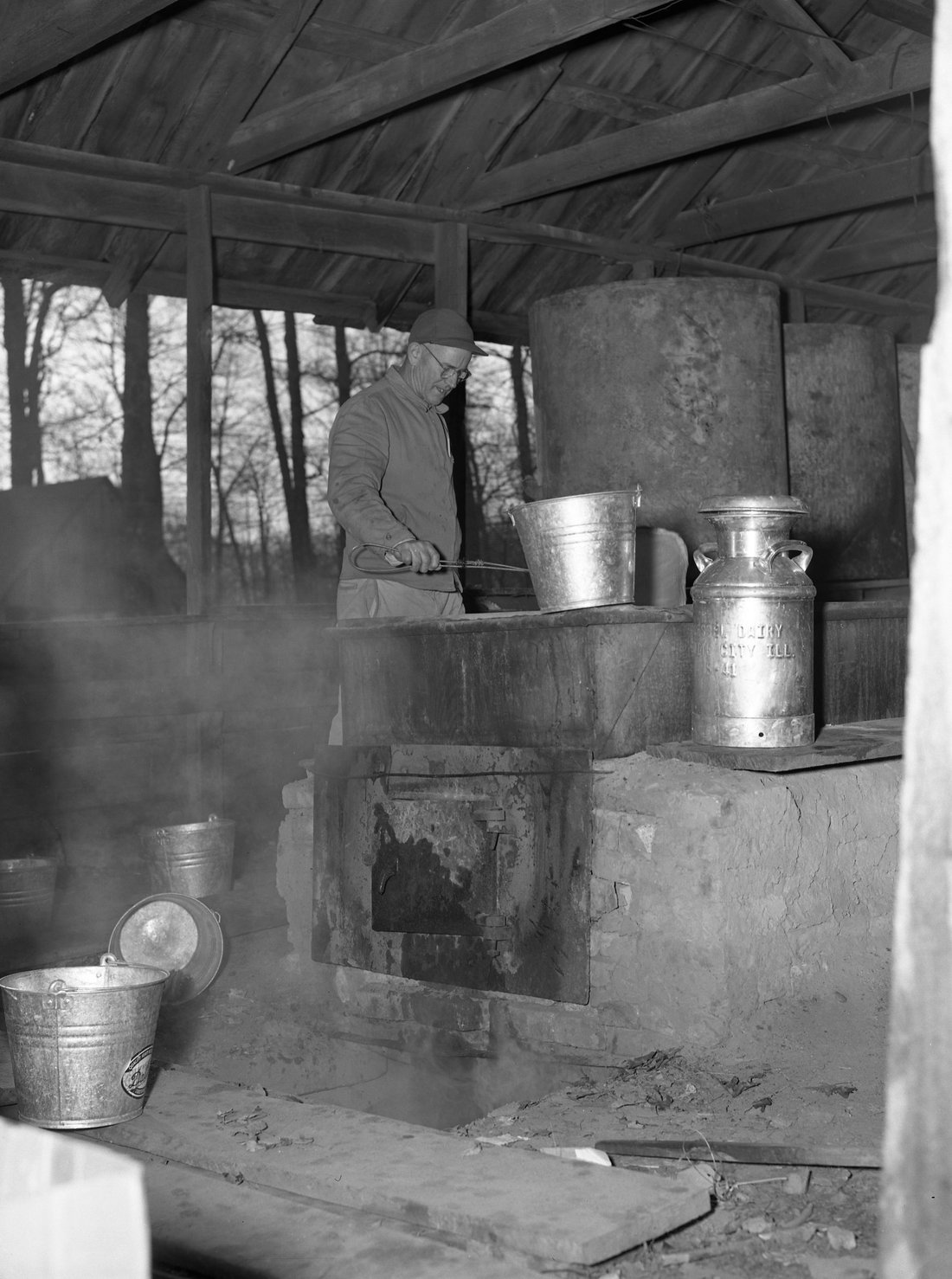
You’ve got a stock tank or a stack of buckets full of faintly sweet water, and you put it over fire. For the first several hours, absolutely nothing interesting happens. It’s water leaving. The volume drops, the steam rolls off, and if you taste it you get… slightly less faint sweet water. It’s dull. It is so dull. First-timers assume they’re doing it wrong.
Then, somewhere near the end, in the last stretch when the sugar concentration has climbed and the boiling point has crept up, it turns. The color comes up amber out of nowhere. The smell arrives all at once — that’s the moment, the one that makes the whole cold, wet, hauling business worth it. And what you have in the pan is suddenly, unmistakably, maple.
What happened in there is principally the Maillard reaction: amino acids reacting with reducing sugars under heat. It’s the same broad chemistry as searing a steak or browning bread crust or roasting coffee, and it is a factory — it doesn’t make one flavor, it makes a whole cascade of them.
More than 250 compounds beyond plain sucrose have been identified in maple syrup. The flavor-active families read like a chemistry-set inventory: carbonyl compounds, phenolics, pyrazines (27 of those identified), alcohols, acids, and furan derivatives. Named ones include vanillin, syringaldehyde, coniferyl alcohol, and protocatechuic acid.
Stop on vanillin for a second, because it’s my favorite detail here. Vanillin is the vanilla molecule — the thing you’re tasting in vanilla extract. It is genuinely present in maple syrup, and it is made by the boil. It wasn’t in the sap. That’s a real, sourced explanation for why maple reads as warm and vanilla-adjacent and round rather than just sweet: there is actual vanilla chemistry in there, and you built it in your pan.
The Maillard reaction also throws off D-amino acids — D-alanine at 33–34% of its pool — which is a curious little fingerprint of just how much rearranging is going on.
One honest gap: I’d love to name the maple molecule for you, the single character-impact compound the way we can point at one for banana or clove. The flavor literature often gestures at maple furanone (HDMF), and you’ll see it cited confidently around the web. I can’t confirm it, and the peer-reviewed review I’m working from doesn’t crown a single compound. So I’m not going to name one. Maple appears to be a chord, not a note.
Quebecol: the molecule the internet gets backwards
Here’s the correction I most want to plant, because it’s everywhere and it’s wrong.
Search “maple flavor molecule” and you’ll be told about quebecol, a phenolic compound named for Québec, and you’ll be told it’s what makes maple taste like maple. It is not.
What’s true, and genuinely interesting: quebecol is not present in raw maple sap at all. It’s created during the transformation of sap into syrup — a processing product, a molecule that exists only because you boiled. It’s found alongside two other markers, lariciresinol and secoisolariciresinol, and the peer-reviewed work positions all three as distinctive markers for maple products — uncommon in syrups from other plants.
That makes quebecol an authenticity marker. It’s how you tell real maple from a jug of caramel-colored corn syrup. It is a chemical signature of the process, not an explanation of the taste. Its contribution to flavor is, in the sources I’ve read, simply not established — and I’m not going to fill that gap with a confident guess just because the web has.
But notice how well it fits the theme of this entire page. Quebecol is a molecule that does not exist in the tree. You make it. Same as the flavor. Same as the color. Same as everything that makes syrup syrup.
Why late-season syrup is darker — and it’s not what you think
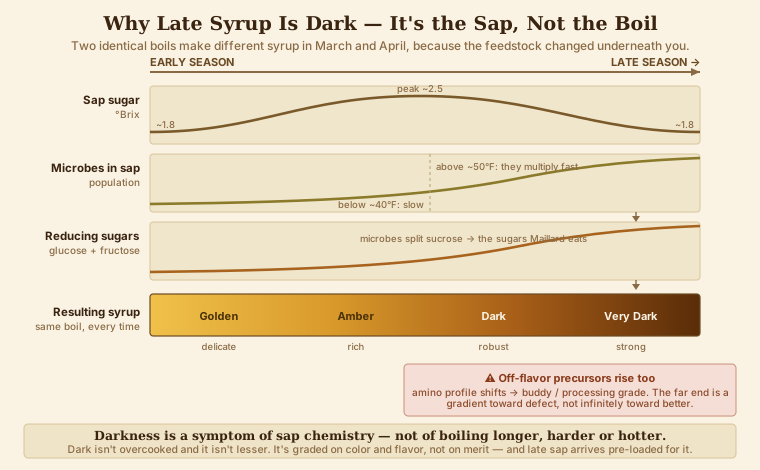
Every sugarmaker knows the arc: early syrup comes out pale and delicate, and as the season rolls on it gets darker and louder, until at the end it’s nearly black and tastes like it means it. The folk explanation is that you boiled it longer, or harder, or hotter.
Wrong. It’s the sap, not the boil. The causal chain is worth spelling out, because it’s a nice piece of chemistry:
- Weather warms as the season progresses, and microbial populations in the sap rise. Below about 40°F, bacteria grow slowly. Above about 50°F they multiply fast.
- Those microbes hydrolyze sucrose — they split it into fructose and glucose. Those are reducing sugars, and reducing sugars are exactly what the Maillard reaction eats.
- More reducing sugar in the pan → more Maillard during the same boil → darker color, stronger flavor.
- Meanwhile the amino acid profile shifts: glutamic acid and histidine decline, methionine and asparagine rise — and those produce off-flavor precursors.
So late-season sap arrives at your pan pre-loaded with the ingredients for a heavier reaction. Two identical boils, done identically, will produce different syrup in March and April because the feedstock changed underneath you.
The corollary is the one that retired the old “Grade B” stigma: darker is not lower quality, and darker is not overcooked. Under the grading system in place since 2015, that dark stuff is Grade A Dark (robust) or Grade A Very Dark (strong) — it’s graded on color and flavor, not on merit. Plenty of us like it best. It’s certainly the syrup you want if it has to survive butter, flour, heat, or bacon.
But don’t over-romanticize the dark end either. That step-4 amino acid shift is producing off-flavor precursors — the far end of the season is a gradient toward defect, not infinitely toward better. Which is where the season ends.
What ends the season — two different things, usually confused
The season ends, and people say “the trees budded.” Sometimes true. Often not. There are two distinct failure modes and they get lumped together constantly.
Sour sap is microbial. Warm weather, massive bacterial buildup, off-flavor. It’s the same mechanism as the darkening above, just run past the point of usefulness. Ohio State’s maple people make the pointed argument that producers blame the buds when the real cause is microbial colonies shutting the system down. End-of-season sap can drop sharply in pH and yield syrup that’s paradoxically light in color but tastes wrong.
True “buddy” syrup is developmental. It’s caused by dormancy release — the tree breaking dormancy and pushing buds. The chemistry is completely different: it’s associated with organic sulfur compounds in the sap and dimethyl disulfide in the finished syrup. That’s the source of the notorious cabbagey, off note. Dormancy release is necessary for the defect; microbial activity may pile on top of it.
The practical difference matters. Sour sap is partly on you — it’s a handling problem, and cold sap boiled promptly avoids most of it. Buddy is on the tree, and when it arrives, you’re done. Pull the taps.
Which brings up the deadline this whole hobby operates under. Sap is like milk. It’s not sterile, it’s not acidic, it’s barely sweet — it is essentially a mild nutrient broth sitting in a bucket in the woods. Below 40°F, bacterial growth is slow; above 50°F it’s rapid; at room temperature you can get souring and off-flavors in six to twelve hours. The rule I go by, and it’s the rule the extension people give: if your sap hits 50°F and you can’t cool it, boil immediately. Otherwise boil within 24–48 hours. Michigan’s own guidance is blunt about it — keep it at 40°F or below until it’s boiled, which in February is free and in late March is a genuine problem.
This is also, quietly, an argument for the bucket-and-fryer setup being harder than it looks. Sap sits warm and exposed in a bucket in the sun. The clock is running from the moment it leaves the tree.
Knowing when it’s syrup
The finish line is physics, not judgment, which I appreciate.
Syrup is done at about 66–67% sugar — and there’s a beautiful shortcut for finding that, because a sugar solution’s boiling point rises as it concentrates. Syrup boils at approximately 7.1°F above the boiling point of water.
Note the phrasing: above the boiling point of water — today’s water, at your elevation, in your barometric pressure. Not 219°F. Not any fixed number. You boil a pot of plain water first, read what it boils at right now, and add 7.1. A storm rolling through moves the target. This is the single most common way people miss: they memorize a number from a book written at somebody else’s elevation on somebody else’s afternoon.
And the reason the last stretch goes so fast — why you can walk away for five minutes and come back to scorched candy — is that same curve. Early on, boiling off a gallon of water barely moves the concentration. At the end, every ounce of steam is a meaningful jump in Brix, so the temperature climbs faster and faster right when you’re closest to the edge. The last few degrees take minutes. That’s the part that gets everybody once. It got me.
The short version
The tree is not giving you syrup. It’s not even giving you flavor. It’s running a freeze-thaw gas-pressure cycle to clear air bubbles out of its own plumbing, and you’ve drilled a hole in the side of it and caught the leak. What comes out is 2% sugar water with essentially no maple character at all.
Everything you love about the stuff — the color, the aroma, the vanillin, the 250-odd compounds, even the quebecol that proves it’s real — gets manufactured in your pan, by the Maillard reaction, in the last hour of a very long boil.
That’s why sugaring feels less like harvesting and more like cooking. Because it is.
For the practical side — trees, timing, tapping, and the Michigan season — keep going through the rest of the Tree Syrups section. The breads page covers Maillard chemistry from the other direction, if you want to see the same reaction wearing a different hat.
Comments (0)