American Sycamore
I have never tapped a sycamore.
Same disclosure as the rest of this section, and for the same reason: everybody on the internet writes like they’ve done everything. I run maple — sugar and red, buckets on spiles, a turkey fryer in the yard, fifty to two hundred taps in Michigan, and I sell the jars at a store and a farmers market. Sycamore I’ve read about. I have never hung a spile in one, never boiled a drop of its sap, and never tasted the syrup.
So let me lead with the number instead of a tasting note, because the number is the honest part.
A hundred sycamore taps make about three gallons of syrup in a season.
That’s from a funded research project that actually did it. Three gallons. A hundred taps. For comparison, a hundred maple taps in a decent year is a different order of magnitude entirely — I’d be disappointed with anything under twenty-five.
And here’s the thing: I still find this the most interesting tree in this section. Not because the arithmetic works. It doesn’t. Because the arithmetic is the story, and because the internet has gotten this tree badly, specifically, checkably wrong in a way I can show you with a calculator.
Start with the bark, because you already know this tree
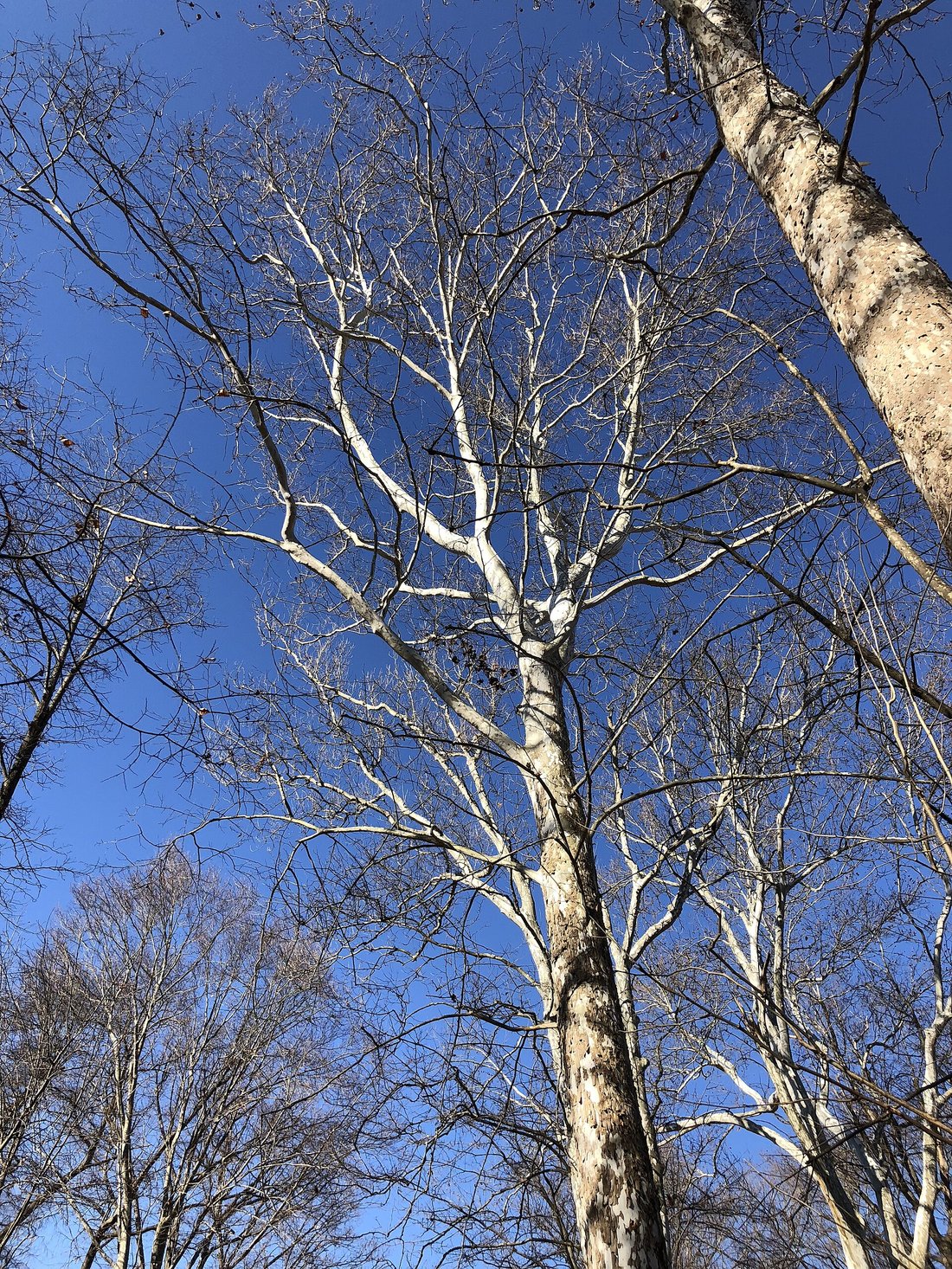
If you’ve driven a Michigan river bottom you’ve seen sycamore even if you couldn’t name it. It’s the tree with the peeling, mottled bark — the outer layer flaking off in irregular plates to leave cream and tan and something close to bone-white underneath, so the upper limbs look like they’ve been bleached. Nothing else in our woods looks like that. It’s the one tree in this whole section you can identify from a moving truck at forty miles an hour.
American sycamore (Platanus occidentalis) grows in Michigan. The USDA Forest Service puts the native range’s northern edge at “extreme southern Ontario, central Michigan, and southern Wisconsin,” and the Forest Service’s fire-effects database is more specific for us: “In Michigan specifically, sycamore occurs most commonly and in greatest abundance in the southern Lower Peninsula” — along streams and in bottomlands. It’s also naturalized beyond its native range down here from old plantings.
So it’s not a hypothetical. It’s a tree I could go touch this afternoon.
But read that habitat line again, because it’s going to matter more than anything else on this page: bottomland. Riparian. Along streams. My maples are upland. Hold that thought.
The number that kills the myth
Here’s the part I actually want you to take away, and it’s the reason this page exists.
Search around and you’ll find sycamore described as having sugar content “similar to maple trees,” with “a 40-to-1 sap to syrup yield.” It’s repeated confidently, in a lot of places, in the same phrasing — which is usually the tell.
It’s wrong. And you don’t need to trust me, because the arithmetic gives it away.
What was actually measured
The best source on sycamore sap by a mile is a Northeast SARE grant — project ONE21-404, Dr. Michael Rechlin at Future Generations University in West Virginia, about $30,000, running 2021 through June 2023. Somebody with funding went out and put a refractometer on sycamore sap for two full seasons.
| Season | Measured average |
|---|---|
| Year 1 | 0.53 °Brix |
| Year 2 | 0.46 °Brix |
| Combined | ~0.5 °Brix |
Half a percent sugar.
Independently, The Crooked Chimney — a New Hampshire producer who made sycamore syrup first-hand — reports sap “often around 0.7 °Brix” and a working ratio of “around 130 to 1.”
Two sources. Both measured. 0.5 to 0.7 Brix.
Now do the arithmetic
There’s an old sugarmaker’s shortcut called the Jones Rule of 86: divide 86 by the sap’s sugar percentage and you get roughly the gallons of sap per gallon of syrup. It’s an approximation, and I take it apart properly over on the science, but it’s close enough to settle this and every sugarmaker alive already knows it.
- At 0.5 Brix: 86 ÷ 0.5 = ~170:1
- At 0.7 Brix: 86 ÷ 0.7 = ~123:1 — which lands right on Crooked Chimney’s reported ~130:1
So the measured sources land at roughly 130:1 to 170:1, and they land there independently of each other — one by measuring Brix and doing the math, one by actually boiling the stuff and counting gallons. When a calculation and a boiling pan agree, that’s about as good as this corner of the literature ever gets.
And now run the myth backwards
This is the part I love.
What sugar content would a 40:1 ratio require? Run the rule in reverse: 86 ÷ 40 = ~2.1 Brix.
Two point one. That’s maple. That’s my sugarbush. That is exactly the sugar content the 40:1 claim needs sycamore to have — and it’s the sugar content nobody measuring sycamore has ever recorded. Not the SARE project across two seasons. Not the producer who made the stuff commercially. The highest number anybody reports is 0.7, which is a third of what the claim requires.
So the “40:1” figure isn’t a slightly-optimistic estimate or a good year. It’s off by a factor of three to four, and it’s self-refuting. It smuggles in a claim about sugar content that its own arithmetic exposes. Anybody who repeated “sugar content similar to maple, expect 40:1” was, without knowing it, asserting a Brix reading that has never existed in a real sycamore.
The measured answer is ~0.5–0.7 Brix, roughly 130:1 to 170:1. That’s three to four times maple’s boil. The widely-repeated “40:1” is contradicted by the only two sources that actually measured anything, and the Rule of 86 shows you why in one division.
I’m not averaging 40 and 170 into some diplomatic middle. One of these numbers came from instruments and one came from being copied. They don’t get equal weight.
And notice what the wrong number does to a reader: 40:1 says sycamore is basically maple, give it a shot. 170:1 says you will boil four times as long for a third as much. That’s not a rounding difference. That’s the difference between a decision and a mistake, and it’s being made for people by a number nobody checked.
The yield, in units I actually budget in
The ratio is the famous number, but it isn’t the one that runs my life. I budget in taps — holes drilled, buckets hung, trips through the woods in the dark. So here’s SARE’s number in that unit:
0.03 gallons of syrup per tap. From about 5.7 gallons of sap per tap per season.
Three hundredths of a gallon. Call it under four ounces per tap. Which is where the headline comes from: a hundred taps, three gallons.
Sit with the shape of that for a second, because it’s not the shape you’d guess. The sap volume isn’t the disaster — 5.7 gallons per tap per season is thin, but it’s not absurd. The sugar is the disaster. Sycamore hands you a respectable puddle of what is very nearly water and asks you to remove 99.5% of it.
That’s a boil. And not a metaphorical one — that’s my turkey fryer running for a day and a half to make one jar.
⚠ Vacuum isn’t optional, and that’s the real gate
Here’s where a Michigan bucket operation like mine hits the wall.
SARE: “sycamores require some vacuum to produce sap.” Gravity collection failed.
Not “underperformed.” Failed. The working setup was a small diaphragm pump at medium vacuum, around 10 inches of mercury. Crooked Chimney agrees a vacuum pump is typically necessary, with a nice honest caveat: “sometimes conditions are right and sycamore trees can generate enough stem pressure to exude sap at atmospheric pressure.” Sometimes. That’s a description of luck, not a system.
Understand what that sentence does to my whole approach. My operation is buckets. Buckets and spiles and a propane burner in the yard. That’s not a limitation I’m apologizing for — it’s a deliberate scale that fits my Februaries. And buckets are gravity. Sycamore says gravity doesn’t work.
So sycamore doesn’t ask me to add taps. It asks me to become a different kind of operation: a pump, a power source, tubing runs, the whole vacuum apparatus — and then, at 0.5 Brix, you’re immediately staring at reverse osmosis too, because boiling 170 gallons of water off a gallon of syrup over propane is not a plan, it’s a penance. I make that argument in full over on equipment, and it’s the same argument birch forces. Sycamore just forces it harder.
Now stack that on the habitat. Sycamore is a bottomland tree; my maples are upland. So this isn’t a vacuum line through the sugarbush I already walk. It’s a vacuum line to scattered streamside trees, in wet ground, somewhere else entirely. (That’s my read, not a sourced claim — but I don’t think it’s a controversial one if you’ve ever tried to run tubing through a river bottom.)
A hundred taps. Three gallons. And you have to build a vacuum system in a swamp to get it.
That’s the honest scale. I’m not going to soften it, and anybody who tells you sycamore is a “just try a few taps” tree either hasn’t read the research or is quoting the 40:1.
Season: it doesn’t extend anything
The obvious hope for a sugarmaker is that a second species buys you calendar — weeks you aren’t already using.
Sycamore doesn’t.
Per the SARE work, producers tap earlier than maple, and “sycamore trees may run better in colder weather.” Crooked Chimney’s best flow came on “unseasonably warm midwinter days that follow freezing periods coupled with rain events.”
And there’s no fall season — SARE tried fall tapping and got “no significant sap flow.” That’s a useful negative result, and I’m glad somebody published it.
So the practical read (mine, flagged as interpretation): sycamore runs before maple, or at the cold front edge of the maple window. It doesn’t add weeks after the season the way hophornbeam is reported to. It sits down at the same table as early maple and asks for the same labor.
That’s the same structural problem black walnut has, and it’s the one that kills these projects for working operations. It’s never “is this tree interesting.” It’s “is this tree interesting during the three weeks I’m already sleeping four hours a night.”
Flavor: honey and butterscotch — and the chemistry behind it
I haven’t tasted it. I want that on the record before I quote anybody, because a tasting note is the easiest thing in the world to fake.
But the reported character comes from a research source, not just vendor copy, which matters:
- UNH / NH Agricultural Experiment Station: sycamore syrup tastes “like honey or butterscotch,” and pairs well with savory foods.
- Crooked Chimney: it “tastes quite different than maple and birch syrups.”
And here’s the detail that makes it make sense, and it’s the best thing on this page after the arithmetic. Sycamore sap contains “very little sucrose and lots of fructose and glucose” (Crooked Chimney).
That single fact explains the whole product.
Maple sap is sucrose. That’s why maple tastes like maple — sucrose under heat throws the particular set of reactions that give you maple’s flavor. Sycamore isn’t carrying sucrose; it’s carrying fructose and glucose, which are different molecules that caramelize differently and brown at different temperatures. So it isn’t that sycamore is a weaker maple. It’s a chemically different sugar going through a different transformation — and it comes out honey-and-butterscotch instead. Of course it does. You didn’t put maple’s sugar in the pan.
And it means the stuff scorches. Fructose and glucose are more heat-fragile than sucrose. The guidance is: process at low temperature and don’t hold it hot. Which is a genuinely cruel joke when you’ve just been told the ratio is 170:1 — the sap that needs the longest boil of anything in this section is also the sap least willing to sit in a hot pan. You can’t just put the fryer on and walk away. That’s an RO argument all by itself, before you even get to the fuel bill.
One more practical note, and it’s single-sourced: sycamore sap is acidic, so use plastic, stainless steel, and glass only (Crooked Chimney). I’d follow it — it’s chemically sensible and it echoes the standing advice for the birch-family saps — but it’s one producer’s word, not a study, and you should know that’s what you’re following.
Tree health: nobody has studied it
Short section, because there’s nothing in it, and that absence is the finding.
I found no sycamore-specific research on tapping injury, taphole closure, or long-term tree health. None.
What you’ll see instead is the standard guidance — ten inches diameter at breast height minimum, one tap for trees ten to twenty inches. That’s maple guidance being generalized to a different genus. It’s not that it’s wrong; it’s that nobody has checked whether it’s right for Platanus. Different wood, different bark, different growth rate, different tree.
Sycamore is at least a favorable case on the size question — it’s a big, fast-growing tree that blows past any tapping diameter you’d care to set. The constraint in Michigan is habitat, not size. But “it’s big enough” isn’t the same as “we know what a taphole does to it,” and I’m not going to imply that maple’s well-studied compartmentalization tells us anything certain about a bottomland tree in a different family.
So: probably fine, on the same reasoning that has trees surviving tapholes generally. Not established. If you read a page that states sycamore tapping guidelines with confidence, ask where they got them, because the honest answer is from a maple bulletin.
Is anybody actually selling this? Barely.
Hillsboro Maple Works in Hillsboro, West Virginia — the SARE project’s partner — did sell sycamore commercially, and interestingly “had more demand than they had product at their initial price point.” They also tried sycamore syrup straws, which “seemed to be a hit and sold well.” I like that detail more than I can justify. A syrup this expensive makes more sense as a novelty you hand somebody than as a bottle they pour.
The Crooked Chimney in Lee, New Hampshire produced sycamore commercially — but they’ve been on hiatus and sold out since 2015. Their pages are still the best first-hand writing about this tree anywhere, and I’ve leaned on them all over this page. You cannot buy their syrup. Don’t let anybody, including me, imply otherwise.
Now the economics, which are the actual story:
| Sycamore | Maple | |
|---|---|---|
| Bulk price (SARE estimate) | ~$325/gallon | ~$26/gallon |
| Yield, 100 taps | ~3 gallons | (not close) |
| Season revenue, 100 taps | ~$1,000 | — |
UNH independently pegs alternative syrups at “about $300 per gallon,” which agrees with SARE nicely — so the ~$300–325/gallon bulk range is about as solid as anything here.
Sycamore fetches roughly twelve times maple’s bulk price. And it’s still marginal. That’s the whole thing in one line. A twelve-fold price premium does not rescue you from a hundred taps making three gallons — under a vacuum system you had to buy, in a bottomland you had to run line to, boiled at low temperature so it doesn’t scorch.
And here’s the most candid data point in the entire research file. The SARE team’s answer to poor market acceptance was a blend: “Maplemore,” roughly 20% sycamore and 80% maple — to manage both flavor unfamiliarity and price resistance.
Read that for what it is. The people who ran the grant concluded that straight sycamore is a hard sell, and their fix was to hide four-fifths of it in maple. That’s not a criticism of them; it’s good honest product development and I’d probably do the same at a farmers market table. But it tells you exactly where this stands.
Verdict: research and hobby, with a small experimental commercial fringe in West Virginia. Nobody is making a living on sycamore syrup.
Where I actually land
Sycamore is the one tree in this section where the numbers are good and the news is bad.
That’s worth pausing on, because it’s unusual. Most of what I’ve written here is hedged — I keep having to tell you nobody measured the juglone, nobody studied the bark harvest, my own state’s extension service has published nothing. Sycamore is the opposite. Sycamore rests on real research: a funded Northeast SARE grant with two seasons of measured Brix and a university experiment station program behind it. The numbers here are trustworthy.
They’re just brutal. 0.5 Brix. 130-to-170 to one. Four ounces a tap. Vacuum or nothing.
And I want to be honest about the shape of my own reasoning, because this page has an angle and I’d rather name it than pretend I don’t. The yield numbers will never talk you into this. They can’t. There is no arrangement of these figures where sycamore pencils out for a guy with buckets and a turkey fryer, and I’ve tried a few.
But “it doesn’t pencil out” and “don’t do it” are different sentences, and I’ve noticed I’m not willing to say the second one.
Because look at what’s actually sitting there. A tree with bark like nothing else in the woods, growing in my end of Michigan, along the creeks I already drive past, that makes something tasting of honey and butterscotch — for a reason you can explain from its chemistry, because it isn’t carrying maple’s sugar and never was. That’s a real thing. It’s not marketing. A research station said the flavor and a chemist could tell you why.
You’d tap a sycamore because you want to know. That’s the only reason available, and I’ve decided that’s allowed. I sell maple to pay for maple. I’d tap a sycamore the way you’d build something in a garage — because the object at the end is interesting and you wanted to have made it.
What I won’t do is dress that up as a business. If somebody tells you sycamore is 40:1 and worth a look, they’ve handed you a number that requires a sugar content nobody has ever measured in that tree, and the arithmetic that exposes it takes ten seconds. That’s the disservice. Not the enthusiasm — the enthusiasm is fine, I’ve got it too. The false promise. Sell somebody a 40:1 dream and they’ll hang taps and boil for two days and end up with four ounces and think they failed. They didn’t fail. They were lied to by a number.
Three gallons off a hundred taps, honestly stated up front, is a thing a person can decide about.
If I ever run it, this page changes. It gets a tasting note I earned, a picture of my own jar against that mottled bark, and probably a paragraph about scorching a pan. Until then it’s research, told by a guy who taps a different tree on higher ground.
For why sugar content drives the ratio — and the Rule of 86 arithmetic that ends the 40:1 claim — see the science. For the vacuum and RO argument this tree forces on you, see equipment. For the tree I actually run, see maple.
Comments (0)